
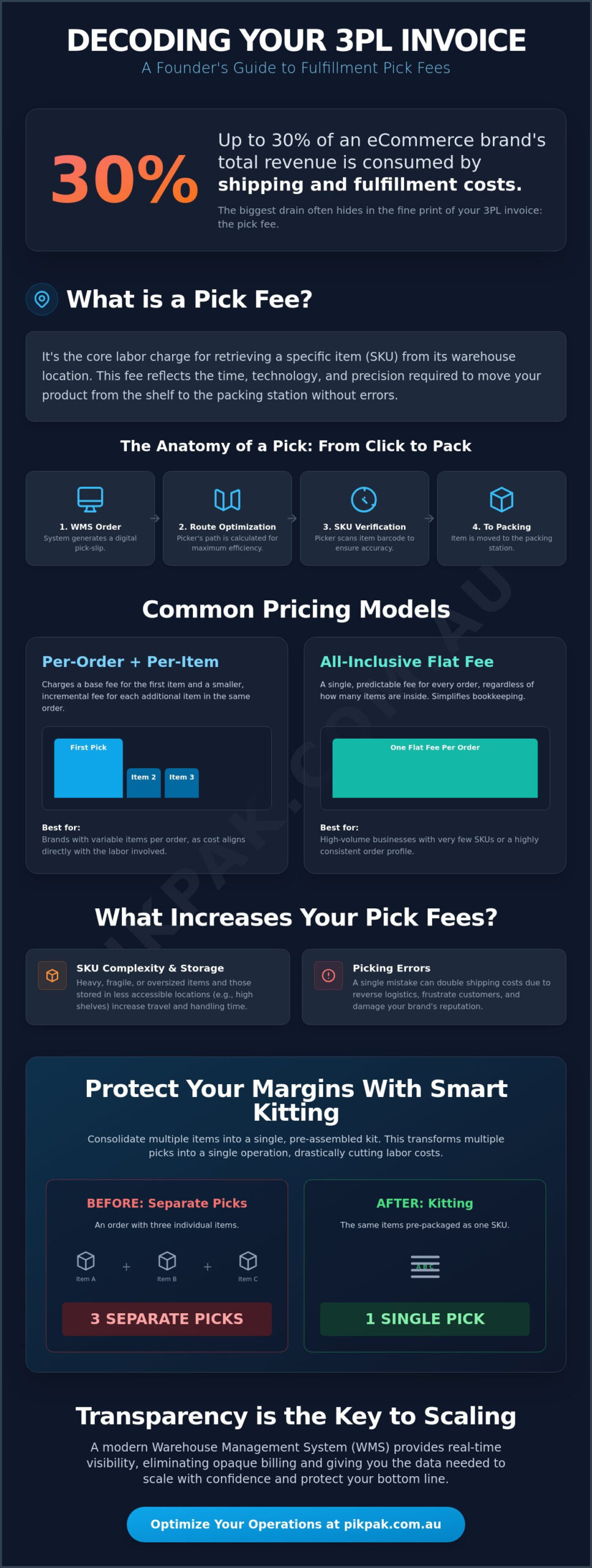
Did you know that shipping and fulfillment costs now consume up to 30% of the average eCommerce brand’s total revenue? While most founders focus on marketing and product development, the real drain on your margins often hides in the fine print of your 3PL invoice. One of the most common questions we hear from growing brands is, what are pick fees, and why do they seem to vary so much between providers? These charges are the pulse of warehouse efficiency. They represent the labor and technology required to pull an item from the shelf and prepare it for its journey to your customer.
You’re likely tired of opaque billing and the stress of trying to compare 3PL quotes that don’t seem to speak the same language. It’s difficult to scale when your margins are shrinking due to costs you didn’t see coming. This guide will provide the clarity you need to take back control of your operations. We’ll break down the math behind fulfillment billing, offer a framework for comparing providers, and share specific strategies to help you lower your per-order expenses. By the end of this article, you’ll have a clear roadmap to optimize your logistics and protect your bottom line.
Key Takeaways
- Understand exactly what are pick fees and why these labor-based charges are a critical indicator of your warehouse’s operational efficiency.
- Compare the industry-standard per-item pricing model against flat-fee options to determine the most cost-effective structure for your specific SKU count.
- Identify how SKU complexity and storage bin locations influence your picking invoice, helping you avoid unexpected spikes in fulfillment costs.
- Learn how to use kitting and assembly strategies to consolidate multiple picks into a single operation, effectively protecting your eCommerce margins.
- Discover how real-time visibility through a cloud-based WMS platform eliminates opaque billing and provides the data needed to scale with confidence.
What Are Pick Fees? Breaking Down the Core of Fulfillment Costs
Every time a customer clicks the “buy” button on your website, a complex chain of events begins in the warehouse. At the center of this activity is the pick fee. This charge represents the labor involved in retrieving a specific SKU from its designated warehouse location. While it might seem like a minor line item, these fees are the primary driver of your operational expenses. They reflect the precision and time required to move your products from bulk storage to a packing station without errors.
A high-performing pick and pack warehouse uses these fees to maintain high-speed throughput. Efficiency here is not just about speed; it is about the strategic use of technology to minimize human error. You aren’t just paying for someone to walk to a shelf. You’re paying for a system that ensures the right item reaches the right customer every single time. Understanding what are pick fees is the first step toward auditing your logistics spend and identifying where your margins might be leaking.
The Anatomy of a Pick: From WMS to Shelf
The process starts long before a warehouse staff member moves toward a bin. It begins with the Warehouse Management System (WMS). This software generates a digital pick-slip that optimizes the picker’s route through the facility. This optimization is crucial because travel time is often the most expensive part of the fulfillment journey. By reducing the number of steps taken, the warehouse keeps costs predictable and delivery times short.
Once the picker reaches the location, they use handheld scanners to verify the SKU. This verification step is a critical defense against the high costs of reverse logistics. A single picking error can lead to a returned item, a frustrated customer, and doubled shipping costs. Investing in accuracy at this stage protects your brand’s reputation and your bottom line. Precision in the warehouse translates directly to confidence in your business growth.
Pick vs. Pack: Understanding the Distinction
It is common to see these terms grouped together, but they serve two distinct operational functions. Picking is the “finding and fetching” phase of the journey. It is the physical act of gathering items. Packing, on the other hand, is about “securing and shipping.” This involves selecting the right box size, adding protective dunnage, and sealing the package for transport. Many 3PLs separate these line items to provide better transparency, allowing you to see exactly where your labor spend is going.
These individual tasks are essential components of the broader order fulfillment process, which dictates how quickly your brand can scale. By breaking these costs down, you can identify if a specific product is particularly difficult to pick or if your packaging strategy is driving up costs. Pick fees are the labor cost of inventory retrieval triggered by a customer order.
Common Pricing Models: How 3PLs Calculate Pick and Pack Fees
Choosing the right fulfillment partner often comes down to how they structure their billing. Most modern 3PLs have moved away from unpredictable hourly labor rates toward more standardized units. This shift provides you with the predictability needed to forecast your monthly expenses accurately. When you evaluate a potential partner, you’re essentially asking: what are pick fees going to look like as my order volume scales? Understanding these models allows you to select a structure that protects your margins as your business grows.
The industry standard for growing brands is the ‘Per-Order + Per-Item’ model. This approach charges a base fee for the first item in an order and a smaller, incremental fee for every additional item. It aligns the cost directly with the physical labor involved. Some high-volume businesses with very few SKUs might prefer an ‘All-Inclusive’ flat fee. While this simplifies your bookkeeping, it can sometimes hide inefficiencies or lead to overpaying if your order profile changes. Identifying which model aligns with your current order fulfilment volume is a critical step in optimizing your logistics spend.
The Per-Order vs. Per-Item Breakdown
The ‘First Pick’ fee is usually the highest because it covers the fixed labor of a staff member traveling to the first bin and starting the digital order process. ‘Additional Item’ fees are significantly lower because the picker is already active in the warehouse aisles. This structure makes multi-item orders much more cost-effective for the merchant. By increasing your average items per order, you can effectively lower your Cost of Goods Sold (COGS) and improve your overall profitability. It’s a pragmatic way to scale without seeing a linear increase in your fulfillment expenses.
Pickup Picking Fees: The Local Pickup Scenario
Click & Collect services are becoming a staple for many Australian eCommerce brands. It is a common misconception that these orders should be free of picking charges because there is no courier involved. However, the labor required to locate, verify, and prepare the items remains the same. These ‘pickup picking fees’ cover the essential work performed by the warehouse team to ensure the order is ready for the customer. Managing these fees transparently ensures your local pickup options remain a viable and profitable channel for your business. If you need a partner that offers this level of clarity, exploring our pick and pack services can help you gain better control over your operational costs.
Variables and Hidden Charges: What Influences Your Picking Invoice?
When you review your monthly logistics statement, you might notice that costs fluctuate even when order volumes remain steady. Understanding what are pick fees requires looking past the base rate to the variables that dictate warehouse labor. Not every item is retrieved with the same level of ease. Fragile products require specialized handling to prevent breakage, while oversized items may necessitate heavy machinery or a two-person team. These complexities are reflected in your invoice because they directly impact the time required to fulfill an order.
Storage location also plays a significant role in your total cost. Picking an item from an “active” bin at eye level is a fast, streamlined process. However, if your stock levels aren’t managed correctly, a picker might need to retrieve a “reserve” pallet from high-density racking. This transition from bulk storage to the picking face adds minutes to the process. Additionally, order edits and cancellations create a hidden labor cost. Reversing a pick involves returning the item to its precise location and updating the digital inventory record, a task that is often as labor-intensive as the original retrieval.
The Impact of SKU Proliferation
Managing an extensive catalog can inadvertently drive up your average costs. A high number of slow-moving SKUs often leads to a spread-out warehouse floor, increasing the travel time for every order. Your inventory storage strategy should prioritize “velocity mapping,” where your best-sellers are grouped in the most accessible zones. By cutting the “dead weight” of stagnant stock, you ensure that the warehouse team spends less time walking and more time shipping. This direct relationship between storage layout and picking efficiency is the key to maintaining slim margins.
Packaging Materials and Surcharges
The transition from “pick” to “pack” is where many brands encounter unexpected surcharges. Standard boxes are quick to assemble, but custom branded packaging or complex protective dunnage adds seconds to every order. While sustainable, eco-friendly materials are a priority for many consumers, some can be more time-consuming to secure than traditional plastics. Research indicates that the average eCommerce package contains approximately 40% wasted space, which can lead to higher dimensional weight charges from carriers. You can avoid these pitfalls by choosing transparent 3PL services that offer kitting and assembly to streamline your presentation. We focus on “right-sizing” your packaging to reduce both labor time and shipping waste, ensuring your fulfillment remains a competitive advantage rather than a financial burden.
Strategies to Lower Your Pick Fees and Protect Your Margins
Understanding what are pick fees is only the first step toward a more profitable eCommerce operation. The real value lies in taking active steps to lower these costs through strategic planning and operational discipline. Your margins don’t have to shrink as you scale. By implementing a few pragmatic changes to your inventory and marketing strategies, you can turn your fulfillment process into a lean, efficient engine for growth.
Start with SKU rationalization. Stagnant inventory is more than just a storage burden; it creates “dead weight” that forces warehouse staff to travel further for every order. By regularly auditing your catalog and removing slow-moving items, you streamline the physical flow of the warehouse. Another highly effective strategy is kitting and assembly. By consolidating multiple items into a single SKU, you effectively turn three separate pick operations into one. This significantly reduces the labor cost per order and simplifies your billing. If you want to see how kitting can transform your margins, explore our pick, pack, and ship services.
Technology is your greatest ally in this process. Leveraging advanced technology support allows you to forecast order volumes with precision. When you can provide your 3PL with accurate data about upcoming peaks, you’re in a much stronger position to negotiate rates and ensure staffing levels are optimized. This level of visibility eliminates the guesswork and helps you stay in control of your logistics spend.
Incentivising Multi-Item Orders
Your marketing department plays a surprising role in warehouse efficiency. By encouraging customers to buy more per order, you lower your average pick fee per item. Strategies like “free shipping over $100” or “buy two and save” are not just sales tactics. They are operational tools. When a customer adds a second or third item to their cart, the incremental cost of the additional pick is much lower than the base fee for a new order. Calculating the ROI of these bundling strategies often reveals a significant boost to your net profitability.
Warehouse Receiving Guidelines
Efficiency starts the moment your stock arrives at the dock. Properly labeled inbound stock reduces the likelihood of picking errors and ensures items are placed in the correct “active” bins immediately. Following established warehouse receiving guidelines ensures your inventory is ready for efficient picking from day one. Accurate inbound documentation is the foundation of low-cost outbound picking. When the WMS knows exactly where every unit is located, the physical journey of the picker is shortened, and your monthly invoice remains predictable and fair.
Why Transparent Pick Fees are the Key to Scaling with Pik Pak Logistics
Scaling an eCommerce brand is a complex puzzle where every piece of data matters. To make informed decisions, you need absolute clarity on your fulfillment spend. At Pik Pak Logistics, we believe that understanding what are pick fees shouldn’t require a degree in forensic accounting. Our approach is built on pragmatic, scalable pricing that eliminates hidden surcharges. We provide the transparency you need to forecast your growth without the fear of unexpected operational friction. This clear-cut billing model ensures that as your order volume increases, your logistics costs remain predictable and manageable.
Our cloud-based WMS platform offers real-time visibility into your 3PL logistics costs. You can see the exact status of every order and the associated fees as they occur. This level of detail allows you to reclaim your time and refocus on your core business objectives. By delegating the physical “fetch and carry” tasks to our expert team, you remove a major operational hurdle. Choosing a local 3PL in Australia ensures your inventory is handled by professionals who understand the local market, resulting in faster and more accurate picking for your customers. It’s a simple way to gain total control over your backend operations.
Technology-Driven Efficiency
Accuracy in fulfillment starts with a seamless digital handshake. Our API integrations automate the picking trigger the moment an order is placed on your store. This automation reduces human error and ensures that the warehouse team receives precise instructions instantly. Through our technology-first logistics model, you gain access to real-time tracking that shows exactly when an item was picked and packed. This data-driven approach doesn’t just improve speed; it provides the audit trail necessary to ensure your pick fees are always accurate and fair. Pik Pak Logistics uses technology to eliminate the guesswork that often leads to billing disputes in traditional fulfillment settings.
A Partner in Your Growth
We view pick fees as a shared metric for efficiency. If your costs are rising, we work with you to identify the cause, whether it’s SKU proliferation or packaging complexity. Our dedicated support team helps you interpret your logistics data, turning raw numbers into actionable insights. This partnership allows you to delegate operational burdens with confidence. It is a reassuring way to scale, knowing that your logistics partner is entirely focused on delivering tangible results. It’s time to stop worrying about the minutiae of warehouse labor and start prioritizing your business growth. Reclaim your focus and scale your business by partnering with a team that makes logistics feel effortless.
Take Command of Your eCommerce Fulfillment Margins
You now have a comprehensive understanding of what are pick fees and how they influence your bottom line. Success in 2026 requires looking beyond the base rate to the operational precision of your 3PL partner. By auditing your SKU velocity and incentivizing multi-item orders, you can transform these labor costs from a margin drain into a scalable advantage. High-speed throughput is achievable when you align your marketing goals with warehouse efficiency.
Don’t let opaque billing or hidden surcharges stall your growth. You deserve a partner that offers real-time WMS visibility and expert Australian-based support to simplify your logistics. With seamless eCommerce integrations, you can delegate the daily operational friction and refocus on building your brand. Ready for transparent, scalable fulfillment? Get a quote from Pik Pak Logistics today. We are here to help you reclaim your time and achieve the tangible results your business deserves.
Frequently Asked Questions
Are pick and pack fees the same as shipping costs?
No, pick and pack fees are entirely separate from shipping costs. Shipping costs are the rates you pay to carriers like Australia Post or FedEx for the physical transport of a parcel. In contrast, pick and pack fees cover the internal warehouse labor required to retrieve items from shelves and prepare them for transit. These fees ensure your orders are handled with precision before they ever leave the warehouse dock.
How much should I expect to pay for a standard pick fee in Australia?
Standard rates vary based on your specific order volume, SKU complexity, and the 3PL provider you choose. Most businesses find that pricing is structured to reward higher volume with lower per-unit costs. To understand exactly what are pick fees for your unique business model, it’s best to request a tailored quote that reflects your product dimensions and average monthly shipping frequency. This ensures you only pay for the resources you actually use.
Do I pay a pick fee if a customer returns an item?
You generally don’t pay a standard outbound pick fee for a return, but you will likely encounter a returns processing fee. This charge covers the labor involved in inspecting the returned item, verifying its condition, and returning it to the correct storage bin. Effective returns management is a critical part of reverse logistics that ensures your inventory remains accurate and ready for the next sale without creating operational friction.
What is a ‘first item’ vs. ‘additional item’ pick fee?
The ‘first item’ fee covers the fixed labor cost of a picker traveling to a location and initiating a digital order. ‘Additional item’ fees are significantly lower because the staff member is already active in the warehouse aisles and the order is already open. This structure makes multi-item orders much more cost-effective. It’s a pragmatic way for 3PLs to pass on labor efficiencies to brands that successfully encourage customers to buy more per transaction.
Can I reduce my pick fees by changing my product packaging?
Yes, simplifying your packaging can often reduce the labor costs associated with the ‘pack’ portion of fulfillment. Complex custom branding or excessive protective layers take more time to assemble, which can lead to higher labor charges over time. You might also consider kitting and assembly services to group popular items into a single SKU. This strategy effectively reduces the number of individual picks required for your most common order combinations.
Why does SKU count affect my pick and pack charges?
A high SKU count often leads to a larger warehouse footprint, which increases the travel time for pickers. When inventory is spread across more locations, the physical “fetch and carry” process becomes less efficient. This is why many brands perform regular SKU rationalization to remove slow-moving products. Keeping your inventory storage focused on high-velocity items helps maintain lower average charges and streamlines your entire outbound operation.
What happens if the 3PL makes a picking error?
Most professional 3PLs operate under a Service Level Agreement that defines acceptable accuracy rates and remediation steps. If an error occurs, the provider typically handles the cost of the re-shipment or provides a credit to rectify the mistake. High-quality providers use advanced WMS technology to minimize these occurrences from the start. You should always verify the error-remediation policy in your service agreement to ensure your brand’s reputation stays protected.
Is there a minimum monthly pick fee for small businesses?
Many 3PL providers implement a minimum monthly spend or order volume to cover their fixed technology and account management costs. These minimums vary between companies and are designed to ensure the partnership remains viable for both parties as you scale. If you are a high-growth startup, look for a partner that offers scalable pricing structures. This allows you to grow your business without being held back by intimidating entry barriers or opaque billing practices.