
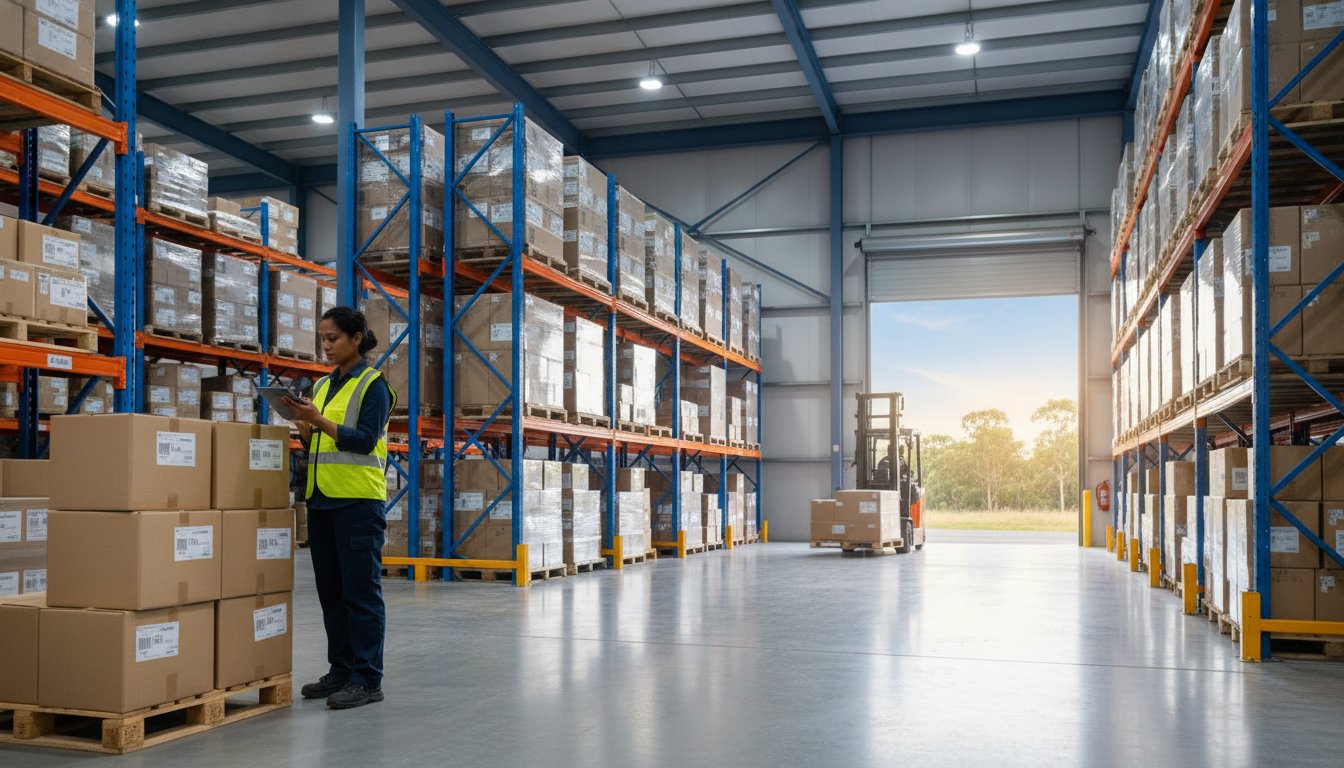
What if the most critical moment for your profit margin happens before a single order is even placed? Many business owners view inbound logistics as a simple drop-off, only to be surprised by line items on their monthly invoice. If you’ve ever looked at your billing and wondered exactly what is a receiving fee in 3pl, you aren’t alone. It’s often the source of friction between brands and warehouses; however, it serves as the essential gatekeeper for your data integrity.
We understand that unexpected fees can feel like a hurdle to your growth. This guide will clarify how these charges work, why they’re essential for preventing inventory discrepancies, and how you can optimize your shipments to keep costs low. With Australians spending a record $82.6 billion online in 2025, getting your stock into the system accurately is more important than ever. We’ll break down the difference between pallet and carton billing, explain the impact of new 2026 climate reporting standards on supply chains, and provide actionable steps to help you reclaim your time and focus on scaling your business.
Key Takeaways
- Understand how receiving fees cover the essential labor and technology required to move your stock from a delivery truck to “available” inventory.
- Learn how to navigate different billing models, such as per-pallet or per-carton, to clarify what is a receiving fee in 3pl for your specific operations.
- Discover why accurate inbound processing is your best defense against “ghost stock” and inventory discrepancies that hurt customer trust.
- Identify five actionable strategies to standardize your supplier shipments and significantly reduce manual handling surcharges at the warehouse.
- See how real-time visibility through WMS platform access can transform your inbound logistics into a transparent, manageable task.
Defining the 3PL Receiving Fee: More Than Just Unloading
When your shipment arrives at a warehouse, the clock starts on your inventory accuracy. Many retailers ask what is a receiving fee in 3pl because they assume it’s just a simple unloading charge for moving boxes. In reality, this fee covers the specialized labor and technology required to transform a physical shipment into sellable units on your digital storefront. It is the bridge between inbound freight and live inventory; it’s the moment your investment becomes an asset.
The process is highly structured and professional. It begins when a driver checks in at the dock and ends only when your stock is safely shelved and visible on your dashboard. This ensures that every unit you paid your supplier for is actually in the building and ready for your customers. Without this gatekeeping step, your warehouse would quickly descend into chaos, leading to lost items and frustrated buyers.
The Dock-to-Stock Journey
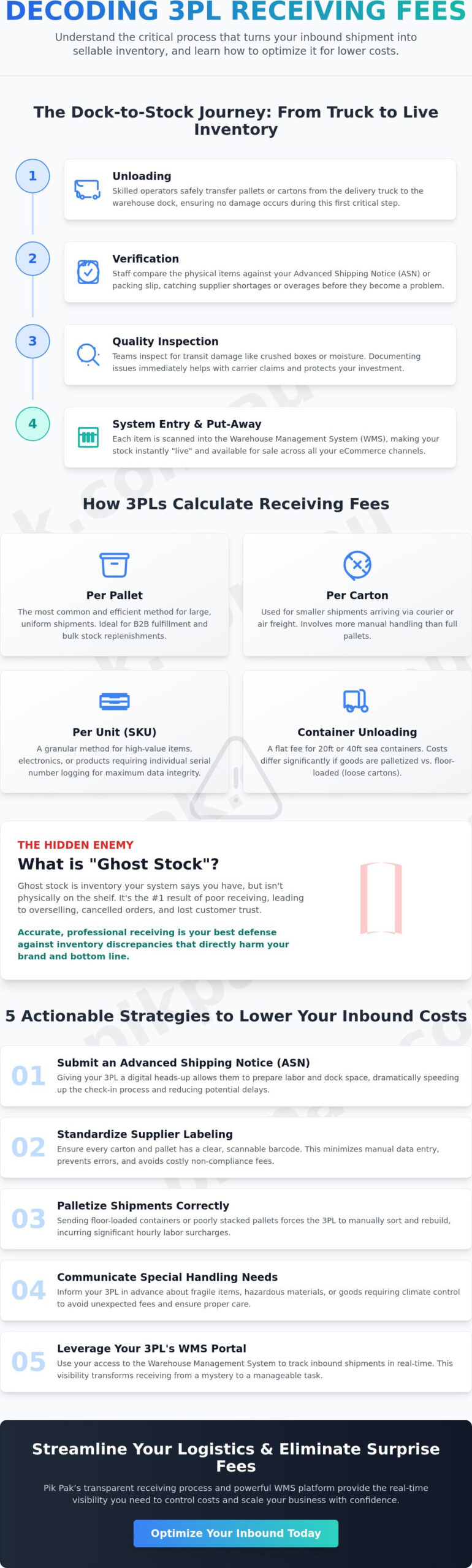
The journey from the trailer to the shelf involves several critical touchpoints that require precision and speed. These steps include:
- Unloading: Warehouse teams safely remove pallets or cartons from the transport vehicle. This requires skilled operators to ensure no stock is damaged during the transition from the truck to the warehouse floor.
- Verification: Staff check the physical count against your packing slip or Advanced Shipping Notice (ASN). This step is vital for catching supplier shortages or overages before they impact your books.
- Quality Inspection: Teams look for signs of transit damage, such as crushed corners or moisture. Documenting these issues immediately allows you to file claims with your carrier or supplier before the stock is put away.
- System Entry: Staff scan barcodes to update the Warehouse Management System (WMS). This action makes the stock “live” for sale across all your connected eCommerce channels instantly.
Why 3PLs Charge for Inbound Processing
Providing these services requires significant investment in both people and hardware. Third-party logistics providers maintain complex infrastructure to handle these tasks efficiently. This includes high-spec loading docks, forklifts, and industrial-grade scanning technology that syncs with your online store.
Beyond equipment, receiving is one of the most hands-on tasks in a fulfillment center. It requires trained personnel who understand how to spot discrepancies and handle complex SKU lists. There is also a major transfer of liability. Once the 3PL signs for the delivery, they take full responsibility for the security and condition of that stock. The fee reflects this commitment to protecting your business. To help your provider work faster and reduce potential surcharges, you can follow specific warehouse receiving guidelines that streamline the entire inbound process.
How 3PLs Calculate Receiving Fees in Australia
Pricing structures for inbound logistics aren’t a one-size-fits-all “tax” on your inventory. Instead, they’re calculated based on the physical labor and time required to process your specific goods. When you’re evaluating what is a receiving fee in 3pl, you’ll find that most providers align their billing with the way your stock is packed. Analyzing Varying Cost Structures shows that labor efficiency and warehouse space optimization are the primary drivers of these charges. Your total cost will typically scale based on volume, frequency, and whether your items require special handling like climate-controlled storage or fragile-goods protocols.
Per Pallet vs. Per Carton vs. Per Unit
Most Australian logistics partners use one of three primary billing methods. Per-pallet charging is standard for bulk B2B shipments or large stock replenishments; it’s the most efficient way to move high volumes quickly. If your goods arrive via courier or air freight in smaller batches, you’ll likely see a per-carton fee. For high-value items or electronics that need individual serial number logging, a per-unit fee ensures every single item is tracked from the moment it hits the dock. This granular approach provides the data integrity you need to avoid “ghost stock” in your online store.
Container Unloading Fees
If you’re importing stock from overseas, your receiving costs will include container unloading. 3PLs usually charge a flat fee for 20ft or 40ft sea containers. There’s a major distinction here between palletized containers, which can be unloaded quickly with a forklift, and floor-loaded containers. Floor-loaded shipments require “de-stuffing,” a labor-intensive process where staff manually move loose cartons onto pallets. This manual handling adds time and cost, so it’s a key area where you can optimize your supplier’s packing methods to save money. You can find more details on managing these variables on our warehousing and fulfillment page.
Australian Pallet Standards (CHEP & Loscam)
Australia has unique pallet standards that significantly impact receiving costs. The standard AU pallet dimensions are 1165mm x 1165mm. If your stock arrives on non-standard international pallets, your 3PL may charge for a “slipsheet” transfer or a manual repalletization to fit their racking systems. Additionally, managing pallet hire accounts like CHEP or Loscam is a critical administrative task. Your 3PL handles the pallet exchange or transfer paperwork, ensuring you aren’t hit with ongoing hire fees for pallets that are no longer in your possession. This professional management keeps your supply chain lean and avoids the “hidden” costs of lost or unreturned equipment.
Why Receiving Accuracy is Critical for eCommerce Growth
Accuracy at the receiving dock is the foundation of a healthy supply chain. When business owners ask what is a receiving fee in 3pl, they’re often looking at a line item on an invoice, but they should be looking at an insurance policy for their data. A high-quality receiving process provides a “clean” start for your inventory. It ensures that the stock levels reflected on your eCommerce platform aren’t just estimates; they’re verified facts. This precision allows you to scale with confidence, knowing your digital storefront matches your physical warehouse.
Inbound errors are the root cause of “ghost stock,” a scenario where your website shows items as available that aren’t actually in the warehouse. Overselling leads to cancelled orders, negative reviews, and a permanent loss of customer loyalty. By paying a professional receiving fee, you ensure that every SKU is scanned and verified immediately. This proactive approach identifies supplier errors, such as “short-ships” where a manufacturer sends fewer units than invoiced, before they impact your bottom line or your customer’s experience.
Preventing Inventory Discrepancies
A professional 3PL acts as your eyes and ears at the warehouse door. Our team performs quality control checks to spot transit damage or incorrect labeling early in the process. This reduces your future return rates by catching defects before they ever reach a buyer’s doorstep. Dock-side verification prevents downstream order errors by ensuring the physical reality of your stock matches your digital records before the first order is even picked. It is a simple step that eliminates massive operational friction later in the fulfillment cycle.
Speed to Market: The Dock-to-Live Metric
In the fast-paced Australian eCommerce market, speed is a major competitive advantage. Modern logistics standards typically demand a 24-48 hour turnaround for inbound processing. Our WMS platform access ensures that your stock becomes available for sale the moment it’s scanned. This rapid replenishment is critical for trending products or seasonal peaks when demand can spike unexpectedly. Turning over your capital quickly allows you to reinvest in growth rather than having cash tied up in unprocessed boxes sitting on a warehouse floor. By prioritizing our service priorities, we help you maintain the momentum your business needs to stay ahead of the competition.
5 Strategies to Lower Your Inbound 3PL Costs
Reducing your inbound logistics spend starts long before your stock reaches the warehouse door. When you analyze what is a receiving fee in 3pl, you’ll see it is fundamentally tied to the time and complexity of the task. If your shipment is disorganized, the warehouse team spends more hours sorting, which increases your bill. Preparation is your most effective tool for lowering costs and ensuring your inventory is live for sale faster. By standardizing your approach, you can turn a complex logistical hurdle into a simple, manageable routine.
Utilising Advanced Shipping Notices (ASN)
An ASN is a digital manifest that tells your 3PL exactly what is coming, when it will arrive, and which SKUs are on which pallets. We prioritize ASNs because they allow us to pre-load data into our system. This means our team simply scans and verifies rather than manually typing in product details. This reduces administrative fees and eliminates the “surprise” shipments that lead to dock congestion. By providing digital manifests in advance through our WMS platform, you streamline the entire workflow and avoid manual data entry surcharges.
Supplier Compliance and Labelling
Enforcing strict labelling rules on your manufacturers or wholesalers is a massive cost-saver. If barcodes are missing, unreadable, or placed inconsistently, your 3PL must manually re-label every carton to ensure it can be tracked. Re-labelling at the warehouse is far more expensive than having it done at the factory level. Instruct your suppliers to use high-contrast labels and place them in the same spot on every box. This simple directive ensures our scanning technology works perfectly the first time, protecting your profit margins from unnecessary labor costs.
Optimising Palletisation
How your supplier stacks a pallet directly impacts your receiving cost. You should avoid “chimney” stacking or overhanging loads. These are unstable and often require labor-intensive restacking for safety before they can be placed in racking. Instead, aim for uniform SKU counts per pallet. When every pallet has the same number of units, verification happens in seconds rather than minutes. This consistency allows for faster counting and immediate system updates. For a full breakdown of these standards, check our Warehouse Receiving Guidelines.
Ready to simplify your inbound logistics and reclaim your time? Explore our fulfillment services to see how we provide transparent, efficient receiving for your business.
Streamline Your Logistics with Pik Pak’s Transparent Receiving
Logistics should be an enabling force for your business, not a source of operational friction. We believe that when you understand what is a receiving fee in 3pl, you should feel confident that every dollar spent is buying you precision and speed. Pik Pak focuses on eliminating the traditional “black hole” of inbound logistics by providing total transparency from the moment your shipment arrives. We’ve designed our processes to be simple, manageable, and entirely focused on getting your products to your customers without delay.
Our flexible receiving models are built specifically for the Australian eCommerce market. Whether you are a growing boutique brand or a high-volume retailer, our team adapts to your specific requirements. We integrate directly with your online store, ensuring that your inventory levels are always accurate across all sales channels. This seamless connection removes the stress of manual updates and allows you to reclaim your time for high-level business growth.
Technology-Driven Inbound Processing
Data integrity is the core of our operation. Through our Technology Support portal, you gain real-time visibility into your inbound shipments. You don’t have to guess if your stock has arrived; you’ll receive automated notifications the second your items are scanned, verified, and ready for picking. This level of automation provides detailed reporting on supplier accuracy and inbound history, giving you the insights needed to manage your manufacturing partners more effectively. Our web-based platform turns complex warehouse data into clear, actionable information that you can access from anywhere.
Expert Support for Australian Brands
Our team understands the unique complexities of the Australian transport network. We handle everything from standard pallet arrivals to complex kitting and assembly projects upon arrival. If your stock requires special handling or specific “put-away” rules, we execute those tasks with precision. This expertise ensures that even the most chaotic delivery schedules are handled calmly and efficiently. We invite you to see how we simplify Warehousing and Fulfilment by requesting a consultation with our logistics experts.
Get Started with Effortless Receiving
Choosing a logistics partner is about building a foundation for your future. With Pik Pak, you get transparent pricing with no hidden “dock fees” or surprise administrative charges. We handle the heavy lifting so you can focus on scaling your brand and reaching new markets. Our goal is to make your backend operations feel effortless, providing the security and reliability your business deserves. Stop wondering what is a receiving fee in 3pl and start experiencing a partnership that prioritizes your success. Request a Quote from Pik Pak Logistics Today and take the first step toward a more efficient supply chain.
Master Your Inbound Logistics for Scalable Growth
Understanding what is a receiving fee in 3pl is the first step toward a more transparent and profitable supply chain. It’s not just a cost of doing business; it’s an investment in the data integrity of your digital storefront. By standardizing your supplier shipments and utilizing advanced shipping notices, you eliminate the operational friction that often slows down growth. You deserve a partner that handles the heavy lifting while giving you the clarity to make better decisions.
As an Australian-owned and operated provider, we bring specialized eCommerce fulfillment expertise to every shipment we process. Our technology provides real-time WMS inventory visibility, ensuring you’re never left in the dark about your stock levels. Delegate the complexities of the warehouse to a team that prioritizes your success. Ready to simplify your inbound logistics? Contact Pik Pak today. We look forward to helping you reclaim your time and focus on what you do best: growing your brand.
Frequently Asked Questions
Is a 3PL receiving fee the same as a storage fee?
No, these are two distinct charges in the warehouse billing cycle. A receiving fee is a one-time labor charge for the physical work of unloading, verifying, and logging your stock into the system. Storage fees are recurring monthly costs based on the amount of space your inventory occupies in the warehouse racking or floor area. You pay for the labor once, while you pay for the space for as long as the items remain in the facility.
Can I avoid receiving fees by shipping small parcels via Australia Post?
You cannot avoid these fees by changing the delivery method. Even if your stock arrives in small parcels rather than large pallets, our team still needs to open the packages, verify the contents against your order, and scan each item into the inventory system. While the specific price might be lower for a single carton than a full container, the labor involved in what is a receiving fee in 3pl still applies to ensure your data remains accurate from the start.
What happens if my 3PL finds damaged stock during the receiving process?
We document the damage immediately and notify you through your dashboard. Our team takes photos of the damaged cartons or items before they are moved into storage. This proactive step allows you to file a claim with your transport provider or supplier right away. By identifying issues at the dock, we prevent damaged goods from being sent to your customers, which protects your brand reputation and reduces your future returns volume.
How long does it typically take for a 3PL to receive stock?
Most professional logistics providers aim for a 24 to 48 hour turnaround for inbound processing. This timeframe depends heavily on the quality of your preparation. If you provide an Advanced Shipping Notice (ASN) and your stock is correctly labeled, the process is much faster. Shipments that arrive without notice or require significant manual sorting may take longer to move from the loading dock to your “available” inventory count.
Do I have to pay a receiving fee for returns (reverse logistics)?
Yes, returns management requires a specialized type of receiving process. When a customer sends an item back, our team must inspect it for damage, verify the reason for return, and determine if it can be returned to sellable stock. This is often more labor-intensive than receiving new stock because each item must be handled individually. Paying this fee ensures that your returns are processed quickly so you can reclaim the value of the inventory.
What is a “floor-loaded” container surcharge?
This is an additional fee for sea containers where loose cartons are stacked directly on the floor instead of on pallets. Unloading these containers requires our team to manually lift and palletize every single box before they can be moved into the warehouse. Because this process takes significantly more time and labor than using a forklift for palletized goods, 3PLs apply a surcharge to cover the extra manual handling required to clear the container.
How can I track my inbound stock status in real-time?
You can track every stage of the inbound journey through your WMS platform access. As soon as a driver checks in at our dock, the status updates in your portal. Once our team scans the first barcode, you’ll see your inventory levels begin to rise in real-time. This visibility eliminates the need for phone calls or emails to check if your stock has arrived, giving you total control over your supply chain data from any device.
Is there an extra charge for receiving items without barcodes?
Yes, items that arrive without scannable barcodes usually incur a manual labeling fee. Our systems rely on barcodes to ensure 100% accuracy during the pick and pack process. If your supplier hasn’t labeled the goods, our team must print and apply labels to every unit before they are placed in storage. To keep your costs low, we recommend enforcing strict labeling compliance with your manufacturers so your stock is ready for the scanner the moment it arrives.