

What if your monthly warehouse bill wasn’t just an unavoidable expense, but a clear report card on your supply chain efficiency? With the global 3PL market projected to reach $1.22 trillion in 2026, many business owners still find themselves overwhelmed by confusing invoices and hidden surcharges for aged stock. Understanding storage fees for inventory is often the difference between a profitable quarter and a budget deficit. It’s frustrating to see your hard-earned margins eaten away by complex fee types you didn’t see coming, especially when you’re trying to scale.
We’re here to turn that operational friction into a streamlined advantage. This guide will help you master the complexities of warehouse storage costs and show you how to optimise your inventory to boost your bottom line. We’ll compare the latest 2026 Amazon FBA surcharges with standard 3PL models, providing a clear framework for calculating the ROI on every pallet you store. You’ll learn how to use real-time visibility to eliminate waste, lower your monthly bills, and transform your logistics from a source of stress into a predictable, manageable engine for business growth.
Key Takeaways
- Learn why storage fees cover more than just floor space, including the security and insurance required to protect your investment.
- Master the common billing units used in Australia, such as pallets, shelves, and cubic metre calculations for irregular items.
- Gain a competitive edge by understanding storage fees for inventory and how to avoid Amazon’s aggressive peak season price hikes.
- Implement proven strategies like ABC Analysis and Just-in-Time replenishment to lower your monthly warehouse bills.
- Discover how real-time WMS visibility and integrated shipping services create a predictable, effortless logistics budget.
Beyond Floor Space: What Inventory Storage Fees Actually Cover
Think of storage fees as the price of momentum. While many see them as a simple real estate expense, understanding storage fees for inventory requires looking at the total cost of holding stock. When your products sit in a professional facility, you aren’t just paying for air. You’re paying for a secure, managed environment that preserves your asset’s value until the moment it ships. This is the “carrying cost” of your business, and it encompasses far more than just rent.
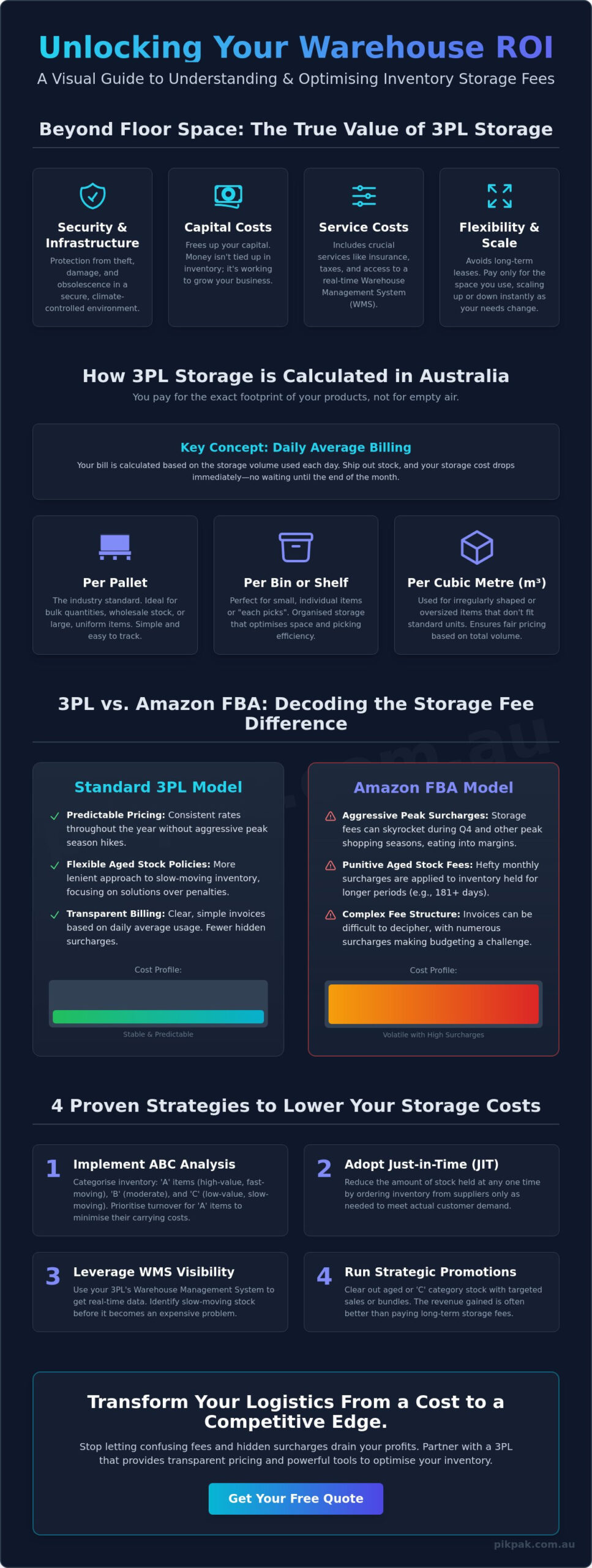
A professional 3PL facility provides a climate-controlled, secure space designed to maintain product integrity and lifespan. This is a far cry from a dusty garage or a basic self-storage unit. In a 3PL environment, you can choose between fixed storage, where you pay for a dedicated area, and variable storage. Variable storage is the pragmatic choice for growing brands, as it follows a pay-as-you-use model. You only pay for the pallets or bins you actually occupy, which keeps your overhead lean during slower months.
The Components of Carrying Costs
Effective inventory management involves balancing three main carrying cost pillars. Capital costs are often the most overlooked. These represent the opportunity cost of money tied up in stock rather than being invested in marketing or new product development. Every dollar sitting on a shelf is a dollar that isn’t working elsewhere in your business.
Service costs include the essential extras that keep your operations running smoothly. This covers insurance, warehouse taxes, and the overhead of the Warehouse Management System (WMS) that provides your real-time data. Finally, risk costs protect you against the “invisible” drains on your profit. These include protection against obsolescence, shrinkage through theft or misplacement, and physical damage. By understanding storage fees for inventory through this lens, you can see that you’re paying for the elimination of risk.
Why 3PL Storage is More Efficient Than Self-Warehousing
Self-warehousing often becomes a trap for scaling businesses. You’re forced into long-term commercial leases that don’t shrink when your stock levels drop. If you have a quiet month, you’re still paying for empty floor space. A 3PL removes this friction by allowing you to scale up or down instantly. You get the benefit of professional-grade security and specialized equipment without the massive upfront CAPEX of buying it yourself.
Delegating your storage to experts means you can refocus on your core business objectives. You gain the peace of mind that comes with high-end infrastructure and automated tracking. To see how these professional environments differ from standard storage sheds, explore our guide on what is a warehouse and how it specifically supports the needs of modern e-commerce brands.
The 3PL Pricing Model: How Storage is Calculated in Australia
Mastering the logistics landscape starts with understanding storage fees for inventory and how they apply to your specific stock profile. In Australia, 3PL providers typically move away from the flat rental fees of commercial real estate and toward more granular, activity-based billing. You pay for the specific footprint your products occupy, whether that is a standard pallet, a shelf, or a small pick bin. This precision ensures you aren’t subsidising empty warehouse space.
Most local providers use “Daily Average” billing to determine your costs. Instead of taking a single snapshot on the first of the month, the system calculates your storage volume every 24 hours. If you ship out half your stock on the 15th, your bill for the rest of the month reflects that reduction immediately. It is a pragmatic approach that prevents you from paying for space you emptied weeks ago. However, your initial setup often involves receiving fees. These cover the labour and technology required to scan, verify, and put away your stock, setting the foundation for accurate tracking.
Pallet vs. Bin Storage: Which Fits Your Business?
Choosing the right storage unit is a vital step in controlling the costs of excess inventory and maintaining healthy margins. Your choice depends on your order volume and product size:
- Pallet Storage: Best for bulk quantities, wholesale replenishment, or oversized goods that don’t fit on standard shelving.
- Bin and Shelf Storage: Ideal for fast-moving eCommerce items. These smaller units allow for quicker access during the pick and pack process.
A smart strategy is to monitor your unit costs. When you find yourself paying for twenty separate bins for a single product line, it is usually more cost-effective to consolidate that stock onto a single pallet. Our warehousing and fulfilment solutions help you identify these transition points to keep your overheads as low as possible.
The Importance of Accurate SKU Dimensions
Precision is the enemy of hidden costs. Modern 3PLs rely on “dim weights” and physical measurements to calculate your monthly invoice. If your product dimensions are recorded incorrectly in the system, you could be overpaying for every day that item sits on a shelf. A Stock Keeping Unit (SKU) is a unique alphanumeric code assigned to a product that allows a warehouse to track its specific dimensions, weight, and storage volume within a facility.
By understanding storage fees for inventory, you can see why accurate data is non-negotiable. A robust Warehouse Management System (WMS) tracks every millimetre of occupied space in real time. This technology eliminates guesswork, providing you with a transparent view of your logistics spend and helping you maintain a predictable budget for your growing business.
3PL vs. Amazon FBA: Decoding the Storage Fee Difference
Choosing between Amazon FBA and a dedicated 3PL isn’t just about shipping speeds. It’s a strategic decision that dictates your long-term profitability. While FBA offers massive reach, its fee structure is designed to keep stock moving at a frantic pace. If your inventory slows down even slightly, the costs can escalate rapidly. Understanding storage fees for inventory in the FBA ecosystem means preparing for aggressive surcharges that many Australian sellers find unsustainable as they scale across multiple channels.
One major advantage of a 3PL is the ability to maintain a single, consolidated storage pool. Instead of splitting your stock between Amazon’s warehouses and a separate facility for your Shopify or eBay orders, you keep everything in one place. This eliminates the “Inventory Health” trap where Amazon forces you to remove stock or pay punitive fees. By centralising your goods, you gain better control over your stock levels and avoid the hidden costs associated with inventory management that often plague multi-channel sellers.
Peak Season Surcharges and Your Margins
Amazon’s pricing model shifts dramatically during the Christmas rush. From October to December 2026, standard size storage fees jump from roughly $0.80 per cubic foot to over $2.40. That is a 300% increase during your busiest sales period. These hikes can gut your margins exactly when you should be most profitable. In contrast, 3PLs like Pik Pak offer price stability. We provide a predictable year-round budget, so you don’t have to worry about your storage bill tripling just because it’s December. For a deeper look at how this fits into your overall strategy, check out our order fulfilment guide.
Long-term Storage and Aged Stock
Amazon applies an “Aged Inventory Surcharge” for items that haven’t sold in over 180 days. By 2026, these fees reach $1.50 per cubic foot after six months and climb to $3.80 after nine months. If your stock sits for over a year, you’ll face a staggering fee of up to $7.56 per cubic foot. This model punishes businesses with seasonal goods or slower-moving SKUs.
A pragmatic 3PL approach is different. We focus on partnership rather than penalties. Instead of just charging you more for “aged” items, we provide the visibility you need to move slow stock through promotions or kitting. It’s about solving the problem, not just billing for it. If you’re unsure how your current stock profile would be billed, our team can help with specific warehousing and fulfilment questions to ensure you’re always understanding storage fees for inventory before they impact your cash flow.
Strategic Inventory Management: 5 Ways to Lower Your Storage Costs
Reducing your overhead requires more than just selling faster. It involves a surgical approach to your shelf space. Understanding storage fees for inventory means recognizing that every cubic centimetre has a price tag. To keep your logistics budget predictable, you must treat your warehouse footprint as a high-value asset. This starts with moving away from a “set and forget” mentality and adopting a dynamic strategy that rewards efficiency.
Ready to streamline your stock? Explore our warehousing and fulfilment services to see how we help you optimise your space and protect your margins.
The 80/20 Rule of Inventory Turnover
Apply the Pareto Principle to your warehouse. Focus your management efforts on the 20% of SKUs that drive 80% of your revenue. These high-velocity items should occupy prime pick locations to reduce labour time and keep your fulfilment engine running smoothly. To benchmark your efficiency, calculate your Inventory Turnover Ratio by dividing your cost of goods sold by your average inventory. A higher ratio indicates that you are moving stock effectively and avoiding the trap of paying for stagnant shelf space.
Auditing Your SKU Library
Inactive SKUs are profit-killers. They clutter your digital records and physically occupy space that could be used for your best-sellers. Sentiment has no place in a professional warehouse; if an item hasn’t moved in six months, it is likely “dead stock” consuming your capital. It is recommended that businesses conduct a comprehensive inventory audit at least once every quarter to maintain data accuracy and identify slow-moving stock before surcharges apply. This keeps your Warehouse Management System (WMS) clean and your storage costs lean.
By understanding storage fees for inventory, you can implement these five pragmatic tactics to reclaim your budget:
- Implement ABC Analysis: Categorise stock into ‘A’ (high value/turnover), ‘B’ (moderate), and ‘C’ (low). Focus your tightest controls on ‘A’ items.
- Adopt Just-in-Time (JIT) Replenishment: Coordinate with suppliers to receive stock closer to when it is needed, minimising your days-on-hand.
- Liquidate Dead Stock: Use clearance sales or donations to remove items that have reached the “aged” threshold.
- Optimise Packaging: Work with your 3PL to ensure your product packaging is as compact as possible, reducing the physical footprint per unit.
- Utilise Kitting: Use our kitting and assembly services to bundle slow-movers with best-sellers, clearing shelf space while increasing your average order value.
Delegating these operational burdens to a tech-savvy partner allows you to refocus on your core growth objectives. Instead of micromanaging pallets, you can use real-time data to make informed decisions that drive your business forward.
Effortless Inventory Control: The Pik Pak Approach to Transparent Storage
Logistics shouldn’t be a source of friction for your business. At Pik Pak, we believe that understanding storage fees for inventory should be the simplest part of your day. We’ve designed our service model to replace confusing invoices and hidden surcharges with total transparency. By integrating our inventory storage directly with our pick, pack, and ship services, we create a seamless flow that keeps your stock moving and your costs predictable.
Our Melbourne-based expertise is specifically tailored for the Australian eCommerce market. We understand the local landscape and the unique challenges of scaling a brand in this region. Delegating the “boring” details of warehouse management to us means you can stop worrying about pallet counts and start focusing on your core objectives. We handle the heavy lifting, giving you back the time needed to grow your product range and reach new customers.
Technology Support That Saves You Money
Precision is built into our platform. Our cloud-based Warehouse Management System (WMS) provides real-time visibility into every unit you store with us. You don’t have to wait for a monthly statement to see how your stock is performing; you can check your dashboard at any moment. This live data is a powerful tool for maintaining lean operations and avoiding unnecessary carrying costs.
Our technology support includes automated reporting that flags slow-moving items before they become a fee burden. If a SKU sits idle for too long, you’ll know about it immediately, allowing you to take action through promotions or kitting. Additionally, our API integrations sync your inventory levels across Shopify, eBay, Catch, and other sales channels. This prevents overselling and ensures that your physical stock always matches your digital storefront.
Ready to Scale Your Business?
Growth requires a partner that can move as fast as you do. When you’re understanding storage fees for inventory, you’ll see that the true value of a 3PL isn’t just a shelf; it’s the enabling force that removes operational hurdles. We provide the infrastructure and professional-grade security you need without the long-term commitments of a commercial lease. This flexibility is what allows you to pivot during peak seasons and scale back when necessary without financial penalty.
It’s time to take control of your logistics budget with a transparent, no-surprises storage quote. Whether you’re moving ten pallets or a thousand, we provide a clear framework that helps you calculate your ROI on every item. Delegate your operational burdens to a seasoned, tech-savvy team and refocus on what you do best.
Request a Quote from Pik Pak Logistics Today and discover how effortless your inventory management can be.
Take Control of Your Logistics Budget
Logistics shouldn’t be a guessing game. By now, you know that understanding storage fees for inventory is about more than just finding a place for your pallets. It’s about using real-time data to eliminate waste and choosing a partner that offers price stability over seasonal surcharges. You’ve learned how to categorise your stock to maximize turnover and why accurate SKU dimensions are the foundation of a predictable budget.
It’s time to stop letting hidden costs eat into your margins. Delegate your operational burdens to a team that values transparency as much as you do. With our Melbourne-based expert support and real-time WMS visibility, you can monitor your stock levels effortlessly across all your sales channels. Our seamless eCommerce integrations ensure your data is always accurate, giving you the freedom to refocus on your core business growth.
Get a Transparent Storage Quote from Pik Pak Today
You have the tools to turn your warehouse bill into a report card for efficiency. We’re here to help you make every square metre work for your bottom line. Take the next step toward a leaner, more profitable supply chain today.
Frequently Asked Questions
How are storage fees calculated in a 3PL warehouse?
3PL warehouses calculate storage based on the physical space your goods occupy and the duration of their stay. Most providers use a daily average volume calculation to ensure you only pay for the space you use each day. This involves counting the number of pallets, shelves, or bins in use. By understanding storage fees for inventory, you can see how moving stock quickly reduces your daily footprint and lowers your monthly bill.
What is the difference between monthly storage and long-term storage fees?
Monthly storage is the standard recurring cost for active inventory moving through the facility. In contrast, long-term storage fees are additional surcharges applied to items that remain in the warehouse for extended periods, typically over 180 or 365 days. While monthly fees cover operational overhead, long-term fees are designed to discourage stagnant stock from taking up valuable warehouse space. Keeping your inventory turnover high helps you avoid these punitive costs.
Can I avoid storage fees by using Amazon FBA?
You cannot avoid storage fees by using Amazon FBA; in fact, they are often more complex and expensive than 3PL alternatives. Amazon applies aggressive peak season price hikes from October to December and charges significant surcharges for aged inventory. While FBA offers reach, it requires precise management to prevent fees from eroding your profit. Many businesses find that a 3PL provides more stable, predictable pricing for their multi-channel operations.
What happens if my inventory doesn’t sell quickly?
If your inventory sits idle for too long, it begins to incur higher costs known as aged inventory surcharges. These fees increase the longer the item remains in storage, which can quickly turn a profitable product into a financial burden. To prevent this, you should use real-time visibility to identify slow-movers early. Implementing clearance sales or bundling items through kitting are pragmatic ways to move stagnant stock and reclaim your warehouse space.
How does cubic volume affect my storage invoice?
Cubic volume is used to calculate fees for oversized or irregular items that don’t fit into standard pallet or bin sizes. Your 3PL will measure the length, width, and height of your goods to determine the total cubic metres (CBM) occupied. Accurate measurements are essential, as even a small error in SKU dimensions can lead to overcharging. understanding storage fees for inventory involves ensuring your product packaging is as compact as possible to minimize this volume.
Is it cheaper to store pallets or individual bins?
The most cost-effective option depends on your stock volume and sales velocity. Pallet storage offers a lower cost per unit for bulk items and wholesale replenishment, but it is less efficient for picking individual orders. Individual bins or shelves are better for fast-moving eCommerce stock but can become expensive if you have high quantities of a single SKU. Transitioning from bins to full pallets as you scale is a smart way to reduce your total storage expense.
How often should I audit my inventory to reduce costs?
You should conduct a comprehensive inventory audit at least once every quarter to maintain data accuracy. Regular audits help you identify inactive SKUs, prevent shrinkage, and ensure your physical stock matches your digital records. For fast-growing brands, monthly spot checks on high-value items are even better. This proactive approach allows you to liquidate dead stock before it incurs aged inventory fees, keeping your logistics budget predictable and your operations lean.
Does 3PL storage include insurance for my inventory?
Most 3PL providers maintain insurance for the facility and their own liability, but this typically does not cover the full replacement value of your specific goods. It is a standard industry practice for business owners to maintain their own inventory insurance policy. You should check your contract to understand the specific coverage limits and security measures in place. Professional facilities provide the high-end security and fire protection required to keep your stock safe and secure.