

What if the line item you’re most tempted to cut is actually the one keeping your business from collapsing under its own growth? It’s frustrating to open a monthly invoice and see 3pl account management fees without a clear explanation of what you’re actually buying. You’ve likely felt the sting of non-transparent billing or the fear that you’re paying for “fluff” services that don’t move the needle. We agree that comparing logistics quotes shouldn’t feel like solving a puzzle with missing pieces.
This article will de-mystify these costs and show you how to evaluate the real value of dedicated logistics support for your eCommerce brand. You’ll learn the 2026 industry standards for management fees, how to calculate the ROI of expert oversight, and which red flags to spot in a contract. With new mandatory climate disclosures starting in July 2026 and shifting government fuel charges, having a pro in your corner is how you reclaim your time and focus on scaling. We’ll break down the difference between a hidden markup and the insurance policy for your operational precision.
Key Takeaways
- Understand why 3pl account management fees are now a standard requirement for navigating the operational complexities of the 2026 logistics market.
- Break down exactly what you’re paying for, from dedicated human support for issue resolution to the technology infrastructure powering your WMS.
- Compare flat monthly fees against variable pricing models to determine which structure offers the most predictability for your current order volume.
- Evaluate the true ROI of your logistics partnership by measuring “time reclaimed” against the significant expense of hiring an in-house coordinator.
- Identify contract red flags and learn why transparent, real-time visibility is the key to a stress-free, scalable eCommerce operation.
Understanding 3PL Account Management Fees in the Australian Market
Think of your logistics partner as more than just a warehouse. In the fast-moving Australian market, third-party logistics providers have shifted away from “all-in” pricing to provide better clarity for business owners. At its core, 3pl account management fees represent the recurring charge for administrative oversight and access to high-level system infrastructure. This isn’t a “hidden fee” designed to pad margins. It’s the cost of ensuring that your inventory is healthy, your orders are flowing without friction, and your business stays compliant with shifting regulations.
The logistics landscape in 2026 has become significantly more complex. With mandatory climate-related financial disclosures beginning for larger entities on July 1, 2026, and temporary changes to the Heavy Vehicle Road User Charge, the administrative burden on logistics providers has grown. Management fees cover the expertise required to navigate these shifts so you don’t have to. You’re paying for a dedicated team to monitor these variables, ensuring your supply chain remains resilient and cost-effective.
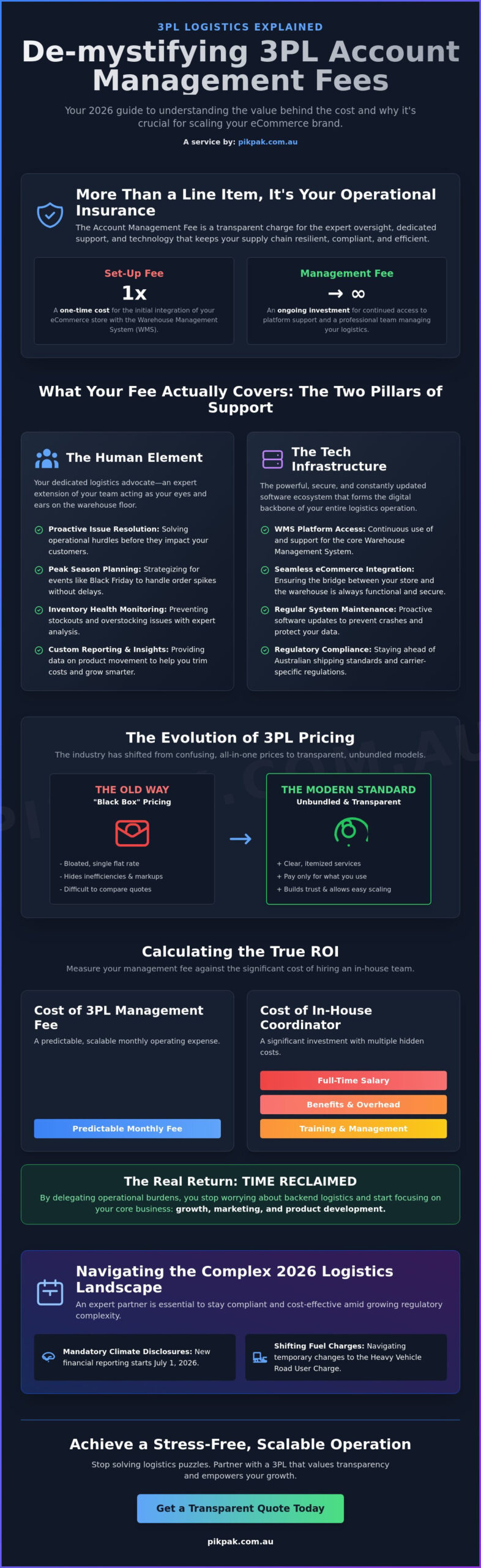
It’s vital to distinguish between set-up fees and management fees. A set-up fee is a one-time cost for the initial integration of your eCommerce store with a warehouse management system. In contrast, 3pl account management fees are ongoing. They ensure you have continued access to WMS platform support and a professional point of contact who understands your specific business goals.
The Evolution of 3PL Pricing Structures
Modern Australian logistics contracts now favour transparency over “black box” pricing. We’ve seen a industry-wide move toward unbundled pricing. Unbundled pricing is the practice of itemising every service to ensure clients only pay for what they use. This shift empowers you to see exactly where your money goes. Instead of a bloated flat rate that hides inefficiencies, you get a clear breakdown. This transparency builds trust and allows you to scale your services up or down based on real-time demand.
Why 3PLs Charge for Management Separately
Managing a modern supply chain requires more than just moving boxes. 3PLs charge for management separately because it involves high-level tasks that go beyond basic pick and pack services. These tasks include:
- Inventory Health: Proactive monitoring to prevent stockouts or overstocking issues.
- System Maintenance: Ensuring the bridge between your eCommerce platform and the warehouse floor remains secure and functional.
- Regulatory Compliance: Staying ahead of Australian shipping standards and carrier-specific regulations.
- Issue Resolution: Providing a seasoned expert to solve operational hurdles before they reach your customers.
By delegating these operational burdens, you reclaim your time. This allows you to stop worrying about backend logistics and start focusing on your core business growth.
What Is Included in a Standard Account Management and Tech Fee?
Ever wonder what actually happens behind the scenes after you sign a logistics contract? Standard 3pl account management fees generally cover two critical pillars: Human Support and Technology Infrastructure. While some providers stay vague about these costs, a transparent partner breaks them down so you see the tangible value. These fees fund the invisible work that keeps your business running, such as constant carrier negotiations to secure better rates and the regular software updates that prevent system crashes during high-traffic periods.
Understanding how these costs fit into common 3PL pricing models helps you identify a fair deal. You aren’t just paying for a login. You’re paying for a managed ecosystem. These 3pl account management fees aren’t just a charge for a dashboard; they’re an investment in operational stability and data security.
The Human Element: Your Logistics Advocate
Your account manager acts as your eyes and ears on the warehouse floor. When inventory discrepancies happen, they don’t just report them. They investigate and fix them before they affect your customers. During peak seasons like Black Friday, this advocate leads the proactive planning required to handle order spikes without delays. They also provide custom reporting. This data helps you understand which products are moving and where you can trim costs. It’s about having a seasoned problem-solver who understands your brand’s unique needs. They do the heavy lifting so you don’t have to.
Technology Support and System Integration
The digital side of the fee ensures your eCommerce store talks to the warehouse in real-time. This includes maintaining cloud-based WMS platforms and ensuring your API connections to Shopify, WooCommerce, or eBay remain stable. Tech fees cover the 24/7 server uptime and security protocols required to protect your customer data. API maintenance isn’t just a one-time setup. Platforms like Shopify update their code frequently. Your management fee ensures your 3PL’s tech team is already working on the compatibility patch before the update even hits your store. This proactive approach prevents the dreaded order sync error that can halt your business for days.
Managing these moving parts is a full-time job. If you’re ready to see how a managed solution simplifies your daily routine, explore our comprehensive 3PL services today.
Comparing 3PL Pricing Models: Fixed vs. Variable Fees
Choosing the right pricing structure is just as important as the services themselves. When you evaluate 3pl account management fees, you’ll typically encounter three main models: flat monthly fees, percentage of spend, or per-order charges. Each has its place depending on your business stage and operational complexity. To get a broader view of the industry landscape, reviewing a guide to 3PL fees and rates can help you benchmark these options against market averages.
The flat monthly fee provides ultimate predictability. Growing brands often prefer this because it eliminates the surprise of a high bill during a record-breaking sales month. You know exactly what your overhead is, which makes financial forecasting a simple task. Usually, these fixed 3pl account management fees include a higher tier of dedicated support, giving you a direct line to someone who knows your inventory inside out.
A percentage of spend model aligns your 3PL’s incentives with your own growth. In this scenario, the management fee is a small slice of your total monthly shipping and storage bill. If you’re selling more, they’re earning more. This creates a partnership focused on efficiency. However, if your margins are razor-thin, you’ll need to calculate whether this percentage scales reasonably as you hit higher volumes.
For seasonal businesses or startups, a per-order management fee is often the most accessible. You only pay when you ship. It’s a low-risk way to access professional logistics without a heavy monthly commitment. To choose the right fit, look at your SKU count and order frequency. High SKU counts with low turnover often benefit from fixed fees to keep storage and management costs stable. High-volume brands with fewer SKUs might find variable models more cost-effective.
The Pros and Cons of Fixed Monthly Fees
Established brands value budgeting accuracy above all else. Fixed costs mean no surprises. The only real risk is during slow months where the fee might feel high relative to your sales. But during peak seasons, that same fee becomes a bargain. You get the same high-level support and system access during your busiest times without paying a premium for the extra administrative work. This stability allows you to focus on marketing and customer acquisition rather than checking every line item on an invoice.
Variable Fees and Performance-Based Pricing
Variable fees lower the barrier to entry for new eCommerce stores. It’s a pragmatic way to scale. Just be sure to check your contract for “minimum monthly spends.” Some providers charge a base amount if your volume drops too low. It’s also helpful to understand how your pick and pack services interact with these fees. Often, a variable management fee is bundled into the transaction cost, making it easier to calculate the exact cost of every order you send out. This approach ensures you don’t over-invest in logistics before your sales volume justifies the expense.
How to Evaluate the ROI of Your 3PL Account Management Fee
Measuring the value of 3pl account management fees requires looking past the monthly expense and focusing on the “time reclaimed” for your business. As an eCommerce owner, every hour you spend resolving inventory discrepancies or chasing missing parcels is an hour taken away from marketing or product development. High-quality management ensures these operational frictions disappear before they reach your desk. You aren’t just paying for a service; you’re paying for the freedom to focus on growth while a professional handles the logistics heavy lifting.
Beyond time, consider the impact on order accuracy. A well-managed system significantly reduces mispicks and shipping errors. Each mistake costs you money in reverse logistics, replacement shipping, and potential customer churn. When your account manager proactively optimizes your inventory flow and catches errors early, they’re directly protecting your bottom line. If your 3PL is doing its job, your customer service inbox should be quieter and your reviews should be better.
However, price doesn’t always equal value. A high fee is a major red flag if response times are slow or if you’re forced to do the administrative heavy lifting yourself. If you aren’t getting proactive reporting or strategic advice, you aren’t getting the management you’re paying for. A transparent partner makes their value obvious through consistent performance and clear communication.
Calculating the Cost of In-House Logistics
Hiring an in-house logistics coordinator is a significant commitment. Beyond a base salary, which often starts around $65,000 per year in the Australian market, you must factor in superannuation, office space, and specialized software licenses. Comparing this to a standard monthly management fee makes the decision clear. You get a team of experts and a high-end warehouse management system for a fraction of the cost of one full-time employee. This eliminates the “distraction tax” on leadership and removes the burden of managing staff. For a deeper look at these fundamentals, read What is 3PL? Your Complete Guide.
The Hidden Fee Checklist: What to Watch For
Not all 3pl account management fees are created equal. Some providers use these fees as a base and then layer on extra charges that can erode your margins. Use this checklist to ensure your contract is truly transparent:
- Customer Service Fees: Check if you are billed for every email or phone call to your account manager.
- Software Maintenance: Ensure system access is truly included and not a separate “tech tax.”
- Account Inactivity: Watch for penalties if your volume drops during a slow month.
- Price Escalators: Question any annual increases that aren’t tied to specific service improvements.
If you want to stop guessing and start scaling, contact us to discuss a transparent partnership that puts your growth first.
Why Pik Pak Logistics Prioritises Transparent 3PL Management
At Pik Pak Logistics, we believe that “Effortless Logistics” isn’t just a catchy phrase. It’s a commitment to removing the operational friction that stops eCommerce brands from reaching their full potential. We know that 3pl account management fees can often feel like a black box of hidden costs. That’s why our philosophy focuses on radical transparency. We provide real-time visibility through our WMS platform at no hidden cost, ensuring you always know exactly where your inventory sits and how your orders are progressing. This level of control isn’t an “extra” feature; it’s the foundation of a reliable partnership.
Managing your backend shouldn’t feel like a second job. When you partner with us, you’re delegating the heavy lifting to a team that views logistics as an enabling force for your growth. We don’t hide behind automated ticketing systems or generic support queues. You get direct access to experts who understand your business goals and are dedicated to maintaining the precision of your supply chain. This approach allows you to reclaim your time and refocus your energy on scaling your brand, confident that the operational details are in capable hands.
Expert Support Without the Jargon
Logistics is full of complex terminology, but your support shouldn’t be. Our Melbourne-based team takes pride in handling the intricacies of order fulfilment with clear, direct communication. We understand the unique challenges of the Australian eCommerce landscape, from local carrier nuances to seasonal demand shifts. We’re committed to responding to your enquiries within business hours, ensuring you’re never left waiting for days for a simple answer. Whether you’re navigating a sudden stock discrepancy or planning a major product launch, we provide the pragmatic advice you need to keep moving forward without the fluff.
Get a Transparent Quote Today
The best way to evaluate 3pl account management fees is to see them in a context that makes sense for your specific volume and SKU count. We invite you to experience a quoting process where every line item is clearly defined and justified. Our pricing models are built for scalability. We want our partnership to grow as you grow, meaning our fees only scale when your success does. There are no annual price escalators or hidden “tech taxes” tucked away in the fine print. We focus on delivering tangible results through precision and efficiency, giving you the security you need to invest in your business’s future.
Don’t let operational hurdles slow your momentum. Take the first step toward a more streamlined supply chain and request a transparent 3PL quote from Pik Pak Logistics today.
Take Control of Your Logistics Costs
Your logistics partnership should feel like a strategic asset, not an administrative burden. By understanding the specific components of 3pl account management fees, you can move away from the frustration of non-transparent billing and focus on scaling your brand. These costs are the foundation of a resilient supply chain, covering the human expertise and technology infrastructure required to keep your orders moving accurately. The real value of this investment is the time you reclaim to focus on product development and marketing while professionals handle the operational heavy lifting.
At Pik Pak Logistics, we eliminate the guesswork from your monthly invoice. We are proudly Australian owned and operated, offering a service model where real-time WMS visibility is always included at no extra cost. You won’t find hidden “per-email” support fees here; just direct access to experts who prioritise your success. It’s time to delegate your operational hurdles to a partner who values clarity as much as you do. Simplify your logistics with a transparent quote from Pik Pak and build a more efficient, scalable future for your business today.
Frequently Asked Questions
What is a typical 3PL account management fee in Australia?
A typical 3PL account management fee in Australia varies based on your specific volume and the complexity of your inventory. Most providers offer either a flat monthly rate for predictability or a variable percentage based on your total activity. It’s a pragmatic way to ensure you have professional oversight without the cost of a full-time employee. Always ask for a transparent breakdown to see exactly what administrative tasks and system access are covered in your agreement.
Do I have to pay for technology access separately from management fees?
Technology access is sometimes bundled into 3pl account management fees, but some providers list it as a separate line item. This often covers your WMS platform access and real-time data syncing between your store and the warehouse. If a provider charges for technology separately, ensure the fee includes all necessary security updates and API maintenance. This prevents unexpected costs when your eCommerce platform releases a new software update.
Can I negotiate 3PL account management fees as my volume increases?
Yes, these fees are often negotiable once your business reaches higher order volumes. As your inventory turnover increases, the administrative work per order often becomes more efficient for the warehouse. This efficiency can lead to lower management rates or a shift from a flat fee to a more competitive variable model. Regular contract reviews are a pragmatic way to ensure your costs remain aligned with your business size and growth trajectory.
What happens if my 3PL doesn’t provide a dedicated account manager?
Without a dedicated account manager, you’ll usually be directed to a general support queue or ticketing system. This often results in slower response times and a lack of personal knowledge about your brand’s specific needs. A dedicated manager acts as an advocate for your business on the warehouse floor. They solve problems before they reach your customers, which is a key factor in maintaining high order accuracy and professional service.
Are account management fees different for B2B vs B2C fulfilment?
Fees often differ because B2B orders typically involve higher administrative complexity. Managing bulk shipments to retailers requires specific routing guides, pallet labelling, and strict compliance with delivery windows. In contrast, B2C fulfilment focuses on high-volume, individual parcel delivery. Because B2B requires more manual oversight and coordination between carriers and receiving docks, the management fee might reflect that additional workload to ensure compliance with retail standards.
How do I know if I am being overcharged for 3PL administration?
You might be overcharged if you see additional fees for basic communication, such as “per-email” or “per-call” support charges. Review your 3pl account management fees against the actual value of the support you receive. If you’re still spending hours every week fixing logistics errors yourself, the fee isn’t delivering a high ROI. A fair fee should simplify your operations and reclaim your time, not add more complex line items to your invoice.
Is the account management fee tax-deductible for my business?
In most cases, these fees are considered a legitimate business expense and are tax-deductible for Australian companies. Since they’re a necessary cost of operating your supply chain and managing inventory, they fall under standard operational expenditures. You should consult with your accountant or tax professional to confirm how these specific logistics costs apply to your business’s financial structure and reporting requirements for the current financial year.