

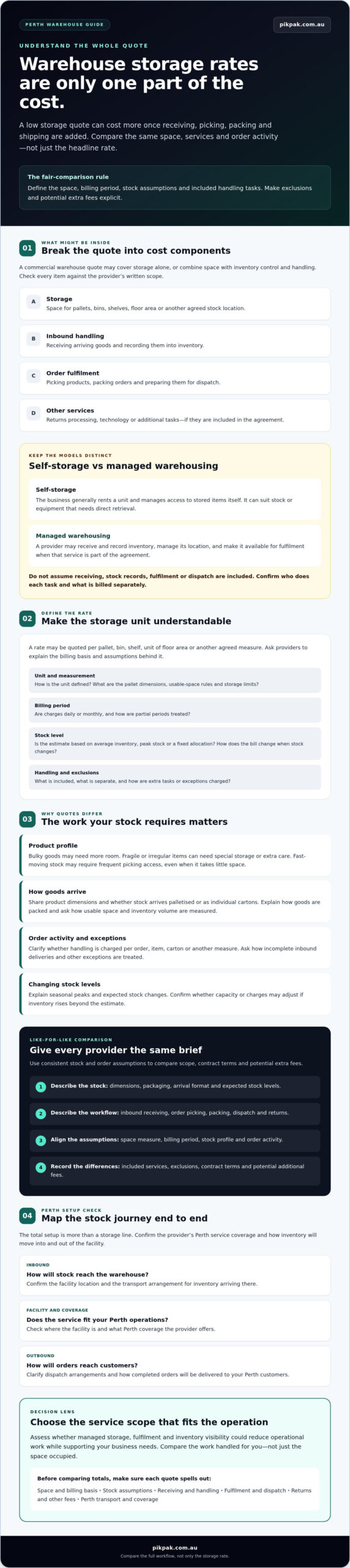
The lowest warehouse quote can cost more once receiving, picking, packing and shipping are added. That’s why warehouse storage perth rates are useful only when you compare the same space, services and order activity.
A simple per-unit price may not tell you what managed inventory storage includes. A third-party logistics provider (3PL) quote can combine storage, handling, fulfilment, returns and technology in different ways. Compare what each provider charges for and how its service fits your operations, not just the headline rate.
This guide explains the cost components to check, how to compare quotes using consistent assumptions, and when a 3PL may suit your business better than managing warehouse space yourself. It also covers practical checks for Perth service coverage and stock transport, so you can assess the full setup rather than just the storage line.
Key Takeaways
- Compare warehouse storage perth rates only after confirming the billing basis, space assumptions and services included in each quote.
- Separate storage from receiving, pick-and-pack, dispatch and returns to see what your business may be charged for across the full workflow.
- Use the same stock and order assumptions to compare provider scope, contract terms and potential extra fees.
- Before choosing a provider, confirm Perth coverage, the facility location, how stock will reach it and how orders will be delivered.
- Assess whether managed storage, fulfilment and inventory visibility could reduce operational work while supporting your business needs.
Warehouse storage Perth rates: what businesses are actually paying for
A commercial warehouse quote can cover more than space for stock. Depending on the provider and agreement, it may include inventory control, receiving goods, order picking, packing and dispatch. Or it may cover storage alone, with each handling task charged separately. That’s why warehouse storage Perth rates can’t be compared fairly using a headline figure alone.
At its simplest, warehousing is the storage of goods as part of a supply chain. For a business, the practical question is what the provider does with your inventory while it’s there, and how those activities are billed.
What a business warehouse quote can cover
- Storage: Space for pallets, bins, shelves or other stock locations.
- Inbound handling: Receiving and recording goods arriving at the facility.
- Order fulfilment: Picking products, packing orders and preparing them for dispatch.
- Other services: Returns processing or additional tasks, if included in the agreed scope.
Check each item against the quote. Storage rates don’t automatically include these services.
How is business warehouse storage different from self-storage?
With self-storage, a business generally rents a unit and manages access to the stored items itself. That can suit stock or equipment you need to retrieve directly. Managed warehousing works differently: a provider may receive your inventory, record it and manage its location, then make it available for order fulfilment if that service is part of your agreement.
For example, an online retailer may need stock held, individual items picked for customer orders, packed and prepared for dispatch. This connects storage with order handling and delivery arrangements. Don’t assume a warehouse quote includes every step. Confirm who handles receiving and stock records, which fulfilment tasks are included, and what attracts a separate fee.
What does a warehouse storage rate usually describe?
A rate may be quoted per pallet, bin, shelf, unit of floor area or another agreed measure. Ask how the provider defines that unit, whether charges are calculated daily or monthly, and how partial periods are treated. Clarify the measurement rules too. Pallet dimensions, usable space and any limits on how stock is stored can affect what a quoted unit means.
Check the stock assumptions behind the estimate. Is it based on average inventory, peak stock levels or a fixed allocation? If your stock changes, ask how the bill changes. Separate storage from receiving, order handling and dispatch so you can see the cost of the full service.
A comparable warehouse storage rate is a price for a clearly defined amount of space over a stated billing period, with included handling tasks and exclusions made explicit. Use that definition when requesting quotes. It helps you assess the price against your stock and workflow.
What changes warehouse storage rates for a Perth business?
A quote reflects the work your stock requires, not just the space it occupies. Product dimensions, order frequency and where stock needs to travel can all affect the operating scope. To understand warehouse storage Perth rates for your business, give providers the same clear picture of your inventory and workflow. Ask them to state their assumptions and potential additional fees in writing.
How stock profile and space requirements affect a quote
Bulky goods may need more room than compact items, while fragile or irregularly shaped products can require special storage or extra care during handling. Fast-moving stock has a different pattern: it may need frequent access for picking, even if it takes up little space. These differences can affect both the storage arrangement and the work involved.
Share product dimensions, how goods arrive and how they’re packed, including whether they’re palletised or supplied as individual cartons. Ask how the provider measures usable space and inventory volume, and what stock levels the quote assumes. If stock rises during seasonal peaks, explain the expected change and confirm whether capacity or charges could adjust. A quote based on average inventory may not reflect the space you need at your busiest point.
How handling and Perth logistics can change the total
Storage is only one part of the workflow. Ask whether inbound receiving, order picks, packing materials, dispatch preparation and returns are included or scoped separately. Clarify whether handling is charged per order, item, carton or another measure, and how exceptions such as incomplete inbound deliveries are treated.
Then map the stock journey. How will inventory get to the warehouse, and how will completed orders reach your Perth customers? A facility’s location, delivery zones and transport arrangements can affect cost and timing, so confirm details for your actual origin and destinations. Don’t assume that a provider serving Australian businesses stores or fulfils stock in Perth. Ask which facility would handle your account and what transport is included in the quote.
The Australian Logistics Council describes itself as the peak national body representing Australia’s freight and logistics industry. Its industry perspective can provide context, but your quote still needs to spell out the provider’s own service scope and assumptions.
- Provide stock dimensions, packaging and expected inventory changes.
- Share typical order activity and explain any seasonal peaks.
- Request a written breakdown of storage, handling and transport assumptions.
- Ask which charges may change if stock volumes or order patterns shift.
To see how warehousing and fulfilment may be scoped together, review Pik Pak’s warehousing and fulfilment services, then confirm Perth coverage, facility location and account-specific fees directly.
How to compare Perth warehouse storage quotes like for like
Two quotes can use different billing units and include very different work. To compare warehouse storage Perth rates fairly, give every provider the same stock profile and order scenario. Include product dimensions, expected inventory levels, inbound delivery format and typical order activity. Ask for a written breakdown rather than a headline storage rate alone.
Which line items should a warehouse quote disclose?
Request the storage unit and billing frequency, plus a clear description of receiving and inventory handling. Ask how picking, packing, packaging materials, dispatch and returns are scoped. Confirm whether setup, account management, system integration or minimum-volume charges apply. These fees may not apply to every arrangement, so ask providers to state what is relevant rather than assuming items are included or excluded.
Use a table like this to compare responses. Fill it in from each provider’s written quote, and ask for an explanation of any blank or unclear cell.
| Billing basis | Space | Included tasks | Excluded fees | Contract assumptions |
|---|---|---|---|---|
| Unit and billing frequency | Measured allocation and stock assumptions | Receiving, storage, picking, packing, dispatch, returns | Packaging, setup, account or integration fees, if applicable | Term, minimums, volume changes and notice conditions |
Make the comparison useful by using one scenario for every quote. Provide the same expected stock volume, time period, inbound delivery details and order activity. Ask each provider how the estimate changes if inventory or orders increase, and identify which charges are variable.
How can you compare a self-storage quote with a 3PL quote?
A self-storage quote may price access to a unit, while a third-party logistics provider (3PL) may also handle inventory and customer orders. Don’t compare the unit price alone. For self-storage, account for the operational work your team would manage, including staff time, stock records, order preparation and transport to customers. Then compare that full setup with the 3PL’s stated service scope.
Keep the inputs consistent: use the same inventory volume, comparison period and expected order activity. Check whether fulfilment includes the tasks your business needs or whether they’re charged separately. For a closer look at how storage can connect with order handling, read the guide to warehouse and fulfilment services. Clear assumptions help you assess the complete operating model, not just the lowest line item.
What to ask before choosing a warehouse storage provider in Perth
A provider’s national presence doesn’t confirm it has a Perth facility or can handle your Perth operation from a suitable location. Before comparing warehouse storage Perth rates, verify where your stock would be held, how it would get there and how orders would reach customers. Use this checklist when requesting a quote, then confirm the answers in writing before accepting one.
- Which facility would store my inventory? Ask for the warehouse location, not just a general service-area claim. Confirm whether the provider can receive and fulfil stock for your business and customer locations in Perth, and whether the proposed facility suits your delivery needs.
- How will inbound stock reach the facility? Clarify who arranges transport, what delivery types the warehouse can receive and what information or preparation is needed. Check booking procedures, receiving hours and how the provider records stock or flags discrepancies. Review the warehouse receiving guidelines to see the preparation details worth discussing.
- How are orders delivered to customers? Ask which home delivery options are available for your destinations, how delivery zones are defined and whether shipping is included or quoted separately. Confirm how dispatch information and delivery exceptions are communicated.
- How will I see inventory and order activity? Ask whether you can view stock counts and order status, how often information updates, and how discrepancies or other exceptions are reported. If you use an eCommerce platform, confirm whether it integrates with the provider’s system and what data connection is supported.
- What happens when a customer returns an item? Check whether returns handling is available, which steps are included and how returned stock is assessed or reflected in inventory records. Ask the provider to define the process rather than assuming all returns are handled the same way.
- What exactly is included in the quote and agreement? Request the service scope, assumptions, exclusions and any applicable fees in writing. Confirm how changes in stock volume or order activity are treated, along with the contract term and exit conditions.
These questions reveal whether a provider’s systems and processes fit your workflow, not just whether its headline quote looks attractive. Use this guide to warehouse and fulfilment questions to structure discussions with potential providers.
Pik Pak Logistics provides warehousing and fulfilment services, but its Perth facility location and service coverage should be confirmed before you decide whether it fits your needs. Explore Pik Pak’s logistics services and ask about the facility, service scope and quote assumptions relevant to your business.
Is Pik Pak a fit for Perth warehouse storage and fulfilment?
Start with your operating needs, not a provider’s headline rate. Managed storage may suit a business that wants to delegate inventory storage, customer order handling and returns instead of leasing space and coordinating those tasks itself. The right fit depends on your stock profile, order workflow, technology needs and the provider’s confirmed service coverage. Compare those requirements before deciding whether a 3PL can support your operation.
When managed storage and fulfilment may suit your business
If your team spends time tracking stock, preparing orders or processing returns, a managed workflow may reduce some day-to-day operational work. Look for a provider whose confirmed scope matches your needs, whether that’s inventory storage, pick-and-pack, shipping, returns management or kitting and assembly.
Pik Pak Logistics provides eCommerce warehousing and fulfilment services, including inventory storage, pick-and-pack, shipping, returns processing and kitting. Its cloud-based WMS gives customers real-time inventory and order-status visibility, while eCommerce platform integrations can automate the flow of order information. These capabilities may be useful if you want stock and orders visible through a connected system. Read about Pik Pak’s logistics service to understand its broader service model.
The available information doesn’t confirm a Perth warehouse location or Perth-specific availability. Before treating Pik Pak as an option for your business, confirm whether it can receive, store and fulfil your Perth inventory, which facility would handle the account, and what service scope and quote terms apply. Don’t assume an Australia-wide service means stock is held in Perth.
What information to include when requesting a warehouse quote
A useful quote starts with a clear operating profile. Share the information below with Pik Pak and any other provider you’re assessing, so you can compare warehouse storage Perth rates against the same requirements:
- Products and space: Provide product dimensions, how goods are packed or palletised, and expected stock quantities, including seasonal changes.
- Inbound stock: Explain how often deliveries arrive and how they’re presented, such as cartons or pallets. Ask about receiving steps and preparation requirements.
- Orders and packing: Describe expected order activity, packing needs and any kitting requirements.
- Systems: Name your eCommerce platform and ask whether the required integration or data connection is supported.
- Returns and destinations: Outline expected returns handling and list the Perth customer delivery destinations relevant to your business.
Ask Pik Pak to confirm Perth service coverage, the facility location, availability, quote assumptions and every applicable fee before proceeding. If the scope looks relevant, discuss your warehousing and fulfilment requirements with Pik Pak and request details based on your operating profile.
Make your next warehouse decision with confidence
The clearest way to assess warehouse storage perth rates is to compare quotes built on the same stock profile, billing assumptions and service scope. Look beyond the storage charge: receiving, picking, packing, dispatch and returns can all affect the setup your business needs. Confirm the Perth facility location, service coverage and stock transport arrangements directly before making a decision.
If you’re considering managed fulfilment, Pik Pak provides warehousing alongside pick-and-pack, returns processing and kitting. Its cloud-based WMS offers real-time inventory and order-status visibility. Ask whether the service can support your Perth operation, which facility would handle your stock, and what assumptions and fees apply to your quote.
To assess the fit, discuss your warehousing requirements with Pik Pak, including your inventory, order workflow and Perth delivery needs. Ask for a quote based on those details so you can compare the proposed scope and fees with your business requirements.
Frequently Asked Questions
How much does warehouse storage in Perth cost?
There’s no single price for every business, because warehouse storage Perth rates depend on the space, stock profile and services in the quote. A storage-only arrangement differs from managed warehousing that also handles receiving, order picks, packing, dispatch or returns. Request a tailored quote using your expected inventory and order activity. Before comparing providers, check the billing unit, billing period, exclusions and any additional fees.
What is usually included in a warehouse storage rate?
A warehouse storage rate may cover space for your stock, but handling and fulfilment aren’t automatically included. Depending on the provider’s scope, receiving goods, maintaining inventory records, picking products, packing orders, preparing dispatches or processing returns may be separate tasks or charges. Ask for an itemised explanation of what the rate covers, how each task is billed and which services are optional or excluded.
Is warehouse storage different from self-storage for a business?
Yes. Self-storage generally gives your business access to a rented unit, with your team responsible for managing and moving its contents. Managed commercial warehousing may involve a provider receiving and recording stock, then making it available for order fulfilment if agreed. A 3PL may also pick, pack and ship orders, but confirm the exact scope. Choose based on whether you need space alone or help managing inventory and orders.
Do Perth warehouse storage providers charge separately for picking and packing?
Some may quote picking and packing separately from storage, while other proposals may combine selected tasks. Don’t assume either approach. Ask whether charges are based on an order, item or another measure, and whether packaging materials, dispatch preparation or exceptions have separate fees. Request a written quote using your expected order activity so you can see how fulfilment affects the overall cost, not just the warehouse space charge.
How do I compare warehouse storage quotes from different providers?
Give each provider the same stock quantities, product dimensions, inbound delivery pattern and expected order activity. Then compare the billing basis, allocated space, receiving scope, included handling, exclusions and contract assumptions. Check whether returns, packing materials, system integrations or account fees apply. A lower headline rate may not mean a lower total cost if it excludes tasks your business needs. Ask providers to explain unclear items in writing.
Can an Australia-wide 3PL store and fulfil orders for a Perth business?
Possibly, but national coverage alone doesn’t confirm that a provider can store and fulfil your Perth inventory. Ask whether it can serve your business, which facility would handle your account, how stock will reach that location and how orders will be delivered to customers. Pik Pak Logistics provides warehousing and fulfilment, but its Perth facility location, coverage, availability and quote terms must be confirmed directly.
What information do I need to get a warehouse storage quote?
Prepare product dimensions, packaging or pallet details, expected stock quantities and how often inbound deliveries arrive. Include typical order activity, packing requirements, returns expectations and customer delivery destinations. Name your eCommerce platform and describe any integration needs. Explain seasonal or other expected changes in stock and order volumes too. This information helps providers state their assumptions clearly and build a quote around your actual workflow.