

What if a provider delivers to Sydney but doesn’t store your stock there? A search for ecommerce warehousing sydney can bring up both local facilities and providers serving Sydney from elsewhere. A postcode alone won’t tell you whether a setup fits your business. Before moving inventory, get clear answers about facility location, stock visibility, order handling and returns.
Outsourcing can take daily picking, packing and shipping off your plate, but it shouldn’t leave you guessing about stock levels or order status. The right arrangement should suit your customers, order patterns and products while giving you useful visibility and control.
This guide explains what ecommerce warehousing involves and how to assess a fulfilment provider. You’ll learn what to confirm about location and coverage, WMS access and integrations, receiving, storage, dispatch and returns. Pik Pak Logistics offers storage, pick and pack, shipping, returns management, kitting and a cloud-based WMS with real-time inventory and order visibility. Its Sydney facility location and coverage aren’t confirmed here, so check that they match your delivery profile before moving stock.
Key Takeaways
- Assess ecommerce warehousing sydney options by checking both the facility location and the provider’s documented coverage for your customers.
- Look beyond storage: map how stock moves through receiving, picking, packing, dispatch and returns.
- Compare providers on services, systems and receiving requirements. Ask them to put key processes and service areas in writing.
- Before transferring stock, agree on labelling, packaging, exceptions and returns, then test the order flow.
- Use WMS access and integrations to monitor inventory and orders while daily fulfilment is handled for you.
Ecommerce Warehousing in Sydney: Start with Location and Service Coverage
Ecommerce warehousing stores online retailers’ stock and supports the work needed to get orders to customers. Storage holds inventory, while fulfilment receives, picks, packs and dispatches orders. That distinction matters when comparing ecommerce warehousing sydney options. A warehouse may store your products without managing the order journey, while a fulfilment provider handles both. Warehousing is also one part of the wider supply chain, connecting inventory to the customer’s delivery address.
Start with two separate questions: where will your stock physically be held, and which destinations can the provider serve? A provider might dispatch Sydney-bound orders from a facility outside Sydney. That could still suit your business, but location affects how you plan inbound stock, replenishment and any transfers between sites. Ask for specific details rather than assuming that Sydney service coverage means a Sydney warehouse.
Define your delivery profile before comparing providers. Do most orders go to metro Sydney, or do you also need coverage across wider New South Wales and other Australian destinations? Ask providers to confirm coverage for the postcodes you serve and explain what their stated coverage means for your order mix. Don’t rely on broad claims such as “Australia-wide” without checking the details.
Does your provider need a warehouse in Sydney?
Not always. A Sydney facility may suit your stock flows, but the right location depends on where your suppliers are, how often you replenish inventory and where your customers live. Ask where inventory is stored, whether orders for your key postcodes are fulfilled from that location, and how stock transfers are handled. A provider that serves Sydney customers isn’t necessarily operating a warehouse in Sydney.
When outsourced warehousing makes sense for an online store
Outsourcing may be worth exploring when order volume is rising, storage space is tight or packing orders takes time away from running the business. A fulfilment partner can handle inventory storage and the daily picking, packing and shipping process, leaving you more time to focus on products and customers. Before deciding, review what warehousing and fulfilment involves and identify which tasks you want to delegate.
Make the decision based on operational fit, not convenience alone. Check that the provider can support your stock and order workflow, and clarify how you’ll see inventory and order status once fulfilment is outsourced. For a broader explanation of the order journey, read the complete order fulfilment guide.
What Ecommerce Warehousing in Sydney Should Handle Beyond Storage
Storage gives your products a place to sit. Fulfilment moves each order from available stock to a parcel ready for delivery. When assessing ecommerce warehousing sydney, look at the complete workflow, not just the space: receiving, inventory recording, storage, picking, packing and dispatch. The National Freight and Supply Chain Strategy provides a broader Australian context for the freight system these operations rely on.
A provider should be able to explain how stock is received and recorded, stored, picked for each order, packed, dispatched and managed if it’s returned. Ask how those steps connect to your store’s order information. Pik Pak’s cloud-based WMS provides real-time inventory and order visibility. API access and pre-built connectors can support the flow of ecommerce order information. Confirm which connectors work with your platform and how exceptions appear in the system.
From warehouse receiving to dispatched orders
Order accuracy starts before a sale. Receiving checks and inventory records help ensure the system reflects what has arrived, so the team can work from accurate stock information when orders come in. Ask how the provider handles differences between expected and received quantities, damaged goods and inbound delivery bookings. Clarify what information, labelling and packaging are required before you send stock. Pik Pak’s warehouse receiving guidelines can help you prepare for that conversation.
Once inventory is recorded, confirm how orders move from your ecommerce platform into the fulfilment workflow, and how dispatch status and stock changes are reported back. Clear system connections make it easier to monitor operations without managing every pick and pack yourself.
Returns, kitting, and other value-added workflows
Returns don’t end when a parcel arrives back at the warehouse. Agree on what happens next: whether items are inspected, what condition makes them eligible for restocking, how damaged or incomplete returns are flagged, and how inventory records are updated. A defined process helps prevent returned stock from becoming an unexplained gap in available inventory.
Kitting and assembly can help when products are sold as sets or prepared for a promotion. Ask whether the provider can assemble the specific kits or bundles you need, and confirm whether relabelling or other promotional preparation is available. Pik Pak’s services include storage, pick and pack, shipping, returns processing and kitting. Review its warehousing and fulfilment services to understand the service scope, then confirm your requirements directly. A clear task list helps set practical expectations and makes it easier to delegate the right work.
How to Compare Sydney Ecommerce Warehousing Providers
Compare providers against your actual order profile, not a broad promise of “Sydney coverage.” Record what each provider confirms in writing and list anything that still needs verification. This makes ecommerce warehousing sydney options easier to assess without assuming a local facility, delivery reach or process that hasn’t been confirmed.
| What to compare | Questions to ask |
|---|---|
| Facility location and coverage | Where will stock be held? Which Sydney postcodes and other destinations are served, and how is coverage defined? |
| Services | Which tasks are included, such as storage, pick and pack, shipping, returns or kitting? Which need separate confirmation? |
| Systems and visibility | Can you see inventory, incoming stock, orders and fulfilment status? How does order information move between your store and the provider? |
| Receiving requirements | What booking, labelling and stock information is needed? How are discrepancies or damaged goods recorded and reported? |
| Exceptions and support | How are delayed, incomplete or otherwise affected orders communicated? Who can you contact, and through which support channels? |
Questions to ask about Sydney coverage and delivery
Ask whether Sydney orders are dispatched from a Sydney facility or another location, then request the provider’s service area in writing. Confirm available home delivery options and how dispatch updates or delivery exceptions reach you. Consider the postcodes your customers order from, how concentrated orders are in metro Sydney, whether you serve wider New South Wales or other states, and how often you replenish stock. This helps you assess network fit without relying on unverified delivery-time claims.
Assess WMS visibility and ecommerce integrations
A warehouse management system (WMS) should give you a practical view of stock and orders, not leave you chasing updates. Ask to see how incoming inventory, current stock, order status and fulfilment exceptions appear. Clarify how often information updates and confirm that the provider supports the connection your ecommerce store requires. Don’t assume a connector is available until it’s verified for your platform.
Pik Pak Logistics’ cloud-based WMS provides real-time inventory and order visibility, with API access and pre-built connectors. Confirm whether its specific connectors are compatible with your store. Review technology and integration support as part of your assessment.
Finally, compare each response with your order volume, product mix, destination pattern and returns needs. A clear written answer is more useful than a ranking based on claims you can’t verify.
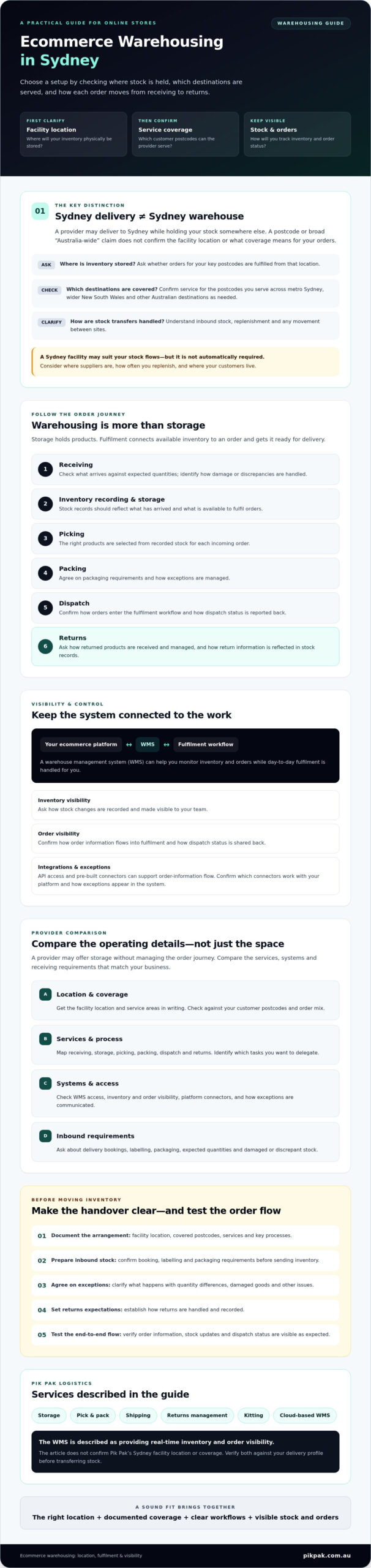
Plan a Smooth Move into Ecommerce Warehousing
A successful warehouse transition starts before stock leaves its current location. For ecommerce warehousing sydney, agree on inventory records, receiving rules, order-system connections and exception processes first. A shared plan helps reduce confusion while stock is being transferred and orders continue to come in.
Prepare inventory and receiving information
Reconcile your inventory records before booking a transfer. Check SKU references, quantities and product identifiers, and note any special handling or packing instructions. Then ask the provider to confirm its requirements for delivery bookings, cartons, labels and accompanying documentation. Requirements vary, so get current instructions directly from the facility that will receive your stock.
Use this preparation sequence:
- Document stock: Check product identifiers and quantities against your records.
- Confirm requirements: Agree on receiving, labelling, packaging, returns and how discrepancies or damaged goods will be reported.
- Plan the transfer: Coordinate the dispatch and arrival of inventory with the provider, taking current stock levels and expected demand into account.
- Test the order flow: Verify the store connection and run sample transactions before relying on the new setup.
- Review results: Compare system records with received stock and check that order updates and exceptions are visible as expected.
Protect order flow during transition
Choose transfer timing with available stock and expected orders in mind. If inventory is moving in stages, clarify which stock remains available to sell and when incoming quantities will appear in the new system. Don’t assume an integration is ready just because it has been connected. Test order syncing, stock updates, fulfilment notifications and exception handling using sample transactions. Then confirm who will investigate issues and how they’ll be communicated.
Before stock moves, confirm the receiving instructions, inventory records, transfer plan, order-system tests, exception process and returns workflow with the provider. Keep the agreed steps in writing so your team knows what to expect from arrival through dispatch and post-purchase handling.
To understand the services that may support your transition, review Pik Pak’s fulfilment services. Confirm facility location, Sydney coverage and specific requirements before making a decision.
Is Pik Pak a Fit for Your Sydney Ecommerce Warehousing Needs?
Pik Pak Logistics may suit online retailers looking to delegate more than storage. Its services include inventory storage, pick and pack, shipping, returns management, kitting and access to a cloud-based warehouse management system (WMS). Together, these cover key parts of the fulfilment workflow. Assess whether they match the tasks your team wants to hand over.
The WMS provides real-time visibility of inventory and order status. API access and pre-built connectors can help move ecommerce order information into fulfilment workflows, but confirm whether a connector supports your specific platform and requirements. Visibility helps you monitor outsourced operations, but you’ll still need to agree on processes, responsibilities and how exceptions are handled.
Important for ecommerce warehousing sydney: the information available doesn’t confirm that Pik Pak operates a Sydney warehouse or specify its Sydney service coverage. Before deciding, ask where your inventory would be stored, which Sydney postcodes can be served, and what delivery options and expectations apply to your orders.
Which retailers may benefit from Pik Pak’s fulfilment model?
Consider Pik Pak if your online store wants support with storage, order picking and packing, shipping, returns or kitting, along with system visibility while daily logistics are delegated. This model may be relevant if fulfilment tasks are taking time away from product and customer priorities. Check that the service scope, connection to your store and delivery coverage suit your business. For common service queries, review the warehouse questions and answers.
What to confirm before requesting a proposal
Prepare a practical overview of your operation so the provider can assess fit. Include typical order patterns, product details, storage needs, returns requirements and the ecommerce connection you need. Then request written confirmation of facility location, Sydney coverage, delivery expectations, receiving requirements and relevant operating processes. Treat each item as unconfirmed until the provider answers it directly.
- Services: Does the scope cover the storage and fulfilment tasks you want to delegate?
- Location and coverage: Where would stock be held, and are your customer postcodes served?
- Technology: Can you access inventory and order status, and is your required connection supported?
- Operations: Are receiving, returns and exception processes clear to both teams?
If the answers align with your needs, discuss your fulfilment requirements with Pik Pak. Confirm the Sydney-specific details before planning a stock move.
Choose a Fulfilment Setup You Can See and Trust
The right ecommerce warehousing sydney setup is about more than finding space nearby. Confirm where your stock will be held, which Sydney destinations the provider serves, and how receiving, dispatch and returns will work for your orders. Clear processes and visibility help you delegate daily fulfilment while staying informed.
Pik Pak Logistics provides ecommerce fulfilment services including storage, pick and pack, shipping, returns and kitting. Its cloud-based WMS offers real-time inventory and order-status visibility, while API access and pre-built connectors can support ecommerce data flows. Check that the available connection fits your specific platform, and confirm Sydney facility location, service coverage and delivery expectations directly before moving stock.
Bring your order patterns, product details and operational requirements to the conversation to make it easier to assess fit and plan a manageable transition. Discuss your ecommerce warehousing requirements with Pik Pak and confirm the Sydney-specific details before planning your stock move.
Frequently Asked Questions
What is ecommerce warehousing?
Ecommerce warehousing combines storing online retail inventory with the processes that prepare and send customer orders. Storage keeps products organised and available. Fulfilment covers tasks such as receiving stock, picking products for orders, packing parcels and dispatching them. Depending on the provider, services may also include returns processing and kitting. Ask which stages are included so you know exactly what your team will still need to manage.
Does an ecommerce warehouse need to be located in Sydney to serve Sydney customers?
No. A provider may fulfil Sydney-bound orders from a facility outside the city, so service coverage and warehouse location are separate questions. For ecommerce warehousing sydney, ask where your inventory will physically be stored and whether the provider serves the postcodes your customers order from. Confirm delivery options and expectations for metro Sydney, wider New South Wales and other destinations relevant to your business.
How do I choose an ecommerce warehouse in Sydney?
Choose a provider whose confirmed services, systems and coverage fit your products and order patterns. Compare facility location, receiving requirements, storage, pick and pack, dispatch, returns handling and support access. Ask how inventory and order status are tracked, how exceptions are communicated, and whether the provider can serve your customer postcodes. Get service areas and operating processes in writing, and separate confirmed capabilities from assumptions.
Can an ecommerce warehouse integrate with my online store?
Some providers connect their warehouse management system (WMS) with ecommerce stores so order information and stock updates can flow between systems. Confirm whether the provider supports your specific platform and how orders, inventory changes, fulfilment status and exceptions appear. Pik Pak Logistics offers a cloud-based WMS with real-time inventory and order-status visibility, plus API access and pre-built connectors. Check directly whether a connector suits your store and requirements.
How much does ecommerce warehousing in Sydney cost?
Costs depend on the services and handling your business needs, so request a tailored written quote rather than relying on a general estimate. Ask the provider to explain how storage, receiving, picking and packing, shipping, returns and additional work are charged. Share your typical order patterns, product details and storage needs, then check what is included, what may incur extra charges and how charges are reported.
How do I move inventory to an ecommerce warehouse without disrupting orders?
Start by reconciling product identifiers and quantities, then confirm the provider’s booking, labelling, carton and documentation requirements. Plan the transfer around available stock and expected orders, and agree when inventory will become available for fulfilment. Before relying on the new setup, test sample transactions to check order syncing, stock updates, fulfilment notifications and exception handling. Review the results and resolve mismatches before treating the transition as complete.
What should I ask a warehouse provider before signing up?
Ask where your stock will be stored, which postcodes are served, and what delivery options and expectations apply. Confirm service scope, receiving requirements, returns processes, WMS visibility, store integrations and how order or stock exceptions are handled. Ask who you can contact for support and request written details of key processes. Share your product, order and storage needs so the provider can clarify whether its setup fits your operation.