
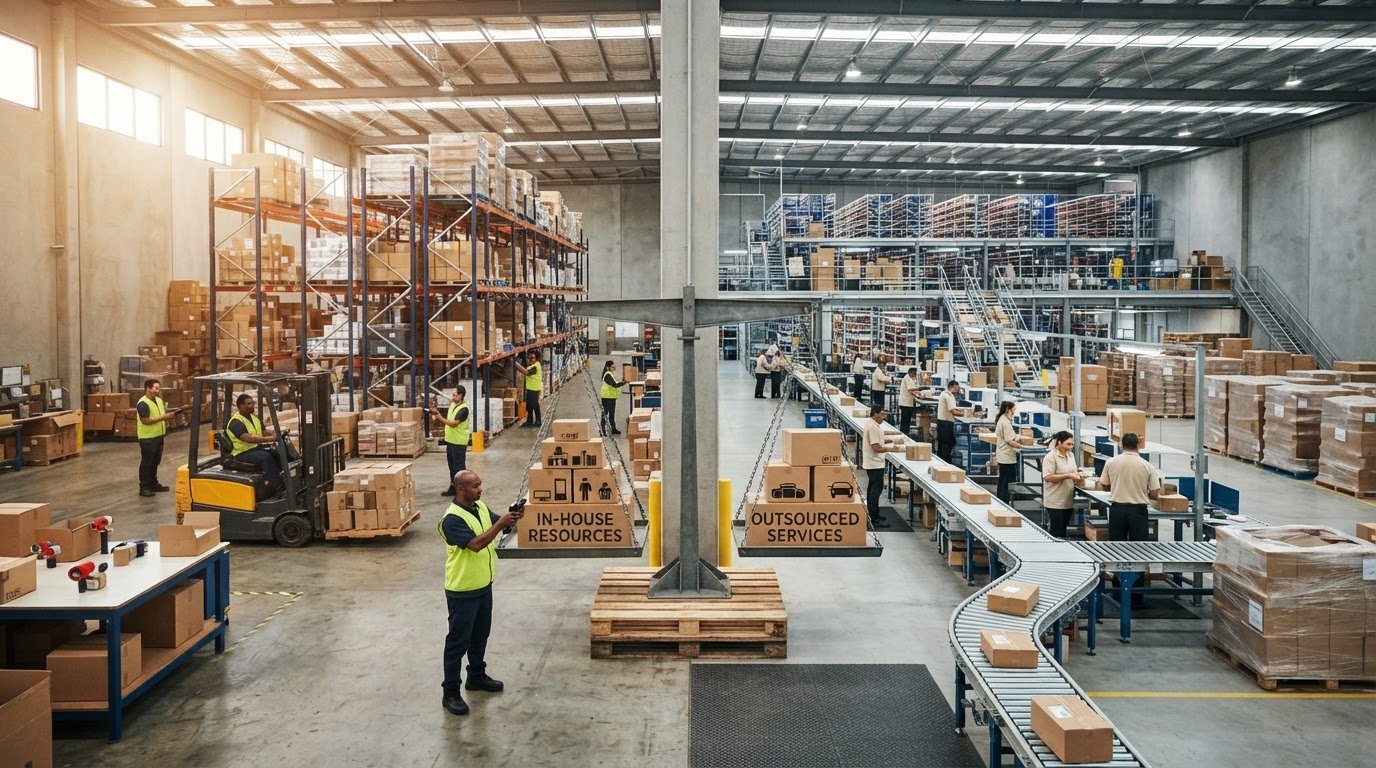
The cheaper-looking fulfilment option can cost more once you count everything. That’s why the in house vs 3pl warehousing cost australia comparison shouldn’t stop at warehouse wages on one side and a 3PL’s pick-and-pack fees on the other.
If you’re weighing the two, it’s reasonable to want a clear answer before committing to ongoing costs. A fair comparison includes in-house labour, space, equipment, systems, insurance and management time, alongside the storage, fulfilment and other charges in a 3PL quote. Fees can vary in what they include, so headline rates alone are difficult to compare.
This article explains how to build a like-for-like cost per order and assess when fixed in-house costs or activity-based 3PL fees may suit your order volume and storage needs. You’ll find the cost categories to include, ways to test how demand changes the result, and the information to gather before requesting itemised quotes. With a consistent comparison, you can make the decision with more confidence and less guesswork.
Key Takeaways
- Compare the full cost of running a warehouse with the services and fees included in a 3PL quote, not just wages and storage.
- Separate employee base pay from employer on-costs, and check which costs apply to your Australian business.
- Use your own order, inventory and staffing data to compare both models over the same period and estimate your break-even point.
- Assess whether in house vs 3pl warehousing cost australia best suits your order patterns, space needs and preferred level of operational control.
- Before choosing a provider, request an itemised quote and confirm how receiving, pick-and-pack, shipping, returns and other services are billed.
Comparing In-House vs 3PL Warehousing Costs in Australia
For an Australian ecommerce business, in-house warehousing means managing stock and customer orders with your own people, space and processes. A third-party logistics provider, or 3PL, stores inventory and handles agreed fulfilment tasks on your behalf. The third-party logistics (3PL) model can include different services, so the label alone doesn’t tell you what a provider’s quote covers.
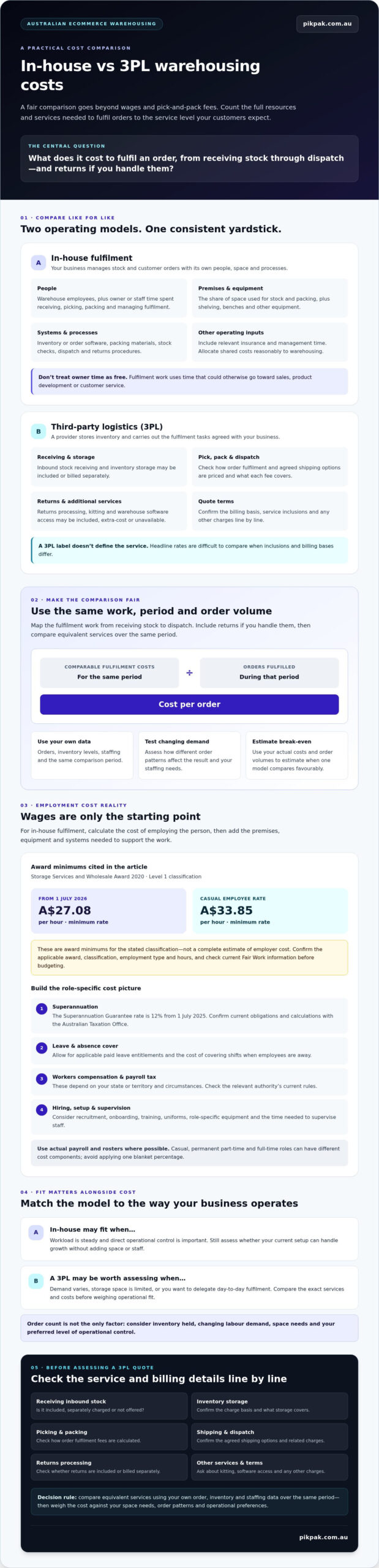
Start by asking the same question of both models: what does it cost to fulfil an order to the service level your customers expect? Map the work from receiving stock through storage, picking, packing and dispatch, then include returns if you handle them. Divide comparable costs by orders fulfilled during the same period. This gives you a more useful comparison than setting wages against a 3PL fee.
What counts as in-house warehousing?
Include the resources your business uses to receive inventory and get orders out the door:
- People: Warehouse employees, plus any owner or other staff time spent receiving stock, picking, packing or managing fulfilment.
- Premises and equipment: The space used for stock and packing, along with shelving, packing benches and other equipment.
- Systems and processes: Inventory or order-management software, packing materials, stock checks and procedures for dispatch and returns.
Some costs, such as premises or software, may support several parts of the business. Allocate the share reasonably used for warehousing rather than assigning the whole expense to fulfilment. Don’t treat unpaid owner time as free, either. Time spent packing orders has an operational cost because it could otherwise go towards sales, product development or customer service.
What does a 3PL warehousing arrangement cover?
A 3PL quote may include receiving inbound stock, inventory storage, order picking and packing, and dispatch using agreed shipping options. Returns processing, kitting and warehouse software access may be included, charged separately or unavailable under a particular arrangement. Confirm the billing basis and service inclusions line by line before comparing quotes. Pik Pak Logistics lists storage, pick, pack and ship services, returns management, kitting and WMS access. Check its current quote and terms for the details that apply to your needs. See the warehousing and fulfilment services page for an overview.
The right in house vs 3pl warehousing cost australia comparison depends on more than monthly order count. Consider how much stock you hold, how labour demand changes, and whether your current setup can handle growth without adding space or staff. A steady workload and a need for direct operational control may support in-house fulfilment. Variable demand, limited storage space or a desire to delegate day-to-day fulfilment may make a 3PL worth assessing. Compare equivalent services first, then weigh cost against operational fit.
Full Cost of Hiring Warehouse Staff in Australia: 2026
A warehouse employee’s hourly wage is only the starting point. For a fair in house vs 3pl warehousing cost australia comparison, calculate the cost of employing the person, then add the premises, equipment and systems needed to support their work.
Which employment costs belong in the calculation?
Start by confirming the applicable Fair Work award, employee classification, employment type and hours. Under the Storage Services and Wholesale Award 2020, the Level 1 minimum rate is A$27.08 per hour from 1 July 2026, or A$33.85 for casual employees. These are award minimums for that classification, not a complete estimate of an employer’s cost. Check current Fair Work information before using a rate in your budget.
Build the on-costs around the actual role and employment arrangement. Consider:
- Superannuation: The Superannuation Guarantee rate is 12% from 1 July 2025. Confirm current obligations and calculations with the Australian Taxation Office.
- Leave and absence cover: Account for applicable paid leave entitlements and the cost of covering shifts when employees are away.
- Workers compensation and payroll tax: These depend on the state or territory and your circumstances. Check the relevant authority’s current rules rather than assuming a single national rate.
- Hiring and setup: Include recruitment, onboarding, training, uniforms and any role-specific equipment. Allow for the time required to supervise and train staff.
Use actual payroll and rosters where possible. A casual role, permanent part-time role and full-time role can have different cost components, so avoid applying one blanket percentage to every worker.
What warehouse costs sit beyond payroll?
Next, include the operating costs required to keep the warehouse functioning. Depending on your setup, these may include rent, utilities, insurance, racking, packing materials, equipment, maintenance and warehouse management software. Include safety-related operating requirements and the time spent managing stock, orders and staff. If equipment is purchased upfront, spread its cost across a reasonable period for your comparison rather than charging the full amount to one month.
Some expenses support more than fulfilment. Allocate a consistent, reasonable share of shared rent, software or management costs to warehouse operations. Don’t assign every company expense to picking and packing, but don’t leave out resources the warehouse genuinely uses.
Cost isn’t the only consideration. The Australian Government Productivity Commission’s report on Australian supply chain vulnerabilities can help frame questions about resilience and operational risk alongside your financial comparison. If you’re assessing outsourced fulfilment, review Pik Pak Logistics’ warehousing and fulfilment services as one option, then confirm inclusions and terms before comparing costs.
How In-House and 3PL Warehousing Fees Compare
Compare the same workload on both sides: order volume, average items per order, stock levels, packaging requirements, delivery options and returns. Match each task to its cost and billing basis. This makes the in house vs 3pl warehousing cost australia comparison more useful than comparing a single in-house expense with a 3PL headline rate.
| Cost category | In-house cost to include | 3PL charge to check | Typical cost behaviour |
|---|---|---|---|
| Labour | Time spent receiving, picking, packing, dispatching and managing orders | Pick-and-pack labour, which may be bundled or charged per order or item | In-house staffing may be fixed or roster-dependent; 3PL charges are often activity-based |
| Storage | Warehouse space and the share used for inventory | Storage charged by the provider’s stated measure, such as space or stock location | In-house premises can be ongoing; 3PL storage may vary with inventory held |
| Receiving | Staff time and equipment used to check and put away stock | Inbound receiving, unloading or stock-entry charges | Usually linked to deliveries, units, handling time or an agreed fee |
| Pick-and-pack | Labour and process costs for each order | Order picking and packing fees, including any additional-item charges | Often varies with order and item count |
| Packing | Cartons, mailers, protective materials and packing equipment | Packaging materials or special packing fees, if charged separately | Usage-based; confirm what materials, if any, are included |
| Shipping | Carrier charges and time spent preparing dispatch | Delivery charges and any handling fees within the quoted scope | Depends on parcels, destinations, service and the provider’s billing terms |
| Returns | Staff time to receive, inspect and process returned items | Returns processing fees, if offered and included in the quote | Usually driven by return activity; confirm the exact task covered |
Which 3PL charges should you check?
Ask for an itemised quote that states whether receiving, storage, pick-and-pack, packaging, dispatch and returns are charged separately. Check for account minimums, setup charges, peak-period rules and extra fees for services outside the standard workflow. Compare shipping terms separately: confirm which delivery options and handling tasks are included, and which charges sit outside the quoted scope. If a fee is based on units, orders or storage space, ask how that measure is recorded so you can compare it with your own data.
How do fixed and variable costs change the comparison?
In-house rent and staffing can continue through quieter periods, while a 3PL’s activity-based charges may rise or fall with orders, inbound deliveries and stock levels. But variable pricing doesn’t guarantee a lower total, and fixed costs don’t automatically make in-house fulfilment more expensive. Confirm each provider’s actual billing basis, then model both options using the same busy and quiet periods, service requirements and inventory profile.
How to Calculate Your Australian Warehouse Break-Even Point
Use your own operating data to find the order volume where in-house fulfilment and a 3PL cost the same. Keep the period and service requirements consistent. This turns the in house vs 3pl warehousing cost australia decision into a practical comparison rather than a guess based on headline rates.
What data should you collect before calculating?
Gather records for a recent representative period, then request an itemised 3PL quote using the same workload and requirements. Include monthly dispatched orders, order lines, stock levels, storage footprint, inbound deliveries and returns. Record staff hours and fully loaded labour costs, plus attributable premises expenses, packing materials, equipment and systems. For inbound stock details, use Pik Pak’s warehouse receiving guidelines as a reference when preparing information to share.
How can you calculate and interpret the result?
Work through these steps for both models:
- 1. Set the comparison period. Use the same month or other period for your in-house records and the 3PL quote.
- 2. Total in-house fulfilment costs. Add attributable labour, premises, equipment, systems, packaging and other operating costs for that period.
- 3. Total the 3PL charges. Include the quoted services and any applicable minimums, setup costs or other fees for the same period. Keep shipping treatment consistent on both sides.
- 4. Calculate cost per order. Divide each model’s comparable total by the number of orders dispatched in that period. Note any costs or services excluded from either total.
- 5. Test different volumes. Repeat the calculation using low, typical and peak order volumes, adjusting storage, staffing and other activity-based assumptions to match each scenario.
The break-even volume is the point where the estimated total costs for the two models are equal. Compare cost per order as well as total spend, service requirements, available capacity and the management time each option demands. The result can change if a seasonal peak requires extra staff, inventory growth needs more space, or order patterns shift.
Be explicit about assumptions, such as which shared expenses you allocated, how you treated owner time and what the 3PL quote includes. The calculation is a decision aid, not a promise of future savings. Revisit it when your order profile or storage needs change. To compare your requirements with outsourced fulfilment, explore Pik Pak’s warehousing and fulfilment services.
Choose the Right Warehousing Model and Assess a 3PL Quote
The best option is the one that fits your workload, stock profile and service requirements, not simply the one with the lower headline cost. Use your cost comparison as a starting point, then check how each model supports control, capacity and business continuity.
When might in-house fulfilment remain the better fit?
In-house operations may suit a business with a steady workload, staff and facilities with genuine spare capacity, or processes that need close day-to-day control. Specialised handling can also favour keeping fulfilment in-house if an external provider can’t meet the required process. Include the time spent managing the operation, and consider how orders would be handled if a key employee or facility became unavailable.
When should you assess a 3PL like Pik Pak?
A 3PL may be worth assessing if order patterns change, space is constrained, or storage, dispatch and returns are taking time away from core growth work. Compare the provider’s actual service scope with the tasks your team handles now. Check whether its WMS visibility and ecommerce integrations suit your systems and reporting needs, rather than assuming every provider offers the same capabilities.
Before accepting a quote, ask clear questions about the working relationship:
- Service scope: Which receiving, storage, pick-and-pack, shipping, returns or kitting tasks are included, and which are charged separately?
- Inventory visibility: What stock and order information can you access, how often is it updated, and how are discrepancies handled?
- Integrations: Does the WMS connect with the ecommerce and order systems you use, and are there setup or ongoing requirements to confirm?
- Support and exceptions: Who do you contact about delays, errors or unexpected order volumes, and what process applies?
- Contract terms: What minimums, price review terms, notice periods, exit steps and stock-transfer responsibilities apply?
Compare the answers with your cost model, including busy and quieter periods. A quote is only like-for-like if its assumptions about order volume, inventory, packaging and service levels match yours. Pik Pak Logistics provides warehousing and fulfilment services including inventory storage, pick, pack and ship, returns management, kitting and WMS access. Review the warehousing questions resource as you assess fit, then compare Pik Pak’s warehousing and fulfilment services with your requirements.
A considered in house vs 3pl warehousing cost australia decision balances cost with capacity, control and the time your team can put back into growing the business.
Make Your Next Fulfilment Decision with Confidence
A useful in house vs 3pl warehousing cost australia comparison looks beyond wages and headline fees. Include the full cost of staff, space, equipment and systems, then compare it with an itemised 3PL quote covering the same order volume, inventory profile and service requirements.
Use your own recent operating data to estimate cost per order and test quieter, typical and peak periods. The result can show where each model may fit, but cost isn’t the only factor. Consider how much control you need, whether your current team and facility can handle demand, and how much time fulfilment takes away from other priorities.
Pik Pak Logistics provides Australian ecommerce warehousing and fulfilment, including inventory storage, pick-and-pack and returns processing. Its cloud-based WMS provides real-time inventory and order-status visibility. Check the service scope and quote details against your actual needs before deciding.
Compare your fulfilment needs with Pik Pak Logistics and take the next step with a clearer view of your options.
Frequently Asked Questions
Is a 3PL warehouse cheaper than hiring warehouse staff in Australia?
Not automatically. A 3PL may reduce the need for dedicated premises, staff and warehouse systems, but its charges depend on the services used and how they’re billed. In-house costs can include wages, employment on-costs, space, equipment and management time. For a fair in house vs 3pl warehousing cost australia comparison, match order volume, storage needs and service requirements, then compare total costs over the same period.
How much does it cost to hire a warehouse employee in Australia in 2026?
It depends on the role, award classification, employment type, hours and applicable on-costs. As a reference point, the Level 1 minimum rate under the Storage Services and Wholesale Award 2020 is A$27.08 per hour from 1 July 2026, or A$33.85 for casual employees. These aren’t full employer costs. Check current Fair Work information and include superannuation, leave and other applicable costs.
What costs should I include when comparing in-house warehousing with a 3PL?
For in-house operations, include attributable wages and employment on-costs, premises, utilities, insurance, equipment, racking, packaging, systems and management time. For a 3PL, check charges for receiving, storage, pick-and-pack, packaging, dispatch, returns and software access. Also account for any minimums, setup charges or extra services. Allocate shared business expenses consistently, and compare costs for equivalent order volumes, inventory levels and service requirements.
Can a small ecommerce business save money by outsourcing fulfilment?
It can, but savings depend on the business’s current workload and the 3PL’s quote. Outsourcing may help avoid taking on more warehouse space or staff, and can free owners to focus on other work. However, minimum monthly charges, setup costs or services billed separately may affect the total. Compare an itemised quote with your actual fulfilment expenses, including the time you and your team spend handling orders.
How do I calculate the break-even point between in-house fulfilment and a 3PL?
Total comparable costs for each model over the same period, then divide each total by the number of orders dispatched to estimate cost per order. For a break-even point, model how each total changes at different order volumes until the costs are equal. Use your own staffing, storage, inbound, order and returns data. Test low, typical and peak periods, and record assumptions or excluded costs so the result is clear.
What fees should I check in an Australian 3PL warehousing quote?
Ask whether receiving, storage, pick-and-pack, packaging, dispatch, shipping, returns and WMS access are included or charged separately. Check how each fee is calculated, such as by order, item, storage footprint or inbound delivery. Also ask about minimum monthly spend, setup or integration charges, peak-period rules and additional service fees. Confirm shipping terms and contract conditions, then compare the quote with your own operating requirements.
When does it make sense to move from in-house warehousing to a 3PL?
Consider assessing a 3PL if changing order volumes strain your staff, storage space is limited, or fulfilment takes time away from core business work. Compare the provider’s service scope, systems and terms with your needs, including inventory visibility, integrations, returns handling and capacity during busier periods. Pik Pak Logistics provides ecommerce warehousing and fulfilment, including storage, pick-and-pack and returns processing, with a cloud-based WMS for real-time inventory and order-status visibility.