

If the question is “getting my finance team to approve a 3pl,” start with more than the proposed fulfilment fee. Your current costs may be spread across labour, warehouse space, systems, shipping and management time, which can make a fair comparison difficult.
Finance is right to question whether outsourcing adds cost. A forecast built on uncertain order growth or transition effort won’t settle the issue. Compare like with like: map the full cost of your current fulfilment model against the proposed service scope, then show the assumptions and risks behind each option.
This guide explains how to build an evidence-led business case, define measures finance can monitor, and agree on diligence and implementation checks before making a decision. It also shows how storage, pick, pack and ship, returns management and WMS visibility can fit into the comparison. The goal is a measured decision that helps your team understand the trade-offs and decide whether a 3PL is the right next step.
Key Takeaways
- Frame the proposal as a choice between operating models. Explain what change in growth, service needs or capacity makes a review timely.
- Use consistent assumptions for order volume, time period and fulfilment scope so finance can compare the options fairly.
- Pair each concern with evidence to request, a responsible owner and a measure to review.
- Build the proposal around a clear decision path, from baseline and requirements through diligence and recommendation.
- Before transition, confirm responsibilities, system connections and commercial terms. Then prepare a launch checklist for key fulfilment workflows.
How to frame the 3PL decision as a finance question
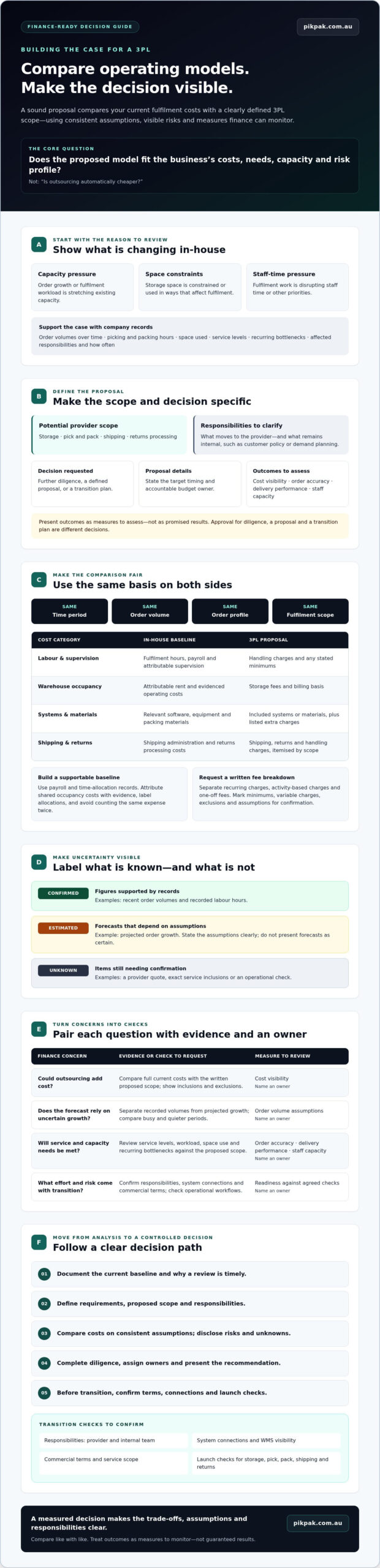
A 3PL proposal can look like a new supplier expense if finance sees only the quoted fees. Frame it as a comparison between two operating models: fulfilment managed internally, or defined activities handled by an external provider. The question is whether the proposed model fits the business’s needs, costs, capacity and risk profile, not whether outsourcing is automatically cheaper.
A 3PL business case is an evidence-led comparison of current and proposed fulfilment models, showing the scope, assumptions, costs, risks and measures finance needs to assess a decision. Separate confirmed figures, such as recent order volumes or recorded labour hours, from estimates, such as projected growth, and unknowns that still need a quote or operational check.
A review may be timely if order growth is stretching existing capacity, storage space is constrained, or labour pressures are disrupting fulfilment. Use company records to show the pattern: order volumes over time, hours spent picking and packing, space used, service levels and recurring bottlenecks. If fulfilment work is taking staff away from other priorities, specify which responsibilities are affected and how often. Label forecast assumptions clearly rather than presenting them as certain.
What finance needs to approve when you propose a 3PL
State the decision requested, proposed scope, target timing and accountable budget owner. Specify what may move to the provider, such as storage, pick, pack, shipping or returns processing, and what will remain internal, such as customer policy or demand planning. Define the outcomes you plan to assess, including cost visibility, order accuracy, delivery performance and staff capacity. Present these as measures, not promised results.
Be clear about the approval stage. Finance may be asked to approve further diligence, a defined proposal or a transition plan. These are different decisions with different commitments. The request is easier to assess when it is specific and its assumptions are visible.
When outsourcing fulfilment is worth evaluating
Review the option when internal data points to persistent space or capacity limits, a rising fulfilment workload, or pressure on staff time. Compare busy and quieter periods, and note where estimates depend on future order growth. A 3PL may cover inventory storage, pick and pack, shipping and returns, but confirm the exact scope and responsibilities in a written proposal.
For a foundational overview of third-party logistics (3PL), explain to finance that providers can handle defined logistics activities while the business retains other responsibilities. Then connect that general idea to your proposed scope instead of treating outsourcing as an all-or-nothing change.
Build a like-for-like in-house versus 3PL cost comparison
Give finance a comparison it can check, not two totals built on different assumptions. Use the same period, order volume, order profile and service scope on both sides. If the proposed model includes storage, pick and pack, shipping and returns, don’t compare it only with current picking and packing labour. Review Pik Pak’s warehousing and fulfilment services to help define the scope you want priced, then confirm the specific inclusions in writing.
| Cost category | In-house baseline | 3PL proposal |
|---|---|---|
| Labour and supervision | Fulfilment hours, payroll and attributable supervision | Handling charges and any stated minimums |
| Warehouse occupancy | Attributable rent and evidenced operating costs | Storage fees and billing basis |
| Systems and materials | Relevant software, equipment and packing materials | Included systems or materials, plus listed extra charges |
| Shipping and returns | Shipping administration and returns processing costs | Shipping, returns and handling charges, itemised by scope |
Which in-house costs belong in the baseline?
Use payroll and time-allocation records for picking, packing, dispatch and supervision. Include occupancy costs only when you can reasonably attribute them to fulfilment and support the allocation with records. Add relevant systems, packaging, returns and management effort, but don’t count the same labour or expense in multiple categories. Label shared costs and explain how you allocated them.
How to model variable 3PL fees and assumptions
Ask for a written fee breakdown covering storage, handling, shipping, returns and any additional services in scope. Separate recurring charges, activity-based charges and one-off fees. Mark minimums, variable charges, exclusions and assumptions for confirmation rather than filling gaps with estimates. Check the proposed service and any technology or order-flow requirements before treating a fee as confirmed.
Use your own forecasts to model lower, expected and higher order volumes. Show total costs for each scenario, then calculate cost per order using the same cost categories on both sides. State what’s excluded, such as transition effort or internal work that will remain, so the metric doesn’t suggest a complete saving when the comparison is partial. A transparent comparison makes the decision easier to assess, even if a 3PL does not cost less in every scenario.
If finance also wants to assess supply-chain security, the U.S. Customs and Border Protection page on the CTPAT programme explains the programme. Treat it as background for questions to ask, not evidence that an Australian provider participates or that the programme applies to your operation.
Answer finance’s main 3PL concerns with evidence and controls
Finance needs evidence relevant to your operation, a named person responsible for checking it, and a measure to review after launch. Treat software features and service descriptions as capabilities to verify, not proof of a particular outcome. This turns the proposal into a practical risk assessment rather than a bet on promises.
Use a simple register to connect each concern with a check and an owner:
- Control and inventory accuracy: Request an explanation of how receipts, stock movements, adjustments and counts are recorded. Assign your inventory lead to agree how discrepancies will be investigated and tracked.
- Customer delivery and returns: Confirm which delivery and returns activities are included, how exceptions are reported, and which responsibilities stay with your team. Have the ecommerce or customer operations lead define the service measures and reporting period.
- Provider dependency: Document what data, processes and decisions rely on the provider, who owns the relationship internally, and what steps your business would take if service is disrupted or the arrangement changes.
- Transition risk: Identify dependencies such as inventory data, order flows and receiving procedures. Assign owners and agree on contingency steps before setting a launch plan.
How to assess inventory, service and transition risks
Ask how inventory movements, order status, exceptions and returns will be visible to your team. A WMS can provide inventory and order-status visibility, but that feature alone doesn’t establish inventory accuracy or delivery performance. Define the measure, data source, reporting frequency and accountable reviewer before comparing proposals. For example, agree what counts as an order exception and how it will be recorded.
Write down transition dependencies and internal owners, then review unresolved items before approval. This makes responsibilities clear and gives finance a way to monitor risk instead of relying on general assurances.
How to check integration and operational fit
Confirm the ecommerce platform, order and inventory data flows, connector or API requirements, and technical responsibilities in scope. Ask who handles setup, access, reporting and operational support, and what happens when data doesn’t transfer as expected. Pik Pak’s technology support information can help frame questions about WMS visibility and integration. Confirm the specific connector and requirements for your platform directly.
Before selecting a provider, prepare questions about scope, exceptions, reporting and ownership. Record the answers, evidence requested and any open items so finance can see what’s confirmed and what still needs diligence.
Prepare a finance-ready 3PL proposal with a clear decision path
A strong approval memo makes the decision easy to follow and challenge. Set out the case in order: current baseline, business requirements, like-for-like comparison, provider diligence, recommendation, then the specific approval requested. Link the fulfilment activities under review to relevant 3PL services, such as storage, pick and pack, shipping and returns, and confirm the proposed scope in writing.
Include order-volume assumptions, cost categories, risks, accountable owners and open questions. A quote is only useful when finance can see what it covers and what remains internal. If the request is to proceed to diligence rather than approve a transition, say so. Clear decision boundaries make approval a staged process instead of an all-or-nothing request.
What to include in the approval memo
Summarise the operational issue and why the current model needs review, using company data rather than general claims. Attach the cost comparison, provider proposal, scope assumptions and risk register. Identify unresolved questions, name the budget owner and operational stakeholders, and set a proposed review date so the case has a clear next checkpoint.
Show how order growth or service needs could change the comparison. Use your business’s forecasts rather than unsupported industry averages:
| Scenario | Assumption to test | What finance should review |
|---|---|---|
| Lower volume | Orders below the expected forecast | Minimums, fixed charges and cost per order |
| Expected volume | Your current planning forecast | Quoted fees and included service scope |
| Higher volume or service need | More orders or added requirements | Variable charges, capacity assumptions and exclusions |
These scenarios aren’t predictions. They show which assumptions matter and where the operating model may respond differently as demand changes.
How to make the recommendation auditable
Keep source data, quote details, calculation logic and assumptions with the memo. Label each figure as an actual, forecast or provider-confirmed charge, and note its source and date. This lets finance trace totals back to evidence instead of relying on an unexplained summary.
Before final approval, ask finance to review the sensitivity assumptions, including order volumes, service scope and charges that still need confirmation. Record the agreed measures and owners for later review. For a specific proposal based on your fulfilment requirements, see how to discuss ecommerce fulfilment needs with Pik Pak.
Move from 3PL approval to a controlled fulfilment transition
Approval is the start of the handover, not the finish line. Before inventory or orders move, confirm the final service scope, responsibilities, integration requirements and commercial terms in writing. Check that the agreed proposal matches the assumptions finance approved, including what the provider will handle and what your team will retain.
A practical launch checklist helps keep the work visible and owned:
- Inventory data: Confirm product records, stock quantities and any required identifiers are accurate and ready to share.
- Receiving: Agree how stock must be prepared, documented and sent. Review Pik Pak’s warehouse receiving guidelines for preparation details, then confirm requirements for your specific inbound stock.
- Order flows: Verify the ecommerce platform, connector or API requirements, order information passed between systems and who checks that the flow works as intended.
- Returns and exceptions: Define how returns, stock discrepancies and order issues are recorded, escalated and resolved, including which team owns each step.
Assign a named owner for integration, stock reconciliation and operational escalation. Before the first orders move, agree on the reporting cadence, data sources and review measures, such as inventory discrepancies, order exceptions and actual fulfilment costs against approved assumptions. These are measures to monitor, not outcomes to assume.
What to confirm before fulfilment goes live
Use a readiness review to check that required inventory information is complete, receiving steps are understood, and the people responsible have discussed order and returns workflows. Confirm applicable onboarding requirements and service responsibilities with the provider. If a system connection or process remains untested or unclear, record the issue, owner and next step before treating the transition plan as ready.
How to review the 3PL decision after launch
After operations begin, compare actual charges and agreed service measures with the approved case. Review exceptions, inventory visibility, returns and order-flow issues with the teams who own those processes. Separate one-off transition issues from recurring patterns, and document the evidence behind any proposed change.
Use these findings to decide whether the service scope, internal responsibilities or volume forecasts need adjustment. Evaluate the 3PL against documented requirements, not assumed savings or performance claims. Close the loop with a defined review owner and a clear record of what the results show.
Share your order profile, fulfilment requirements and expected service scope with Pik Pak Logistics to discuss whether its storage, pick and pack, shipping, returns management or WMS access fits your needs, and request a proposal based on those requirements.
Make the next fulfilment decision with confidence
A credible 3PL case isn’t built on a promise of savings. It gives finance a fair comparison of current and proposed fulfilment costs, makes assumptions and risks visible, and sets clear measures for reviewing the decision. Evidence first, followed by a controlled transition plan, is a stronger basis for approval.
Match the proposed service scope to your actual needs, confirm commercial and integration details, and assign owners to monitor costs, inventory visibility, order status and exceptions after launch. Pik Pak Logistics provides ecommerce fulfilment covering warehousing, pick and pack, shipping and returns processing. Its cloud-based WMS provides real-time inventory and order-status visibility. Confirm its fit for your proposed setup.
To assess your options, discuss your fulfilment requirements with Pik Pak Logistics and request a proposal based on your business profile. Bring your order profile, required services and questions about fees and integration so the proposed scope can be assessed against your needs.
Frequently Asked Questions
How do I convince my finance team to approve a 3PL?
Present a fair comparison of your current and proposed fulfilment models, backed by company data and a written provider proposal. Explain the business need, costs, service scope, assumptions, risks and measures finance can review. Be clear about the decision you’re requesting, such as permission to continue due diligence or approval to plan a controlled transition.
What costs should I include when comparing a 3PL with in-house fulfilment?
Include comparable costs for labour, supervision, warehouse occupancy, systems, packing materials, shipping administration and returns. On the 3PL side, request written details for storage, handling, shipping, returns and any additional services in scope. Check which charges are recurring, activity-based or one-off, and note minimums, exclusions and assumptions. Include only in-house costs you can evidence and reasonably attribute to fulfilment.
How do you calculate the cost per order for a 3PL?
Divide the total 3PL charges included in your comparison by the number of fulfilled orders in the same period. If your chosen scope includes storage, handling, shipping and returns, use the relevant charges and state what’s included. Compare the result with an in-house cost per order calculated using equivalent services, time period and order volume. Label excluded costs so the metric isn’t misleading.
Can a 3PL cost more than managing fulfilment in-house?
Yes. A 3PL may cost more under some assumptions, order volumes or service requirements. Compare the full cost of each model rather than assuming outsourcing will reduce spending. Consider whether the proposed scope includes activities your business currently pays for separately, and assess operational capacity and service needs alongside cost. If the numbers don’t support a move, the comparison can still show what would need to change.
What information does finance need before approving a 3PL?
Finance needs the current cost baseline, proposed service scope, order-volume assumptions, written fee breakdown, risk controls and the decision being requested. Provide source data and identify which figures are actuals, forecasts or provider-confirmed charges. Include internal responsibilities, unresolved questions and the measures you’ll monitor. Confirm applicable fees, onboarding needs and operational assumptions with the provider before asking finance to approve a transition.
How can I reduce the risk of moving fulfilment to a 3PL?
Reduce transition risk by agreeing on responsibilities, system requirements, receiving processes and escalation steps before inventory or orders move. Confirm how stock information, order status, returns and exceptions will be recorded and reviewed. Assign internal owners for integration, reconciliation and provider communication, and document contingency steps for unresolved issues. A launch checklist helps teams verify key dependencies rather than relying on general assurances.
What should I measure after outsourcing fulfilment to a 3PL?
Compare actual charges with the approved cost assumptions, and review agreed measures for order exceptions, inventory discrepancies, order status and returns. Define each measure, its data source, reporting cadence and responsible reviewer before launch so results are consistent. Discuss findings with the teams who own fulfilment and customer operations. Use the evidence to identify recurring issues and decide whether forecasts, responsibilities or service scope need adjustment.