
Last peak season, one Melbourne retailer watched A$12,000 in potential revenue vanish because their 3PL transition caused a three-week stockout they never saw coming. It’s a nightmare scenario that keeps many Australian business owners awake at night. You likely agree that while your current setup is flawed, the thought of migrating to a new fulfillment partner feels like an invitation for tech failures and expensive double-handling fees. You shouldn’t have to choose between stagnant growth and operational chaos.
This guide changes that. We’ll show you how to execute a seamless transition that protects your bottom line and keeps your orders flowing without a single day of downtime. We’ve simplified the complex move into a pragmatic 2026 roadmap. You’ll learn how to sync your systems effortlessly, maintain real-time visibility, and finally reclaim your time to focus on your business. Let’s turn what seems like a logistical headache into an easy win that makes your operations run like clockwork.
Key Takeaways
- Identify the hidden costs of a substandard 3PL and recognize the “scalability ceiling” signs that indicate it is time to move.
- Master a tech-first vetting process that prioritizes WMS compatibility and optimized carrier networks for efficient Australian home delivery.
- Discover why migrating to a new fulfillment partner using a parallel operations model is the safest way to eliminate downtime and protect your sales.
- Follow a proven 30-day roadmap to manage everything from API integrations to physical stock transfers without the usual logistics headaches.
- Learn how Pik Pak’s “Pay as you go” model allows you to scale effortlessly while reclaiming your time to focus on growing your business.
Recognizing the Breaking Point: Why Businesses Migrate Fulfillment Partners
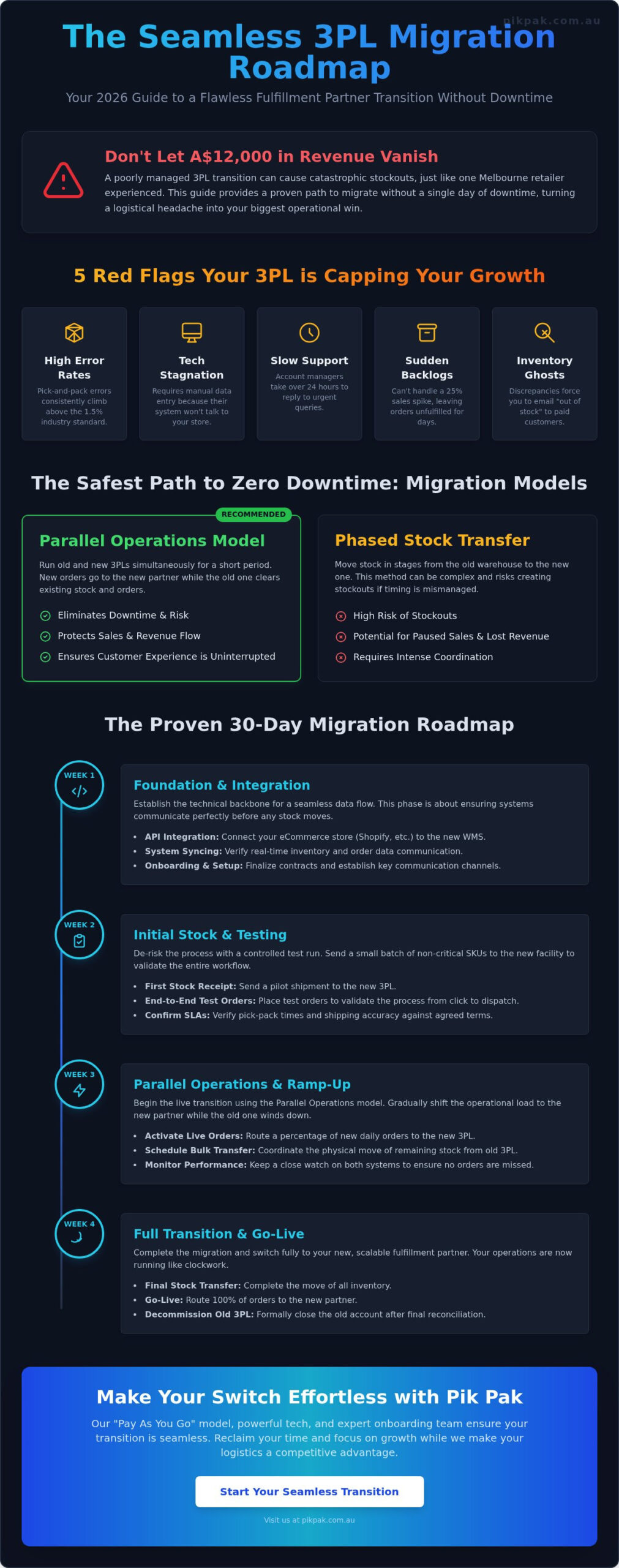
Your business deserves to run without constant friction. Many Australian eCommerce brands reach a point where their current logistics setup stops being an asset and starts being a bottleneck. Sticking with a substandard provider often feels safer than the alternative, but the hidden costs are draining your growth. When you consider migrating to a new fulfillment partner, you aren’t just moving boxes; you’re removing the “Scalability Ceiling” that limits your brand’s potential. If your provider can’t handle a 25% increase in order volume during a flash sale, they are actively capping your revenue.
Technological stagnation is a massive dealbreaker as we move through 2026. If your provider lacks a modern Third-party logistics platform with real-time API hooks, you’re operating in the dark. You can’t manage inventory you can’t see, and you can’t promise delivery dates you can’t guarantee. This lack of transparency directly tarnishes your brand reputation. Every shipping error is a lost customer who will likely never return. It’s time to stop settling for “good enough” when your competitors are moving faster and more accurately.
The 5 Red Flags of a Failing 3PL Relationship
- Pick-and-pack error rates that consistently climb above 1.5% per month.
- Manual data entry requirements because their system won’t talk to your eCommerce platform.
- Account managers who take over 24 hours to reply to urgent shipping queries.
- Sudden “backlogs” during sales events that leave orders unfulfilled for days.
- Inventory discrepancies that result in “out of stock” emails to customers who have already paid.
Calculating the Real Cost of Inefficiency
Inefficiency costs more than just a warehouse fee. You have to factor in the lost Customer Lifetime Value (LTV). Recent industry data suggests that 84% of consumers will abandon a brand after a single bad shipping experience. If you lose a customer with an LTV of A$450 due to a late package, that’s a direct hit to your future profit. Add in the 10 to 15 hours your internal team spends every week managing 3PL “headaches” and the drain becomes obvious. Switching to professional warehousing and fulfilment services allows you to reclaim that time and focus on your business. Let Pik Pak do the hard work for you so your operations run like clockwork.
The Tech-First Vetting Process: Choosing a Partner That Scales
Migrating to a new fulfillment partner in 2026 isn’t just about finding a bigger warehouse; it’s about finding a tech stack that speaks the same language as your business. Your Warehouse Management System (WMS) is the brain of your entire operation. If that brain can’t communicate with your sales channels in real-time, you’re going to face data silos and shipping delays. Compatibility is the most critical factor for a successful move. You need a partner that offers “Point, Click, and Connect” simplicity. This eliminates the need for expensive developers or “computer geeks” to get your systems talking. It’s about making the complex feel like an easy game.
Beyond the software, evaluate the carrier networks. In the Australian market, shipping costs can fluctuate wildly based on your partner’s volume discounts and hub locations. A partner with a robust network of home delivery options ensures your customers get their parcels quickly, whether they are in Sydney or regional WA. Physical infrastructure still matters too. Check for 24/7 security, specialized kitting capabilities for promotional bundles, and a strategic location that minimizes the “last mile” distance. This distance can account for up to 41% of total supply chain costs according to 2025 logistics reports.
Integrating Your eCommerce Storefront
Your 3PL should act as an extension of your Shopify, WooCommerce, or Magento store. When migrating to a new fulfillment partner, ensure the integration is deep rather than superficial. You need a seamless flow where orders drop into the warehouse the moment a customer clicks “buy.” Real-time inventory visibility is your best defense against the dreaded “out of stock” email. When your warehouse and storefront are perfectly synced, you eliminate waste and prevent overselling. You can learn more about our technology support to see how we make these connections effortless.
Service Levels and Performance Benchmarks
Don’t settle for vague promises. Demand clear Service Level Agreements (SLAs) that define exactly what “success” looks like. In 2026, a 99.9% pick accuracy and same-day dispatch for orders received before 2:00 PM are the benchmarks for high-growth brands. You also need to understand their approach to reverse logistics. Returns shouldn’t be a headache; they should be a streamlined process that gets stock back on the shelf fast. Transparency in pricing is non-negotiable. Every fee should be clearly stated in A$ so you can protect your margins and focus on your business. If you want your operations to run like clockwork, it starts with choosing a partner that values transparency as much as you do. Let Pik Pak manage your service priorities so you can get back to growing your brand.
Strategic Migration Models: Parallel Operations vs. Phased Stock Transfers
Choosing the right model for migrating to a new fulfillment partner determines whether your transition is a smooth evolution or a logistical headache. The “Big Bang” approach involves moving every SKU over a single weekend. It’s fast, but for 85% of Australian eCommerce businesses, the risk of technical glitches or shipping delays is too high. If your systems aren’t perfectly aligned, you risk “dark days” where no orders go out. Most successful brands prefer a controlled, phased transition to keep customers happy.
Inventory phasing is a smarter way to test the waters. Start by moving slow-moving SKUs or seasonal items first. This allows you to stress-test the new provider’s systems without risking your bestsellers. While this happens, start redirecting all new purchase orders from your manufacturers to the new facility. This prevents double-handling costs, which can save your business up to A$15 per pallet in unnecessary transport and cross-docking fees.
The Parallel Operations Strategy
Running two 3PLs simultaneously is the safest way to eliminate downtime. You can split your order flow by region. For example, ship East Coast orders from a new Sydney hub while your old provider clears remaining stock in Melbourne. Managing data sync is the priority here. You need a robust WMS connection to ensure your Shopify or BigCommerce store doesn’t oversell stock that exists in one warehouse but not the other. Pull the plug on the old provider once their inventory levels hit a “long tail” phase. This is usually when less than 5% of your total stock volume remains.
Inventory Receiving and Quality Control
Your first inbound shipment is a litmus test for the new partnership. To ensure a fast turnaround and avoid backlogs, you must adhere strictly to the warehouse receiving guidelines. This includes precise labelling and providing advanced shipping notices (ASNs) for every delivery. Conduct a full stocktake during the transfer to reset your data baseline. Industry data from 2024 shows that 12% of migration errors stem from carrying over incorrect inventory counts from old, messy systems. Use this move to clean your data and ensure your operations run like clockwork from day one. Let Pik Pak handle the heavy lifting so you can focus on your business growth.
The 30-Day Migration Roadmap: A Step-by-Step Execution Plan
Moving your operations shouldn’t feel like a gamble. A structured 30-day timeline ensures your business stays online while your inventory moves behind the scenes. When migrating to a new fulfillment partner, the goal is zero downtime and 100% data integrity. By breaking the process into three distinct phases, we eliminate the “headache” and replace it with a predictable, manageable workflow.
Week 1-2: Data and Communication
Phase 1 (Days 1-10) focuses on the digital foundation and planning. We establish the API handshake between your sales channels and our warehouse management system. This isn’t a complex coding project; it’s a “point, click, and connect” process designed to automate your order flow immediately. You’ll spend this time syncing SKUs and ensuring every product description matches your physical stock. It’s also the perfect moment to notify your customers about the upcoming “logistics upgrade.” Frame the move as a benefit that will lead to faster shipping and better tracking. If you’re looking for a partner that handles the heavy lifting, explore our warehousing and fulfilment services to see how we simplify this transition.
Week 3-4: The Physical Move and Go-Live
Phase 2 (Days 11-20) involves the physical inventory transfer. Coordinating transport between warehouses, especially across major Australian hubs like Melbourne and Sydney, requires strict timing. We manage the receiving process to ensure every pallet is counted and logged against your manifest. Phase 3 (Days 21-30) is about live testing and customer notification. Once the stock is live, we monitor the first 100 orders with extra scrutiny. We look for pick accuracy, speed, and how well the kitting holds up during transit. This “soft launch” allows us to refine your packaging and kitting processes with the warehouse team before you hit full scale. It ensures that when your marketing team turns up the heat, the logistics engine is already running like clockwork.
The final step is the Post-Migration Audit. We measure success against your old benchmarks to prove the value of migrating to a new fulfillment partner. We focus on three key areas:
- Order Accuracy: Did we hit the 99.9% target on the first 500 shipments?
- Dispatch Speed: Are orders leaving the warehouse within the agreed 24-hour window?
- Cost Efficiency: Are you seeing the expected savings in freight and storage fees compared to your previous provider?
By comparing these results to your previous 3PL performance, you can clearly see the impact on your bottom line. We don’t just move boxes; we optimize your entire supply chain to ensure your business is ready to grow.
Ready to reclaim your time and scale your brand without the logistical headache? Get started with Pik Pak today and let us do the hard work for you.
Making the Switch Effortless with Pik Pak Logistics
Migrating to a new fulfillment partner shouldn’t feel like a high-stakes gamble for your business. At Pik Pak, we’ve refined our onboarding process to eliminate the “headache” typically associated with shifting stock and data. We treat logistics as an easy game, taking the heavy lifting off your plate so you can focus on your business goals. Our team handles the transition logistics, ensuring your inventory moves from point A to point B without a single missed order.
Our “Pay as you go” model is designed for the modern Australian eCommerce landscape. You don’t have to worry about the overhead of fixed warehouse leases or staffing costs that don’t fluctuate with your sales volume. This flexibility allows you to scale as you grow, paying only for the space and services you actually use. It’s a pragmatic solution that keeps your capital free for marketing and product development. By removing these financial barriers, we help brands maintain a lean operation while still accessing world-class infrastructure.
Control is everything in eCommerce. Our cloud-based Warehouse Management System (WMS) gives you real-time business control from any device. You don’t need to be a computer geek to master it; we provide a simple “point, click and connect” interface. This technology ensures your operations run like clockwork, providing 100% transparency on stock levels and order statuses. You stay in the driver’s seat while we manage the daily grind of picking, packing, and shipping.
Why Australian Brands Trust Pik Pak
Australian retailers operate in a unique environment with specific geographical challenges. We’ve built our reputation on making logistics simple and reliable. Our partners gain access to a robust network of customer delivery options that ensure fast, cost-effective shipping across the country. We don’t just provide a service; we act as a seasoned partner that understands the local market. Our dedicated support team is based right here in Australia, providing clear communication and expert problem-solving whenever you need it.
Your Next Steps to a Better Fulfillment Experience
Taking the first step toward migrating to a new fulfillment partner is easier than you think. Start by booking a free logistics consultation with our experts. We’ll walk you through the process of preparing your data for a seamless onboarding experience. This ensures that when your inventory arrives at our facility, the digital transition is already complete. Don’t let outdated logistics hold your brand back. Get a quote and free up your time today to see how we can make your fulfillment effortless.
Ready to Scale Your eCommerce Operations
Transitioning your inventory shouldn’t feel like a gamble. By following a structured 30 day roadmap and selecting a tech-first provider, you turn a logistical hurdle into a competitive edge. Success in the 2026 Australian eCommerce market demands 100% stock accuracy and a partner that grows with your order volume. Migrating to a new fulfillment partner is the most effective way to eliminate operational waste and reclaim your schedule.
Pik Pak makes this transition effortless. You gain instant, real time WMS visibility into your stock levels with absolutely no software to install on your end. Our Australian based expert support team manages the heavy lifting, ensuring your logistics run like clockwork while you focus on high level strategy. We’ve designed our systems to be a point, click, and connect solution that removes the stress of warehouse management entirely. It’s about moving away from the headache of manual tracking and moving toward a streamlined, automated future.
Focus on your business and let Pik Pak handle the hard work—get started today!
Your business deserves a logistics partner that makes growth feel easy. We’re ready to help you make the move and start your next chapter of success.
Frequently Asked Questions
What is the best time of year to migrate to a new fulfillment partner?
The best time of year for migrating to a new fulfillment partner is during your slowest sales period, typically in late January or early February after the holiday rush. Moving in Q1 allows you to iron out technical kinks before the EOFY sales in June. Industry data shows that 65% of successful transitions happen at least four months before Black Friday. This ensures your operations run like clockwork when volumes spike later in the year.
How long does a typical 3PL migration take for an eCommerce store?
A typical 3PL migration for an Australian eCommerce store takes between 4 and 8 weeks from the first discovery call to the first shipment. This timeline includes 14 days for systems integration and 7 days for physical stock transfer. Rushing this process often leads to inventory discrepancies. We recommend a 30 day overlap where both warehouses are active to maintain service levels and eliminate any potential customer headaches during the move.
Will I have to stop taking orders during the migration process?
You don’t have to stop taking orders if you use a phased transition strategy. By keeping a small buffer of high-velocity stock at your old warehouse while the bulk moves to the new facility, you can maintain 100% uptime. Most brands choose a go-live date on a Monday morning, switching the API connection over the weekend. This ensures customers never see an out of stock message or experience a shipping delay during the transition.
How do I handle my remaining stock at the old warehouse?
Handle remaining stock by performing a full cycle count before it leaves the old warehouse to ensure records match. You can use a sell-through method where you stop replenishing the old site and let stock deplete naturally over 14 days. Once levels are low, hire a local pallet courier to move remaining units. Expect to pay between A$60 and A$120 per pallet for transport within metro Melbourne or Sydney logistics hubs.
What are the most common mistakes when switching 3PL providers?
The most common mistake when migrating to a new fulfillment partner is failing to clean up SKU data before the move. Inaccurate dimensions or weight data can lead to a 15% increase in unexpected shipping costs. Other errors include not testing the Shopify or WooCommerce API connection in a sandbox environment. Always verify that your Ship From address is updated in your settings to avoid compliance issues and incorrect tax calculations for Australian orders.
Can a new fulfillment partner help reduce my shipping costs in Australia?
A new partner can reduce your Australian shipping costs by providing access to wholesale carrier rates that small businesses can’t access alone. By utilizing a warehouse closer to your primary customer base, like a Sydney or Melbourne hub, you move orders from Zone 3 to Zone 1. This shift often results in a 20% to 30% reduction in Australia Post or StarTrack freight charges for standard parcels under 5kg sent to metro areas.
How do I integrate my Shopify or WooCommerce store with a new 3PL?
Integrating your Shopify or WooCommerce store is a simple point and click process using a dedicated WMS app or API key. Once you connect the two systems, your orders flow automatically to the warehouse for picking. This automation eliminates manual data entry and ensures tracking numbers are pushed back to your customers within 15 minutes of label printing. It’s designed to be easy, even if you aren’t a computer geek or technical expert.
What should I look for in a 3PL service level agreement (SLA)?
Look for specific performance guarantees in your SLA, such as a 99.8% order accuracy rate and a 24 hour turnaround for receiving new stock. The agreement should clearly state a same-day dispatch cut-off time, typically 1:00 PM or 2:00 PM AEST for Australian orders. Ensure there are clear financial credits if the provider fails to meet these benchmarks for more than two consecutive days. This keeps your logistics partner accountable and your business growing.