

Imagine it is 9:00 AM on a Monday in Melbourne and your inbox is already overflowing with 22 angry emails from customers asking why their orders haven’t arrived. You check your dashboard only to see another 7 inventory discrepancies that just cost you A$1,500 in lost sales over the weekend. Knowing what to do when your 3pl is failing is the difference between scaling your brand and watching your hard earned reputation crumble.
You likely chose outsourcing to free up your time, yet now you spend 5 hours a day playing detective with warehouse staff. It’s a common struggle, but logistics should be a silent engine, not a constant headache. We will teach you how to audit your current provider, implement a 30 day rescue plan, or execute a professional exit without losing a single day of shipping. This guide breaks down the transition process so you can stop firefighting and get back to growing your business.
Key Takeaways
- Identify the critical red flags, from SLA breaches to inventory shrinkage, that indicate your fulfillment partner is no longer fit for purpose.
- Use our “Fix vs. Flee” diagnostic tool to decide exactly what to do when your 3pl is failing and whether the relationship is worth saving.
- Learn how to implement a formal Corrective Action Plan (CAP) to resolve persistent service issues and hold your provider accountable.
- Execute a seamless transition using the “Dark Launch” method to move your stock to a new partner without a single day of downtime.
- Discover how a transparent, pay-as-you-go model allows you to scale your Australian eCommerce business without being trapped by restrictive contracts.
5 Red Flags Your 3PL is Failing Your eCommerce Business
Success in eCommerce is about keeping things simple. When your logistics partner makes things complicated, your growth stalls. You need to know what to do when your 3pl is failing before the damage becomes permanent. Understanding the baseline for third-party logistics (3PL) standards is step one, but you must spot these five critical warning signs in your daily operations.
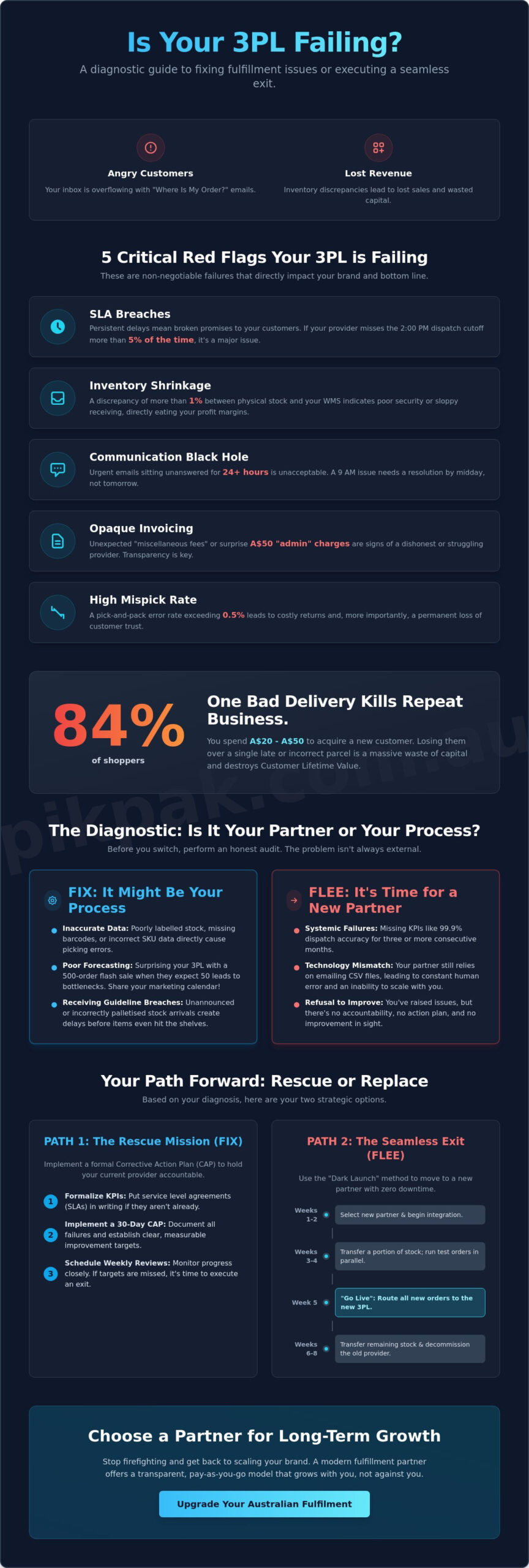
- SLA Breaches: If your provider misses the 2:00 PM AEST dispatch cutoff more than 5% of the time, they aren’t meeting modern Australian standards. Persistent delays mean your customers wait longer than promised.
- Inventory Shrinkage: A discrepancy of more than 1% between your physical stock and the Warehouse Management System (WMS) indicates poor security or sloppy receiving processes. This “hidden” cost eats your margins fast.
- The Communication Black Hole: Urgent emails shouldn’t sit for 24 hours. In the fast-paced Australian market, an issue flagged at 9:00 AM needs a resolution by midday. If you’re constantly chasing them, they’ve failed.
- Opaque Invoicing: Transparency is non-negotiable. If your monthly bill includes “miscellaneous” fees or unexpected A$50 “admin” charges you didn’t agree to, it’s a sign of a struggling provider.
- Mispicks: A pick and pack error rate exceeding 0.5% leads to high return rates. Every incorrect item sent is a double cost: the shipping for the return and the loss of customer trust.
The Impact of Logistics Failures on Customer Lifetime Value
One botched delivery experience kills the chance of a second purchase for 84% of shoppers. You might spend A$20 to A$50 in marketing to acquire a single customer; losing them over a late parcel is a massive waste of capital. Your support team shouldn’t spend 30% of their day answering “where is my order” queries because your warehouse is slow. In 2026, shipping reliability is the primary driver of brand trust and the only way to ensure customers keep coming back.
Identifying Systematic vs. Seasonal Issues
Don’t let a partner blame “Peak Season” for errors that happen in May. While Black Friday creates pressure, a competent warehousing and fulfilment partner scales its labour to match the demand. If your error rates increase by 10% every time you run a minor promotion, the problem is their internal systems. Check your data trends monthly. If the “courier is late” excuse happens on 20 out of 30 days, it’s likely the warehouse didn’t have the order ready for the truck on time. If you see these trends continuing as you scale, it’s a sign that the provider’s technology can’t keep up with your growth.
The 3PL Diagnostic: Is the Problem Your Partner or Your Process?
Before you pull the plug, you need to know if the failure is systemic or operational. Deciding what to do when your 3pl is failing starts with a “Fix vs. Flee” matrix. If your provider misses their 99.9% dispatch accuracy KPI for three consecutive months, it’s likely a terminal partner issue. However, if your own data is inconsistent, the problem might be closer to home. Review your contract today. Are your KPIs clearly defined and enforceable? If you don’t have a written agreement specifying that orders must be out the door within 24 hours, you have no leverage to demand better service.
Self-Audit: Are You a “Difficult” Client?
Logistics is a two-way street. Warehouse bottlenecks often start with the client. If your SKU data is inaccurate or your packaging instructions change every week, you are creating friction. A 12% increase in picking errors can often be traced back to poorly labelled stock or missing barcodes. Are you following standard warehouse receiving guidelines? If stock arrives at the dock unannounced or incorrectly palletised, it won’t hit the shelves quickly.
Poor forecasting is another silent partner in 3PL failure. If you tell your provider to expect 50 orders a day but suddenly drop 500 during a flash sale, the warehouse staff will struggle to keep up. Following best practices for a strong 3PL relationship requires transparency. Share your marketing calendar. Give them a heads-up on big promotions. This allows them to scale labour and ensure your customers aren’t left waiting.
The Technology Mismatch
Manual data entry is the silent killer of eCommerce growth. If you are still emailing CSV files or manually entering tracking numbers, you are inviting human error. This is a common reason why people wonder what to do when your 3pl is failing. In 2024, your eCommerce platform should talk directly to the warehouse management system (WMS) via API integrations. This automation can reduce order processing errors by up to 45%.
- Real-time visibility: Does your provider offer a live dashboard or just weekly spreadsheets?
- Inventory Sync: Does your stock level update across all sales channels every 15 minutes?
- Error Reduction: API integrations eliminate the need for “copy and paste” logistics.
If your current provider can’t offer a “point, click, and connect” solution, they are holding your business back. You deserve a partner that makes operations run like clockwork. You can automate your fulfilment today and finally focus on growing your brand instead of chasing missing parcels.
The 3PL Rescue Mission: How to Fix a Sour Relationship
Deciding what to do when your 3pl is failing doesn’t always mean an immediate exit. Moving inventory is expensive and disruptive. Before you jump ship, attempt a structured rescue mission to see if the relationship is salvageable. Start by scheduling a “State of the Union” meeting with your Account Manager. This isn’t a casual check-in. It’s a formal review where you present documented evidence of missed KPIs, such as a 12% increase in shipping errors or consistent 48-hour delays in dispatch.
During this meeting, you must draft a formal Corrective Action Plan (CAP). This document should outline specific failures and the exact steps the warehouse will take to rectify them. Each item needs a strict deadline. For example, if inventory accuracy has dropped below 99%, the CAP might require a full cycle count of your top 50 SKUs within 7 business days. If they can’t commit to these dates, you have your answer. To keep things objective, implement automated reporting. Manual spreadsheets lead to “he-said-she-said” arguments. Automated data ensures everyone sees the same numbers in real-time.
You should also re-negotiate your Service Level Agreements (SLAs). If your current contract lacks teeth, add financial penalties for repeated failures. If the 3PL misses the agreed-upon dispatch window for more than 5% of orders in a month, a credit should be applied to your next invoice. Finally, set a 30-day probation period. This timeframe allows you to monitor measurable improvements without committing to another year of subpar service.
Communication Protocols That Actually Work
Messy email chains are where accountability goes to die. Switch to a structured ticketing system where every issue is logged, timestamped, and assigned a priority level. Establish a weekly KPI review call to stay ahead of issues before they impact your customers. A Standard Operating Procedure (SOP) for issue escalation is a documented, step-by-step guide that dictates exactly which manager to contact and the required response time if a critical fulfillment error isn’t resolved within 4 hours.
Leveraging Data for Accountability
Data is your best tool for uncovering the truth. Use Warehouse Management System (WMS) timestamps to prove where delays are actually occurring. By comparing the “order packed” timestamp against the courier’s “first scan,” you can determine if the warehouse is slow or if the freight provider is the bottleneck. Many eCommerce brands find that poor visibility is the root of their stress. Investing in logistics technology support ensures you have the transparency needed to hold your provider’s feet to the fire. When you have clear data, you stop guessing and start managing.
The Exit Strategy: Transitioning to a New 3PL Without Downtime
Knowing what to do when your 3pl is failing requires a shift from damage control to strategic execution. A messy exit can hurt your brand more than the failing provider did, so you need a clinical approach to the transition. Start with a rigorous inventory audit. Don’t rely on the digital records of a provider that’s already underperforming. You must conduct a 100% physical count before stock is palletised. Discrepancies of just 3% can lead to thousands of dollars in “lost” stock during the move, so document every unit as it leaves the old warehouse dock.
Legal considerations are your first line of defence against exit fees. Review your Service Level Agreement (SLA) for “material breach” clauses. If your provider has missed their 98% dispatch accuracy target for three consecutive months, you often have the right to terminate immediately without paying a 90-day notice penalty. Once the paperwork is clear, use the “Dark Launch” method. Instead of moving your entire inventory at once, send a single high-volume SKU to your new partner. This allows you to test the new warehouse management system (WMS) and shipping speeds in a live environment without risking your entire catalogue.
The Logistics of the Move
Coordination between the old and new provider is where most transitions fail. Never schedule your stock transfer for a Monday morning. In the Australian eCommerce market, Monday is the highest volume day for order processing. A move on a Monday creates a backlog that can take a week to clear. Instead, aim for a Wednesday or Thursday. This gives the new provider a 48-hour window to rack the stock and sync systems before the weekend. Communicate clearly with your customers. A simple banner on your site stating that orders may face a 48-hour delay due to a warehouse upgrade manages expectations and protects your review scores.
Data and Integration Migration
The technical switch is just as critical as the physical one. You must disconnect the old API and sync the new WMS simultaneously to prevent duplicate or missed orders. Ensure every pending order is either fulfilled or cancelled in the old system before the “go-live” moment at the new facility. This prevents “ghost orders” from being lost in a system you no longer have access to. For a transition that feels effortless, partnering with professional warehousing and fulfilment services ensures your data remains secure and your shipping stays on track. It’s about making the complex feel simple so you can focus on your business.
Choosing a Partner for the Long Haul: The Pik Pak Difference
Switching providers is a major decision. When you are deciding what to do when your 3pl is failing, you need more than just a new warehouse space. You need a partner that fixes the fundamental issues of visibility and communication. At Pik Pak, we prioritise transparency through every step of the fulfilment process. We don’t believe in hiding behind complex reports or delayed updates. Our system provides real-time inventory visibility, so you always know exactly what is on the shelf and what has been dispatched.
Many traditional providers rely on lock-in contracts that trap businesses even when service levels drop. We take a different approach with our “Scale as You Grow” model. There are no restrictive long-term contracts that force you to stay with a failing service. This keeps us accountable every single day. If we don’t perform, we don’t expect your loyalty. It’s a pragmatic, performance-based relationship that puts the control back into your hands. As a local Australian partner, we understand the specific challenges of the domestic market, from Australia Post requirements to local courier networks, providing a level of support that offshore giants simply can’t match.
Built-in Accountability and Tech
Our cloud-based Warehouse Management System (WMS) is designed to eliminate the “black hole” of logistics. You see exactly what we see, when we see it. This level of integration means you can monitor order statuses and stock levels from any device at any time. We focus on proactive problem solving by using automation to flag potential issues before they reach your customer. If a barcode doesn’t scan or an address looks incorrect, we catch it early. This commitment to accuracy is central to our service priorities, ensuring your brand reputation remains intact. We make the technical side easy with point, click, and connect solutions that don’t require a degree in IT to operate.
Reclaiming Your Time to Focus on Growth
A reliable 3PL turns logistics from a constant headache into a genuine competitive advantage. When your fulfilment runs like clockwork, you stop spending your mornings chasing missing parcels and your afternoons responding to angry customer emails. This is the moment you reclaim your time. By letting us handle the hard work of “Pick, Pack & Ship Made Easy,” you can redirect your energy toward marketing, product development, and scaling your business. Logistics shouldn’t be the thing that holds you back; it should be the engine that drives you forward. It’s time to stop managing a crisis and start managing your growth. Request a quote and rescue your logistics today to see how simple professional fulfilment can be.
Take Control of Your eCommerce Fulfilment
Knowing what to do when your 3pl is failing starts with identifying whether the issue lies in poor communication or systemic operational errors. If a rescue mission doesn’t yield measurable results within 30 days, it’s time to execute a clean exit strategy. Transitioning shouldn’t mean downtime for your Australian business; it’s about moving to a partner that treats your inventory like their own. Logistics shouldn’t be a constant source of stress. You deserve a system that runs like clockwork so you can reclaim your time and focus on your business.
Pik Pak removes the complexity with real-time WMS visibility and a transparent pay-as-you-go model that requires zero software fees. Our Australian-based expert support team ensures your operations stay on track without the technical headaches. We make the hard work look easy by automating the heavy lifting. This gives you the freedom to scale without being held back by warehouse bottlenecks.
Tired of logistics headaches? Switch to Pik Pak for effortless fulfilment today.
Your business is ready for the next level, and the right partner will help you get there.
Frequently Asked Questions
How do I know if my 3PL is failing or if the industry is just struggling?
You know your 3PL is failing when their performance drops below the Australian industry standard of 99.8% order accuracy. While global supply chains face 5% to 10% delays during peak periods, consistent errors in picking or inventory counts are internal issues. If your provider misses their own Service Level Agreement (SLA) targets for three consecutive months, it’s a sign they can’t handle your volume.
Can I sue my 3PL for lost sales due to shipping delays?
Suing for lost sales is difficult because most Australian 3PL contracts include clauses that limit liability to the cost of the specific service. You’re unlikely to recover A$5,000 in lost revenue if the shipping fee was only A$20. Review your contract for “consequential loss” exclusions. It’s often more effective to negotiate credits for future invoices than to pursue legal action in court.
How long does it typically take to switch to a new 3PL provider?
Switching to a new provider typically takes between 30 and 60 days. This period allows for 14 days of software integration via API and a physical stock count during the move. At Pik Pak, we focus on making this transition simple so you can focus on your business. We recommend keeping a small safety stock at your old warehouse until the new system is verified.
What are the most common hidden fees in 3PL contracts?
Hidden costs often hide in SKU maintenance fees and manual handling surcharges. You might see a charge of A$2.50 for every pallet that needs wrapping or A$0.50 per month for every unique product code in the warehouse. Understanding these costs is a vital part of knowing what to do when your 3pl is failing. Always ask for a transparent, all-inclusive pricing schedule before signing.
Should I move all my stock at once or do a phased transition?
A phased transition is the smartest way to protect your cash flow. Move your top 15% of high-volume SKUs first to ensure the new warehouse handles your most popular items correctly. Once these orders run like clockwork, move the remaining inventory over a 14 day period. This approach prevents a total shutdown of your shipping operations if the new integration hits a temporary snag.
What is a reasonable “error rate” for a high-quality 3PL?
A high-quality 3PL should maintain a 99.8% accuracy rate for all outbound orders. In a professional Australian warehouse, an error rate higher than 0.5% is considered a major operational risk. If 5 out of every 1,000 customers receive the wrong item, your return costs and negative reviews will quickly eat into your margins. Demand a monthly report that shows these specific performance metrics.
How can I improve communication with a 3PL that won’t reply?
Start by requesting a meeting specifically to discuss SLA breaches. If they don’t reply within 24 hours, escalate the issue by contacting their operations manager directly via phone. Communication silence is a primary indicator of what to do when your 3pl is failing. Reliable partners use automated systems to keep you informed, so you don’t have to chase them for basic updates on your stock.