

Last Monday, an Australian fashion retailer faced a common dilemma: their current warehouse was failing, but the fear of a botched move kept them stuck. They worried that a messy 3pl implementation timeline would lead to lost orders and frustrated customers. It’s a valid concern because your logistics are the heartbeat of your business. We agree that switching partners should feel like a step forward, not a risk to your reputation. You shouldn’t have to pause your growth just to fix your fulfilment.
In this guide, we’ll reveal the realistic 4-to-8 week roadmap for a seamless 3PL transition. You’ll learn how to replace complex tech hurdles with a simple point and click integration that gives you real-time visibility from the moment you start. We’re breaking down the specific steps to ensure a predictable go-live date so you can protect your sales and get back to what you do best. Let’s turn your logistics into an easy game and get your operations running like clockwork.
Key Takeaways
- Map out the realistic 4-to-8 week 3pl implementation timeline for Australian eCommerce businesses to ensure a smooth transition from contract to first shipment.
- Identify the four critical phases of a seamless transition, from initial discovery of your shipping profiles to the technical “heavy lifting” of API integrations.
- Learn how to accelerate your onboarding by preparing clean SKU data and finalising custom packaging before the physical move begins.
- Discover why SKU complexity and integration readiness are the biggest factors in determining how fast your new facility can go live.
- Find out how to maintain 100% sales continuity and gain real-time stock visibility by using a pragmatic, technology-first approach to fulfilment.
Understanding the Standard 3PL Implementation Timeline
Setting up a partnership with a Third-party logistics (3PL) provider isn’t an overnight task; it’s a strategic transition. The 3pl implementation timeline covers the critical window from the moment you sign your contract to the second your first customer order leaves the warehouse dock. In the Australian market, a standard eCommerce integration typically spans 4 to 8 weeks. This duration ensures your data, stock, and shipping protocols align perfectly before you scale.
3PL onboarding acts as a bridge between your digital store and physical delivery. While the technical go-live happens when your systems finally talk to each other, operational stability is the real goal. Technical success means the API works. Operational stability means your warehouse team picks, packs, and ships with 99.9% accuracy. Rushing this process usually results in a 20% to 30% increase in inventory discrepancies during the first month of trading.
The 4 Phases of Onboarding
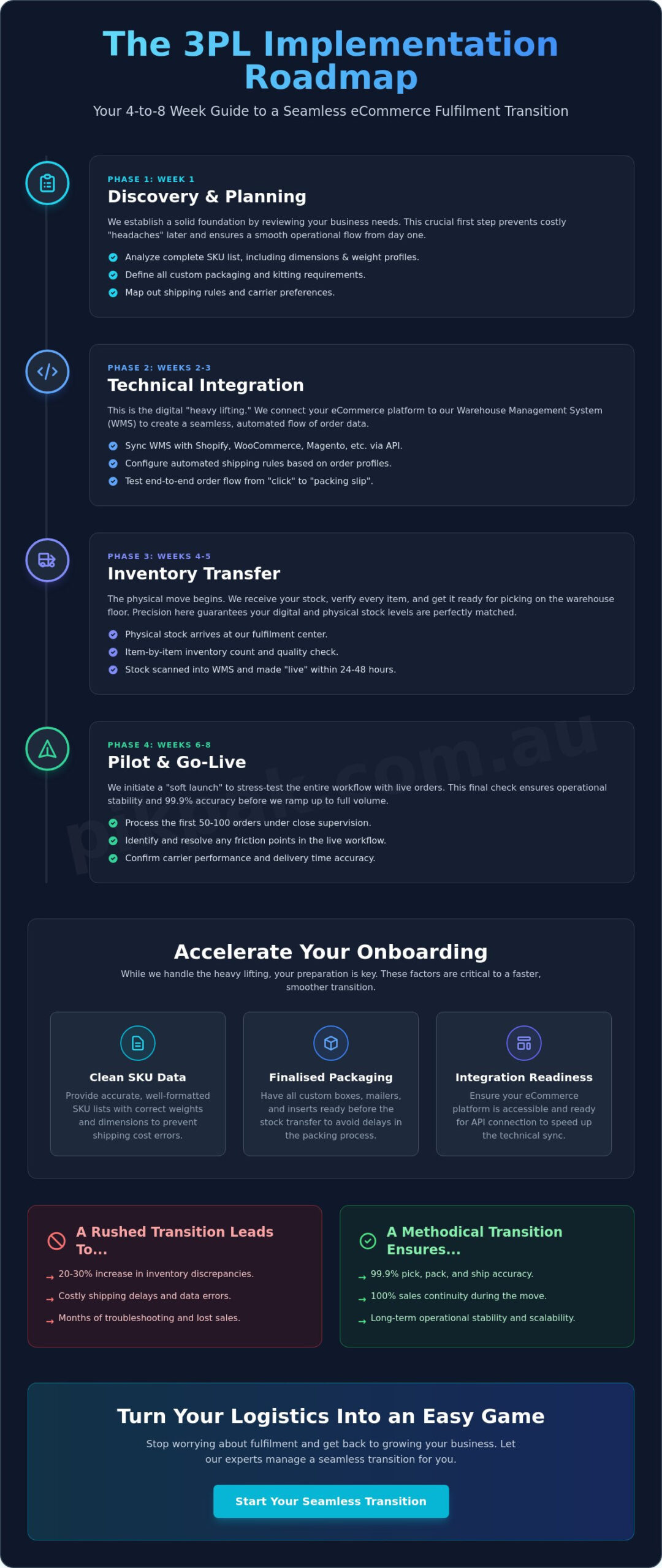
- Discovery & Planning (Week 1): We set the foundation. This involves reviewing your SKU list, packaging requirements, and shipping rules. Clear communication here prevents “headaches” later.
- Technical Integration (Weeks 2-3): Our team syncs our Warehouse Management System (WMS) with your Shopify, WooCommerce, or Magento store. You can learn more about how we handle this through our technology support services.
- Inventory Transfer (Weeks 4-5): You move physical stock to our facility. We count every item to ensure your digital records match the physical reality on the shelves.
- Pilot & Go-Live (Weeks 6-8): We process the first 50 orders under close supervision. This “soft launch” identifies any friction points in the workflow before you hit full volume.
Why “Fast” Isn’t Always Better
It’s tempting to demand a two-week turnaround, but speed often kills accuracy. High-volume environments that skip the pilot phase frequently face shipping delays and data errors that take months to untangle. Data cleaning during the early stages of your 3pl implementation timeline saves weeks of troubleshooting down the road. If your SKU descriptions are messy or your weights are inaccurate, the system won’t calculate shipping costs correctly.
Focus on your business and let us handle the technicalities. Taking the time to get the integration right means your operations will run like clockwork. We believe in doing it once and doing it right so you can scale as you grow without looking back. Let Pik Pak do the hard work for you by ensuring every box, label, and byte of data is exactly where it needs to be.
Deep Dive: The 4 Phases of a Seamless 3PL Transition
Moving your fulfilment isn’t just about hauling boxes from one warehouse to another. It’s a strategic shift that requires a clear 3pl implementation timeline to avoid service gaps. We break this down into four distinct stages to keep your business moving while we set up the back end. The discovery phase is where we get granular. We look at your SKU count, precise dimensions, and weight profiles. This data allows us to calculate storage density and pick paths before a single pallet arrives. Understanding the link between Logistics and Supply Chain Management helps you see how these small data points impact your overall delivery speed and bottom line.
Phase 1 & 2: Data and Digital Sync
The technical heavy lifting happens here. We start by mapping your SKU list to our WMS platform. This isn’t a manual data entry chore; we use smart technology support to sync your Shopify, eBay, or WooCommerce store directly to our system. We then set automated shipping rules. If an order is under 500g and going to Sydney, it follows one path. If it’s a 15kg bulky item heading to Perth, it follows another. Our team tests the order flow from the moment a customer clicks “buy” until the packing slip prints on our warehouse floor. This ensures the digital handshake is firm before stock moves.
Phase 3 & 4: Physical Move and Launch
The physical transition requires precision. You should palletise and label all stock according to our warehouse receiving guidelines to ensure we can scan your inventory into “live” status within 24 to 48 hours. During this “Dark Period,” you might pause your store or set extended delivery times to manage customer expectations. Once the stock is shelved, we begin the Pilot Run. We closely monitor the first 100 orders for picking accuracy and carrier performance. We don’t just hope it works; we validate that every “Pick, Pack & Ship” action runs like clockwork. This phased approach reduces the 3pl implementation timeline from a stressful ordeal to a managed transition. If you’re ready to simplify your setup, you can explore our tailored logistics services to see how we handle the heavy lifting for you.
Factors That Speed Up or Slow Down Your Implementation
Every eCommerce business has a different operational footprint. Your 3pl implementation timeline depends heavily on how prepared you are before the first pallet arrives at the warehouse dock. While some brands transition in a fortnight, others face months of back-and-forth due to avoidable data gaps. Understanding these variables allows you to plan with precision and avoid the “logistics headache” that many owners fear.
SKU complexity is a primary driver of your schedule. A brand with 10 high-volume variants can be mapped in our system in a single afternoon. Conversely, an enterprise with 1,000 unique items requires extensive data mapping for weights, dimensions, and pick locations. This level of detail ensures your 3pl implementation timeline stays on track rather than getting bogged down in pick errors later. High SKU counts can add 5 to 7 days to the onboarding process just for data validation and bin location assignments.
Integration readiness also dictates your speed. If you use native Shopify or WooCommerce connectors, the tech side is almost instant. Custom API builds for bespoke ERPs can add 20 to 30 days to the schedule while developers run tests. Carrier accounts are the final piece of the puzzle. Using Pik Pak’s established rates is a “plug and play” solution that works immediately. If you choose to set up new, independent carrier accounts, expect a 5 to 10 day wait for account verification and label configuration in the Australian market.
The Technology Shortcut
Cloud-based systems eliminate the need for expensive hardware or onsite software installations. We focus on a “point, click, and connect” setup that respects your busy schedule. By using pre-built connectors, you can reduce your tech setup timeline by 50%. Pik Pak’s e-Storefront integration simplifies this stage, allowing your sales data to flow directly into our warehouse management system. This automation removes the need for manual order entry and lets you focus on your business while the tech runs like clockwork.
Operational Bottlenecks to Avoid
The most common delay is the “missing barcode” trap. Every item needs a scannable ID before it hits our shelves. If our team has to print and apply labels for you, it stalls the launch by at least 10 business days. You should also review the warehouse receiving guidelines well before your stock leaves your current provider. 90% of delays occur during the physical stock count phase. When the incoming shipment doesn’t match the manifest, the entire process stops for reconciliation. Get your data right first, and the physical move becomes an easy game.
Merchant Preparation: How to Shorten Your Onboarding Time
Your internal preparation is the single biggest variable in the 3pl implementation timeline. If your data is disorganized, the transition will stall. Efficiency starts with your inventory. We recommend conducting a full audit to remove inactive SKUs before you begin. If a product hasn’t sold in the last 12 months, don’t pay to move it. This is the perfect time to update product weights and dimensions. Accurate data ensures your shipping costs are precise from day one and prevents the re-measurement delays that often happen during the initial intake process.
Finalise your packaging requirements early. If you use custom-branded boxes or specific dunnage, ensure these materials arrive at the new facility at least five business days before your stock. You must also notify your suppliers immediately. Updating the “Ship-To” address on all open purchase orders is critical. A single container sent to your old warehouse can cost you A$500 or more in redirection fees and add a week to your timeline. Finally, prepare your customer service team. They need to be comfortable with the new tracking portal so they can provide instant answers to your customers without needing to contact the warehouse team directly.
The Ultimate Preparation Checklist
A smooth move is a planned move. Start by downloading the warehouse receiving guidelines to understand how your stock needs to be palletised and labelled. This prevents your stock from being rejected at the dock. Create a “Master SKU Sheet” that includes barcodes, descriptions, and current stock levels. If possible, schedule your physical stock move during a “low-sales” window, such as mid-February or the end of July. This reduces the pressure on your team and ensures you aren’t trying to migrate systems during a peak promotional event.
Communicating with Your Customers
Transparency builds trust. Tell your customers about the move before it happens. We suggest setting expectations for a 48-hour shipping pause while the physical inventory transfer takes place. Update your “Shipping & Returns” policy page to reflect the new warehouse location and any changes in delivery times. You can explain the value of this change by sharing how professional warehousing and fulfilment will lead to faster, more accurate deliveries for them. This turns a potential inconvenience into a positive brand upgrade that benefits the end user.
Ready to make your next move effortless? Explore our fulfilment services and let Pik Pak handle the heavy lifting for you.
The Pik Pak Advantage: Making Implementation an “Easy Game”
Logistics often feels like a massive headache, but it doesn’t have to be. We take a pragmatic approach to onboarding that skips the confusing jargon. You won’t deal with “computer geeks” who speak a different language; you’ll work with experts who understand your bottom line. Our goal is to shorten your 3pl implementation timeline by handling the technical heavy lifting. This allows you to stay focused on your business growth while we manage the warehouse floor. What seems to be a challenge for others is an easy game with Pik Pak.
One of the biggest fears in switching partners is losing track of inventory. We solve this through our WMS platform. It provides real-time visibility that answers the “where is my stock?” question instantly. You’ll see every move from the moment it hits our warehouse to the second it reaches your customer’s door. This level of transparency removes the guesswork and gives you total control over your stock levels without needing a degree in IT.
We believe in a “Pay as You Go” model. This means no hidden software fees or restrictive long-term lock-ins while you’re setting up. You pay for the space and services you actually use. It keeps your cash flow healthy during the transition period and ensures you aren’t paying for empty shelf space or features you don’t need yet.
Why Australian Brands Trust Pik Pak
Our team is based right here in Melbourne. We know the Australian courier landscape inside out, from local metro deliveries to complex regional logistics. We’re committed to eliminating waste in your supply chain from day one. This means identifying bottlenecks in your current process and replacing them with automated workflows that just work. By automating the manual tasks, we turn what used to be a complex transition into a simple success story. Your 3pl implementation timeline becomes a predictable path rather than a stressful guessing game.
Your Next Steps to Effortless Fulfilment
Getting started is simple. Request a quote to begin an initial discovery call where we’ll map out your specific needs. We don’t believe in one-size-fits-all solutions. You can review our service priorities to see exactly how our operations align with your growth targets. We’re ready to help you reclaim your schedule and get your orders moving like clockwork. Ready to free up your time? Get started with Pik Pak today.
Take Control of Your Fulfilment Transition
Switching partners is a strategic move that typically requires 4 to 8 weeks of careful planning and execution. Success depends on how quickly you can clean your SKU data and integrate your existing tech stack. By mastering the 3pl implementation timeline, you ensure your Australian eCommerce business avoids the common 15% dip in order accuracy often seen during unmanaged transitions. It’s about moving from chaos to a system that runs like clockwork.
Pik Pak removes the technical hurdles that slow you down. There are no software fees or setup traps to worry about, and you’ll have 100% real-time WMS visibility from day one. Our expert AU-based support team handles the heavy lifting so you don’t have to be a computer geek to get started. Ready to free up your time? Focus on your business and let Pik Pak handle the hard work. You’ve built something great, and now it’s time to let it scale without the logistics headache. We’re here to make sure your growth feels effortless.
Frequently Asked Questions
How long does 3PL onboarding actually take?
A standard 3pl implementation timeline typically spans 14 to 45 days from the initial discovery call to your first outbound shipment. This duration depends on your total SKU count and the complexity of your current software setup. Pik Pak focuses on a pragmatic approach to get you moving quickly; simple integrations often go live in under 10 business days.
Your timeline stays on track when you have your product data ready. We use pre-built connectors that reduce technical setup time by 40% compared to custom API builds. This means you can stop worrying about logistics and start focusing on your business growth sooner.
Will my online store be offline during the implementation?
Your online store remains fully operational and open for customers during the entire transition. We perform the technical integration in the background using a secure API connection that doesn’t interfere with your storefront’s performance. You won’t lose a single minute of sales time while we sync our systems.
We follow a “point, click and connect” process that keeps your data flowing. You’ll continue fulfilling orders from your existing setup until the exact moment your stock is scanned into our warehouse. Once the inventory is live, we flip the switch and take over the hard work for you.
What is the most common reason for 3PL implementation delays?
Inaccurate product data accounts for 60% of all onboarding delays in the Australian logistics industry. If your SKU dimensions, weights, or barcodes don’t match the physical items, it creates a bottleneck during the receiving process. Providing a clean and verified CSV file on day one is the best way to ensure everything runs like clockwork.
Discrepancies in inventory counts from your previous provider can also cause setbacks. We recommend performing a final stocktake before the move. This transparency prevents administrative headaches and ensures your 3pl implementation timeline stays strictly on schedule.
Do I need a developer to integrate my store with a 3PL?
You don’t need a developer or any coding knowledge to connect your store to our fulfilment platform. We’ve designed our system to be user-friendly for business owners who aren’t computer geeks. Most major platforms like Shopify, WooCommerce, and Magento connect via simple authorisation steps that take minutes to complete.
Our team handles the technical heavy lifting behind the scenes. If you use a custom-built website, we provide clear API documentation that makes the process straightforward. For most Australian eCommerce brands, the setup is a simple matter of clicking a few buttons to authorise the data sync.
Can I switch 3PL providers during the peak holiday season?
Switching providers between November 1 and December 24 is highly risky and generally discouraged by industry experts. Most Australian warehouses implement a “code freeze” or “onboarding blackout” during this period to manage the massive influx of Black Friday and Christmas orders. A transition during this peak could lead to shipping delays that hurt your brand reputation.
The ideal time to start your 3pl implementation timeline is in the first or third quarter of the year. Completing your move by September ensures your operations are stable and tested before the holiday rush begins. This gives you the peace of mind that your peak season sales will be handled with total efficiency.
How much does 3PL implementation cost?
Implementation costs generally include a one-time setup fee that covers system integration, SKU mapping, and initial account configuration. These fees vary based on the number of sales channels you need to connect and the volume of inventory being moved. Most providers in Australia structure these as transparent, upfront costs so there are no surprises later.
While we don’t invent specific prices for your unique business needs, you should budget for the labour involved in receiving and counting your initial stock. Investing in a professional setup ensures your automation is configured correctly from the start. This eliminates waste and saves you money on operational errors in the long run.
What data do I need to provide to start the onboarding process?
You need to provide a comprehensive product master list that includes SKU codes, barcodes (EAN or UPC), unit weights, and precise dimensions. This data is the foundation of your fulfilment because it determines storage locations and calculates accurate shipping rates. Without this information, we can’t automate your pick and pack process effectively.
You’ll also need to provide your sales channel credentials and any specific packaging requirements. Having these details ready on day one allows us to create your account environment immediately. It’s all about making the transition as easy and stress-free as possible for you.
How do I move my inventory from my current warehouse to a new 3PL?
Moving inventory involves a coordinated freight transfer, usually via pallets, from your old location to our facility. You’ll need to generate a “Receiving Advice” or “Inbound Documentation” in our system before the truck arrives. This tells our warehouse team exactly what products are coming so they can prepare the space.
We recommend using a professional pallet transport service to ensure your goods arrive safely and are easy to offload. Once the stock reaches our dock, we count and verify every unit within 48 hours. After the count is confirmed, your inventory goes live in our system and we start shipping your orders right away.