
Did you know that Australian retailers lost an estimated A$2 billion in 2024 alone due to the hidden costs of reverse logistics? It’s a staggering figure that highlights a painful reality for many local brands. If you’re tired of watching your hard-earned profits disappear into shipping fees and seeing inventory sit idle in a return loop, you aren’t alone. Learning how to reduce return rates ecommerce is no longer just a “nice to have” strategy; it’s a necessity for protecting your bottom line as we head into 2026.
We understand that managing returns feels like a constant headache that pulls you away from growing your brand. You want predictable profit margins and customers who stay loyal because their orders arrive exactly as described. This guide provides a clear, pragmatic dual strategy that focuses on front-end user experience and back-end logistics precision to help you reclaim lost revenue. We’ll show you how to eliminate shipping errors and use smarter data to ensure your fulfillment process runs like clockwork, letting you focus on your business while the logistics are handled for you.
Key Takeaways
- Identify the true financial impact of returns in 2026, including hidden A$ restocking fees and lost labour costs, to better protect your bottom line.
- Optimise your front-end UX with high-fidelity imagery and precise descriptions to eliminate product misrepresentation before the customer clicks buy.
- Discover how to reduce return rates ecommerce brands face by leveraging barcode-driven Warehouse Management Systems to ensure 99.9% order accuracy.
- Master the “Easy Return” paradox by using automated portals that build customer loyalty while providing the data needed to stop recurring issues.
- Learn how partnering with a localized Melbourne 3PL like Pik Pak eliminates the manual “headache” of fulfilment so you can focus on scaling your business.
Understanding the True Cost of eCommerce Returns in 2026
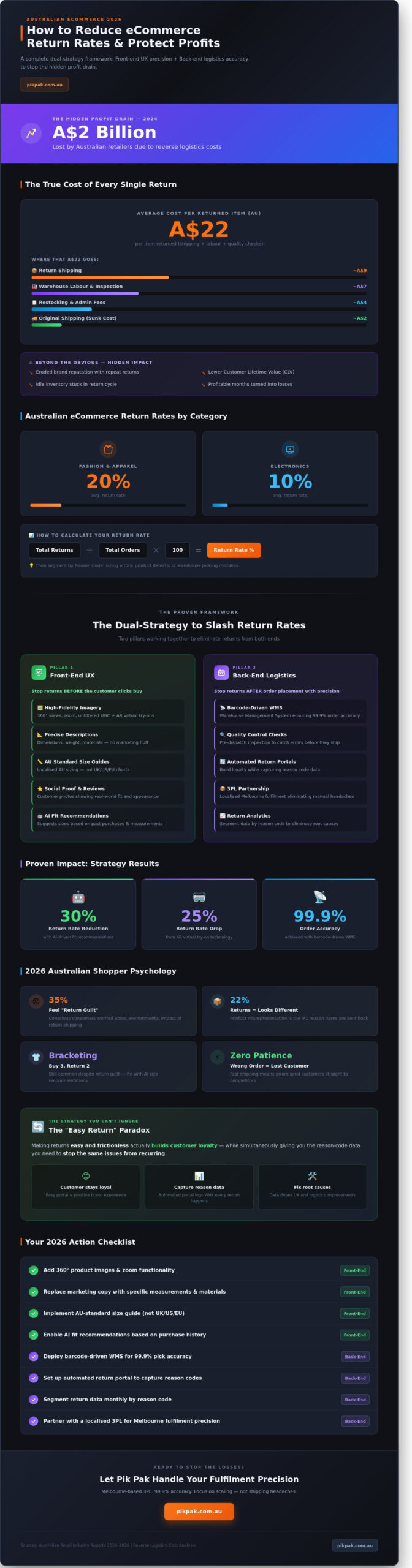
Returns are more than a minor logistics headache; they’re a direct hit to your bottom line. By 2026, the standard eCommerce return rate in Australia has stabilised around 20 percent for fashion and 10 percent for electronics. If you’re searching for how to reduce return rates ecommerce strategies, you must first acknowledge the invisible drain on your resources. Every return triggers a complex web of Reverse logistics that costs Australian retailers an average of A$22 per item when you factor in shipping, warehouse labour, and quality checks. High return rates don’t just hurt today’s profit; they erode your brand reputation and lower your Customer Lifetime Value (CLV). To protect your margins, we focus on two pillars: Front-end UX to ensure customers know what they’re buying, and Back-end logistics to ensure they get exactly what they ordered every time.
The financial impact goes beyond the initial lost sale. You’re dealing with “hidden costs” like re-stocking fees, the labour required to inspect items for damage, and the sunk cost of original shipping. When these costs pile up, they can turn a profitable month into a loss. By streamlining your operations, you can eliminate this waste and ensure your business runs like clockwork.
How to Calculate Your Return Rate Accurately
To fix the problem, you need to measure it correctly. Use the standard formula: (Total Returns / Total Orders) x 100. However, don’t stop there. You must segment these returns by “Reason Code” to identify if the issue is a sizing error, a product defect, or a picking mistake in the warehouse. Return ROI is the net profit remaining once all reverse logistics costs, including labour and shipping, are settled against the recovered value of the item.
Why 2026 Consumer Expectations are Changing
Australian shoppers have become more sophisticated. The rise of “conscious consumerism” means 35 percent of buyers now feel “return guilt” due to the environmental impact of shipping, yet “bracketing” (buying multiple sizes to return most) remains common. Fast shipping across Australia has also made customers less tolerant of errors. If an order is wrong, they won’t wait for a replacement; they’ll simply go to a competitor. Understanding What is Order Fulfilment? is the first step in meeting these high standards. When your fulfilment is precise, you naturally learn how to reduce return rates ecommerce by removing the errors that frustrate modern shoppers.
Front-End Strategies: Reducing Returns Before the Click
Returns don’t start at the warehouse. They start at the digital shelf. If you want to know how to reduce return rates ecommerce, you must first address the gap between customer expectations and reality. Industry data from 2024 indicates that roughly 22% of online returns happen because the product looks different in person. Eliminating “Product Misrepresentation” is your first line of defence. When shoppers know exactly what they’re buying, they’re far less likely to send it back.
- Optimise Descriptions: Move beyond marketing fluff. Clearly state dimensions, weight, and specific materials. If a shirt is 100% Australian wool, explain the texture and thickness.
- Social Proof: Customer reviews that include photos provide a “real world” look that professional studio shots often miss. This helps shoppers see how a product fits a variety of body types.
- Size Guides: Use Australian standard sizing. Don’t leave your customers guessing between UK, US, or EU charts. Clear, localised guides are essential.
Implementing AI-driven fit recommendations can lower return rates by as much as 30% by suggesting sizes based on a customer’s previous purchases or body measurements. This removes the “bracketing” habit where shoppers buy three sizes and return two. It’s a simple way to protect your margins and your stock levels.
Visual Accuracy and Augmented Reality
High-fidelity imagery is non-negotiable in 2026. 360-degree views allow customers to inspect seams and textures, which reduces the “it looks different” complaint. Augmented Reality (AR) virtual try-ons are no longer a gimmick; they are a vital retention tool. Retailers using AR have seen return rates drop by 25% because the technology provides a realistic sense of scale. Use unfiltered user-generated content alongside your professional shots to build authenticity. Customers trust their peers more than a polished brand campaign. It’s about showing the product in a real Australian home or on a real person.
The Power of Detailed Product Data
Details matter more than ever. Your product data should include the “feel” of a material, its weight in grams, and its durability. Use an FAQ section to answer common questions before they become return requests. For example, if a jacket runs small, tell them upfront. Reliability is built on transparency. Ensuring your e-Storefront integration keeps stock levels and descriptions synced across all channels prevents the frustration of “out of stock” cancellations or outdated specs. When your data is accurate, your operations run like clockwork. Let Pik Pak handle the heavy lifting of fulfilment while you focus on building a storefront that converts. If you find the tech side a headache, we can help you simplify your systems for better results.
The Logistics Factor: Eliminating Errors with 3PL Precision
Logistics isn’t just about moving boxes; it’s your first line of defense against profit-killing returns. The “Wrong Item Sent” error is the single most preventable reason for a return. Industry data shows that shipping errors account for approximately 23% of all eCommerce returns. When a customer receives a blue shirt instead of the red one they ordered, it’s an immediate fail that costs you shipping fees and customer trust. It’s a headache you don’t need.
Our Warehouse Management System (WMS) eliminates this guesswork. By using barcode scanning at every single stage, we ensure 99.9% picking accuracy. This tech-driven approach removes the human error that often plagues manual warehouses. Beyond accuracy, speed is a secret weapon in how to reduce return rates ecommerce. The faster a parcel arrives at an Australian doorstep, the less time there is for “Buyer Remorse” to set in. A 2024 consumer study found that orders delivered within 48 hours are 15% less likely to be returned than those taking a week or more. Speed keeps the excitement of the purchase alive.
Picking and Packing Excellence
Errors often hide in the chaotic transition between the shelf and the box. In a professional pick and pack warehouse, every movement is tracked and verified. We use automated weight checks at the packing station to catch missing items before the box is ever sealed. If a parcel weighs even 15 grams less than it should, the system flags it for inspection. A 1% increase in picking accuracy can save thousands in annual return shipping and administrative costs. We make the complex feel simple.
Protective Packaging and Kitting
Australia is a massive country with demanding transit routes. Sending a fragile item from Melbourne to a remote town in Western Australia requires more than a standard bubble mailer. We choose specific dunnage and box strengths designed for long-distance transit to slash “Damaged in Transit” claims. If your product requires multiple components, our kitting and assembly service ensures complex orders arrive complete and correct. Missing parts are a major return trigger that you can easily avoid. We also help you implement sustainable packaging that doesn’t compromise on strength. You can reduce returns without increasing environmental waste. It’s about ensuring your operations run like clockwork so you can focus on your business.
Creating a Return Policy that Balances Conversion and Cost
Your return policy is a powerful marketing tool that directly impacts your bottom line. Many Australian retailers fear that a flexible policy invites abuse, but the “Easy Return” paradox suggests the opposite. When you make returns simple, you build immense trust. Shoppers are more likely to hit the “buy” button when they know they aren’t trapped with a product that doesn’t fit. Finding this balance is a core strategy for how to reduce return rates ecommerce while actually growing your customer lifetime value.
Automation is the key to managing this without drowning in admin. Implementing a returns portal allows customers to manage their own returns, print labels, and track progress. This removes the “headache” for your team and provides you with vital data. If you see a specific product being returned 15% more than others, you can investigate the cause immediately. For low-value items, the “Keep It” or “Partial Refund” model is a game-changer. If return shipping costs A$12 and the item is worth A$25, offering the customer a 50% refund to keep the product saves you money and keeps the customer happy.
Clear communication at checkout is vital. To build trust, ensure your policy is visible before the customer pays. Use these tactics to improve clarity:
- Place a summary of your return policy on every product page.
- Use a simple “Return Window” countdown to create transparency.
- Clearly state if the return is free or if a flat fee applies.
Strategic Policy Adjustments
Different niches require different rules. While free returns are expected in high-end fashion, a flat A$10 fee might be more appropriate for bulky homewares. Setting a reasonable 30-day timeframe prevents “wardrobing,” where items are bought for a single event and returned used. You can also protect your revenue by offering store credit as the primary refund method. Many brands find success by adding an extra A$5 bonus to store credit offers, keeping the money within the business and encouraging a future sale.
Streamlining Reverse Logistics
The speed of your reverse logistics determines how quickly you can resell items. You should integrate your returns with your customer delivery systems to ensure a seamless loop. When a product arrives back, it needs a fast inspection and restocking process. If an item sits in a box for two weeks, it’s dead capital. This is where a professional logistics partner helps. By understanding how to reduce return rates ecommerce through better data and faster handling, you can ensure your inventory runs like clockwork. Professional fulfilment services handle the heavy lifting, getting your products back on the digital shelf within 24 hours of arrival.
Scaling Your Business by Reducing Waste with Pik Pak
The final piece of the puzzle in learning how to reduce return rates ecommerce brands face is eliminating the manual “headache” of logistics. Manual order management is a breeding ground for errors. When a staff member grabs the wrong size or a similar-looking SKU, you aren’t just losing the cost of the item; you’re paying for return shipping and potentially losing a customer forever. Pik Pak’s technology replaces guesswork with precision, ensuring the right product reaches the right doorstep every single time.
Partnering with a localized Melbourne 3PL gives Australian merchants a distinct advantage. Local proximity means faster transit times and less handling, which reduces the 15% of returns caused by items being damaged during long-haul transit. By keeping your stock close to your primary market, you ensure that “Pick, Pack & Ship Made Easy” isn’t just a slogan; it’s your new operational standard.
Technology Support for Error-Free Shipping
Our Warehouse Management System (WMS) acts as the brain of your operation. It integrates seamlessly with Shopify and WooCommerce, pulling orders directly into our workflow without manual data entry. This automation is a critical step in how to reduce return rates ecommerce because it eliminates “Where Is My Order” (WISMO) inquiries. These inquiries often account for 35% of customer service volume in Australia. When customers have real-time tracking and accurate delivery windows, they don’t get frustrated and hit the “return” button before the package even arrives.
Real-time inventory visibility also prevents the dreaded “Out of Stock” cancellation. We’ve seen that 2025 industry data points to stock discrepancies as a major cause of customer dissatisfaction. With Pik Pak, your digital storefront matches our physical shelves. You won’t sell what you don’t have, which protects your brand reputation and your bottom line.
Your Partner in Growth
Scaling requires moving away from a “storage” mindset and adopting an “efficiency” mindset. Many businesses treat a warehouse as a place to keep stuff; we treat it as a tool to accelerate your cash flow. This starts the moment your stock arrives. By following our warehouse receiving guidelines, you ensure that every unit is barcoded and accounted for from day one. This high level of organization prevents the shipping of incorrect items, which is the primary driver of preventable returns.
Outsourcing to a specialist like Pik Pak is the fastest way to lower your return rate because we’ve already solved the problems you’re currently facing. We’ve optimized the picking paths, secured the packaging, and streamlined the integrations. You don’t need to be a “computer geek” to get started; our “point, click, and connect” solution does the heavy lifting for you. Focus on your business and let Pik Pak handle the hard work so your operations can finally run like clockwork.
Turn Your Fulfilment into a Competitive Advantage
Mastering how to reduce return rates ecommerce brands face in Australia requires a shift from reactive fixes to proactive precision. By 2026, the cost of a single returned item can wipe out the profit of three successful sales. You need to focus on your business and let a reliable partner handle the complex bits. Clear product descriptions and seamless e-store integrations ensure customers know exactly what they’re buying before they click. This reduces the friction that leads to buyer’s remorse and costly return shipping fees.
Pik Pak simplifies this process by delivering a 99.9% picking accuracy rate and real-time WMS visibility. We take the “headache” out of logistics so your operations run like clockwork. Whether you’re managing a boutique startup or a scaling enterprise, our tech-savvy approach ensures your customers get the right order every time. It’s time to stop worrying about logistics and start reclaiming your time. You’ve built a great brand; now give it the reliable foundation it deserves to thrive in the Australian market.
Stop the return gremlins and start scaling with Pik Pak Logistics today
The path to a more profitable, stress-free business starts with one simple choice.
Frequently Asked Questions
What is a “good” return rate for eCommerce in 2026?
A good return rate for general eCommerce in 2026 sits between 8% and 12%. While fashion retailers often see higher figures, keeping your rate under 15% is a strong competitive benchmark. If your data shows returns exceeding 20%, it’s time to audit your product descriptions and shipping accuracy to protect your margins.
How do I identify why my customers are returning products?
Use mandatory return reason codes during the returns process to collect specific data. Reports from 2025 indicate that 65% of returns happen because of fit issues or products not matching their online descriptions. Reviewing these analytics monthly helps you spot patterns, like a specific SKU that consistently runs small, so you can fix the root cause. This data is the first step in learning how to reduce return rates ecommerce.
Can I charge customers for return shipping in Australia?
Yes, you can charge for return shipping in Australia for change-of-mind returns. Under Australian Consumer Law, you aren’t required to pay for return postage if a customer simply decides they don’t want the item. However, if a product is faulty or doesn’t match the description, you must cover all return costs. Many Australian retailers now charge a flat A$10.00 fee for change-of-mind returns to offset rising logistics expenses.
How does 3PL help in reducing returns caused by shipping errors?
A 3PL reduces returns by using advanced Warehouse Management Systems to ensure 99.9% picking accuracy. At Pik Pak, we use barcode scanning and automated workflows to eliminate human error during the fulfillment process. When the right product reaches the right customer every time, you eliminate the 10% of returns typically caused by shipping the wrong item or size. It makes your operations run like clockwork.
What is “wardrobing” and how can I prevent it?
Wardrobing is a type of return fraud where customers buy an item, wear it once for an event, and then return it for a full refund. You can prevent this by using 360-degree security tags placed in highly visible areas that make the item unwearable until removed. Industry data suggests these tags can reduce fraudulent returns by up to 25% for high-end apparel brands because the item can’t be returned once the tag is gone.
Should I offer a full refund or store credit for returns?
Offering store credit is often the best way to retain revenue and protect your cash flow. While Australian law requires a full refund for faulty goods, you can offer store credit for change-of-mind returns. This keeps the capital within your business. Statistics show that 70% of customers who receive store credit spend more than the original value on their next purchase, turning a return into a growth opportunity.
How much does it cost to process a single return on average?
Processing a single return costs Australian retailers between A$20.00 and A$30.00 on average. This total includes the cost of return shipping, warehouse labour for inspection, and potential product markdowns. If an item is damaged and can’t be resold, the loss is significantly higher. Understanding these hidden costs is vital when you’re looking at how to reduce return rates ecommerce and save your bottom line.
Will a strict return policy hurt my sales conversion?
A strict return policy can lower your conversion rate because 67% of shoppers check the return policy before completing a purchase. If the terms feel too restrictive or risky, customers will abandon their carts. The goal is to find a balance where the policy is fair but clear. A transparent, easy-to-understand policy builds trust and encourages customers to buy without fear of being stuck with a product they don’t want.