
On 1 January 2024, many Australian retailers saw a sudden 12% jump in fulfillment overheads due to revised surcharges and labour costs. You likely feel the same frustration when opaque accessorial fees appear on your invoices without warning, eating into your profit margins. It’s common to feel trapped in a rigid contract while your order volumes fluctuate, but it doesn’t have to be this way. Mastering how to negotiate 3PL pricing is the key to transforming your logistics from a stressful headache into a simple, scalable asset.
This guide provides a pragmatic framework to help you slash hidden costs and build a partnership that protects your bottom line. We’ll show you exactly which fees are negotiable and how to lower your total cost of fulfillment (TCF) so your operations run like clockwork. You’ll learn how to secure a contract that grows with your brand, finally freeing up your time to focus on your business. Let’s take the guesswork out of your next negotiation and get your margins back on track.
Key Takeaways
- Look past surface-level rates to calculate the “Total Cost of Fulfillment” and safeguard your A$ margins against hidden expenses.
- Build a comprehensive “Logistics Profile” to provide the data transparency needed to secure a fair and competitive quote from the start.
- Master how to negotiate 3pl pricing by strategically targeting storage, handling, and outbound freight to eliminate operational waste.
- Implement strong Service Level Agreements (SLAs) to ensure your operations run like clockwork and minimize stock loss through shrinkage allowances.
- Adopt a flexible “pay-as-you-go” fulfillment model to simplify your scaling process and free up your time to focus on core business growth.
The 3PL Pricing Landscape in 2026: Why Negotiation is Essential
In 2026, 3PL pricing has evolved into a complex, variable ecosystem. It’s no longer a static menu of services. If you’re still looking at a simple pick-and-pack rate to judge value, you’re missing the bigger picture. Smart eCommerce brands now focus on the Total Cost of Fulfillment (TCF). This metric accounts for every A$ spent from the moment stock arrives at the wharf to the final delivery at a customer’s door. It includes technology fees, fuel levies, and even the cost of stock discrepancies.
The Australian logistics market has faced significant shifts recently. Following the 2025 labour reforms and updated Fair Work Commission guidelines, warehouse wages have increased. Many providers have also introduced “automation surcharges” to offset the A$2 million+ investments they’ve made in robotic picking systems. Additionally, green logistics incentives are now standard, with some 3PLs offering discounts for carbon-neutral shipping or charging premiums for non-recyclable packaging. You need to understand these variables to master how to negotiate 3pl pricing in a way that protects your bottom line.
Don’t fall for the myth that small brands lack leverage in Australia. 3PLs aren’t just looking for the biggest fish; they’re looking for the most efficient ones. A brand shipping 500 clean, automated orders a month is often more profitable for a warehouse than a brand shipping 5,000 orders that require manual intervention and constant support tickets. Your efficiency is your currency.
The “Hidden” Costs of Modern Logistics
Cheap base rates often act as a smokescreen for expensive secondary charges. Accessorial fees for kitting, returns processing, and pallet storage minimums can quickly double your monthly spend. If your base pick fee is A$2.00 but your “administrative fee” is A$500 per month, your effective rate is much higher than it looks. You’ll find these costs buried in your warehousing and fulfilment invoices under vague headings like “out-of-scope labour” or “system maintenance.” Review your last three months of invoices. Highlight every line item that isn’t a direct pick, pack, or ship fee. This list is your starting point for negotiation.
Why 3PLs Are More Negotiable Than You Think
The Third-party logistics (3PL) business model relies on predictable volume. Warehouses hate empty shelves and idle staff. If you can prove that your order volume is steady, you’re helping them manage their labour costs. This makes you an “ideal client,” regardless of your size. Seasonality also plays a massive role. Warehouse capacity in major hubs like Sydney and Melbourne fluctuates throughout the year. If you’re looking for how to negotiate 3pl pricing effectively, try timing your contract renewals or initial negotiations during their quieter periods, typically late Q1 or early Q2. Providers are often more flexible when they’re looking to fill space before the peak season rush.
Data Preparation: Your Ultimate Leverage in 3PL Negotiations
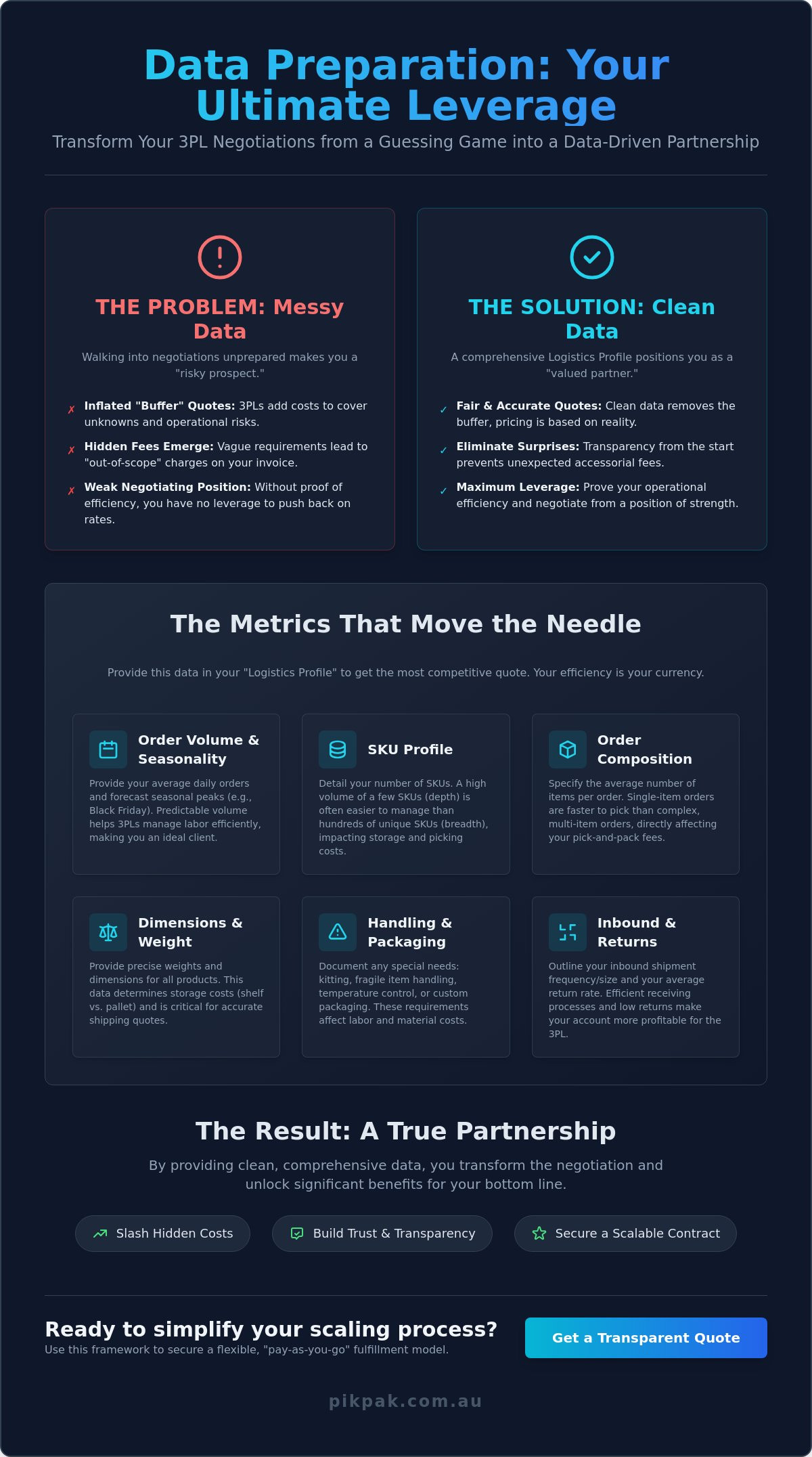
Most eCommerce brands walk into a meeting with a rough idea of their sales and a hope for the best. That’s a mistake. If you want to know how to negotiate 3pl pricing effectively, you need clean data. 3PL providers price their services based on risk and predictability. If your data is messy or incomplete, the provider will naturally add a “buffer” to their quote to cover the unknown. Clean data removes that buffer. It ensures you get a quote based on operational reality, not a worst-case scenario. When you provide clear numbers, you move from being a “risky prospect” to a “valued partner.”
Before your first meeting, build a comprehensive Logistics Profile. This document acts as your brand’s operational resume. It should include precise product dimensions, weights, and specific handling requirements. To ensure your data meets professional standards, you should align your documentation with these Warehouse Receiving Guidelines. When you show up with this information ready, you signal that your business is professional and easy to manage. This level of preparation is your strongest tool for driving down costs from day one.
The Metrics That Move the Needle
3PLs hunt for operational efficiency. They need to understand your average orders per day and how those numbers fluctuate during seasonal peaks like Black Friday or Cyber Monday. A brand shipping 60 orders daily with 15% growth is often more profitable for a warehouse than one that has massive, unpredictable spikes.
- SKU Breadth vs. Depth: Having 1,000 SKUs with only one sale each per month is expensive to store and pick. However, having 20 SKUs with high volume allows the 3PL to optimise warehouse layout and speed up packing.
- Items Per Order (IPO): Your average IPO defines pick-and-pack efficiency. A high IPO means more items are moving in a single box, which often allows for lower per-item handling fees.
Forecasting for Future Discounts
Don’t just talk about your current state. Use a 12-month growth plan to justify “volume tier” pricing. If your data shows a clear path to hitting 3,000 orders per month by June, you can often secure the lower rates associated with that tier immediately. Be careful not to over-promise. Honest forecasts build long-term trust, while inflated numbers can lead to penalty fees or storage minimums if you fail to hit targets. An order profile is the blueprint for 3PL profitability because it defines the exact labour and space required to fulfill your specific mix of products. Understanding how to negotiate 3pl pricing depends entirely on your ability to prove your future value through these numbers.
The Negotiation Playbook: Where to Push and Where to Pivot
Learning how to negotiate 3pl pricing effectively starts with understanding the “Big Three” costs: storage, handling, and outbound freight. These three categories typically account for 85% of your total logistics spend. Negotiating isn’t about demanding the lowest price possible. It’s about finding a sustainable middle ground where the 3PL remains profitable enough to provide excellent service while you protect your margins.
Storage is the first area where you can find quick wins. Many providers default to pallet pricing, which can be a trap for eCommerce brands with high SKU counts but low individual volumes. If you’re storing small items, push for bin or shelf pricing. Paying A$25 per month for a full pallet space that only contains three small boxes is a waste of capital. A 2024 industry report indicates that Australian warehouse vacancy rates are hovering around 1.5%, making space a premium. You can offset these costs by bundling value-added services. For example, integrating kitting and assembly into a flat monthly project rate rather than an hourly labor charge can simplify your billing and lower your total cost per unit.
Use competing quotes as a benchmark, not a weapon. If a competitor offers a lower rate on storage but higher rates on shipping, bring that data to the table. It shows you’ve done your homework. A seasoned provider will respect a data-driven approach and may be willing to match specific line items to win your long-term business.
Negotiating Pick and Pack Rates
Handling fees are often the most flexible part of a contract. Ask for a “per order” pricing model if your average basket size is large. Standard structures often charge a higher fee for the first item and a lower rate for additional items. If your average order contains 3 or more items, this structure is almost always better than a flat per-item fee. For brands running high-volume, single-SKU promotions, ask for a “bulk wave” discount. Since the picker doesn’t have to travel between different warehouse locations, the efficiency gain should result in a 10% to 15% reduction in that specific handling fee.
Leveraging Freight and Shipping Costs
Australia’s geography makes shipping the heaviest burden on your bottom line. You must decide whether to use the 3PL’s carrier accounts or your own. Unless you’re moving more than 50,000 parcels a year, you’ll likely find the 3PL’s rates are 20% lower than what you can secure alone. They aggregate volume from hundreds of clients to get Tier 1 rates from providers like Australia Post and StarTrack. When you master how to negotiate 3pl pricing, focus on regional distribution. Ask about zone-skipping strategies. Moving goods in bulk to a hub closer to the final customer delivery point can cut interstate shipping costs by 12% and reduce transit times by a full day. This keeps your customers happy and your margins healthy.
Contractual Safeguards: Protecting Your Margins Beyond the Rate Card
A low rate card is a trap if the service fails. When you learn how to negotiate 3pl pricing, you quickly realise the rate card is only half the story. You must protect your margins with ironclad contractual safeguards. Start by addressing inventory shrinkage. This is the “missing stock” allowance warehouses claim for lost or damaged items. Many 3PLs in Australia still push for a 2% shrinkage allowance. In 2026, with high stock costs and tighter margins, you should negotiate this down to 0.5% or a “net zero” policy. Ask the right warehousing questions about their cycle counting frequency and security protocols to ensure they can meet these tighter standards. Also, look closely at termination clauses. Don’t let a 3PL hold your stock hostage with massive exit fees or six-month notice periods. A fair contract allows you to move if the service doesn’t meet the agreed standards.
Service Level Agreements (SLAs) as Price Protection
Service Level Agreements act as your financial insurance policy. They turn performance failures into tangible credits. Negotiate specific A$ rebates for every late shipment or picking error. For example, if the 3PL misses the 2:00 PM order cut-off time, they should credit a percentage of the pick fee back to your account. This ensures they have skin in the game. You also need to ensure their technology support uptime is guaranteed in writing. If their system goes down, your orders stop flowing. Demand a 99.9% uptime guarantee with clear financial penalties for any downtime that exceeds two hours. This keeps your business moving like clockwork even when tech hiccups occur.
Price Increase Clauses and Inflation Caps
Inflation is a reality, but it shouldn’t be a blank cheque for your provider. Link all annual price increases to the Australian Bureau of Statistics Consumer Price Index (CPI) or a relevant labour index. A contract without a price cap is a variable liability. Ensure you have at least 90 days of written notice before any surcharge changes take effect, especially for fuel or peak season levies. This window is vital for your cash flow management. It allows you to adjust your own shipping rates before the costs hit your bottom line. Transparent pricing is the only way to ensure your 3PL partnership remains profitable in the long run.
Want a partner who values transparency as much as you do? See how Pik Pak prioritises your service levels.
Building a Partnership: Why Pik Pak Logistics Values Transparency
Negotiation isn’t a battle; it’s a search for alignment. At Pik Pak, we believe “Pick, Pack & Ship Made Easy” starts with a quote you actually understand. When you’re learning how to negotiate 3pl pricing, the most powerful tool you have is clarity. We’ve replaced complex, multi-page fee schedules with a “Pay as you go” model. This means you only pay for the space you use and the orders we fulfill. It’s a pragmatic approach that lets Australian eCommerce brands scale without the A$10,000+ monthly overhead of a private warehouse lease in cities like Sydney or Melbourne.
We don’t cut corners on packaging or security. Instead, we focus on eliminating waste. Waste looks like redundant data entry or stock sitting idle in the wrong zone. By streamlining these movements, we keep your costs down while maintaining high service standards. Our goal is to make your operations run like clockwork so you can focus on your business.
The Pik Pak Advantage: Technology-Driven Savings
Our WMS (Warehouse Management System) does the heavy lifting. It connects directly to your Shopify or WooCommerce store through a simple “point, click and connect” process. This automation removes the manual handling steps that often lead to “hidden” labour charges in traditional contracts. You get real-time visibility into your inventory and billing. There aren’t any surprise invoices at the end of the month because the data is live. You can see exactly what you’re spending in AUD as it happens. This level of visibility is essential when you’re figuring out how to negotiate 3pl pricing because it gives you a data-backed baseline for your costs.
Next Steps: Your 3PL Transition Plan
If your current provider isn’t meeting your needs, it’s time to audit your contract. Look for “minimum spend” clauses or “account management fees” that weren’t clearly explained. These small charges can add up to 15% to your total bill without adding any value to your customer experience.
Our 30-day “Switch and Save” checklist makes the move simple:
- Audit your current SKU list: Ensure your data is clean before the move.
- Review historical data: Use your last 6 months of orders to forecast your needs accurately.
- Schedule a stock transfer: We help coordinate the logistics of moving your goods to our secure facility.
- Connect and test: Link your online store to our technology to ensure orders flow seamlessly.
You don’t need to be a computer geek to get started. We’ve designed our systems to be user-friendly and robust. Let Pik Pak do the hard work for you. Get a transparent, no-headache quote from Pik Pak today and reclaim your time to focus on growth.
Take Control of Your Fulfillment Strategy
Securing a competitive edge in 2026 requires more than just a lower rate card; it demands a deep dive into your shipping data and a commitment to operational transparency. By identifying hidden costs and securing contractual safeguards early, you ensure your margins remain protected as the Australian eCommerce sector continues its projected growth toward A$100 billion in total annual sales. Learning how to negotiate 3pl pricing isn’t just about cutting costs. It’s about building a partnership that scales with your volume and eliminates unnecessary waste from your supply chain.
Logistics shouldn’t be a headache that keeps you from growing your brand. At Pik Pak, we’re specialists in Australian eCommerce fulfillment who believe in making the process as simple as possible. You get full, real-time WMS platform access and zero hidden software fees, ensuring your operations run like clockwork without any nasty surprises. It’s time to stop worrying about the complexities of the warehouse and start focusing on your next big move. We’ve helped hundreds of brands automate their shipping, turning what used to be a challenge into an easy game.
Focus on your business and let Pik Pak handle the rest; get a quote today. We’re ready to help you turn your logistics into a seamless, automated success story that supports your long term growth.
Frequently Asked Questions
Is 3PL pricing usually negotiable for small businesses?
Yes, 3PL pricing is negotiable for small businesses, especially if you show a 15% month on month growth rate. Most providers want to grow with you. When learning how to negotiate 3pl pricing, focus on your projected volume rather than just your current numbers. This helps the provider see the long term value of your partnership and might secure you a 5% discount on storage fees early on.
What are the most common hidden fees in a 3PL contract?
Account management fees and SKU setup charges are the most frequent hidden costs in Australian contracts. These can add A$200 to A$500 to your monthly bill without warning. Always ask for a full schedule of non standard charges before signing. This includes fees for manual data entry or peak season surcharges which can jump by 10% during the November to December period.
How often should I renegotiate my 3PL pricing?
You should renegotiate your contract every 12 months or whenever your shipping volume shifts by 25%. Australian logistics costs fluctuate based on fuel levies and annual CPI increases, which often land around 3% to 4%. Regular reviews ensure you aren’t stuck on an outdated rate card while your business scales. It’s a simple way to keep your operations running like clockwork and eliminate waste.
Can I negotiate better shipping rates through my 3PL?
You can definitely negotiate better shipping rates because 3PLs buy in bulk from carriers like Australia Post or StarTrack. By leveraging their total warehouse volume, you can often save 20% to 35% compared to booking your own freight. Understanding how to negotiate 3pl pricing involves asking for a pass through rate where you benefit directly from these high volume discounts. It makes shipping easy and cost effective.
What is a typical inventory shrinkage allowance in Australia?
A typical inventory shrinkage allowance in the Australian market ranges from 0.5% to 1.5%. This represents the percentage of stock the 3PL isn’t liable for if it’s lost or damaged. If your contract lists an allowance higher than 2%, you’re likely losing money. Ensure this figure is clearly defined to keep your inventory secure and your costs predictable. We believe logistics should be transparent and headache free.
Should I pay for 3PL storage by the pallet or by the square metre?
Choose pallet pricing if your goods fit on standard 1.2m x 1.2m Australian pallets. It’s the most transparent way to manage costs. However, if you sell bulky items like furniture, square metre pricing is more efficient. Pallet storage remains the industry standard for 90% of eCommerce brands because it simplifies reporting and makes auditing your monthly invoices much easier. Let Pik Pak do the hard work of calculating your needs.
How do I know if my 3PL is overcharging me for pick and pack?
Compare your pick and pack costs against the 30% industry benchmark for fulfillment spend. If your per order fees are rising while your volume stays flat, it’s time for an audit. Check for split shipment fees where one order is billed as two separate picks. A reliable partner provides clear reporting so you can see exactly where every cent goes without the stress or confusion.
What happens to my pricing if my order volume suddenly drops?
If your volume drops by more than 30%, you’ll likely trigger a minimum monthly spend clause. Most Australian 3PLs require a base fee, often starting around A$500, to cover their fixed warehouse costs. Your per unit price might also increase if you fall into a lower volume tier. Always check these thresholds early so you can adjust your budget and ensure your business continues to run smoothly.