

Why does your monthly warehouse invoice feel like a riddle you can’t solve? If you’re tired of seeing your margins disappear into a black hole of “in and out” handling fees, you aren’t alone. Many Australian eCommerce owners find that the baseline cost to store a pallet per month is only half the story. You likely agree that logistics should be a predictable line item, not a monthly source of stress that keeps you away from growing your brand. It’s frustrating to pay for empty racking during seasonal dips or get hit with unexpected surcharges just as your sales spike.
This 2026 pricing guide promises to pull back the curtain on the Australian 3PL market. You’ll learn the real factors behind pallet storage rates and how to calculate your total logistics overhead with zero guesswork. We’ll walk you through current industry benchmarks, common hidden costs, and strategies to lower your cost per order. Let’s clear the headache and get your operations running like clockwork so you can focus on your business.
Key Takeaways
- Understand how warehouse location in hubs like Melbourne and Sydney directly impacts your base rates and overall logistics strategy.
- Learn how to accurately calculate the total cost to store a pallet per month by factoring in both base storage fees and essential receiving costs.
- Discover why traditional self-storage often becomes a “garage trap” and how professional 3PL services eliminate hidden DIY expenses.
- Identify five practical ways to lower your monthly storage bill through smarter inventory turnover and SKU rationalisation.
- See how a flexible “pay as you go” model provides the scalability your eCommerce business needs without the risk of long-term leases.
Key Factors Influencing Pallet Storage Costs in Australia
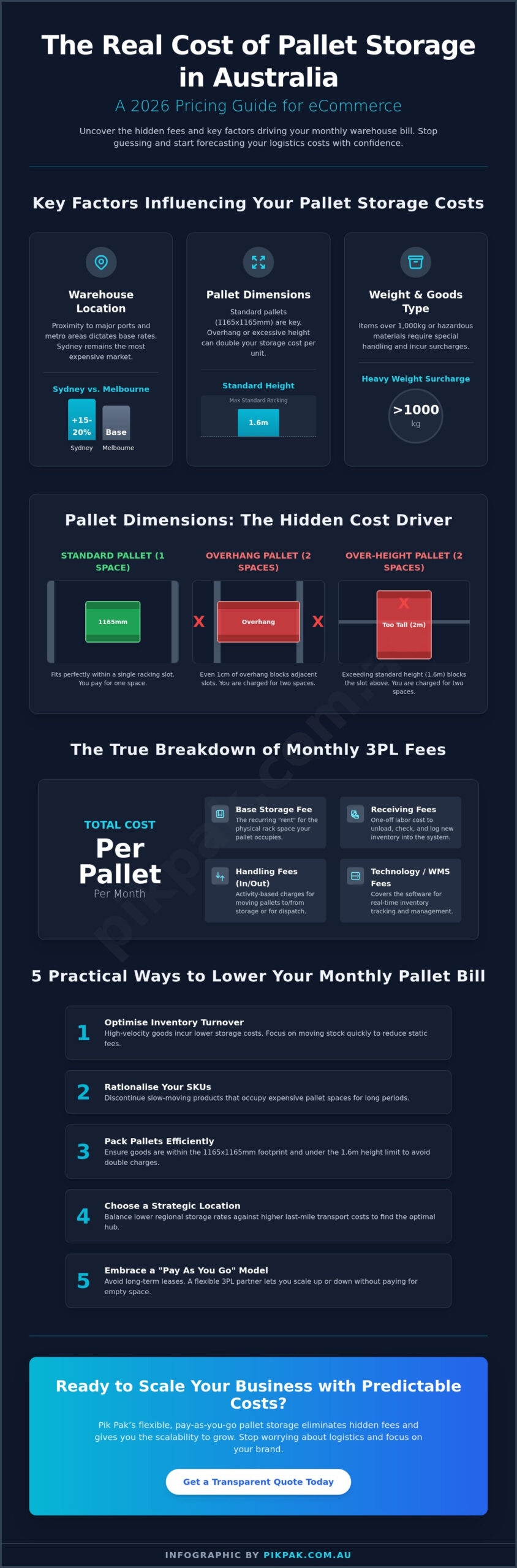
The cost to store a pallet per month in Australia is the fundamental unit of measurement for your inventory overhead. It represents the monthly fee for one standard pallet space in a secure, managed facility. While the concept is simple, the actual price you pay is influenced by a complex mix of market demand and physical logistics. By 2026, warehouse vacancy rates in major hubs remain tight, which keeps pricing firm. Your total bill depends on location, physical dimensions, and the specific nature of your goods. Hazardous materials or heavy items over 1,000kg often trigger surcharges because they require specialized equipment or safety protocols within warehouse operations. Understanding these levers allows you to scale as you grow without hidden surprises. Focus on your business and let a partner like Pik Pak handle the heavy lifting. Our warehousing and fulfilment services are designed to make logistics easy and transparent.
Standard vs. Oversized Pallets
Most Australian facilities use the standard 1165mm x 1165mm footprint. If your goods extend beyond these edges, you have created overhang. This isn’t just a safety issue; it’s a major cost driver. A single centimetre of overhang can force a warehouse to charge you for two pallet spaces because it blocks adjacent slots. Height is equally critical. Standard racking systems are built for pallets roughly 1.2m to 1.6m tall. If your pallet reaches 2m, it won’t fit in standard racking. This often results in double the cost to store a pallet per month because the facility loses a vertical slot to accommodate your height.
Regional Price Variations in 2026
Location is the most significant factor in your 2026 logistics budget. Sydney remains the most expensive market in the country, with rates typically sitting 15% to 20% higher than Melbourne. Proximity to major infrastructure like the Melbourne Docks or Port Botany reduces your transport costs but increases your storage rent. Choosing a regional warehouse might save you A$2.50 per pallet on storage, but you’ll likely pay A$6.00 more in transport to get those goods to your metro customers. It’s a balancing act. You need a pragmatic strategy to ensure your proximity to customers doesn’t eat your margins. We help you automate these decisions so your operations run like clockwork.
- Sydney Metro: Highest demand, highest cost per square metre.
- Melbourne Metro: Competitive rates with excellent port access.
- Regional Hubs: Lower storage costs but significantly higher transport lead times.
- Weight Limits: Pallets exceeding 1,000kg often incur a “heavy weight” fee.
The True Breakdown of Monthly Pallet Storage Fees
A 3PL quote can look like a complex puzzle, but it’s simpler than you think. You aren’t just paying for a square metre of concrete in a warehouse. The total cost to store a pallet per month in Australia usually combines four distinct components that ensure your stock is safe, tracked, and ready for dispatch. Understanding these layers helps you eliminate waste and forecast your logistics spend with confidence.
- Base Storage Fee: This is the “rent” for the rack space your pallet occupies. It’s a recurring charge typically billed weekly or monthly.
- Receiving Fees: These cover the initial labour to unload your container and log every SKU into the system. This ensures your inventory is counted and checked for damage immediately upon arrival.
- Handling Fees (In/Out): These are activity-based charges. You pay these when a pallet is moved from the receiving dock to a rack, or from the rack to the dispatch area.
- Technology and WMS Fees: These cover the digital infrastructure that keeps your business running like clockwork. They provide the visibility you need to manage your business from anywhere.
Standard pallet dimensions in Australia are 1165mm x 1165mm. If your goods overhang these limits, you might find yourself paying for two pallet spaces instead of one. Knowing these specifics allows you to pack more efficiently and keep your cost to store a pallet per month as low as possible.
Storage vs. Handling: Understanding the Difference
Storage is a static cost, while handling is purely activity-based. If your stock sits for months, your storage fees will be the primary expense. Conversely, high-velocity goods that move in and out within days will incur lower storage costs but higher handling fees. When you review a 3PL quote, look for these as separate line items. This transparency ensures you only pay for the work actually performed. It’s a pay-as-you-go model that lets you scale as you grow without hidden surprises.
The Role of Technology in Cost Management
Modern logistics relies on a robust Warehouse Management System (WMS) to eliminate waste. A WMS prevents you from paying for “ghost inventory” by providing real-time accuracy across your entire stock list. Automated stock alerts help you manage reorder points, so you don’t overstock and bloat your monthly bill.
By using API integrations, your store connects directly to the warehouse. This removes the need for manual data entry, which reduces administrative labour costs by up to 30% for many growing brands. This technology makes what seems like a challenge an easy game with Pik Pak. If you want to see how these efficiencies can streamline your operations, it’s a simple way to reclaim your time and focus on your business.
3PL Pallet Storage vs. Self-Storage: A Cost Comparison
Many eCommerce owners fall into the “Garage Trap.” They start by storing stock in a spare room or a local self-storage unit because the monthly rent looks predictable. However, when you calculate the true cost to store a pallet per month, self-storage often becomes a financial drain. You aren’t just paying for the floor space; you’re paying for the “air” in the top half of the unit that you can’t safely reach without industrial racking.
A professional 3PL facility operates differently. You only pay for the exact volume you use. If you have five pallets this month, you pay for five. If your stock levels drop to two pallets next month, your bill drops too. This level of scalability is impossible with self-storage, where you’re locked into a fixed room size regardless of whether it’s full or half-empty. Beyond the rent, DIY storage carries hidden costs like fuel, vehicle wear, and the constant stress of managing your own inventory levels.
Labour: The Invisible Expense
Moving stock yourself is only “free” if your time has no value. If an eCommerce founder spends five hours a week driving to a storage unit, unloading deliveries, and hand-stacking boxes, that’s 260 hours a year. At a conservative business rate of A$80 per hour, that’s A$20,800 in lost productivity. Professional 3PL providers include forklift services and expert handling as part of their standard operations. Choosing outsourced warehousing allows you to stop acting as a warehouse labourer and start acting as a CEO. It frees up your schedule to focus on marketing and product development while we handle the heavy lifting.
Security and Risk Mitigation
A padlock on a self-storage door is a basic deterrent, but it doesn’t offer real business protection. Professional 3PL facilities provide 24/7 monitored security, fire suppression systems, and strict access controls. This environment significantly reduces “shrinkage,” the industry term for lost, stolen, or damaged stock. Inventory accuracy in a 3PL is maintained through a Warehouse Management System (WMS), giving you a digital paper trail for every item.
Risk also extends to how stock arrives. Damaged goods are a major profit killer for Australian retailers. By following professional receiving guidelines, a 3PL ensures that your stock is inspected and logged correctly the moment it hits the dock. This prevents the cost to store a pallet per month from being inflated by unsellable or broken inventory that sits on your shelves for weeks before you notice the damage.
- 3PL: Pay-as-you-go pricing based on actual pallet count.
- Self-Storage: Fixed monthly rent for a set space, even if it’s empty.
- 3PL: Professional equipment and staff included.
- Self-Storage: DIY manual handling and personal transport costs.
5 Practical Ways to Lower Your Monthly Pallet Bill
Reducing your logistics overhead doesn’t always mean searching for the lowest base rate. Often, the most significant savings come from internal process tweaks that reduce the physical footprint of your stock. When you’re calculating the cost to store a pallet per month, every square centimetre of the warehouse floor represents a line item on your invoice. Efficient brands focus on moving products, not just storing them. By tightening your operations, you can ensure you only pay for the space you actually need to generate profit.
- SKU Rationalisation: Review your product list every 90 days. Identify the bottom 5% of performers that take up space without generating consistent sales. If a product isn’t moving, it’s costing you money every day it sits on a rack.
- Consolidate Pallets: Instruct your warehouse team to merge half-empty pallets. Paying for a full pallet position for three small boxes is a quick way to drain your budget. Combining these into a single pallet can slash your storage fees for those items by 50% or more.
- Seasonal Forecasting: Use data from the last 24 months to predict stock levels. This prevents you from over-ordering and paying for excess capacity during quiet periods like February or July.
Improving Inventory Velocity
Inventory velocity is measured by the Days Sales of Inventory (DSI) metric. This figure tells you exactly how many days it takes to turn your stock into revenue. A high DSI means your capital is tied up in stagnant pallets, driving up your cost to store a pallet per month. To fix this, you should liquidate slow-moving items through flash sales or clearance events. There’s a direct link between order fulfilment speed and storage savings. Faster shipping cycles mean stock leaves the warehouse sooner, which frees up pallet positions for new, high-demand inventory that keeps your cash flow healthy.
Packing for Efficiency
Volumetric weight is a calculation that reflects a package’s density, essentially measuring how much space it occupies relative to its actual weight. If your suppliers use oversized cartons for small items, you’re paying to store Australian air. Work with your manufacturers to standardise carton sizes that fit perfectly on a standard 1165mm x 1165mm Australian pallet. Proper stacking is also vital for your bottom line. Avoid “leaning” or “overhanging” pallets. These often require two pallet slots instead of one because they won’t fit in standard racking, which can double your storage fee instantly. Following strict receiving guidelines ensures your stock arrives ready for the rack without requiring expensive manual restacking or extra handling fees.
Stop overpaying for stagnant stock and start scaling your business with a partner that values efficiency. See how Pik Pak simplifies your warehousing today.
Scale Your Business with Pik Pak’s Flexible Pallet Storage
Managing your inventory shouldn’t feel like a gamble with your profit margins. At Pik Pak, we’ve stripped away the complexity of traditional warehousing to offer a “Pay as You Go” model that actually works for growing brands. You don’t have to worry about long-term leases or restrictive lock-in contracts that drain your capital. Instead, you only pay for the space you use. This flexibility is vital when calculating your cost to store a pallet per month, as it allows you to scale up for seasonal peaks and dial back during quieter periods without penalty.
Our Melbourne-based warehouse serves as the engine room for your eCommerce operations. We provide seamless integration from your e-store directly to our facility, ensuring that every order is processed with precision. We believe that transparent pricing is the foundation of a good partnership. It’s what makes logistics run like clockwork for our clients. By leveraging our advanced technology, you can automate the manual bits of fulfilment and focus on what you do best: building your brand. We handle the heavy lifting while you keep your eyes on the growth charts.
The Pik Pak Advantage for eCommerce
Our philosophy is simple: Pick, Pack & Ship Made Easy. We’ve designed our systems to be accessible, even if you aren’t a computer geek. Our central Melbourne location provides a strategic edge for national distribution across Australia, reducing transit times and shipping costs for your customers. Whether you’re moving 5 pallets or 500, we provide the same level of dedicated support. To get a clear picture of your specific cost to store a pallet per month, you can request a tailored quote that reflects your unique volume and requirements.
Ready to Free Up Your Time?
Professional storage does more than just clear out your garage or overcrowded office. It transforms how your business functions. When you outsource to a partner like Pik Pak, you’re reclaiming hours of your week that were previously lost to manual packing and inventory counts. Logistics might seem like a headache, but it’s an easy game when you have the right team in your corner. We’re here to ensure your operations are secure, simple, and automated. Ready to see the difference? Contact us today for a quote and let’s get your business moving.
Take Control of Your Logistics Costs in 2026
Managing the cost to store a pallet per month in Australia doesn’t have to be a source of stress. The transition from expensive self-storage to agile 3PL models is the most effective way to protect your margins as market conditions evolve. You now understand that warehouse efficiency and strategic inventory placement are the primary drivers of long-term savings. It’s about working smarter to keep your business lean and competitive.
Pik Pak is here to handle the heavy lifting. Our pay as you go pricing model eliminates wasted spend, while our real-time WMS visibility ensures you’re never in the dark about your stock levels. With expert Melbourne-based support just a phone call away, we make complex logistics feel like an easy game. Focus on your business and let us ensure your operations run like clockwork.
Get a Transparent Pallet Storage Quote from Pik Pak Today
Your growth is waiting, and we’re ready to help you reach it.
Frequently Asked Questions
How much does it cost to store a pallet per month in Australia on average?
The average cost to store a pallet per month in Australia typically ranges from A$15 to A$50 per unit. These rates fluctuate based on the warehouse location and the total volume of stock you hold. For instance, premium facilities in Sydney or Melbourne often sit at the higher end of the scale due to land value. Using a pay-as-you-go model ensures you only pay for what you use, making logistics a simple, manageable task.
Are there hidden fees in pallet storage quotes?
You’ll often find additional charges beyond the base storage rate, such as “in-and-out” handling fees and container destuffing costs. Handling fees usually range from A$5 to A$15 per pallet move. Some providers also apply administrative or account management fees each month. We believe in transparent pricing to eliminate waste and ensure your operations run like clockwork without any nasty financial surprises.
What is the difference between pallet storage and a full warehouse lease?
A warehouse lease involves a fixed long-term contract for an entire building, whereas pallet storage is a flexible service based on specific unit counts. Commercial leases in Australia can cost A$150 to A$250 per square metre annually, plus extra costs for utilities and staff. Choosing pallet storage with a 3PL provider allows you to scale as you grow. It’s a pragmatic way to free up your time and avoid property management headaches.
Do I have to pay for a whole pallet space if my pallet is only half full?
Most warehouses charge for a full pallet space because the footprint occupied in the racking remains the same regardless of the stock height. A standard Australian pallet measures 1165mm by 1165mm, and that space is reserved exclusively for your goods. If you consistently have small volumes, ask about shelf or bin storage options. This helps you stay in control of your budget and prevents you from paying for empty air.
Is insurance included in the monthly pallet storage cost?
Standard storage fees almost never include comprehensive insurance for your inventory. While the warehouse maintains public liability and building insurance, you’re responsible for “Goods in Transit” or “Stock Throughput” cover. This protects your business against loss or damage from fire, theft, or natural disasters. It’s a small but vital investment that ensures your eCommerce business remains secure and resilient.
How often are pallet storage fees invoiced?
Pallet storage fees are typically invoiced on a weekly or monthly basis depending on your agreement. Many Australian providers prefer weekly billing because it accurately reflects the stock levels that fluctuate as you sell products. This frequent cycle provides a clear view of your expenses in real-time. It makes it easy to track your spending and adjust your inventory strategy to maximize profitability.
Can I access my pallets if I store them with a 3PL provider?
You can access your inventory data and manage movements 24/7 through a digital Warehouse Management System (WMS). While you don’t physically visit the racks, you have total control via a “point, click, and connect” interface. This tech-savvy approach means you don’t need to be a computer geek to manage your stock. Let the experts do the hard work while you focus on your business growth.
What happens to the cost if I have oversized or heavy pallets?
Oversized or heavy pallets often incur surcharges because they require specialized handling or additional racking space. If a pallet exceeds 1.2 metres in height or weighs over 1,000kg, the cost to store a pallet per month may increase significantly. Some facilities charge for two spaces if the goods overhang the edges of a standard pallet. Knowing these dimensions upfront helps keep your logistics costs predictable and easy to manage.