

Why are you still paying for a warehouse that sits 60% empty for nine months of the year just to survive a three-week holiday rush? For many Australian retailers, the traditional logistics model is a trap of high fixed costs and frantic, last-minute hiring. Managing 3pl for seasonal businesses shouldn’t feel like a gamble every time a sale event goes live. You know the frustration of watching shipping delays lead to one-star reviews while you’re personally packing boxes at midnight because your temporary staff couldn’t keep up with the surge.
It’s time to stop the cycle of seasonal burnout. We’ll show you how to eliminate the stress of fluctuating demand and reduce your off-season overhead by leveraging the elasticity of a dedicated logistics partner. You can achieve a reliable 24-hour dispatch even during 500% volume spikes without the headache of managing your own space or staff. This guide explores how to transition to a model that scales automatically, ensuring your operations run like clockwork while you focus on growing your brand.
Key Takeaways
- Escape the “fixed cost trap” by transitioning to a variable pay-as-you-go model that protects your cash flow during the quieter Australian off-season.
- Leverage 3pl for seasonal businesses to access elastic warehouse space that scales instantly when your order volume jumps 5x or 10x.
- Streamline your operations with a professional integration checklist to connect your Shopify or WooCommerce store and automate your peak-season stock management.
- Reduce your operational overhead and eliminate the headache of managing temporary staff by outsourcing complex kitting and seasonal bundling.
- Transform your logistics from a chaotic burden into a simple, automated process that lets you focus on scaling your business with total confidence.
The Seasonal Rollercoaster: Why Fixed Logistics Fail eCommerce Brands
Managing an eCommerce brand in Australia feels manageable until the calendar hits November. Seasonal logistics isn’t just about shipping a few extra parcels; it’s about surviving volume fluctuations of 5x to 10x your baseline. When a 500% order surge hits during the Black Friday sales or the Christmas rush, manual processes that worked perfectly in June will inevitably break. Relying on Third-party logistics allows you to bypass these operational bottlenecks. Most growing brands fall into the ‘Fixed Cost Trap’ because they pay for warehouse space and permanent staff they only truly need for three months of the year. This inefficiency drains your margins and creates unnecessary stress during your most profitable periods.
The Australian peak calendar is relentless. It starts with the End of Financial Year (EOFY) sales in June, followed by the massive Q4 push including Click Frenzy, Black Friday, Cyber Monday, and Christmas. Without a scalable system, your team spends more time fighting fires than growing the brand. Using 3pl for seasonal businesses turns these chaotic peaks into a streamlined, automated process. What seems like a logistics challenge becomes an easy game when you have the right infrastructure behind you.
The Hidden Costs of In-House Warehousing
Commercial leases in Australian hubs like Sydney, Melbourne, or Brisbane often demand three to five-year commitments. These overheads don’t shrink when your sales dip in February. You’re essentially paying for empty air during the off-season. Beyond the rent, there’s the recruitment headache. Hiring and training temporary staff for a six-week surge involves significant costs in payroll, insurance, and management time. This “logistics noise” creates a massive opportunity cost. Every hour you spend managing a warehouse floor is an hour you aren’t spending on marketing or product development. It’s much simpler to let a specialist handle the heavy lifting while you focus on your business.
When to Transition to a 3PL for Seasonal Demand
Identifying the right time to move is critical for your bottom line. You’ve reached the tipping point if your dispatch times regularly slip past 48 hours during sales or if your inventory accuracy falls below 99%. These errors lead to poor reviews and lost customers. When the combined cost of a long-term lease and seasonal overheads exceeds the per-order cost of outsourced fulfilment, it’s time to switch. Utilizing 3pl for seasonal businesses ensures your operations run like clockwork regardless of order volume. Ultimately, 3PL for seasonal businesses is a variable cost solution for a variable demand problem.
How 3PL Solves the Scalability Puzzle for Seasonal Peaks
Managing a sudden surge in orders isn’t just about working harder. It’s about having a system that expands when you need it and shrinks when you don’t. Using a 3pl for seasonal businesses eliminates the risk of outgrowing your garage or paying for a massive warehouse that sits half-empty in July. It transforms a fixed overhead into a flexible cost that matches your revenue flow.
Elastic Warehousing: Only Pay for the Pallets You Use
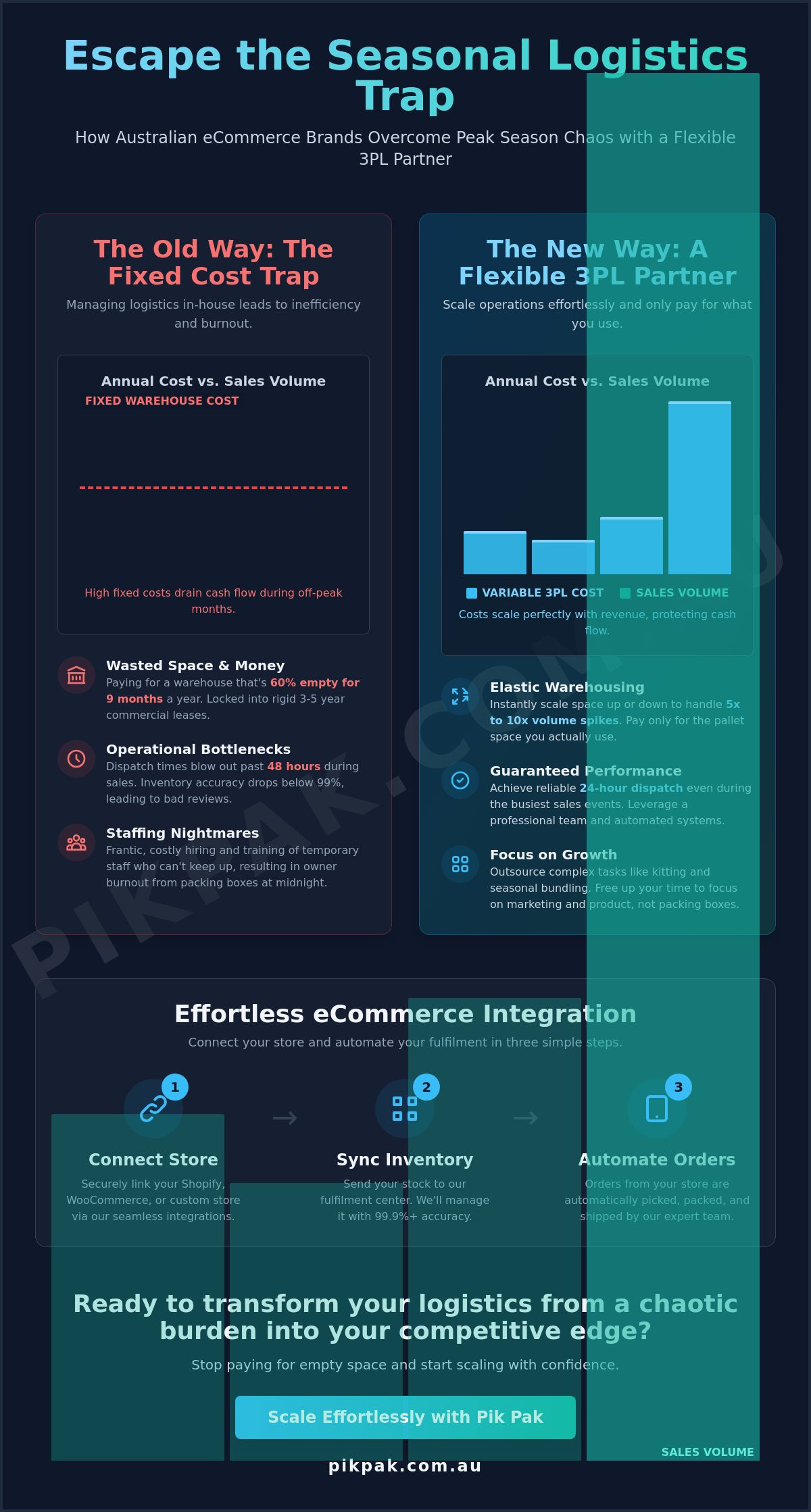
Traditional commercial leases in Australia often lock you into a fixed square meterage for years. This is a drain on your cash flow during quiet months. A professional 3PL offers a “pay-as-you-go” storage model. You only pay for the specific pallet spaces or shelf slots your stock occupies. When your pre-Christmas stock arrives in October, your storage footprint expands instantly to absorb the overflow. By February, as stock levels drop, so does your bill. If you are still building your strategy and need to know what is 3PL?, think of it as a flexible extension of your own business that grows with you.
This flexibility allows you to pivot quickly without the stress of managing physical space. A 2021 report from Forbes highlighted how e-commerce fulfillment solutions provide the necessary labor and space to handle shifts in consumer demand without heavy capital investment. This is especially vital in the Australian market where warehouse vacancy rates in cities like Sydney and Melbourne have hit record lows, making flexible space a competitive advantage.
Kitting and Special Projects for Sales Events
Seasonal peaks often mean gift bundles, “buy one get one” deals, or limited edition packaging. Relying on a 3pl for seasonal businesses to handle these special projects means you don’t have to hire temporary staff for a two-week sale. 3PL providers offer professional kitting services that turn raw inventory into sale-ready kits in hours. This pre-kitting significantly reduces dispatch times during the actual sales event.
It’s about maintaining your brand experience. Even when you’re shipping 500 orders a day, each package needs to look perfect. 3PL teams follow your specific packing instructions to ensure every customer gets that premium unboxing feel. You also benefit from the 3PL’s established courier network. During peak periods, many Australian carriers apply surcharges or limit pickups for smaller retailers. Because 3PLs move high volumes, they often secure better rates and more reliable collection windows for their clients. You stay in control through a Warehouse Management System (WMS). It gives you real-time visibility so you can see exactly how many orders are out the door while you focus on your marketing. If you want to see how this works for your specific products, you can explore our full range of fulfilment services.
The Financial Edge: 3PL Pay-As-You-Go vs. Long-Term Leases
Managing the finances of a seasonal brand often feels like a balancing act between feast and famine. The biggest drain on your capital isn’t usually the product itself, it’s the rigid, fixed costs of traditional logistics. When you choose 3pl for seasonal businesses, you trade those heavy fixed expenses for a nimble “pay-as-you-go” model. This shift protects your cash flow by ensuring your expenses only rise when your revenue does. You aren’t stuck paying for a massive warehouse and a full team during the quiet months of July if your peak doesn’t hit until November.
Many founders fall into the trap of thinking they’re saving money by keeping fulfilment in-house. This is often a myth. When you calculate the true cost of DIY, you have to include warehouse insurance, utilities, packing materials, and the significant value of your own time. A 2023 report on Australian industrial trends noted that small warehouse overheads can increase by 10% annually regardless of your sales volume. Outsourcing removes these hidden “leakages.” Instead of sinking A$30,000 into a yearly lease, you can redirect that capital to fund your next major inventory buy, ensuring you have enough stock to meet peak demand without taking on high-interest debt.
The most common objection is that 3PL services feel expensive when orders are slow. In reality, the opposite is true. During a slow month, a 3PL might only charge you for the ten pallets you have in storage. Compare that to a fixed commercial lease where the rent remains exactly the same whether your warehouse is full of stock or completely empty. It’s the difference between a scalable partnership and a financial anchor.
Cash Flow Management in the Off-Season
The off-season should be a time for planning and marketing, not worrying about “dead costs.” By using a 3PL, you eliminate the expense of empty shelves during February and March. Every dollar saved on unneeded warehouse space is a dollar you can put into Facebook ads or influencer campaigns to build hype for your next peak. To put the savings into perspective, paying roughly A$20 per week for a single pallet of storage is significantly more efficient than committing to a 100sqm industrial lease that could cost upwards of A$2,500 per month in major Australian hubs.
Comparing the Models: In-House vs. 3PL
Choosing the right path depends on how fast you need to move. If a social media post goes viral, an in-house model often hits a breaking point within 48 hours. A professional 3PL is built for these spikes. You can explore how these structures work in detail by looking at warehousing and fulfilment options that adapt to your specific volume.
| Feature | In-House / DIY | Pik Pak 3PL Model |
|---|---|---|
| Staffing | Fixed wages or stressful temp hiring | Professional team included in fees |
| Rent | Fixed monthly lease (3-5 years) | Variable based on actual usage |
| Software | Separate WMS subscriptions | Integrated technology included |
| Shipping Rates | Standard small business rates | Bulk-discounted carrier rates |
The scalability factor is the ultimate tie-breaker. When your business grows 300% in a single week, the 3PL model absorbs the shock. You don’t have to find a new building or spend your weekend packing boxes. You simply watch the orders flow through the system while you focus on the next big win. Using 3pl for seasonal businesses isn’t just a logistics choice; it’s a strategic financial move that keeps your business liquid and ready for growth.
Preparing for the Peak: A 3PL Integration Checklist
Success during the Australian peak retail season isn’t about working harder; it’s about preparing smarter. When you partner with a 3pl for seasonal businesses, the goal is to shift from reactive firefighting to proactive growth. Use this four step checklist to ensure your operations run like clockwork when the orders start flooding in.
- Step 1: Audit your sales data. Don’t guess your stock levels. Review your 2023 reports to forecast peak inventory requirements accurately. If your November sales grew by 15% last year, factor in a similar buffer for this year to avoid stockouts.
- Step 2: Connect your store via API. Whether you use Shopify or WooCommerce, a direct API connection ensures orders flow instantly to the warehouse. This eliminates manual data entry and the 5% error rate typical of human processing.
- Step 3: Define your Receiving Guidelines. Ensure your suppliers know exactly how to label and pack your shipments. When stock arrives correctly, it moves through the system faster.
- Step 4: Automate returns management. With Australian fashion return rates often hitting 25% after Christmas, you need a system that handles the post-holiday surge without manual intervention.
The Power of Seamless Tech Integration
We aren’t all computer geeks, and you shouldn’t have to be. The secret to seasonal agility is a “point, click, and connect” approach. By automating your order flow, you remove the “headache” of spreadsheets. Our technology support provides a robust WMS advantage, ensuring every order is tracked in real time. This visibility allows you to focus on your business while the software handles the heavy lifting.
Warehouse Receiving: Avoiding the Peak Bottleneck
The biggest delay in logistics often happens at the front door. Following our warehouse receiving guidelines is the most effective way to accelerate your supply chain. Proper labelling and palletising can save up to 48 hours in stock-to-shelf time. This means your products are ready for sale two days earlier than your competitors. We set clear Service Level Agreements (SLAs) for dispatch times, so you know exactly when your customers will receive their parcels. Choosing a 3pl for seasonal businesses that prioritises these standards ensures you never miss a delivery window during the December rush.
Ready to reclaim your time and scale without the stress? Explore our logistics services and see how we make fulfilment easy.
Scaling Your Australian Business Effortlessly with Pik Pak
Australian eCommerce moves fast, especially during the significant retail surges seen between November and December. Managing these peaks shouldn’t feel like an operational crisis. At Pik Pak, we solve the headache of local seasonal shifts by providing a stable, scalable infrastructure that grows with your order volume. What seems to be a challenge for others is an easy game with Pik Pak. We move your operations from logistics chaos to clockwork precision, ensuring your customers receive their packages on time, every time.
You started your business to build a brand and connect with customers, not to spend 14 hours a day taping boxes in a cold warehouse. By partnering with a dedicated 3pl for seasonal businesses, you reclaim your most valuable asset: time. We handle the entire pick, pack, and ship process so you can stay focused on high-level growth and marketing. Because we’re a local Melbourne-based partner, we offer support that international providers can’t match. We understand the Australian freight network, local public holidays, and the specific expectations of Aussie shoppers. We’re in your time zone and ready to help when you need us most.
The Pik Pak Advantage for Seasonal Brands
- No long-term contracts: We provide the ultimate flexibility for seasonal sellers. You shouldn’t be trapped in a 12-month commitment when your peak only lasts three months.
- Transparent pricing: We make ROI calculation simple. With clear costs, you can protect your margins and plan your seasonal spend with total confidence.
- Simple integration: Our technology connects to your existing store in minutes.
Our “pay as you go” approach ensures that your costs align perfectly with your revenue. You can explore our tailored logistics solutions to see exactly how we adapt our warehouse space and staffing levels to meet your specific demand cycles.
Getting Started Before the Next Peak
Speed is vital when you’re staring down a looming sales event. Our streamlined onboarding process takes just 14 days. This means it’s never too late to switch providers and protect your brand’s reputation before the next rush hits. We’ve refined our system to be a “point, click, and connect” experience, removing the need for complex technical knowledge or expensive software installations.
A 3pl for seasonal businesses should make your life easier, not more complicated. Let Pik Pak do the hard work for you. We’ll turn your fulfillment from a source of stress into a seamless extension of your brand. Stop worrying about warehouse capacity or casual staffing hurdles. Get a quote from Pik Pak today and start scaling your business with a partner that makes logistics look easy.
Turn Your Seasonal Surge Into a Competitive Advantage
Seasonal peaks shouldn’t feel like a logistical crisis. By transitioning from rigid, long-term warehouse leases to a flexible 3pl for seasonal businesses, you protect your margins and your sanity. You’ve seen how a pay-as-you-go storage model eliminates the waste of paying for empty shelves during quiet months. Combined with seamless API integration that connects your store in minutes, the path to effortless scaling is clear. Australian eCommerce brands that automate their fulfillment see fewer errors and faster shipping times, which keeps customers coming back long after the peak ends.
Pik Pak makes this transition simple with a dedicated Australian-based support team ready to help you navigate every surge. You don’t need to be a tech expert to get started; our point, click, and connect system does the heavy lifting for you. It’s time to stop worrying about warehouse space and start focusing on your growth strategy. Free up your time and focus on your business, let Pik Pak handle the peak. Get Started Today.
Your business deserves a logistics partner that grows at your pace and keeps things running like clockwork year-round.
Frequently Asked Questions
Is a 3PL worth it if my business is only busy for 4 months of the year?
Yes, a 3PL is highly cost-effective for businesses with high seasonality because you avoid the fixed overhead of a year-round warehouse lease. In Australia, commercial warehouse rents can cost upwards of A$150 per square metre annually. By using a 3PL for seasonal businesses, you only pay for storage and labour during your peak. This flexibility saves you from paying for empty shelves during the remaining 8 months. Focus on your business growth while we handle the space.
How quickly can a 3PL scale up for a flash sale or Black Friday event?
We can scale your operations in as little as 24 hours once your stock arrives and the sale begins. Our systems are built to handle sudden 500% increases in order volume without missing a beat. You don’t need to worry about hiring temporary staff or finding extra packing benches. We provide the infrastructure and team to ensure your Black Friday orders ship within our standard 24-hour turnaround time. It’s all done for you.
Do I have to pay for warehouse space I don’t use during the off-season?
No, you only pay for the specific pallet or shelf space your inventory occupies each day. This pay as you go model is a core benefit of using a 3PL for seasonal businesses. If your stock levels drop by 80% after Christmas, your storage costs drop by the same margin immediately. It eliminates the financial headache of traditional leases and ensures your logistics costs stay aligned with your actual sales revenue throughout the year.
Can a 3PL handle seasonal gift wrapping or custom kitting?
Yes, we offer full custom kitting and seasonal gift wrapping services to enhance your unboxing experience. Whether you need 3 items bundled into a Christmas hamper or specific tissue paper for Mother’s Day, our team handles the manual work. We’ve managed kitting projects ranging from 50 to 5,000 units with 100% accuracy. This lets you offer premium seasonal variations without spending your own weekends packing boxes. Let Pik Pak do the hard work for you.
What happens to my returns after a major holiday sales peak?
We manage the entire reverse logistics process by receiving, inspecting, and restocking returned items. Australia Post reports that return rates can jump to 25% after holiday peaks, so having a system is vital. We check every item against your quality standards within 48 hours of arrival. Items in perfect condition go back into your sellable stock immediately. This keeps your inventory levels accurate and ensures you don’t lose money on resaleable goods.
How does a 3PL integrate with my Shopify or WooCommerce store?
Integration is a simple point and click process that takes less than 15 minutes. Our technology connects directly to Shopify or WooCommerce via secure API, so your orders flow to our warehouse automatically. There’s no manual data entry or complex software to install. Once we ship an order, the tracking number syncs back to your store and notifies your customer instantly. It’s a secure way to automate your fulfilment and reclaim your time.
Is there a minimum order volume required to use a seasonal 3PL?
We work with businesses at various stages, though most of our partners ship at least 50 orders per month. Our goal is to help you scale as you grow, so we don’t lock you into restrictive high-volume contracts from day one. This flexibility is perfect for seasonal brands that might ship 20 orders in July but 2,000 in December. You get professional-grade logistics support regardless of where you are in your current growth cycle.