

Is your business actually growing, or are you just paying for the privilege of being busy? With the average all-in fulfillment cost per order reaching as high as $5.50 in 2026, many brands are working harder than ever only to see their margins vanish into a black hole of hidden fees. Learning how to calculate your true fulfillment cost is no longer a luxury for large retailers. It is a vital survival skill for every e-commerce owner who wants to protect their bottom line.
It’s frustrating to watch your profits shrink while trying to decode 3PL invoices that feel intentionally confusing. You aren’t alone in feeling the pressure of the recent 5.9% FedEx and UPS rate hikes or the rising costs of packaging materials like plastic resin. We promise to give you the exact formula and hidden expense checklist you need to find your real cost per order. This guide provides a clear framework to help you identify cost-reduction areas and finally decide if your current setup is sustainable. We will walk through every expense from warehouse labor to the new dimensional weight rules so you can reclaim your time and focus on growth.
Key Takeaways
- Stop falling for the “shipping plus box” trap and learn how to calculate your true fulfillment cost to see what you’re actually spending on every single order.
- Identify hidden “margin killers” like the cost of your own labor and the significant impact of returns on your bottom line.
- Follow a clear, two-phase audit process to export your financial data and isolate exact spending on freight, packaging, and warehouse rent.
- Learn how a 3PL partnership converts rigid overhead into flexible variable costs, giving you more control over your cash flow as you scale.
- Gain a clear dollar figure for your cost per order so you can make data-driven decisions about pricing and outsourcing.
What is True Fulfilment Cost (TFC) and Why Does It Matter?
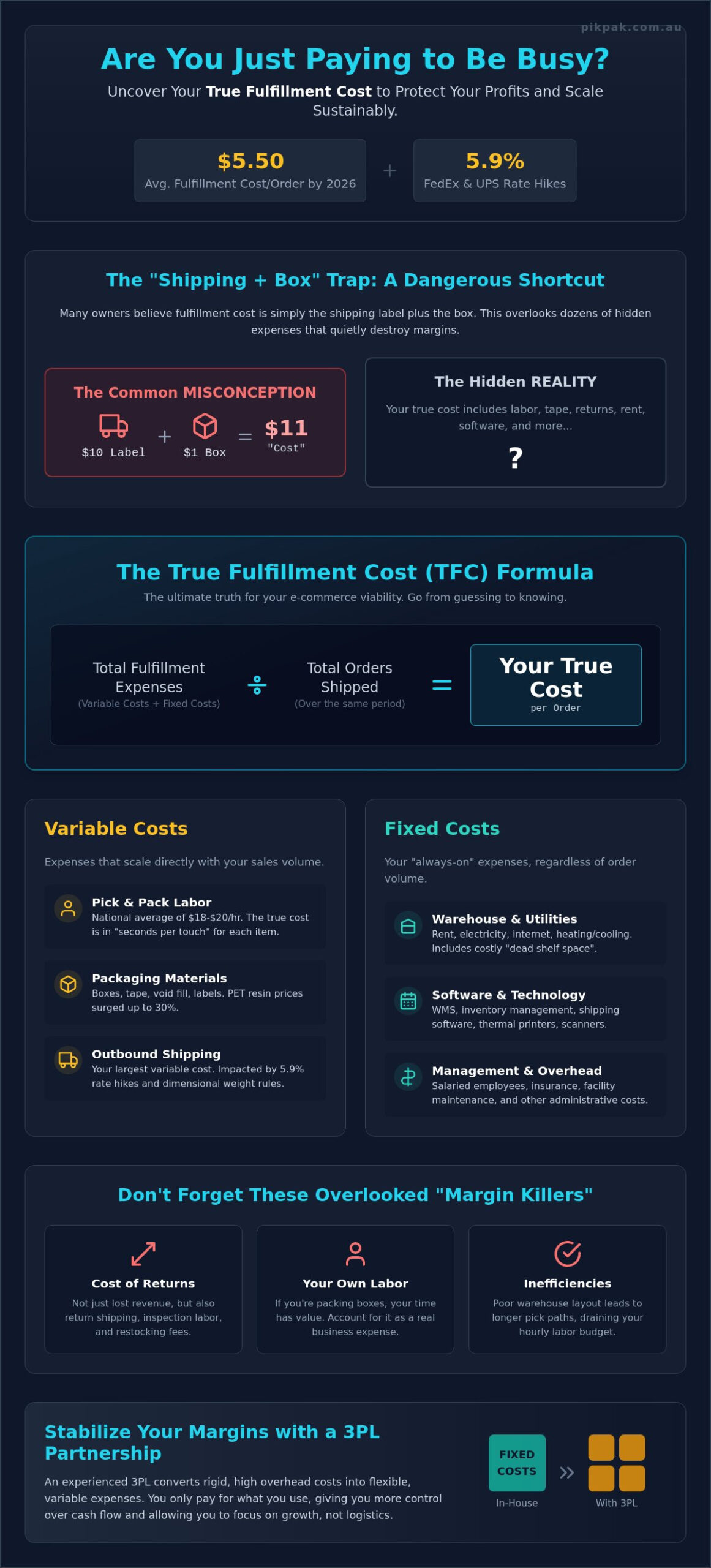
True Fulfilment Cost (TFC) represents the total financial weight of your operations. It is the sum of every single cent spent from the moment a customer clicks “buy” to the moment the package hits their porch. Many business owners fall into the “shipping + box” trap. They assume that if a shipping label costs $10 and a box costs $1, their cost is $11. This logic is a dangerous shortcut that leads to shrinking margins. In reality, your order fulfillment process involves dozens of microscopic expenses that quietly erode your profits. Understanding how to calculate your true fulfillment cost acts as a vital health check for your business. It moves you from the stress of “guessing” your numbers to the confidence of “knowing” your actual profitability. This metric determines if your business is truly scalable or just a high-stress hobby.
Beyond the Shipping Label: The Hidden Margin Killers
Small expenses are often the loudest profit killers. Think about the rolls of tape, the void fill, and the thermal labels used every day. While these seem like mere cents, they frequently add up to thousands of dollars annually. Then there’s the issue of “dead shelf space” in your facility. If you’re paying for warehouse rent but your inventory isn’t moving, that space is an active expense against your revenue. Labor is often the largest factor; industry data suggests it can represent 50% to 60% of total fulfillment expenses. If your warehouse layout is poor, inefficient picking paths drain your hourly budget. Every extra minute a staff member spends walking is money leaving your pocket. These operational frictions are why many brands look to specialized warehousing and fulfilment providers to streamline their overhead.
The Difference Between CPO and Fulfilment Cost
It’s easy to confuse Cost Per Order (CPO) with your fulfillment costs. CPO is a broad metric that usually includes your marketing spend and Customer Acquisition Cost (CAC). To truly audit your operational efficiency, you must isolate your fulfillment expenses. Knowing how to calculate your true fulfillment cost allows you to see if your warehouse is performing well, regardless of how much you spend on ads. When you use these two metrics together, you’ll find your true “break-even” point. This clarity helps you decide if you need to raise your prices, change your packaging, or seek a more efficient logistics partner; for instance, if you operate in the North American market, you can visit Dubo International Logistics to see how expert freight forwarding can support your operations. Isolating these costs is the only way to ensure your growth doesn’t come at the expense of your sanity.
The True Fulfilment Cost Formula: Breaking Down the Components
Finding your real margin starts with a single, uncompromising equation. The Master Formula is: Total Fulfilment Expenses / Total Orders Shipped. By dividing every dollar spent on logistics by the number of packages that actually left your door, you bypass the “estimated” costs and land on the hard reality. This formula is the ultimate truth for eCommerce viability. In 2026, a high-level overview isn’t enough. You need to dig into the specific components of fulfillment costs to see where your cash is leaking. Knowing how to calculate your true fulfillment cost is the first step toward regaining control over your business health.
Variable Costs: The Moving Parts of Every Order
Variable costs are the expenses that scale alongside your sales volume. When you learn how to calculate your true fulfillment cost, these are the easiest numbers to influence through better efficiency. Start with your pick and pack labor. Instead of just looking at the national average wage of $18 to $20 per hour, measure the “seconds per touch” for each SKU. High-maintenance items that require kitting or fragile wrapping cost significantly more to process. Packaging materials also play a massive role. In 2026, prices for plastic resins used in packaging have surged, with PET resin up as much as 30%. Finally, account for outbound shipping. With FedEx and UPS implementing 5.9% rate increases and the USPS dimensional weight divisor moving to 139, your shipping labels are likely your largest variable expense. You can often lower these hurdles by using professional home delivery shipping options that leverage carrier volume discounts.
Fixed Costs: The Baseline of Your Warehouse
Fixed costs are your “always-on” expenses. They don’t care if you had a record-breaking month or zero sales; they must be paid. Warehouse rent is the primary driver here. In major coastal logistics hubs, lease rates have climbed to $12-$18 per square foot in 2026. You must allocate this cost specifically to the square footage used for inventory storage and packing. Technology is another non-negotiable. Your inventory management software and WMS fees are essential for modern operations. These tools prevent costly errors, but their monthly subscriptions must be factored into your total overhead. Don’t forget about equipment depreciation. Items like shelving, forklifts, and packing stations lose value over time. Including a monthly depreciation estimate ensures you aren’t surprised by a large replacement bill down the road.
Overlooked Expenses: The “Invisible” Costs of In-House Fulfilment
Many founders fall into a common trap. They believe that packing orders themselves is “free” labor because no cash leaves the bank. This is a dangerous illusion. When you analyze how to calculate your true fulfillment cost, your own time is often the most expensive line item on the sheet. Beyond the owner’s time, reverse logistics often acts as a silent margin killer. A single return can easily double the fulfillment cost of a sale once you account for return shipping, inspection labor, and restocking fees. Professional logistics services manage these cycles daily, but for an in-house operation, these costs are often invisible until the end of the quarter.
The cost of errors is another frequent oversight. A mis-picked item isn’t just a small annoyance; it’s a financial drain. You lose the original shipping cost, pay for the return, and spend more on labor to fix the mistake. This doesn’t even account for the damage to customer trust. Finally, you must factor in shrinkage and damage. Industry data shows that roughly 1% to 2% of inventory simply disappears or breaks during handling. If your calculations don’t include a buffer for these “ghost expenses,” your profit margins are thinner than you think.
The Opportunity Cost of Your Time
What is your time actually worth? If you value your leadership at $100 per hour but spend half your day in the warehouse, you’re essentially paying a premium for basic labor. This creates a “Growth Ceiling.” Every hour you spend taping boxes is an hour you aren’t spending on strategy or sales. Understanding how to calculate your true fulfillment cost means recognizing that your time is better spent growing the brand. Delegating these tasks to a warehousing and fulfilment partner isn’t just an expense; it’s an investment in your company’s scalability.
The Burden of Management and HR
Managing a warehouse team brings a significant administrative tax. You have the obvious costs of WorkCover and payroll taxes, but the hidden drain is the time spent on recruitment and training. Warehouse labor turnover rates currently average 35% to 50% annually, with each turnover event costing between $3,000 and $6,000 to resolve. These management hurdles create a “mental tax” that pulls your focus away from your core objectives. Outsourcing these operational burdens allows you to reclaim your brainpower. You stop worrying about staff schedules and start focusing on the big picture, knowing that the logistics are being handled with precision and care.
Step-by-Step: How to Audit Your Current Fulfilment Expenses
Auditing your operations doesn’t have to be an overwhelming task. By breaking the process into logical phases, you can strip away the complexity and find the clarity you need. Start with Phase 1: Export your last 90 days of financial data from Xero or MYOB alongside your eCommerce platform’s order history. This 90-day window is essential because it smooths out seasonal spikes while reflecting the current 2026 market rates. In Phase 2, you must isolate every invoice related to freight, packaging materials, and warehouse rent. Don’t overlook the smaller consumables like tape and labels; these “micro-costs” are often where margins begin to leak.
Phase 3 requires you to estimate the total hours spent on logistics by you and your staff. As we discussed earlier, your own time has a high dollar value that must be accounted for. Finally, in Phase 4, apply the Master Formula: add all these expenses together and divide by the total number of orders shipped. This process is the only way to truly understand how to calculate your true fulfillment cost and see the hard reality of your current overhead. Once you have this number, you can stop guessing and start making informed decisions about your company’s future.
Data Collection: Where to Find Your Real Numbers
Your WMS platform is the most reliable source for tracking order volume and pick-times with precision. When pulling freight data, look closely at your final invoices rather than initial quotes. Carriers frequently add “hidden” surcharges for residential deliveries or fuel that can skew your numbers. For instance, residential surcharges increased by approximately 8% in 2026, and these are often billed after the package is delivered. You should also audit your packaging waste. With the USPS dimensional weight divisor now at 139, using a box that is even slightly too large means you’re paying to ship air. If you’re ready to stop the leak, you can streamline your operations with our professional logistics services.
Benchmarking: Is Your Cost Too High?
Once you’ve determined how to calculate your true fulfillment cost, you need to know if your figure is competitive. In 2026, the national average for all-in fulfillment costs (excluding shipping) typically ranges between $3.00 and $5.50 per order. If your TFC sits above this range, it’s time to identify “efficiency leaks.” These leaks often occur in disorganized picking paths or through high labor turnover, which currently costs businesses between $3,000 and $6,000 per event. Use your current audit as a baseline to set a realistic target TFC for the next financial year. Reducing your cost by even fifty cents per order can result in thousands of dollars in reclaimed profit as you scale.
Stabilising Your Margins with a 3PL Partnership
Once you’ve done the math on how to calculate your true fulfillment cost, the results can be sobering. You might find that your in-house operation is costing you significantly more than the industry average of $3.00 to $5.50 per order. This usually happens because in-house models rely on rigid fixed costs. You pay for warehouse rent and staff salaries whether you ship ten orders or ten thousand. A 3PL partnership shifts this dynamic, converting those heavy overheads into flexible variable costs. You only pay for what you use. This immediately stabilises your profit margins, especially during quiet months where rent and labor would otherwise eat your cash flow.
Managing these fluctuations is essential for both business and personal stability; for UK-based owners looking to manage personal financial needs during growth phases, you can discover Pixie Loans to explore credit options through their network of lenders.
The “bulk buy” advantage is another critical factor in 2026. Major carriers like FedEx and UPS have implemented 5.9% general rate increases, and residential surcharges have climbed by 8%. Individual small businesses have little leverage to negotiate these costs. However, a 3PL leverages the collective shipping volume of all its clients to secure significantly lower rates. This allows you to benefit from advanced warehousing technology and carrier discounts that would otherwise be out of reach. By delegating these logistics, you reclaim your most valuable asset: your time. You can stop worrying about tape and labels and refocus on product development and marketing.
The Pik Pak Advantage: Transparency and Scalability
Our pick and pack services are designed to eliminate the guesswork. We provide predictable, per-order pricing that makes your financial forecasting effortless. Instead of the stress associated with peak season hiring or managing casual staff turnover, you get a partner that scales automatically with your demand. You also gain real-time visibility through our integrated dashboard. You can track every cent in real-time, ensuring that you always know your exact cost per order without having to repeat the manual audit process every month. It’s about giving you total control over your operations through simple, automated systems.
Making the Switch: Is It Time to Outsource?
Determining the “Magic Number” for outsourcing depends on your specific audit. Generally, if your combined costs for warehouse rent, labor, and technology exceed the per-order fees of a professional partner, the switch is a financial necessity. Reducing this operational friction allows for effortless growth. You no longer have to worry about outgrowing your space or your team. If you’ve mastered how to calculate your true fulfillment cost and don’t like the answer your current setup is giving you, it’s time for a change. Reclaim your time and protect your margins by choosing a partner that treats your business with the same precision you do. Ready to see your real numbers? Get a transparent quote from Pik Pak today.
Master Your Margins and Scale with Confidence
Taking control of your logistics starts with total transparency. You’ve learned that your real cost per order includes everything from warehouse rent to the hidden tax of your own time. By following our audit process, you can move away from guesswork and start making data-driven decisions that protect your bottom line. Now that you understand how to calculate your true fulfillment cost, you have the power to stop the invisible profit leaks that hold your business back.
Transitioning to a 3PL partnership isn’t just about outsourcing a task; it’s about reclaiming your time to focus on what you do best. Our expert Melbourne-based support team provides real-time inventory visibility and seamless eCommerce integrations to make your operations effortless. You don’t have to carry the burden of logistics alone. Calculate your savings with a Pik Pak Logistics quote and take the first step toward a more profitable, scalable future. Your growth is our priority, and we’re here to help you navigate the complexities of 2026 with ease.
Frequently Asked Questions
How much should fulfilment cost as a percentage of sales?
Ideally, fulfillment costs should range between 15% and 20% of your net sales to maintain healthy profit margins. For those selling through Amazon FBA, this cost-to-serve often reaches between 40% and 60% of the sale price. If your percentage is consistently higher than these benchmarks, it’s a clear signal to examine how to calculate your true fulfillment cost. Identifying where your operational inefficiencies are draining revenue is the first step toward reclaiming your bottom line.
What is the average cost per order for Australian eCommerce stores in 2026?
The average all-in fulfillment cost per order in 2026 typically falls between $3.00 and $5.50, excluding the actual shipping label price. This figure covers essential components like pick and pack labor, warehouse rent, and packaging materials. Because industrial lease rates in major coastal logistics hubs have reached $12 to $18 per square foot this year, many local brands find themselves at the higher end of this range. Monitoring this average helps you benchmark your own performance against the broader market.
Does the true fulfilment cost include the cost of goods sold (COGS)?
No, true fulfillment cost does not include the Cost of Goods Sold (COGS). Fulfillment costs focus strictly on the expenses incurred to store, process, and deliver an item after it has been manufactured or purchased. While COGS covers raw materials and production, fulfillment covers the physical journey from your warehouse to the customer’s door. Keeping these metrics separate is the only way to accurately audit your operational efficiency and find your true break-even point for every sale.
How can I reduce my shipping costs without switching carriers?
Optimizing your packaging is the fastest way to reduce costs without changing carriers. Since the dimensional weight divisor changed to 139 in July 2026, shipping larger boxes has become significantly more expensive. Reducing your box size by even a few centimeters can drop your package into a lower billable weight bracket. You should also audit your surcharges; residential delivery fees increased by roughly 8% this year, so consolidating orders or using satchels where possible can help minimize these hits.
Is it cheaper to use a 3PL or manage my own small warehouse?
It’s often cheaper to use a 3PL once you account for the “invisible” costs of self-management. Managing your own warehouse requires paying for fixed rent and utilities regardless of your sales volume. You also face the high cost of staff turnover, which averages between $3,000 and $6,000 per event in 2026. A 3PL partner converts these rigid expenses into flexible variable costs, meaning you only pay for the storage space and labor you actually use each month.
What are the most common hidden costs in eCommerce fulfilment?
Reverse logistics and packaging consumables are the most common hidden costs. A single return can double your total fulfillment expense for a sale due to inspection labor and restocking fees. Additionally, the price of plastic resins used in packaging has surged in 2026, with PET resin increasing by up to 30%. These small, fluctuating expenses are why it’s so important to know how to calculate your true fulfillment cost with granular detail to avoid unexpected margin erosion.
How does kitting and assembly affect my fulfilment cost per order?
Kitting and assembly increase your cost per order because they require additional labor “touches” before a product is ready to ship. Every second a staff member spends grouping items or building custom bundles adds to your pick and pack labor expense. While kitting can increase your average order value (AOV), you must ensure the extra margin covers the added fulfillment complexity. Using professional kitting services can often streamline this process through specialized assembly lines and better workflow management.
Can a Warehouse Management System (WMS) help lower my costs?
Yes, a WMS lowers costs by reducing human error and optimizing picking paths. Inefficient movement in a warehouse is a major drain on your labor budget. A modern system automates inventory tracking and ensures your team takes the most direct route to find products. This precision prevents mis-picks, which are expensive to fix, and provides the real-time data you need to see exactly where every cent of your fulfillment budget is going each day.