
Did you know that the average ecommerce return rate in Australia has climbed as high as 30% in 2026? If you feel like you’re losing the battle against rising shipping costs and inventory inaccuracies, you aren’t alone. Effectively handling ecommerce returns management australia has become one of the most complex hurdles for local retailers. It’s often the difference between a profitable quarter and a logistical nightmare, especially with the ACCC increasing its focus on consumer guarantee compliance this year.
We understand that slow refund processing and restocking delays don’t just hurt your bank account; they damage your reputation with your customers. This guide is designed to help you transform your returns process from a profit-killer into a powerful customer-retention engine through professional reverse logistics. You’ll discover how to implement automated notifications, accelerate the restocking of sellable items, and significantly reduce operational friction. We’ll show you how to simplify these complex tasks so you can reclaim your time and focus on your core business objectives.
Key Takeaways
- Understand why Australian return rates are hitting record highs in 2026 and how to protect your profit margins.
- Learn the step-by-step anatomy of a professional returns process to ensure every item is documented and graded with precision.
- Identify the clear operational indicators that your in-house team has reached its tipping point and needs professional support.
- Streamline your ecommerce returns management australia by integrating cloud-based WMS technology and automating your RMA workflow.
- Reclaim your time and refocus on business growth by delegating complex reverse logistics to a seasoned, tech-savvy partner.
The State of eCommerce Returns Management in Australia
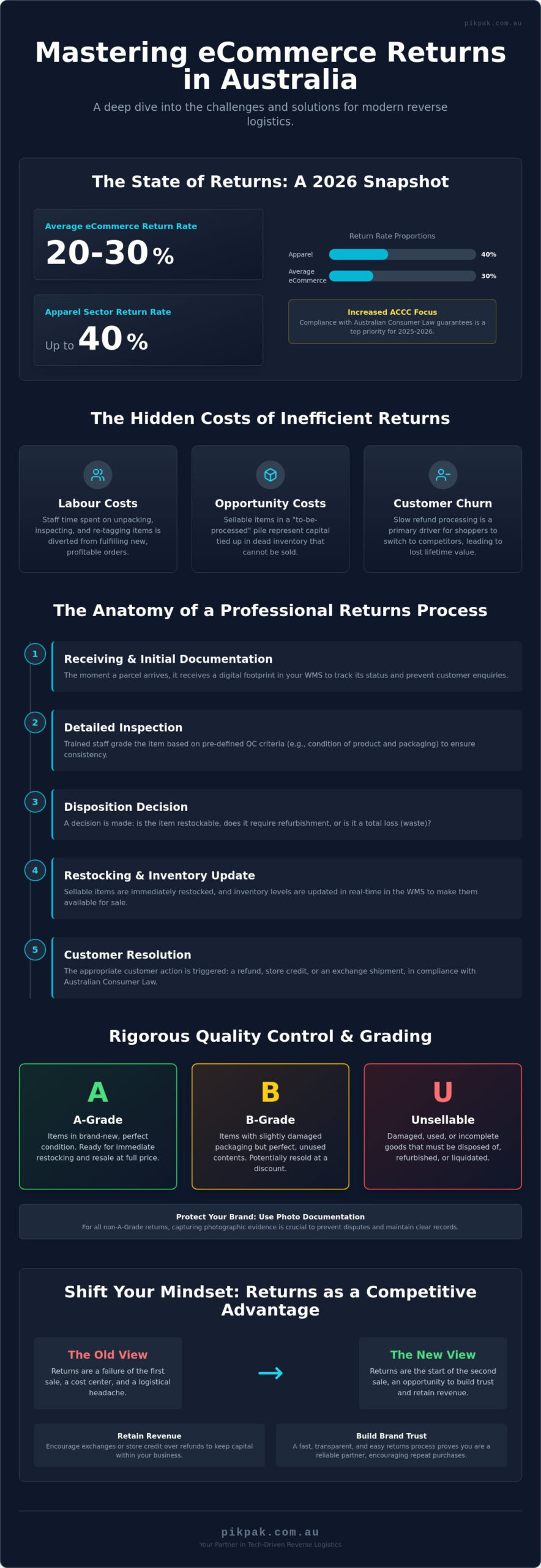
In the simplest terms, ecommerce returns management australia is the process of receiving, inspecting, and restocking goods that customers send back. While it sounds straightforward, this cycle, often called reverse logistics, has become a high-stakes game for Australian retailers. In 2026, return rates have hit record highs, with the average ecommerce return rate sitting between 20% and 30%. For those in the apparel sector, that number can climb as high as 40%. This isn’t just a minor operational hiccup. It is a fundamental shift in how we do business online.
Your returns policy isn’t just a document on your website; it’s a legal and commercial cornerstone. Under the Australian Consumer Law (ACL), you’re required to provide a remedy for products that are faulty, unsafe, or not as described. The ACCC has made industry compliance with these guarantees a top priority for 2025-2026. While you aren’t legally forced to accept “change of mind” returns, the market has made its own rules. A transparent, “no-questions-asked” return policy has become the gold standard for winning customer loyalty in a crowded marketplace.
The Hidden Costs of Inefficient Returns
Inefficiency in your returns process acts like a slow leak in your profit bucket. First, consider the labour costs. Every minute your staff spends unpacking, inspecting, and re-tagging individual items is time taken away from sending out new orders. Then, there is the opportunity cost. When sellable items sit in a “to-be-processed” pile, your capital is tied up in dead inventory that could have been sold to someone else. Finally, think about customer churn. Slow refund processing is a primary reason shoppers switch to competitors. If a customer has to chase you for their money, they won’t be coming back for a second purchase.
Reverse Logistics as a Competitive Advantage
Smart brands don’t view returns as a failure of the first sale. They see them as the start of the second. By streamlining your Reverse logistics, you can encourage customers to choose an exchange or store credit instead of a full refund, effectively retaining that revenue. Speed and transparency build a level of brand trust that marketing alone can’t buy. When you process a return quickly and communicate clearly, you prove you’re a reliable partner. Reverse logistics serves as the essential backbone of modern eCommerce trust. Aligning your operations with clear service priorities ensures that every returned parcel is handled with the same precision as a new outbound order.
The Anatomy of a Professional Returns Process
A successful approach to ecommerce returns management australia isn’t just about opening boxes as they arrive. It’s a high-speed, five-step workflow designed to recover as much value as possible while keeping your customers happy. When a return parcel hits the warehouse floor, the clock starts ticking. Every hour an item sits unprocessed is an hour it isn’t available for sale to a new customer.
The process begins with receiving and initial documentation. The moment a parcel arrives, it needs a digital footprint in your system to prevent “where is my refund” enquiries. Next comes a detailed inspection. Your team must grade the item based on pre-defined criteria to ensure consistency. Once graded, a disposition is made; you decide if the item is restockable, needs refurbishment, or is unfortunately waste. If it’s sellable, the fourth step is immediate restocking and a real-time inventory update in your WMS. Finally, you trigger the customer resolution, whether that’s a refund, store credit, or an exchange. This final step must strictly follow the Australian Consumer Law to ensure your business remains compliant and trustworthy.
Quality Control and Grading Standards
Protecting your profit margins requires a rigorous Quality Control (QC) process. We recommend categorising returns into three clear tiers: ‘A-Grade’ for items in brand-new condition, ‘B-Grade’ for items with slightly damaged packaging but perfect contents, and ‘Unsellable’ for damaged or used goods. To prevent disputes and protect your brand, implement photo documentation for every return that doesn’t meet A-Grade standards. These custom QC rules should be tailored to your specific product category; what’s acceptable for a home appliance might be a total loss for high-end cosmetics. If you have specific concerns about your inventory types, you can find more answers in our warehousing questions section.
Restocking and Inventory Velocity
Speed is the ultimate weapon in reverse logistics. Rapid restocking prevents stockouts on your most popular items and keeps your capital moving. By integrating your returns process directly with your primary pick and pack warehouse operations, you ensure that returned goods are available for sale across all your channels simultaneously. This level of integration eliminates the “returns pile” that often plagues smaller operations. When your returns move as fast as your outbound orders, you turn a logistical burden into a streamlined inventory source.
DIY vs. Outsourced Returns: Which is Right for You?
Deciding how to handle your ecommerce returns management australia often depends on your current volume and growth trajectory. In the early days, often called the ‘garage phase’, managing returns yourself makes perfect sense. It keeps you close to your product and your customers’ feedback without adding external service fees. However, as you scale, that hands-on approach quickly becomes a bottleneck that stifles your growth. You’ve reached the tipping point when your team spends more than 20% of their day unpacking boxes instead of shipping new orders.
A pragmatic cost analysis often reveals that while 3PL per-item fees are visible, the hidden costs of DIY are far higher. Consider the warehouse rent for space occupied by unsellable returns, staff burnout during peak periods, and the lost sales from ‘dead’ inventory sitting in a pile. Outsourcing allows you to handle massive seasonal spikes, such as the post-Christmas return surge, without hiring temporary staff or renting extra space. By following ecommerce returns management best practices, you can determine if your current margins and operational friction justify making the switch to a professional partner.
The Complexity of Multi-Channel Returns
Selling across Shopify, eBay, and Catch is excellent for revenue, but it’s a logistical nightmare for returns if you don’t have a central system. Your order fulfilment process becomes significantly harder when returns are siloed by channel. If an eBay return is processed differently than one from your website, inventory errors are inevitable. Professional providers use integrated technology to ensure every return is handled identically, regardless of the sales channel. This precision reduces shipping errors and ensures your inventory levels remain accurate across all platforms simultaneously.
Risk Management and Compliance
Professional returns management isn’t just about speed; it’s about security. Return fraud and ’empty-box’ scams are rising threats in 2026 that can quietly erode your profits. A seasoned partner provides a clean audit trail for financial reporting and ensures that damaged or hazardous goods are disposed of according to Australian safety regulations. By delegating these risks, you protect your business from financial leaks and legal headaches. This shift allows you to reclaim your time and refocus on what actually moves the needle for your brand.
Leveraging Technology for Returns Automation
Automation isn’t just a luxury; it’s the engine that makes ecommerce returns management australia scalable. Without a digital bridge between your storefront and the warehouse, the physical steps we discussed earlier remain slow and prone to error. By integrating your eCommerce platform with a cloud-based Warehouse Management System (WMS), you remove the manual data entry that usually leads to inventory inaccuracies. This connection ensures that the moment a return is scanned at the warehouse, your store updates in real time. No more spreadsheets. No more guessing.
A professional strategy relies on self-service returns portals to give customers control. These portals allow shoppers to generate their own ‘Returns Merchandise Authorisation’ (RMA) and print shipping labels without ever contacting your support team. This significantly reduces customer service tickets and speeds up the entire cycle. When the customer feels in control, their trust in your brand grows, even when a product didn’t work out the first time. It transforms a potentially negative experience into a streamlined, tech-driven interaction.
The Role of API and WMS Integration
Modern technology support eliminates the friction between different sales channels. Whether a return comes from Shopify or an online marketplace, an API-driven WMS ensures your inventory counts stay accurate across all platforms simultaneously. This prevents the “phantom stock” issue where you accidentally sell items that are actually sitting in a returns bin. Furthermore, tracking return reasons digitally allows you to identify product quality trends. If a specific SKU has a 15% return rate due to “incorrect sizing,” you can update your website information immediately to prevent future losses.
Data-Driven Decision Making
Data is your best defence against profit erosion. By monitoring return patterns, you can identify ‘serial returners’ or high-risk products that consistently fail to meet customer expectations. This insight allows you to refine your product descriptions or update your sizing charts based on real-world feedback. In 2026, advanced AI tools can predict return volumes based on your current sales trends, allowing you to staff your warehouse appropriately before the surge hits. This predictive power helps you maintain a lean, efficient operation year-round. If you want to see how integrated tech can simplify your backend, explore our WMS platform access today.
Scaling Your Brand with Pik Pak’s Returns Solutions
Managing the physical reality of returns is often where business growth stalls. Pik Pak’s approach to ecommerce returns management australia is built to remove that friction entirely. By aligning our service priorities with your specific growth goals, we turn a complex backend burden into a predictable, manageable operational step. We believe in total transparency; that’s why we offer per-item pricing with no hidden fees or surprise surcharges. You’ll always know exactly what your logistics costs are, allowing for better financial forecasting. With access to our nationwide delivery network, your return parcels spend less time in transit and more time being processed for resale. Our seasoned Australian logistics team provides the personalised support you need to navigate any challenge with confidence and precision.
Delegating your reverse logistics isn’t just about outsourcing a task. It’s about empowering your brand to move faster. When you aren’t bogged down by the minutiae of inspecting boxes, you can focus on marketing, product development, and customer acquisition. We act as your calm expert in a chaotic field, ensuring that every return is handled with the same care as your most important outbound shipment. This level of reliability is what builds long-term trust with your customer base.
Customised Reverse Logistics Workflows
We don’t believe in one-size-fits-all solutions. We tailor our inspection process to match your brand’s exact quality standards, ensuring that every ‘A-Grade’ item is truly ready for its next customer. Beyond simple receiving, we offer flexible options for kitting, re-labelling, and assembly of returned goods to restore them to peak condition. By linking your returns to our broader 3PL services, you create a closed-loop system where inventory moves seamlessly between return, storage, and new outbound orders. This integration ensures your stock remains liquid and your warehouse stays organised without any extra effort on your part.
Getting Started with Effortless Returns
Transitioning your logistics shouldn’t be a headache. Our onboarding process is designed for speed; we guide you from initial system integration to your very first processed return with ease. Growing Australian brands trust Pik Pak because we provide end-to-end logistics that scale as they do. We handle the heavy lifting so you don’t have to. It’s time to stop letting returns hold your business back and start using them as a tool for retention. Reclaim your time and focus on growth with Pik Pak today.
Mastering Your Reverse Logistics for 2026 and Beyond
Success in 2026 requires viewing returns not as a failure, but as a critical touchpoint for building customer loyalty. By moving away from manual, siloed processes and embracing professional ecommerce returns management australia, you protect your margins and reclaim your valuable time. We’ve explored how expert quality control grading and seamless ecommerce platform integrations can turn a “returns pile” into a high-velocity inventory source. It’s about creating a system that works for you, rather than one you have to work for every single day.
You don’t have to navigate the complexities of reverse logistics alone. With real-time WMS visibility and a team of seasoned problem-solvers behind you, scaling your brand becomes a manageable, rewarding journey. Delegate the operational friction to a partner you can trust so you can refocus on your core business objectives. Take the first step toward a more efficient, profitable future today.
Streamline Your Returns with Pik Pak Logistics Today
Frequently Asked Questions
What is the average return rate for eCommerce in Australia?
The average ecommerce return rate in Australia currently sits between 20% and 30%, though this varies significantly by product category. For instance, apparel and accessories often see rates as high as 40%, while electronics generally remain lower, between 8% and 15%. These figures highlight why efficient ecommerce returns management australia is essential for protecting your bottom line. Monitoring these benchmarks helps you understand if your own rates are within healthy industry standards.
How does a 3PL handle damaged items that can’t be resold?
Damaged items are identified during the initial grading process and moved to a designated “unsellable” location. Once an item is deemed unfit for resale or refurbishment, we follow your specific instructions for disposal, recycling, or returning it to the manufacturer. This ensures your active inventory storage remains clutter-free and accurate. We maintain a clear digital audit trail for every item disposed of, ensuring your financial reporting remains precise and compliant with safety regulations.
Can I use my own shipping labels for customer returns?
Yes, you can use your own shipping labels or those generated by your eCommerce platform’s native returns tool. Most modern logistics partners allow you to integrate these labels directly into their WMS for seamless tracking. However, using a 3PL’s integrated returns portal often provides a more streamlined experience for the customer. It automates the documentation process the moment the label is scanned, which triggers faster processing and more accurate inventory updates across your sales channels.
How long does it typically take to process a return in a 3PL warehouse?
Most professional warehouses aim to process return parcels within 24 to 48 hours of arrival. This timeframe includes the initial scan, quality inspection, grading, and updating the item’s status in your inventory management system. Speed is critical here because the sooner an item is processed, the sooner it can be relisted for sale. Rapid processing also allows you to issue customer refunds or credits faster, which is a key driver for long-term customer retention.
Does Pik Pak integrate with Shopify and WooCommerce?
Pik Pak provides seamless integration with major eCommerce platforms including Shopify and WooCommerce. Our WMS platform access allows for real-time data syncing between your storefront and our warehouse floor. When a return is processed in our facility, your store’s inventory levels update automatically without any manual data entry. This tech-forward approach eliminates the risk of overselling and ensures your backend operations remain effortless, even during high-volume periods like the post-holiday return surge.
What are the legal requirements for eCommerce returns in Australia?
The Australian Consumer Law (ACL) mandates that businesses must provide a repair, replacement, or refund for products that are faulty or not as described. It’s illegal to display “no refund” signs or policies that override these basic consumer guarantees. While you aren’t legally required to accept returns for a “change of mind,” doing so has become a competitive necessity. Your ecommerce returns management australia strategy must always prioritise these legal obligations to avoid regulatory enforcement and build customer trust.
How do I reduce the overall number of returns my business receives?
Reducing returns starts with improving the accuracy of your product presentations online. Investing in high-resolution photography, detailed video demonstrations, and precise sizing charts can prevent common “not as described” complaints. We also recommend tracking the specific reasons for every return within your WMS to identify trends. If a specific product has a recurring issue, such as a sizing discrepancy or a material defect, you can address it with your supplier or update the listing immediately.
Can a 3PL handle international returns for Australian businesses?
Yes, many 3PL providers can manage international returns by providing local return addresses or consolidating shipments to reduce shipping costs. This process involves receiving the items overseas, performing an initial inspection, and then shipping them back to the primary Australian warehouse in bulk. Handling international returns this way prevents high individual shipping fees from eroding your margins. It also provides your global customers with a much simpler, more reliable return experience, which is essential for scaling your brand internationally.