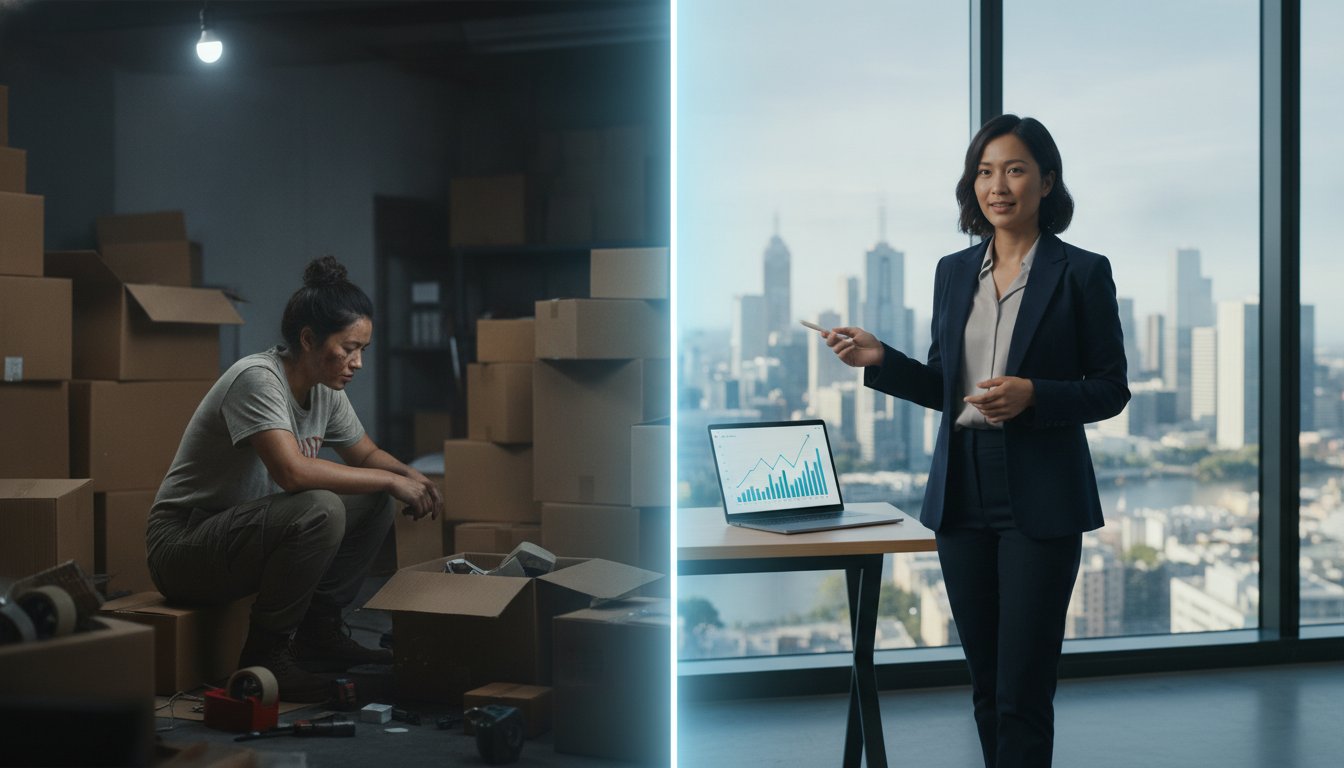
Self-fulfilment isn’t a cost-saving measure; it’s a “Growth Tax” that online founders pay in lost strategic hours and mental exhaustion. While it feels like you’re saving money by packing every box yourself, this hidden expense, known as the opportunity cost of self-fulfillment, is often the single biggest barrier to scaling an eCommerce brand in 2026. You likely started doing your own logistics to maintain control. Now, you’re facing constant fatigue and stagnant sales because there’s simply no time left for marketing or product development.
It’s time to stop valuing your time at a warehouse worker’s hourly rate. In this article, you’ll discover how “doing it yourself” is actually costing your business more than you realize and how to reclaim your schedule for strategic growth. We’ll provide a clear framework to justify outsourcing your logistics and show you a path to scaling that doesn’t lead to personal burnout. We will explore how shifting away from manual labour allows you to focus on the high-level decisions that actually move the needle for your brand.
Key Takeaways
- Realise why spending hours on manual fulfilment is a tax on your growth that prevents you from reaching your revenue goals.
- Learn how the mental fatigue of warehouse tasks limits your capacity for the creative work that drives sales.
- Calculate the opportunity cost of self-fulfillment to see the real price of staying small and staying stuck in operations.
- Apply a simple formula to identify the specific dollar amount your current DIY operations are costing your business every month.
- See how delegating logistics to a professional partner provides the effortless control needed to focus on your core objectives.
What is the Opportunity Cost of Self-Fulfilment?
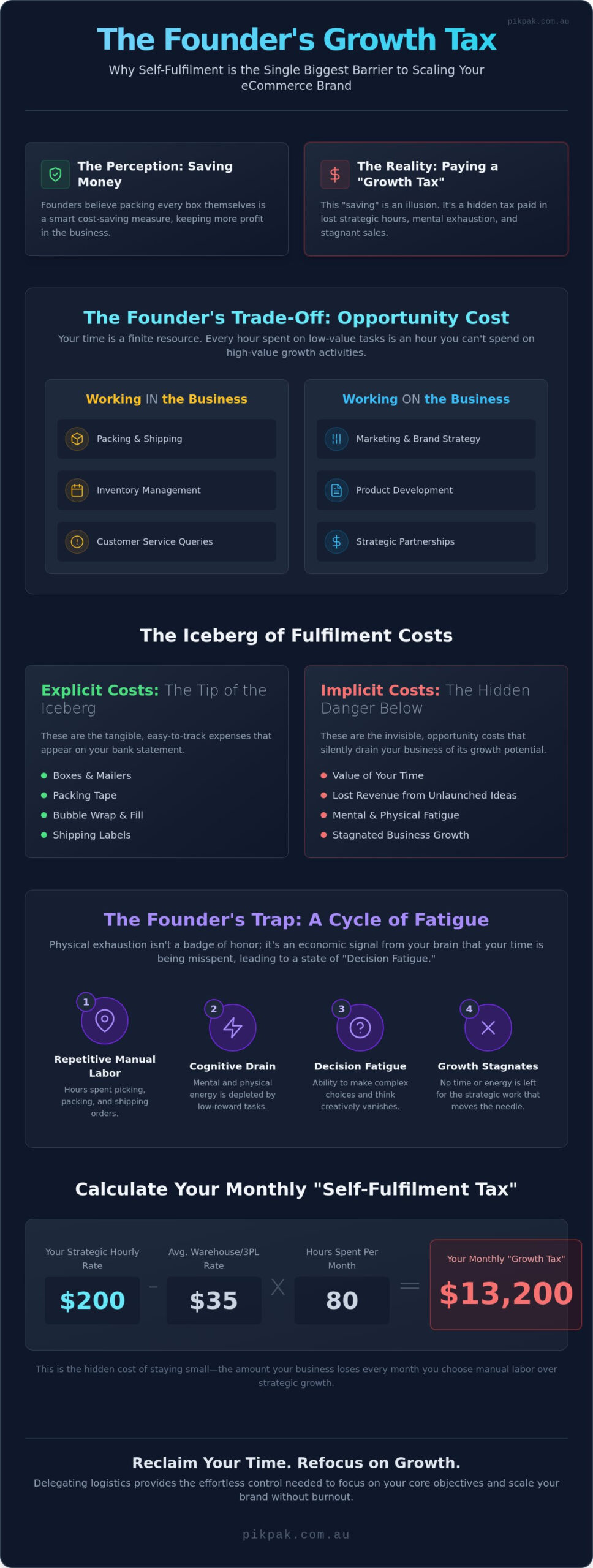
Every choice you make as a founder involves a trade-off. For many eCommerce business owners, the decision to manage logistics in-house feels like a smart way to save money. You might think that by packing boxes yourself, you’re keeping more profit in the business. However, this perspective ignores a fundamental economic principle. To truly understand your business health, you must ask: What is Opportunity Cost?
In a business context, opportunity cost is the value of the next best alternative you give up when you make a decision. When you spend four hours every afternoon taping boxes and printing shipping labels, you aren’t just “saving” the cost of a 3PL. You’re actively choosing not to spend those four hours on high-value tasks like product development, customer acquisition, or brand strategy. This is the opportunity cost of self-fulfillment. It is the hidden price of staying small by focusing on low-value manual labour instead of high-level growth.
The Difference Between Explicit and Implicit Costs
Business owners often focus on explicit costs because they’re easy to track. These are the tangible expenses that appear on your bank statement, such as the money spent on tape, boxes, and bubble wrap. You see these costs and try to minimise them. However, implicit costs are far more dangerous to your long-term success. These are the invisible costs, like the value of your time and the lost revenue from marketing ideas that never launched because you were too busy in the warehouse.
Implicit costs don’t show up in your accounting software, but they’re real. If your strategic time is worth $200 an hour and you spend it doing a task that could be outsourced for a fraction of that, you’re losing money. You’re paying a “Growth Tax” every single day you choose manual labour over strategic execution.
Why Scarcity Dictates Your Success
Your most limited resource isn’t capital; it’s your “Founder’s Time”. You can always raise more money or find new investors, but you can’t manufacture more hours in a day. The economics of scarcity force you to choose between working in the business or working on the business. Physical fatigue from picking and packing orders doesn’t just take your time; it drains your cognitive energy, leaving you too tired to make the big decisions that scale a brand.
In simple terms, order fulfilment is the entire process of receiving, processing, and delivering orders to customers; when you handle this yourself, the opportunity cost of self-fulfillment is the value of the strategic growth tasks you’re forced to ignore. By delegating these operational hurdles, you reclaim the scarcity of your time and refocus it where it generates the most impact.
The “Founder’s Trap”: The Psychology of Mental Effort and Fatigue
The physical exhaustion you feel after a long day in the warehouse isn’t just about sore muscles or standing on concrete. It is a cognitive response. Many eCommerce founders view their fatigue as a badge of honour or a sign of hard work, but psychology suggests something different. According to the Kurzban Opportunity-Cost Model, the sensation of “mental effort” and fatigue acts as an internal economic signal. Your brain is constantly evaluating the reward of your current activity against the potential rewards of alternative actions.
When you spend your day on repetitive manual tasks, your brain signals that the reward for this effort is low compared to the potential gains of high-level strategy. This aligns with the formal definition of opportunity cost, where every choice involves a sacrifice. If you are packing boxes, you are sacrificing your executive function. This leads to “Decision Fatigue,” a state where your ability to make complex choices or think creatively vanishes. You simply cannot write a brilliant ad campaign or negotiate with a new supplier after six hours of picking and packing. The opportunity cost of self-fulfillment is, quite literally, your ability to lead your company.
Fatigue as an Economic Signal
Your brain calculates the “cost” of continuing a task like packing by comparing it to the “Next Best Alternative.” As the hours pass, the mental friction increases because your subconscious knows your time is better spent elsewhere. This leads to diminishing returns on your creativity. Staying stuck in the warehouse creates a cycle of operational friction that drains your mental battery before you even get to your desk. Delegating these tasks to a professional 3PL warehouse provides immediate psychological relief, allowing you to switch your focus back to growth.
The High Cost of “Low-Value” Tasks
To break the cycle, you must categorise your tasks by their Return on Investment (ROI). Consider these two categories:
- Low-Value Tasks: Packing, taping, and labelling. These have a market value of roughly $25 per hour.
- High-Value Tasks: Marketing strategy, product sourcing, and partnership building. These have a potential value of $500 per hour or more.
The “Founder’s Trap” is the belief that “I’m the only one who can do this right.” This perfectionism keeps you anchored to $25-an-hour work while your $500-an-hour opportunities wither away. This is the true opportunity cost of self-fulfillment. By leveraging advanced technology support and automated systems, you can step away from manual labour and finally start working on the business instead of just in it.
Comparing the Real Costs: Self-Fulfilment vs. Professional 3PL
Most founders calculate the cost of logistics by looking at their monthly shipping invoice. They see the postage rates and the price of cardboard boxes. This is a narrow view. It ignores the opportunity cost of self-fulfillment, which represents the actual financial liability of your time. When you handle your own shipping, you’re choosing a fixed cost model where your own labour is the primary currency. This model scales poorly. The more successful your marketing becomes, the more time you spend in the warehouse; this leaves you with less time to manage the very growth you’ve created.
The “break-even point” for many eCommerce brands occurs when the value of the hours lost to manual labour exceeds the cost of outsourcing. If you could generate $500 in new sales with the hour you spent packing five boxes, keeping that task in-house is a financial loss. You aren’t saving money; you’re spending your most valuable asset on a low-ROI activity.
The Hidden Costs of DIY Logistics
Errors are an invisible drain on your profits. A single mispicked item requires double the postage to fix and often results in a lost customer. Beyond errors, there is the “Garage Ceiling.” Physical space limitations prevent you from purchasing inventory in bulk, which means you pay higher per-unit prices. Transitioning to professional warehousing and fulfilment services removes these physical barriers. It provides instant scalability that allows you to focus on procurement and sales rather than shelf space. You gain the ability to scale up during peak seasons without the stress of finding extra hands or space.
ROI Comparison: Strategy vs. Execution
Consider two scenarios for your business growth. In Scenario A, you spend 20 hours a week packing orders. Your growth remains linear because you can only sell what you can physically ship. In Scenario B, you delegate those 20 hours to a partner and spend that time on influencer outreach or data-driven marketing. The result is exponential growth. While a manual spreadsheet relies on human entry and is prone to lag, a cloud-based WMS integrates directly with your storefront to provide real-time inventory accuracy without a single minute of founder intervention.
Many founders hesitate because they see a 3PL as an extra expense. In reality, it is a variable cost that replaces fixed overheads. Instead of paying for a warehouse lease, utilities, and equipment regardless of order volume, you only pay for the services you use. This flexibility protects your cash flow during quiet periods and provides the infrastructure you need to explode during sales events. It’s the difference between being owned by your operations and owning a scalable business.
How to Calculate Your “Self-Fulfilment Tax” (Step-by-Step)
To stop paying the Growth Tax, you first need to see it. Most founders treat their time as a free resource. This is a mistake. To find your true operational costs, follow this four-step audit. It will reveal the actual price you pay for staying small.
- Step 1: Determine your Market Value Hourly Rate. If you weren’t there, what would it cost to hire a CEO or a high-level strategist to run your brand? This is your replacement cost.
- Step 2: Track your hours. Be honest. Log every minute spent on kitting, assembly, and packing over a typical week.
- Step 3: Add the Space Premium. Your garage, spare room, or office has a per-square-metre value. If it’s filled with inventory, that is a real estate cost you aren’t charging back to the business.
- Step 4: Quantify Lost Opportunity. This is the opportunity cost of self-fulfillment. Assign a dollar value to the projects you shelved because you were too busy with manual labour.
Finding Your True Hourly Rate
Don’t value your time at $0 just because you don’t take a large salary yet. Your business must be able to afford its leadership. If you spend 10 hours a week packing, and a CEO rate is $150 an hour, you’re spending $1,500 a week on tape and cardboard. That’s money stolen from your future wealth. Every hour you spend in the warehouse is an hour you’ve effectively stolen from your brand’s growth. You are overpaying for a warehouse worker by using yourself for the job.
The Growth Tax Audit
Review the last three months of your operations. Identify which marketing campaigns were delayed because you were overwhelmed by order volume. Calculate the cost of “Stock-outs” caused by manual inventory tracking that couldn’t keep up with demand. These aren’t just minor inconveniences; they’re structural leaks in your profit margin.
Using professional technology support provides the real-time visibility you need to spot these hidden leaks before they drain your accounts. If your audit shows that your time is being wasted on low-value tasks, it’s time to make a change. Contact us today to reclaim your strategic focus and stop paying the Growth Tax. Reclaiming your schedule is the first step toward exponential growth. You’ve built a brand; now give yourself the time to lead it.
Reclaiming Your Time: Transitioning to Pik Pak Logistics
After calculating your self-fulfilment tax, the path forward becomes clear. You can’t reach your 2026 revenue targets while standing at a packing bench. Pik Pak Logistics acts as the enabling force that removes this operational weight from your shoulders. We transform your logistics from a source of friction into a background process that runs with absolute precision. This isn’t just about outsourcing; it’s about reclaiming your capacity to lead.
The Pik Pak Advantage: Precision and Simplicity
Our pick, pack, and ship services integrate directly with your online store. This setup provides real-time visibility through a web-based platform, giving you effortless control without the warehouse headaches. You can monitor inventory levels and order statuses from any device. This transparency allows Australian brands to move from the “Hustle” phase into “Scale” mode. You stop managing boxes and start managing a business.
Your First Step to Scaling
Moving your operations to a professional partner is a logical step that shouldn’t disrupt your sales. We’ve designed our onboarding to be simple and supportive. By following our warehouse receiving guidelines, you ensure a smooth transition of your inventory into our secure storage. This precision at the start prevents delays and sets the foundation for a reliable partnership. Reclaim your time today and stop paying the Growth Tax. Your business deserves your full attention, not your manual labour.
Stop Paying the Growth Tax and Start Scaling
You’ve identified the hidden leaks in your profit margins. By understanding the opportunity cost of self-fulfillment, you now see that every hour spent in the warehouse is an hour stolen from your brand’s future success. You’ve learned how to calculate your true hourly rate and why mental fatigue is a signal to delegate low-value tasks. Now, it’s time to act on that knowledge and shift your focus back to the big picture. Reclaiming your schedule is the most important strategic move you’ll make this year.
Delegating your logistics doesn’t mean losing control; it means gaining a professional partner. With our real-time WMS platform access and seamless eCommerce integrations, you maintain total visibility while we handle the heavy lifting. Our dedicated Australian-based support ensures your operations run smoothly; this allows you to focus on the high-value growth projects that actually move the needle. You’ve built a brand with massive potential. It’s time to give it the leadership it deserves. Stop packing and start leading.
Reclaim your time and scale your business with Pik Pak Logistics today. We’re ready to help you move from the daily grind to sustainable, long-term growth.
Frequently Asked Questions
What is a simple example of opportunity cost in eCommerce?
A simple example is choosing to pack fifty orders yourself instead of spending that afternoon negotiating with a new supplier. If that negotiation could have lowered your unit cost by 10%, but you spent the time taping boxes to save on labour, that lost saving is your opportunity cost. You’ve sacrificed a long-term margin improvement for a short-term operational task.
How do I know if I am ready for a 3PL partner?
You are ready when operational tasks prevent you from executing your marketing calendar or growth strategy. If your sales are stagnant because you have no time for customer acquisition, or if you are consistently working late into the night to catch up on “real” work after packing, it’s time to outsource. Reaching 500 to 1,000 monthly orders is a common trigger for this transition.
Is self-fulfilment always cheaper for small startups?
It appears cheaper on a balance sheet because many founders don’t pay themselves an hourly wage for manual labour. However, this is a false economy that ignores the opportunity cost of self-fulfillment. Once your order volume grows, the time you spend on logistics becomes a financial liability that prevents you from performing the high-value tasks that actually scale the brand.
Can opportunity cost be measured in non-monetary terms?
Yes, it is often measured in mental burnout, lost creativity, and decreased focus on the customer experience. Physical fatigue from repetitive warehouse tasks reduces your ability to innovate and lead. This cognitive drain is a significant non-monetary loss that can lead to poor decision-making and personal exhaustion, which eventually impacts the bottom line.
What is the difference between explicit and implicit costs in logistics?
Explicit costs are the tangible payments you make for shipping labels, packaging materials, and warehouse rent. Implicit costs are the invisible losses, such as the value of the strategic time you spent packing instead of building a high-converting email funnel. While explicit costs appear in your bank account, implicit costs represent the growth you never achieved.
How does decision fatigue affect my business growth?
Decision fatigue acts as a cognitive drain that impairs your executive function. After hours of picking and packing orders, your brain is less capable of making complex strategic choices or thinking creatively. This leads to missed opportunities and slower business growth because you’re too mentally exhausted to focus on the high-level tasks that drive revenue.
Why is “Founder Time” considered a scarce resource?
Time is the only resource you cannot manufacture or buy back once it is spent. As a founder, your unique vision and strategic input are the primary drivers of your company’s value. Using this limited resource for low-value manual tasks creates a bottleneck for the entire business, as nobody else can provide the strategic direction required to scale.
What happens to my opportunity cost as my business scales?
It accelerates significantly. As your brand grows, your strategic time becomes more valuable to the company’s success. The opportunity cost of self-fulfillment is much higher for a founder managing a large-scale operation than for one just starting out, as the financial impact of every lost hour of strategy is much greater for a larger business.