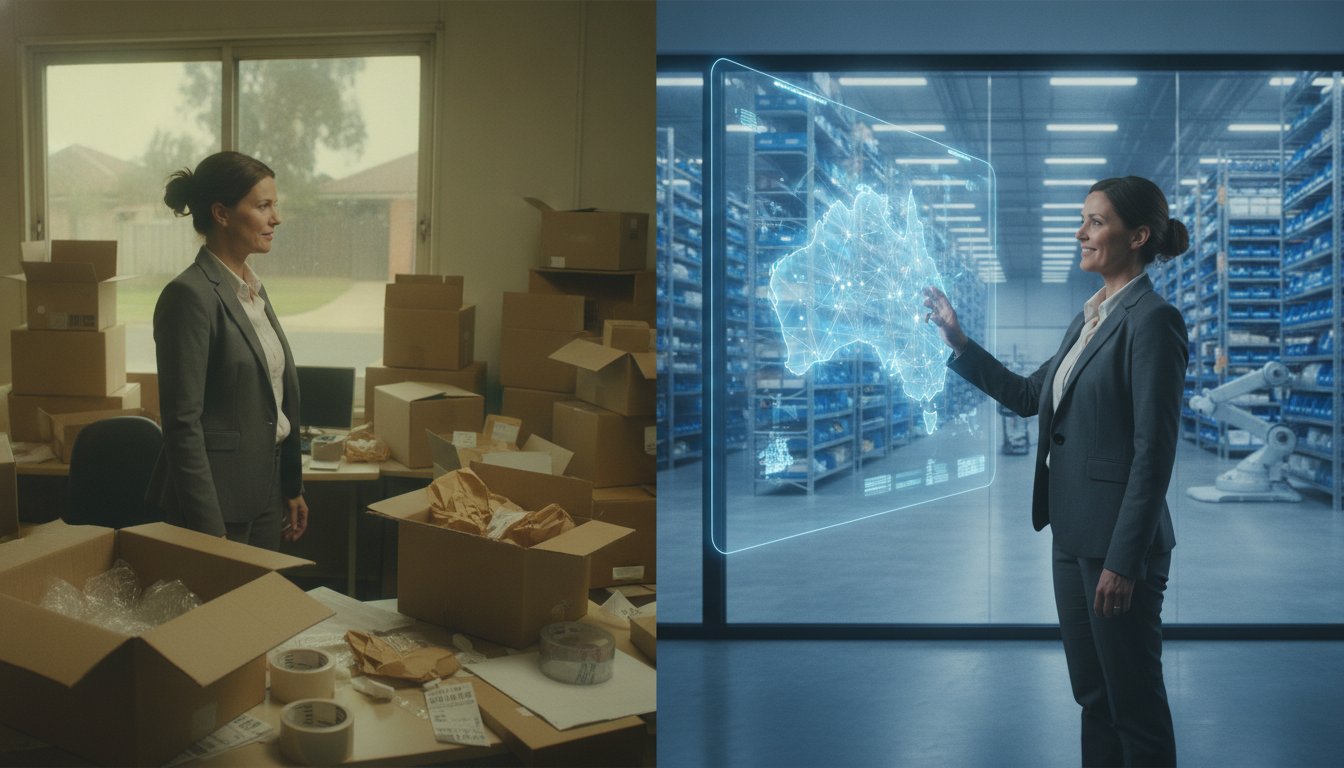
If you’re shipping under 1,500 orders per month, managing your own logistics might feel like the safe choice, but the hidden overhead of warehouse space and labor can quickly become a growth killer. Most founders reach a breaking point where they spend more time taping cartons than building their brand. You’ve likely felt the frustration of running out of office space or seeing shipping rates eat your margins while competitors scale effortlessly. It’s a common hurdle, but staying stuck in a manual process limits your ability to compete in a fast-moving market.
Deciding between in-house vs outsourced order fulfilment is the most significant operational choice you’ll face in 2026. We understand that letting go of your inventory feels risky, but it’s actually the fastest way to reclaim your time and lower your per-order costs. This guide will show you how to move from a fixed-cost burden to a variable-cost advantage. You’ll learn how to gain seamless inventory visibility, navigate new safety regulations, and finally focus on the marketing and product development that drives your business forward.
Key Takeaways
- Identify the specific “inflection point” where managing your own logistics begins to hinder your brand’s growth and scalability.
- Understand the hidden overhead of warehousing, such as lease rates and equipment, to accurately compare the costs of in-house vs outsourced order fulfilment.
- Discover how a 3PL partner leverages high shipping volumes to secure lower delivery rates that are typically unavailable to smaller, independent businesses.
- Learn how cloud-based WMS technology provides real-time inventory visibility and eliminates the operational friction of manual stock tracking.
- Reclaim your time by delegating complex logistical tasks, allowing you to focus your energy on marketing and product development.
The Logistics Crossroads: Defining In-House and Outsourced Fulfilment
Every eCommerce business eventually hits a wall where their current shipping process simply stops working. In 2026, the global e-commerce fulfilment market is valued at $154.31 billion. This is a clear sign that logistics is no longer just a backend chore; it’s a strategic battleground. Choosing between in-house vs outsourced order fulfilment isn’t just about where you store your stock. It’s about deciding whether you want to be a logistics manager or a brand builder.
The traditional way of shipping, where you handle every parcel personally, is becoming obsolete in a market that demands instant precision. Customers now expect transparency and speed that manual systems struggle to provide. Transitioning from “doing it all” to “managing a partner” allows you to scale without the constant friction of physical limitations and operational fires.
What is In-House Fulfilment?
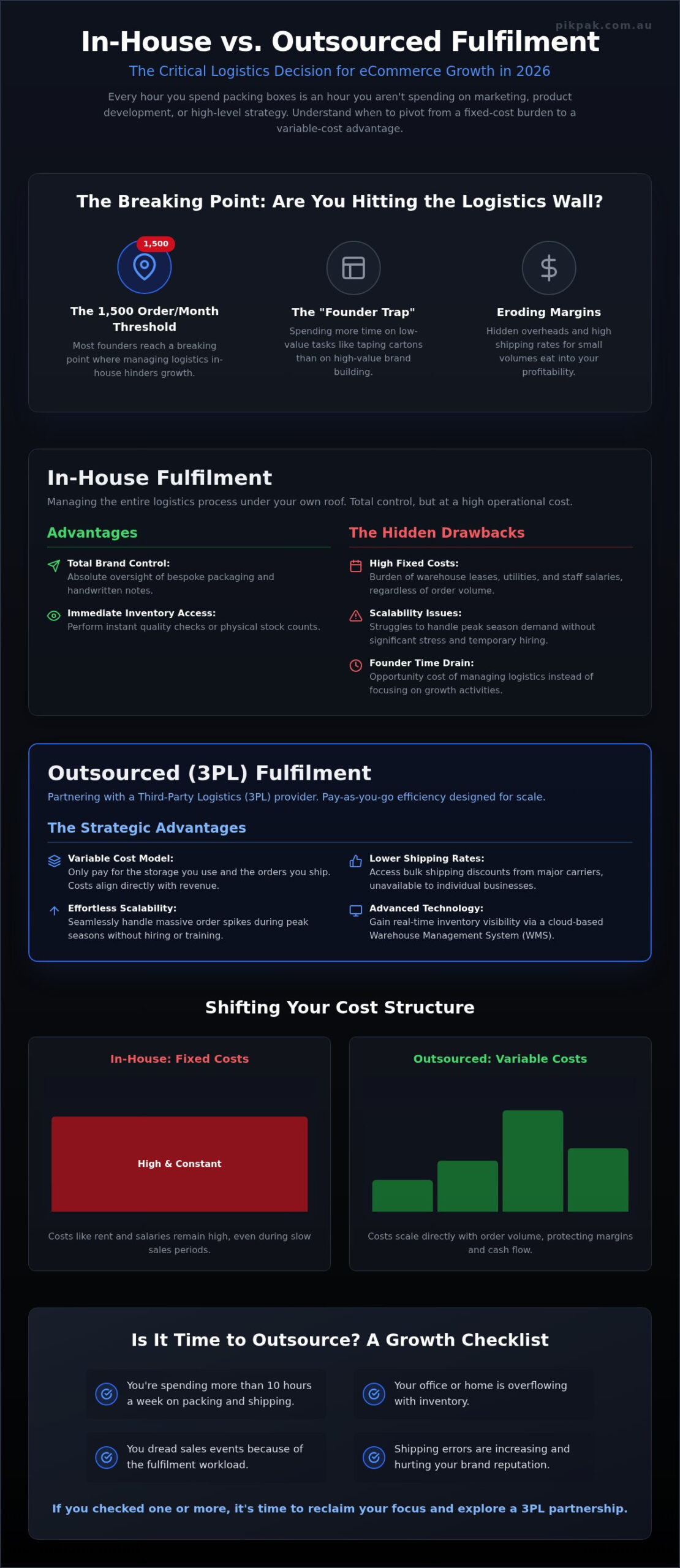
In-house fulfilment, often called self-fulfilment, means you manage every stage of the logistics chain under your own roof. This is the classic “garage phase” of a startup. You have absolute control over the unboxing experience and the physical security of your inventory. It’s often the starting point for artisanal brands with very low volumes or highly bespoke packaging requirements.
However, the physical demands are heavy. You need dedicated storage space, organised packing stations, and reliable staff. In major Australian hubs like Sydney and Melbourne, warehouse lease rates continue to climb in 2026, making this a high-stakes investment. You aren’t just paying for tape and boxes. You’re paying for the square footage, the utilities, and the significant time spent managing casual labour.
What is Outsourced (3PL) Fulfilment?
Outsourcing involves partnering with a Third-Party Logistics (3PL) provider to manage your order fulfilment. Instead of a fixed monthly rent, you move to a variable “pay-as-you-go” model. You only pay for the storage you use and the orders you actually ship.
A 3PL acts as a strategic partner, offering advantages that individual businesses often cannot access on their own:
- Scalability: Effortlessly handle peak season spikes without the stress of hiring and training temporary staff.
- Bulk Shipping Rates: Access deep discounts from carriers by leveraging the 3PL’s total shipping volume.
- Advanced Technology: Use a cloud-based Warehouse Management System (WMS) for real-time inventory visibility and automated order processing.
This model removes the major operational hurdles of daily logistics. It gives you the freedom to reclaim your time and refocus your energy on the core objectives that actually grow your brand.
Weighing the Pros and Cons: The Realities of In-House Logistics
Managing your own warehouse feels like the ultimate way to maintain quality. You see every item before it leaves the building. You ensure every sticker is perfectly aligned. For many founders, this sense of “total control” is the primary driver behind keeping logistics in-house. However, this control often transforms into a daily grind of operational fires. When a label printer malfunctions or a staff member calls in sick during a sale, the business owner becomes the warehouse manager. This shift is the psychological burden few people discuss when debating in-house vs outsourced order fulfilment.
The Advantages of Staying In-House
Keeping your logistics under your own roof offers specific benefits for brands in their early stages or those with highly specialised needs:
- Custom Branding: You have absolute oversight of bespoke packaging, handwritten notes, or complex kitting requirements that define your brand identity.
- Physical Access: You can perform immediate quality checks or count inventory without waiting for a digital report.
- No Management Fees: You avoid the monthly platform fees or 3PL integration costs that come with external partnerships.
The “Founder Trap”: Hidden Drawbacks
The biggest risk of self-fulfilment is the opportunity cost. Every hour you spend packing boxes is an hour you aren’t spending on marketing, product development, or high-level strategy. If your business grows at the projected industry average of 11.62 percent annually, your manual processes will eventually break. You’ll find yourself trapped in low-value tasks while your competitors focus on expansion.
Scalability is the second major hurdle. If a social media campaign goes viral and your orders double overnight, an in-house setup often collapses. You simply don’t have the physical space or the casual staff to pivot instantly. This leads to inconsistent shipping times, which quickly damages your brand reputation. Additionally, in-house logistics comes with high fixed costs. Rent, utilities, and equipment leases don’t disappear during slow sales months, putting pressure on your cash flow.
Competing with the delivery speeds of larger brands is also difficult without a professional network. By the time you’ve manually processed a batch of orders, a professional partner has already dispatched theirs. If you’re feeling overwhelmed by the physical demands of your stock, it might be time to explore professional logistics services that can take the weight off your shoulders. Relying on an expert partner ensures your customers get their orders on time, every time, regardless of how fast you grow.
Choosing between in-house vs outsourced order fulfilment requires a deep dive into your balance sheet. The biggest mistake is looking only at the postage bill. The real cost of scaling lies in the infrastructure you don’t see until it starts to break. Running your own warehouse in Australia means committing to high fixed overheads that stay the same whether you ship ten orders or ten thousand. This rigidity is a major risk for growing brands that experience seasonal fluctuations.
Direct Costs of In-House Operations
In major Australian hubs like Sydney and Melbourne, commercial lease rates are a significant hurdle in 2026. You aren’t just paying for the floor space; you’re paying for insurance, industrial utilities, and site security. Then there’s the labour. Beyond base wages, you have superannuation, workers’ compensation, and the constant cost of training new staff. You also need to invest in physical equipment like industrial label printers, handheld scanners, and pallet racking. These capital expenditures tie up vital cash that should be used for inventory or marketing. Managing these assets requires constant attention, pulling you away from the work that actually generates revenue.
Errors and returns represent another hidden drain on your margins. A single mispick doesn’t just cost the price of the item. It costs the double shipping fee, the replacement packaging, and the time spent on customer service. Managing reverse logistics in-house is often chaotic and inefficient. Without professional systems, returned stock often sits in a corner instead of being processed back into inventory, leading to significant stock shrinkage and lost capital.
The 3PL Efficiency Dividend
The most powerful financial advantage of a 3PL is the shift from fixed to variable costs. This protects your margins during seasonal dips because you only pay for the storage and handling you actually use. You also gain immediate access to a professional transport company network. Because 3PLs ship massive volumes across the country, they secure tier-one rates for customer delivery that an individual business simply can’t negotiate. This allows you to offer more competitive shipping prices to your customers without sacrificing your profit per order.
By removing the need for warehouse technology investment and reducing inventory shrinkage through professional management, a 3PL provides an efficiency dividend. You stop paying for empty shelf space and start paying for tangible results. This model ensures your logistics costs stay perfectly aligned with your sales volume, providing the financial stability needed for long-term growth.
Decision Framework: When to Pivot to an Outsourced Partner
Knowing when to switch from in-house vs outsourced order fulfilment is the difference between a brand that scales and one that plateaus. Most business owners wait too long, staying tethered to the packing table until their growth actually begins to reverse. To avoid this, you need a clear framework based on data rather than gut feeling. Logistics should be a lever for growth, not a weight that holds you back.
Start with the “4-hour rule.” If you or your core team spend more than four hours each day managing stock and packing parcels, your business is suffering. That time represents a massive loss in marketing and product development potential. Physical space is another undeniable signal. When your home office or small warehouse feels like a maze of boxes and you’re struggling to find items, your efficiency has already peaked. These constraints create a ceiling on how much revenue you can actually generate.
Operational Red Flags
If your current setup is failing, your customers will be the first to tell you. Watch for these specific triggers that suggest your internal processes can no longer keep up with demand:
- Shipping Delays: If it takes longer than 48 hours to dispatch an order during a promotion or sale event, your system is broken. In 2026, customers expect immediate action.
- Accuracy Issues: A high rate of incorrect items or “Item Not Received” (INR) complaints suggests your manual tracking can’t handle the volume.
- Overselling: Frequent refunds due to inventory inaccuracies mean your sales platform and physical stock are out of sync.
Strategic Growth Indicators
Sometimes the pivot isn’t about failure; it’s about preparing for the next level. If you’re expanding into marketplaces like Amazon, eBay, or Catch, you’ll need the fast turnarounds and professional standards these platforms require. Nationwide expansion across Australia also demands a more robust logistics network than a small-scale operation can provide. Many brands also find that professional kitting & assembly services allow them to create bundles and gift sets that significantly increase their average order value without adding to their own daily workload.
Recognising these signs early allows you to transition smoothly before a crisis hits. Don’t wait for your operations to collapse before you act. If you’re seeing these red flags today, it’s time to request a professional logistics assessment to see how a dedicated partner can help you scale effortlessly and reclaim your time.
Pik Pak Logistics: Making Outsourced Fulfilment Your Competitive Advantage
Pik Pak Logistics isn’t just a warehouse; it’s a strategic extension of your brand. We take the friction out of the in-house vs outsourced order fulfilment debate by providing a platform that feels like your own, without the physical burden. Our goal is to transform your logistics from a source of stress into a competitive edge. By delegating the heavy lifting to us, you can stop worrying about tape and boxes and start focusing on the big picture. We provide the infrastructure you need to compete with major retailers while maintaining the agility of a growing business.
Tech-Savvy Logistics for Modern Brands
In 2026, real-time data is the currency of eCommerce success. Pik Pak provides total visibility through our cloud-based Warehouse Management System (WMS). This isn’t a complex, intimidating tool; it’s a user-friendly platform that integrates seamlessly with your existing storefront. You’ll never have to guess about stock levels or order statuses again.
- Automated Order Flow: Orders from your store flow directly to our warehousing and fulfilment centres, which eliminates the need for manual data entry and reduces the risk of human error.
- Real-Time Tracking: Both you and your customers stay informed with live tracking updates from the moment a parcel is scanned to the second it arrives at the door.
- API Connectivity: For brands with custom needs, our API access allows for tailored reporting and deeper integrations, ensuring your tech stack remains unified.
This technological foundation ensures your inventory management is precise and your shipping is fast. It bridges the gap between complex backend processes and simple user actions, giving you total control without the daily operational grind.
Effortless Scaling and Support
Scaling your business shouldn’t feel like a gamble. We offer transparent pricing models that move with your order volume. If you have a slow month, your costs drop. If you have a record-breaking sale, we scale up to meet the demand without you having to hire a single person or lease more space. This variable-cost model is the ultimate protection for your margins.
We provide dedicated support to ensure your transition is smooth. This includes helping you navigate our warehouse receiving guidelines so your stock is processed and ready for sale as quickly as possible. We act as a seasoned, tech-savvy problem-solver in a chaotic field, allowing you to breathe easier.
The choice between in-house vs outsourced order fulfilment becomes simple when you have a partner that prioritises your growth. Let us handle the pick, pack, and ship process while you reclaim your focus for marketing and product development. With Pik Pak, you aren’t just outsourcing a task; you’re building a foundation for a more efficient and profitable future.
Take Control of Your Business Growth in 2026
The choice between in-house vs outsourced order fulfilment ultimately comes down to how you value your time and your brand’s potential. Sticking with manual, internal processes might feel safe today, but it often creates a ceiling that prevents you from reaching the next level. By shifting to a variable-cost model, you protect your margins and gain the agility needed to handle rapid sales spikes without the stress of managing a warehouse yourself.
You now have the framework to identify your inflection point and move beyond the physical constraints of self-fulfilment. You deserve to focus on marketing and product development while experts handle the physical heavy lifting. Our team provides real-time WMS visibility, seamless API integrations, and expert Australian-based support to ensure your operations run effortlessly. Reclaim your time and scale your business with Pik Pak Logistics today.
Your growth shouldn’t be limited by the size of your office or the speed of your packing tape. It’s time to build a foundation that supports your ambition and lets your brand truly thrive.
Frequently Asked Questions
Is it cheaper to fulfil orders in-house or outsource to a 3PL?
Generally, outsourcing is more cost-effective once you factor in the “invisible costs” like warehouse rent, labour, and equipment. When comparing in-house vs outsourced order fulfilment, businesses shipping under 1,500 orders per month almost always find a 3PL lowers their per-order cost. In 2026, shifting from fixed overheads to a variable-cost model protects your margins during slow months and eliminates the burden of high capital expenditure.
At what order volume should I consider outsourcing my fulfilment?
The standard industry threshold for 2026 is approximately 1,500 orders per month. Below this volume, self-fulfilment might seem manageable, but the complexity of in-house vs outsourced order fulfilment becomes clear as you scale. If your team spends more than four hours daily packing boxes, or if you’re frequently out of physical storage space, you’ve reached the inflection point where a 3PL becomes a strategic necessity for growth.
Will I lose control over my brand if I use a 3PL?
No, you actually gain control over your brand’s reputation by ensuring consistent, professional delivery. While you delegate the physical packing, you maintain total visibility through a cloud-based WMS. You set the standards for how items are handled, and a professional partner ensures those standards are met every time. This precision eliminates the operational fires that usually distract you from high-level brand strategy and marketing.
How does a 3PL integrate with my Shopify or WooCommerce store?
Integration is handled through pre-built connectors and API access that link your storefront directly to the warehouse management system. When a customer places an order, the data flows automatically to the fulfilment centre for picking and packing. This eliminates manual data entry and ensures real-time inventory synchronisation. It’s a seamless process that requires minimal technical knowledge from your side, allowing you to focus entirely on sales.
Can a 3PL handle customer returns and reverse logistics?
Yes, a professional 3PL provides end-to-end returns management to keep your inventory moving. When a customer sends an item back, the warehouse team inspects the product, determines its condition, and either returns it to stock or handles disposal. This structured approach to reverse logistics prevents returned items from piling up and ensures your stock levels remain accurate and ready for the next sale.
What are the hidden costs of running an in-house warehouse?
Hidden costs include warehouse insurance, industrial utilities, equipment maintenance, and the “opportunity cost” of your time. You also pay for empty shelf space during slow seasons and the constant expense of training and managing casual staff. In major hubs like Sydney and Melbourne, climbing lease rates make these fixed overheads a significant burden. Outsourcing converts these unpredictable expenses into a transparent, variable cost that scales with your actual sales.
How does outsourcing fulfilment improve shipping times in Australia?
3PLs use sophisticated sorting technology and established carrier networks to accelerate the dispatch process. By leveraging a professional network, your orders are often processed and out the door faster than a manual in-house team could manage. Access to multiple home delivery shipping options ensures your customers receive their parcels via the most efficient route, helping you meet the high expectations of the 2026 Australian eCommerce market.
Can I still do custom kitting or bundling with an outsourced partner?
Absolutely. Specialised kitting and assembly services are a core offering for modern 3PLs. You can create custom bundles, gift sets, or subscription boxes without ever touching a roll of tape. You simply provide the instructions, and the warehouse team assembles the items to your exact specifications. This allows you to increase your average order value and offer unique product combinations while maintaining a completely hands-off logistics operation.