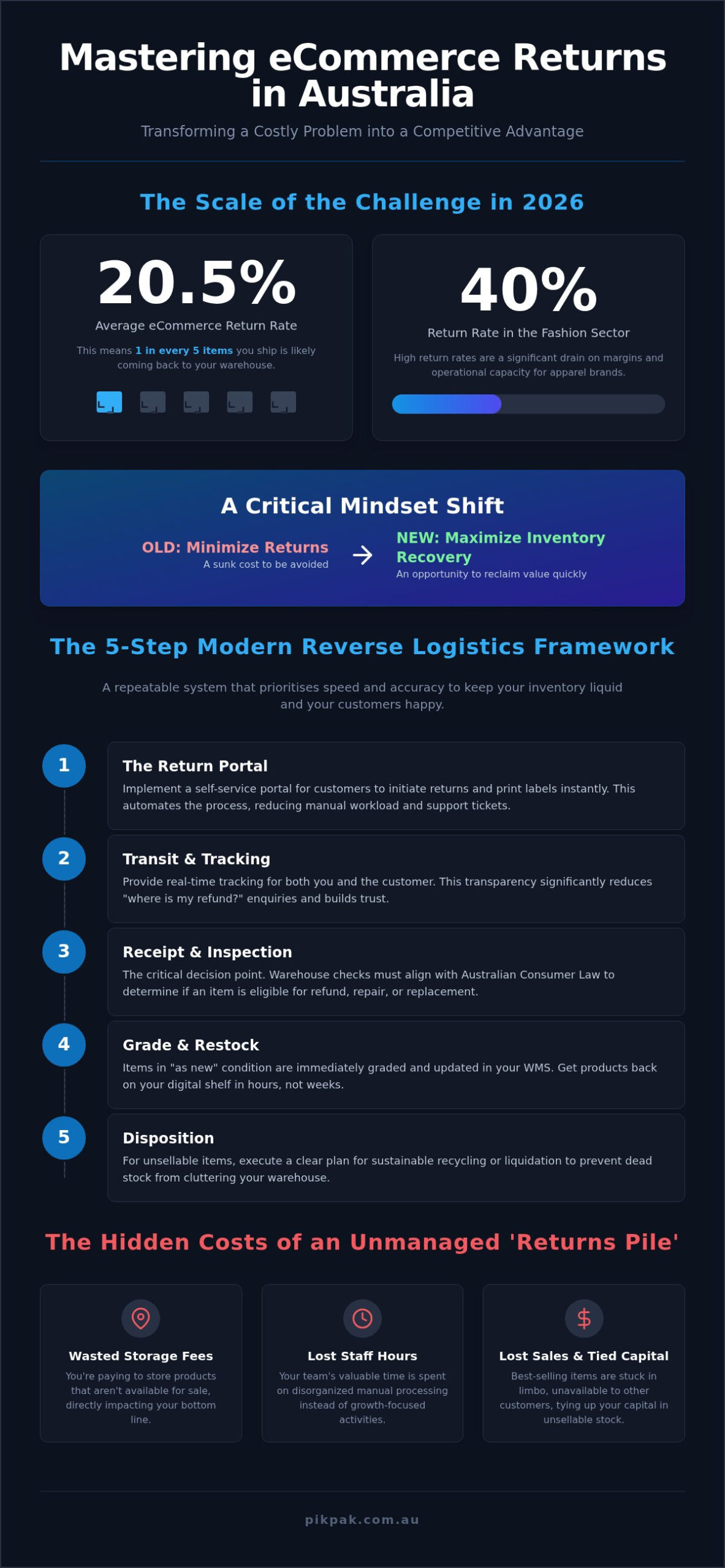
With eCommerce return rates in Australia hitting 20.5% in 2026, one in every five items you ship is likely coming back to your warehouse. If you’re in the fashion sector, that figure can climb as high as 40%. You’re likely tired of seeing high freight costs eat your margins while returns piles sit idle for weeks, tying up capital and frustrating your customers. It’s an operational friction point that feels like a constant drain on your time and resources.
We’re here to help you regain control. This guide will show you how to master ecommerce returns management australia to transform these costly reversals into a streamlined engine for inventory recovery and customer loyalty. You’ll learn how to lower your overheads and build a set and forget workflow that gets products back on the shelf in record time. We’ll cover everything from the latest reverse logistics technology to staying ahead of the July 2027 Australian Consumer Law updates, ensuring your business stays both compliant and profitable.
Key Takeaways
- Adapt to 2026 consumer demands by shifting your focus from simply minimizing returns to maximizing the speed of restocking returned items.
- Implement a 5-step automation framework that handles everything from label generation to real-time tracking, significantly reducing your team’s manual workload.
- Master ecommerce returns management australia by bridging the gap between digital return portals and physical warehouse processing for faster inventory recovery.
- Build a transparent returns policy that acts as a powerful conversion tool, helping you win customer trust while maintaining strict quality control.
- Delegate the complexity of reverse logistics to a tech-savvy partner so you can reclaim your time and focus on scaling your brand.
The State of eCommerce Returns Management in Australia (2026)
ECommerce returns management is the end-to-end journey of a product from the moment a customer initiates a request until that item is back on the shelf, ready for resale. In 2026, the “Amazon Effect” has fully matured in the Australian market. Local customers don’t just hope for free and easy returns; they expect them as a baseline service. This expectation puts immense pressure on margins, especially for SMEs where manual processing acts as a silent killer of growth by draining resources that should be spent on acquisition.
To stay competitive, successful brands are moving away from viewing this process as a sunk cost. They’re adopting a comprehensive Reverse logistics framework to pivot from simple “returns” to “inventory recovery.” The goal isn’t just to get the item back; it’s to restore its value as quickly as possible. Effective ecommerce returns management australia requires a shift in mindset where every returned SKU is treated as potential revenue waiting to be unlocked through speed and precision.
Why Australia is a Unique Returns Challenge
Australia presents geographical hurdles that international models often ignore. We face a “Distance Tax” when handling returns from Perth, Darwin, or regional hubs, where transit times can easily exceed a week. Rising courier costs in 2026 have made the “Free Returns” model difficult to sustain without high efficiency. Additionally, local labour shortages in warehousing mean that relying on staff to manually inspect and re-bag items is no longer sustainable. You need a tech-driven approach to maintain control without ballooning your payroll.
The True Cost of the ‘Returns Pile’
Many founders ignore the “returns pile” in the corner of the warehouse, but the hidden costs are staggering. You’re paying storage fees on unsellable stock, wasting staff hours on unorganized boxes, and losing sales because your best-selling sizes are stuck in limbo. In the context of reverse logistics, inventory velocity is the speed at which a returned product transitions from a customer’s doorstep back into your available-to-sell stock. Beyond the balance sheet, there’s a heavy psychological toll on founders who spend their time managing logistics instead of marketing. Delegating this operational burden allows you to reclaim your time and refocus on business growth.
The Mechanics of Modern Reverse Logistics: A 5-Step Framework
To master ecommerce returns management australia, you need a repeatable system that prioritises speed and accuracy. It’s no longer enough to just “handle” returns; you must move them through a structured framework designed to recover value. This five-step process ensures nothing gets lost in the shuffle and your inventory stays liquid.
- Step 1: The Return Portal – Stop using manual email chains. Implement a self-service portal where customers can initiate their own returns and print labels instantly. This automation reduces your team’s workload and gives the customer an immediate sense of progress.
- Step 2: Transit & Tracking – Maintain total visibility. When both you and your customer can track a return in real-time, you’ll see a significant drop in “where is my refund” support enquiries.
- Step 3: Receipt & Inspection – This is the critical decision point. You must align your warehouse checks with Australian Consumer Law requirements to determine if an item is eligible for a full refund, repair, or replacement.
- Step 4: Grade & Restock – Sellable items should hit your WMS immediately. If an item is in “as new” condition, it should be back on your digital shelf within hours, not weeks.
- Step 5: Disposition – For items that can’t be sold, have a clear plan for sustainable recycling or liquidation to keep your warehouse floor clear of dead stock.
The Inspection Protocol: Protecting Your Brand
Standardised quality control checklists are vital to ensure returned items are truly “as new” before they’re sent to another customer. A single mistake here can lead to a negative review that damages your brand’s reputation. Sometimes, a product just needs a minor touch-up to be sellable again. We handle Kitting & Special Projects to help you recover stock through professional re-bagging, re-labelling, or component replacement. This level of care turns potential losses into successful sales.
Data-Driven Returns: Learning from Why They Send it Back
Your returns data is a goldmine for business growth. By using WMS insights, you can identify “High Return” SKUs that might have consistent sizing issues or manufacturing flaws. In 2026, AI-driven sorting systems in modern warehouses are drastically increasing efficiency by automatically categorising items based on historical return patterns. Closing the loop by feeding this data back to your product team helps you fix issues at the source. If you’re ready to see how real-time data can simplify your operations, our WMS platform access provides the transparency you need to make informed decisions.
Software vs. Physical 3PL: Which Management Style Wins?
Many business owners fall into the “software trap.” They invest in a beautiful returns portal that automates labels but forget that a digital tool can’t physically inspect a product or check a broken seal. Conversely, a traditional warehouse without real-time tech is just a black hole for inventory. To master ecommerce returns management australia, you need a hybrid approach that combines a smart WMS with a responsive physical team. A portal is just an interface; the real work happens on the warehouse floor where items are graded and restocked.
Scaling brands often struggle to decide between in-house management and outsourcing. While in-house seems like it offers more control, it usually results in “returns piles” and slow restock times that tie up your capital. The hybrid sweet spot is an integrated physical fulfilment hub. When your warehouse uses a cloud-based WMS, an item is scanned upon arrival and your digital storefront updates instantly. This creates a seamless flow that keeps your inventory liquid and your customers informed without you having to lift a finger.
Hidden Costs of In-House Returns
Managing returns yourself carries massive invisible expenses that eat into your margins. You’re paying rent-per-square-metre for dead stock that isn’t moving, effectively turning your office or warehouse into expensive storage for damaged goods. There’s also the “distraction cost” where your customer service team spends hours on manual data entry instead of driving sales. This is why 3PL Logistics offers better economies of scale. You gain access to professional systems and dedicated teams, paying only for the space and labour you actually use.
Integration: The Brains of the Operation
Efficiency in the Australian eCommerce market depends on how well your systems talk to each other. Connecting your Shopify or WooCommerce store directly to the warehouse allows for instant inventory updates. API access is the engine here, automating refund triggers the moment an item passes inspection. It’s about removing the middleman. Professional Technology Support eliminates the risk of human error and ensures your data is always accurate. You don’t need to manually check spreadsheets when the system does the heavy lifting for you.
Building a Returns Policy that Boosts Conversion
Your returns policy is often the final hurdle a customer faces before completing a purchase. Data shows that 67% of shoppers check the returns policy before buying, meaning a confusing or restrictive page can kill your conversion rate instantly. In 2026, transparency is your most effective sales tool. By presenting a “no-hassle” guarantee, you build immediate trust and lower the perceived risk of the transaction. Success lies in balancing this customer confidence with smart fraud prevention measures, such as requiring photo evidence for damaged goods within your automated portal.
Implementing tiered policies is a pragmatic way to protect your margins. You might offer free returns for your full-price collections while applying stricter rules or store-credit-only options for sale items. This approach respects the customer’s needs without leaving your business vulnerable during high-volume clearance events. Additionally, sustainability has become a core requirement for the modern Australian shopper. With 57% of consumers concerned about the environmental impact of their orders, offering carbon-neutral shipping or “Eco-Returns” through consolidated hub drops can differentiate your brand from less conscious competitors.
The Psychology of the Refund
The goal of ecommerce returns management australia isn’t just to give money back; it’s to keep the customer in your ecosystem. Incentivising store credit or exchanges over cash refunds helps you retain revenue that would otherwise walk out the door. Using modern WMS technology, you can even offer “Instant Credit.” This allows a customer to shop for a replacement item the moment their return is scanned at a post office, rather than waiting days for warehouse processing. Reducing friction through printer-less return options further simplifies the experience, making your brand the easiest choice for their next purchase.
Legal Compliance: ACCC and Australian Consumer Law
Staying compliant with the Australian Competition and Consumer Commission (ACCC) is mandatory, but your policy shouldn’t read like a dry legal contract. Clearly distinguish between “change of mind” returns, which you aren’t legally required to accept, and “faulty goods,” where you must offer a repair, replacement, or refund. Use simple, reassuring language to explain these rights. To ensure your brand is ready for the 2026 landscape, your returns page should include:
- A clear, step-by-step guide on how to initiate a return.
- Specific timeframes for both domestic and international requests.
- Definitions of “as new” condition for restockable items.
- Transparent information on who covers the return freight costs.
- An easy-to-find contact method for support enquiries.
If you’re ready to turn your policy into a competitive advantage, you can streamline your returns process with our integrated logistics solutions today.
Why Pik Pak is the Strategic Choice for Australian Returns
Choosing the right partner for ecommerce returns management australia determines whether your reverse logistics remains a cost centre or becomes a competitive asset. Based in Melbourne, our facility serves as a central hub for efficient national distribution. This location is strategic; it provides faster access to the major East Coast markets where the bulk of Australian eCommerce activity occurs. By centralising your returns in a tech-forward Melbourne hub, you reduce transit times and get sellable stock back into your inventory faster than regional or fragmented alternatives.
We provide total transparency through our cloud-based WMS. Unlike traditional warehouses where returns disappear into a “black hole,” our system gives you real-time visibility into every stage of the reverse journey. You’ll know exactly when an item is received, graded, and restocked. This precision is essential for maintaining accurate stock levels across your Shopify or WooCommerce store. Whether you’re processing 10 returns a month or scaling past 1,000, our infrastructure grows with your volume, ensuring that your operational quality never dips as your brand expands.
Software-only solutions often miss the critical human element of quality control. Our team provides expert inspection and kitting services that a portal simply can’t replicate. We don’t just scan a box; we check for broken seals, verify item condition, and perform professional re-labelling. This hands-on approach ensures that only perfect items return to your shelves, protecting your brand reputation and reducing the likelihood of a second return.
Beyond Shipping: A Partner in Growth
We view ourselves as an extension of your team, not just a service provider. Our commitment to Service Priorities ensures that accuracy and speed are at the forefront of every transaction. By delegating the complex “returns pile” to us, you reclaim your most valuable resource: your time. Instead of untangling logistics, you can focus on product development and marketing strategies that drive your business forward. To ensure a smooth start, we provide clear Receiving Guidelines that make onboarding your inventory a simple, manageable task.
Ready to Automate Your Returns?
Transitioning your reverse logistics to a professional partner is a straightforward process. Our onboarding team guides you through the API integration, connecting your store to our warehouse in just a few steps. We believe in transparency, which is why our pricing models are direct and predictable. You won’t find hidden “return processing” traps or unexpected fees here. We provide the security and automation you need to put your logistics on autopilot. If you’re ready to eliminate operational friction and refocus on growth, get a custom returns management quote from Pik Pak today.
Turn Your Returns Into a Competitive Edge
Navigating the complexities of ecommerce returns management australia doesn’t have to be a drain on your resources. By shifting your focus toward inventory velocity and automating the reverse journey, you transform a logistical headache into a streamlined engine for recovery. The key is bridging the gap between digital convenience and physical precision. Whether it’s through a transparent returns policy that boosts conversion or a hybrid 3PL model that restocks items in record time, your operational choices today will define your brand’s profitability in 2026.
As Melbourne-based 3PL experts, we’re here to help you delegate the “returns pile” so you can refocus on scaling your business. Our cloud-based WMS provides real-time inventory tracking, while our specialized kitting and re-labelling services ensure your products return to the shelf in perfect condition. You don’t have to manage the chaos alone. It’s time to reclaim your time and build a logistics workflow that works for you, not against you.
Streamline your Australian eCommerce returns with Pik Pak Logistics and start turning your reverse logistics into a driver for customer loyalty today. You’ve built a great brand; let us handle the heavy lifting so you can keep growing.
Frequently Asked Questions
What is the average return rate for eCommerce in Australia?
The average eCommerce return rate in Australia is approximately 19% to 20.5% in 2026. These figures vary by industry, with fashion and apparel often reaching rates between 30% and 40%. Monitoring these benchmarks is a vital part of ecommerce returns management australia. If your rates are higher than the average, it’s a clear signal to review your product descriptions and sizing guides to help customers make more informed purchases.
Does a 3PL handle the actual refund to the customer’s bank account?
A 3PL doesn’t typically process the financial transaction to a customer’s bank account. Our team handles the physical side of the journey, including receiving, inspecting, and grading the returned item. Once the product passes inspection, our WMS sends an automated trigger to your Shopify or WooCommerce store. You or your customer service team then authorise the final refund or store credit through your eCommerce platform’s dashboard.
How long does it typically take to restock a returned item with a 3PL?
Most returned items are processed and restocked within 24 to 48 hours of arriving at our Melbourne facility. This timeframe includes the initial scan, a quality control inspection, and any necessary re-bagging or re-labelling. Our goal is to maintain high inventory velocity so your sellable stock is back on the digital shelf quickly. Real-time updates ensure your store’s inventory levels are accurate the moment the process is complete.
Can Pik Pak handle returns for large or bulky items?
We focus on standard eCommerce parcels and products that fit within our high-efficiency picking and packing workflows. While we manage a wide range of SKU sizes, specialized bulky freight or oversized furniture often requires different handling equipment and transport arrangements. It’s best to check with our team regarding your specific product dimensions. We’ll help you determine if our infrastructure and ecommerce returns management australia systems are the right fit for your brand.
What is the difference between returns management and reverse logistics?
Returns management is the customer-facing strategy and policy side of the process, focusing on the rules and experience for the buyer. Reverse logistics refers to the physical operations and movement of goods from the customer back to the warehouse. One manages the relationship and expectations, while the other handles the transportation, inspection, and restocking. Both must work together to ensure your business recovers the maximum value from every returned item.
How do I integrate my Shopify store with Pik Pak’s returns system?
Integrating your Shopify store is a straightforward process using our API-first cloud WMS. Once the connection is established, your store and our warehouse communicate in real-time. When a customer initiates a return through your portal, the data flows directly into our system so we’re ready for its arrival. After our team completes the inspection, the WMS automatically updates your Shopify inventory counts, eliminating the need for manual data entry or spreadsheets.
Is it better to offer free returns or paid returns in Australia?
The best choice depends on your margins and category. Research shows that nearly one-third of Australian shoppers won’t return an item if a fee is involved, yet many are willing to pay a small amount, like $5, for convenience. A pragmatic approach is a hybrid model: offer free returns for exchanges or store credit to keep the revenue, while charging a shipping fee for full cash refunds to cover your costs.
What happens to returned items that are damaged or unsellable?
Unsellable items are managed according to your specific disposition instructions. We can perform minor repairs, kitting, or re-labelling to restore an item to “as new” condition if possible. If the product is truly damaged beyond repair, we can facilitate sustainable recycling or set it aside for bulk liquidation. Our WMS keeps these items separate from your active stock, providing you with a clear record of the loss for your accounting and inventory planning.