In 2026, your warehouse is no longer just a room for boxes; it’s a tech-enabled growth engine that determines your brand’s survival. With household ecommerce penetration in Australia now exceeding 82%, the pressure to deliver accurately and instantly has never been higher. If you’re currently tripping over stock in a home office or losing sleep over manual picking errors, you’ve likely realized that your current setup can’t keep pace with your ambitions.
We understand that scaling is stressful when your logistics feel like a chaotic hurdle rather than a streamlined asset. This guide provides a clear roadmap for mastering ecommerce warehousing australia, moving you from manual frustration to a high-performance strategy that drives customer loyalty. You’ll discover how to implement a scalable storage solution that grows with your order volume and automates inventory sync across your online stores. We’ll preview the essential shifts in automation and shipping reliability that allow you to reclaim your time and refocus on your core business objectives. It’s time to turn your logistics into a simple, manageable task that fuels your growth.
Key Takeaways
- Learn why modern warehousing has shifted from simple storage to a tech-enabled fulfillment engine that integrates digital logic with physical space.
- Understand how a cloud-based Warehouse Management System (WMS) provides the real-time inventory visibility needed to eliminate picking errors and stockouts.
- Discover the true ROI of professional ecommerce warehousing australia by uncovering the hidden costs of DIY storage, manual labor, and inefficient shipping.
- Identify the critical factors to audit when choosing an Australian partner, from proximity to major courier hubs to their capacity for managing complex returns.
- See how delegating logistics to a tech-heavy partner allows you to reclaim your time and refocus your energy on brand growth and customer loyalty.
Beyond Four Walls: Redefining the Modern eCommerce Warehouse
Scaling an online store often follows a predictable path. You start in a spare room or garage, managing every pick and pack task yourself. But as order volumes rise, physical space becomes a bottleneck. In 2026, ecommerce warehousing australia has evolved far beyond the traditional industrial shed. It’s no longer just about four walls and a roof; it’s a sophisticated ecosystem where physical space meets digital logic.
Transitioning from the “garage phase” to a professional setup is the most critical move you’ll make for your brand’s survival. When you outgrow your home office, you aren’t just looking for a place to put boxes. You’re looking for a system that eliminates manual errors and gives you back your time. This is where the modern third-party logistics (3PL) model transforms your business from a local operation into a national competitor. By delegating the heavy lifting of logistics, you reclaim the mental energy needed to focus on growth.
The Evolution of Warehousing in 2026
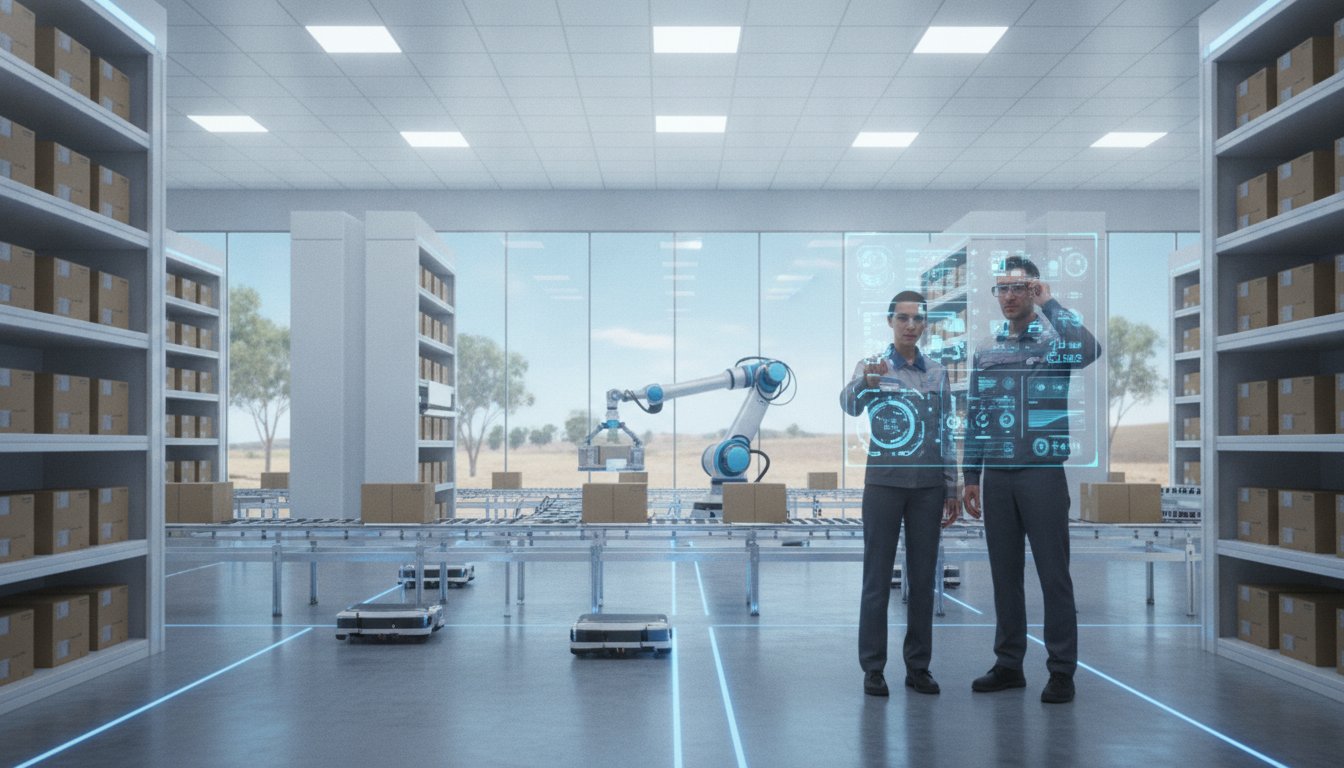
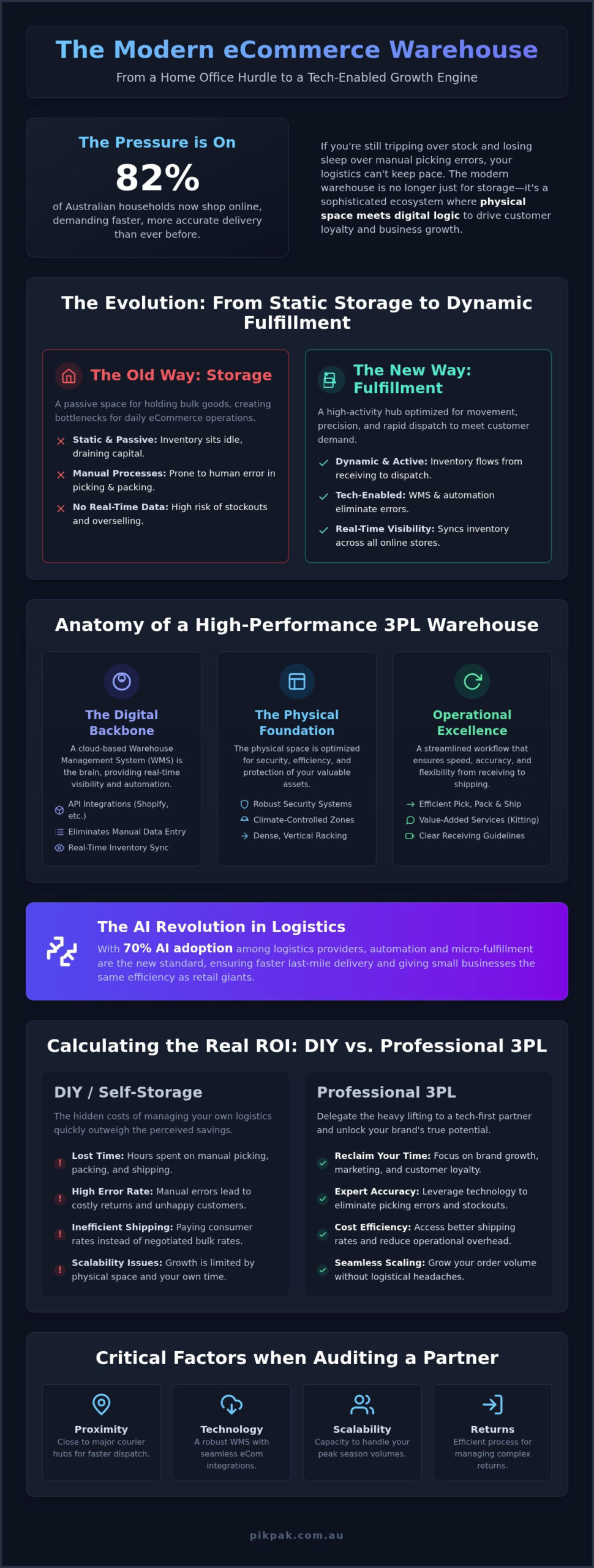
The Australian logistics landscape has shifted rapidly. With AI adoption in logistics reaching 70% among providers this year, small businesses now expect the same efficiency as retail giants. Modern fulfillment centers use autonomous mobile robots and advanced sorting systems to handle the heavy lifting. This shift toward automation and micro-fulfillment ensures faster last-mile delivery across Australia, meeting the record-high demand from the 82% of households now shopping online.
Static storage has become a liability. In a high-velocity market, stock that sits idle without real-time tracking drains your capital. You need a solution that prioritizes movement and precision over simple occupancy. The goal is to keep your inventory flowing, not just sitting on a shelf.
Storage vs. Fulfillment: Which Do You Actually Need?
Understand the difference between holding stock and moving it. Simple storage involves keeping bulk goods in a facility with minimal movement. This works for raw materials or seasonal overflow, but it fails the modern eCommerce brand that needs to ship daily.
A high-performance fulfillment center is a high-activity environment. It’s optimized for individual order picking, kitting, and rapid dispatch. For most growing Australian brands, a fulfillment-focused strategy is the only way to meet customer expectations for speed and reliability. Stop treating your inventory as a static asset and start treating it as the engine of your customer experience. Delegate the operational friction of manual packing and focus on your next marketing campaign instead.
The Anatomy of a High-Performance 3PL Warehouse
A high-performance warehouse is more than a storage site; it’s an essential component of the national economy that ensures goods move seamlessly from shelf to doorstep. To master ecommerce warehousing australia, you need a facility that balances physical security with digital precision. Physically, this means robust security systems to protect your assets, climate-controlled zones for sensitive products, and dense racking systems that maximize vertical space.
Accuracy begins at the loading dock. Clear receiving guidelines ensure that every item is accounted for the moment it arrives. This precision continues through value-added services like kitting and assembly, where individual SKUs are combined into ready-to-ship bundles. These services save you time and reduce shipping costs by allowing you to offer complex product variations without managing the manual labor yourself. It’s about creating an effortless flow from the moment stock arrives until it leaves as a finished order.
The Digital Backbone: WMS and Integration
Real-time inventory visibility is the standard for modern sellers. A cloud-based Warehouse Management System (WMS) acts as the brain of the operation. It uses direct API integrations to connect your online store, whether it’s Shopify or WooCommerce, directly to the warehouse floor. This automation removes the need for manual data entry. Orders flow instantly from your checkout to a picker’s handheld device, which helps eliminate human error and the delays associated with manual processing.
Operational Excellence: Pick, Pack, and Ship
Efficiency in a 3PL warehouse is a science. It starts with optimized picking paths that reduce the distance staff travel to fulfill an order. Once picked, packaging standards play a dual role: they protect your items during transit and minimize volumetric weight to keep shipping costs low. You don’t want to pay for shipping air, and your customers don’t want damaged goods.
Handling returns, or reverse logistics, is often the most complex part of the chain. A professional system processes these returns quickly, inspecting items and updating your inventory levels in real-time. This level of control keeps you in the driver’s seat while we handle the heavy lifting. If you’re ready to see how a tech-first approach can simplify your operations, consider how outsourcing your fulfillment could free up your time today.
Self-Storage vs. Professional Warehousing: Calculating the Real ROI
Many business owners view the cost of professional logistics as an added expense rather than a strategic investment. It’s common to look at a storage quote and assume that keeping stock in a garage or small self-storage unit is the more economical choice. However, the ecommerce warehousing australia landscape has shifted. As highlighted in a recent Australian eCommerce warehousing market report, the complexity of modern fulfillment requires sophisticated systems that go far beyond simple shelving.
The real cost of DIY warehousing isn’t just the rent; it’s the operational friction that slows your growth. When you spend four hours a day packing boxes, you’re losing four hours that could be spent on marketing, product development, or customer acquisition. This opportunity cost is often the biggest invisible tax on a growing brand. Delegating these tasks allows you to refocus on the high-value activities that actually move the needle for your business.
The Hidden Costs of Managing Your Own Space
Managing your own facility brings a list of overheads that many founders overlook. Commercial lease commitments are often rigid, forcing you to pay for unused square footage during quiet months. If your inventory levels drop, you’re still paying for that empty space. If you scale up quickly, you’re suddenly hunting for a new lease and dealing with the logistical nightmare of a physical move.
Hiring and managing staff in Australia adds another layer of complexity. You don’t just pay an hourly rate; you’re responsible for Superannuation, WorkCover insurance, and managing casual schedules. Then there’s the equipment. A professional setup requires thermal label printers, heavy-duty packing benches, and potentially forklifts. These are significant capital outlays that tie up your cash flow and require ongoing maintenance.
The 3PL Advantage: Pay-As-You-Go Scaling
Outsourcing to a professional provider transforms your fixed overheads into variable costs. This pay-as-you-go model means you only pay for the specific space you occupy and the orders you ship. This flexibility is a massive advantage for protecting your cash flow during seasonal dips, such as the post-Christmas lull in February.
By joining a 3PL network, you also tap into bulk shipping rates. Because providers aggregate volume from hundreds of clients, they pass on deep discounts from major Australian carriers. This gives you access to a professional customer delivery network that would be impossible to negotiate as a standalone small business. ROI in warehousing is the delta between in-house operational friction and outsourced efficiency.
How to Audit an Australian Warehouse Provider Before Signing
Selecting a logistics partner is a pivotal decision for your brand’s future. In the competitive landscape of ecommerce warehousing australia, you can’t afford to sign a contract based on storage rates alone. A proper audit ensures your partner can actually handle the heavy lifting while you focus on scaling. Start by evaluating their physical location. A warehouse situated near major Australian ports and primary courier distribution hubs isn’t just convenient; it’s a strategic advantage that slashes delivery times and reduces transit costs for your customers.
Inventory accuracy starts the moment a pallet touches the dock. This is why you must scrutinize a provider’s warehouse receiving guidelines. If their process for checking in stock is vague or manual, your inventory levels will never be reliable. You need a partner who values precision from day one. Demand transparency in their support systems as well. You shouldn’t have to chase an email for days to find out the status of a shipment. Look for dedicated, multi-channel support that keeps you in total control of your operations.
Technology and Compatibility Audit
Your warehouse must speak the same language as your online store. Ask if their WMS integrates directly with Shopify, WooCommerce, or your specific ERP system. Beyond simple shipping, verify if they can handle special projects like kitting, assembly, or promotional labeling. As your brand grows, your requirements will become more complex. Ensure they have the digital infrastructure to manage data security and provide comprehensive inventory insurance. This protection is vital for your peace of mind and business continuity.
Service Levels and Scalability
Peak periods like Black Friday or the Christmas rush will test your logistics to the limit. Ask potential partners about their specific cut-off times for same-day dispatch and how they scale their labor force during high-volume weeks. You need to know they won’t buckle under the pressure of a successful marketing campaign. Inquire about their broader network of transport companies to ensure they have the backup options needed to avoid delivery delays during industry-wide disruptions.
Auditing your logistics shouldn’t be a source of operational friction. If you’re ready to partner with a team that prioritizes transparency and tech-first efficiency, contact us to see how we simplify your fulfillment today.
Scaling with Pik Pak: Tech-First Warehousing for Growing Brands
Choosing the right partner for ecommerce warehousing australia is about more than finding a place to store stock; it’s about finding a team that removes the operational friction from your daily life. At Pik Pak Logistics, we position ourselves as the seasoned expert in a complex field. We simplify the entire logistics chain by acting as a capable extension of your business. Our Melbourne-based hub serves as a strategic launchpad for national distribution, ensuring your products reach customers across the country with precision and speed.
The core of our service is an effortless, web-based platform that gives you total control without the technical headache. You don’t need to be a logistics expert to manage your inventory. By delegating the heavy lifting to us, you reclaim your most valuable asset: your time. This allows you to refocus on marketing, product development, and the high-level strategies that drive brand growth. We handle the backend, so you can lead the front.
The Pik Pak Logistics Difference: Precision and Simplicity
Our commitment to our service priorities means we focus on accuracy, speed, and visibility at every stage of the fulfillment process. We know that a single error can damage a customer’s trust, so we use precision-driven systems to ensure the right product reaches the right person every time. Our technology support removes the technical burden from your shoulders, providing seamless integration between your online store and our warehouse floor.
Security is a cornerstone of our operation. You can rest easy knowing your inventory is held in a secure, state-of-the-art facility designed for high-velocity eCommerce. This isn’t just storage; it’s a dynamic environment where your stock is protected and ready for immediate dispatch. We provide the digital and physical infrastructure that allows you to scale without hesitation.
Ready to Move Out of the Garage?
Transitioning to professional warehousing is a significant milestone. We make the onboarding process simple and transparent, guiding you from the initial API integration to your very first shipment. You won’t find hidden fees or complex jargon here. Our transparent pricing models are designed to help Australian businesses plan for 2026 and beyond with total confidence.
Stop letting manual packing and inventory spreadsheets hold your brand back. It’s time to trade operational chaos for professional efficiency. If you are ready to see how a tech-first approach can transform your logistics into a competitive advantage, contact Pik Pak Logistics for a custom quote today. Let us handle the warehouse while you build the future of your brand.
Take Control of Your Growth in 2026
Scaling your business requires moving beyond the limitations of manual packing and physical space constraints. Modern warehousing is a digital asset; real-time visibility and automated order flows determine your success in a high-velocity market. By shifting from fixed overheads to a variable cost model, you protect your cash flow and gain access to national delivery networks that were once reserved for retail giants. This transition is the defining step between managing a side project and leading a national brand.
Mastering ecommerce warehousing australia doesn’t have to be a source of operational friction. With our cloud-based WMS providing 24/7 visibility and seamless integration with platforms like Shopify and WooCommerce, we handle the heavy lifting while you focus on your core objectives. As specialists in Australian eCommerce fulfillment, we ensure your logistics are precise, secure, and entirely effortless. You’ve done the hard work of building a brand; now it’s time to provide the high-performance engine that helps it thrive.
Get an Instant Quote for Professional Warehousing
The operational hurdles that once slowed you down are now manageable tasks. We’re ready to help you reclaim your time and build the future of your business with confidence.
Frequently Asked Questions
What is the difference between a warehouse and a fulfillment center?
A warehouse is primarily designed for the long-term storage of goods, while a fulfillment center is an active hub optimized for the rapid movement of individual orders. While both provide space, a fulfillment center focuses on the end-to-end process of receiving orders, picking items from shelves, packing them securely, and shipping them to customers. This high-activity environment is essential for brands needing fast turnaround times and real-time inventory updates rather than just static storage space.
How much does it cost to store products in an Australian 3PL warehouse?
Storage costs in a professional facility are typically calculated based on the physical space your inventory occupies, such as pallet positions or shelf units. Most providers use a variable cost model where you only pay for the space you use each week. This approach protects your cash flow during seasonal fluctuations. Factors like product dimensions, special handling requirements, and the total volume of stock being held will influence your final monthly storage investment.
Can I still see my inventory levels if my products are in your warehouse?
Yes, you maintain total control through a cloud-based Warehouse Management System (WMS) that provides real-time visibility of your stock levels 24/7. This digital layer connects directly to your online store, ensuring that every time a customer makes a purchase, your inventory count updates instantly. You don’t need to be physically present in the warehouse to know exactly what is on the shelf, which helps you avoid stockouts and plan reorders with precision.
What happens if a customer wants to return a product to the warehouse?
Managing returns is a standard part of a professional logistics service. When a customer sends a product back, it is received at the warehouse, inspected for damage, and processed according to your specific instructions. Items in good condition can be returned to active inventory, while damaged goods are set aside. This end-to-end returns management system ensures that reverse logistics remain a simple, manageable task rather than an operational bottleneck for your business.
Do I need to sign a long-term lease for eCommerce warehousing?
No, one of the primary advantages of using a 3PL for ecommerce warehousing australia is the elimination of rigid, long-term commercial leases. Instead of committing to a fixed space for years, you access a flexible, pay-as-you-go model. This allows you to scale your storage up or down based on your actual order volume. It’s a pragmatic solution for growing brands that need to remain agile without the financial burden of a traditional industrial lease.
How long does it take to integrate my online store with a 3PL warehouse?
Integration is typically a fast and straightforward process thanks to pre-built API connectors for major platforms like Shopify and WooCommerce. Most businesses can have their online store synced with the warehouse management system within a few days. Once the connection is live, your orders flow automatically to the picking team without any manual data entry. This seamless setup removes the technical burden from the merchant and allows for an effortless transition to professional fulfillment.
Is my inventory insured while it is stored in a third-party facility?
While professional facilities are equipped with high-end security and fire suppression systems, inventory insurance is a critical topic to discuss with your provider. Most 3PLs maintain their own building and public liability insurance, but merchants are often responsible for insuring their specific goods against loss or damage. It’s a simple task to add your off-site inventory to your existing business policy, providing the peace of mind that your assets are protected at all times.
What are warehouse receiving guidelines and why do they matter?
Warehouse receiving guidelines are a set of standards that dictate how your stock must be labeled and packaged when it arrives from a supplier. These rules are vital because they ensure that every item can be scanned and accounted for accurately the moment it hits the dock. Following these protocols prevents delays in making your stock live for sale and eliminates the picking errors that occur when inventory is not properly identified during the inbound process.