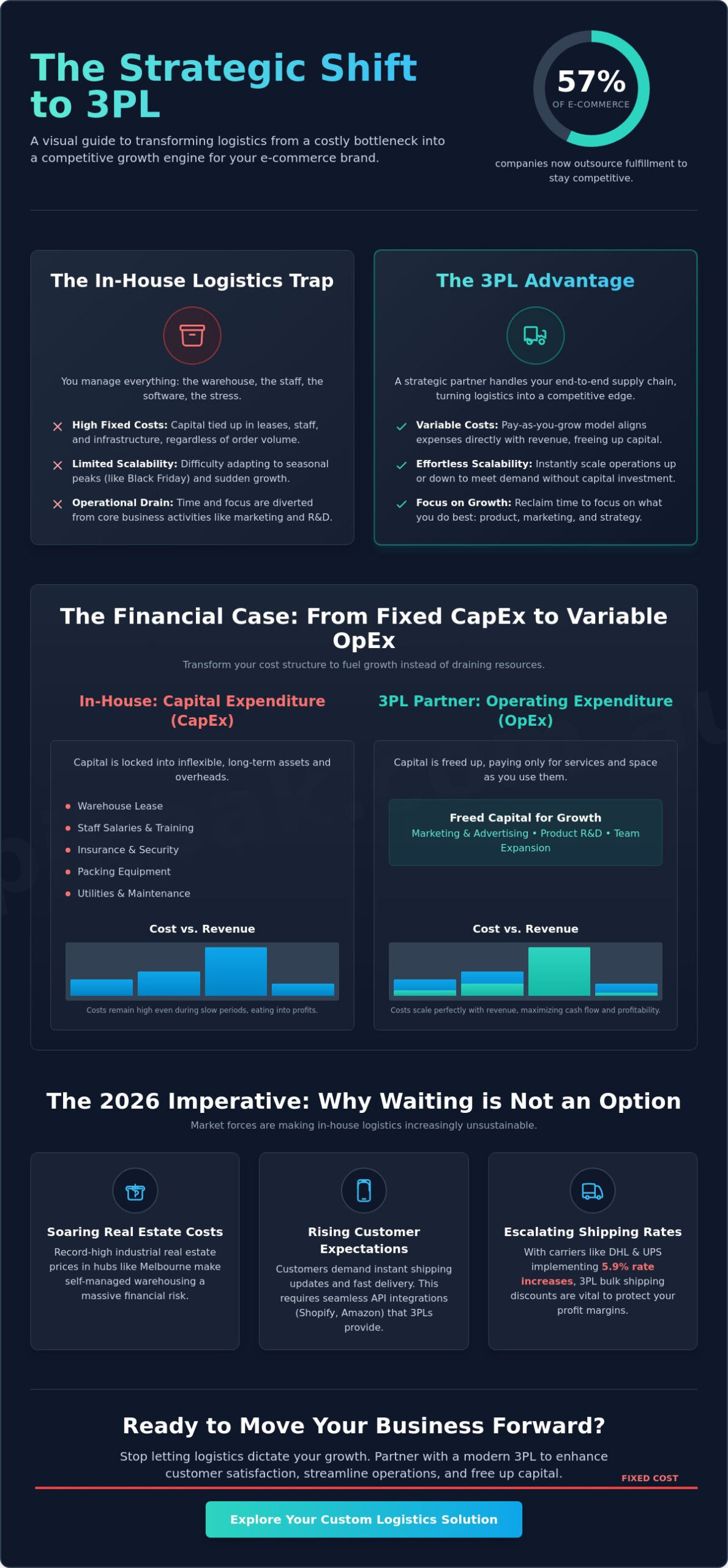
Did you know that approximately 57% of e-commerce companies now outsource some or all of their fulfillment processes to stay competitive? Crafting a persuasive presentation on 3pl benefits is the most effective way to show your leadership team how to join this majority and reclaim lost operational hours. You likely already feel the friction of managing rising overheads and the constant stress of scaling up for peak seasons like Black Friday. It’s exhausting to watch orders slip away simply because your current shipping process can’t keep pace with demand.
We understand that proposing a major shift in operations requires a solid, evidence-based argument. This guide provides a structured, data-driven framework to help you present the strategic and financial advantages of third-party logistics to your stakeholders. We’ll cover everything from converting fixed costs into growth capital to a roadmap for seamless tech integration. By the end of this article, you’ll have a clear set of arguments and a roadmap to move your logistics from a bottleneck to a business driver.
Key Takeaways
- Learn how to convert fixed warehouse overhead into variable operational capital, freeing up cash flow for core business growth.
- Discover how cloud-based WMS technology and automated pick and pack services eliminate manual errors and streamline your inventory management.
- Master a data-driven framework for your presentation on 3pl benefits to effectively communicate ROI and scalability to your leadership team.
- Boost customer satisfaction by utilizing established shipping networks for faster home delivery and professional returns management.
- Identify the key selection criteria for a logistics partner, including the strategic importance of a Melbourne-based distribution hub.
Defining 3PL for Your Presentation: More Than Just Moving Boxes
When you begin your presentation on 3pl benefits, you must clear up a common misconception. A 3PL isn’t just a warehouse for hire. It’s a strategic partnership that manages your end-to-end supply chain. In a traditional 1PL (First-Party Logistics) model, you’re the one leasing the shed, hiring the staff, and troubleshooting the software. It’s a heavy burden that eats your time and limits your growth. Third-party logistics (3PL) changes this by integrating these complex functions into a single, scalable service that adapts to your needs.
Think of a 3PL as your brand’s operational engine. While you focus on marketing, product design, and high-level strategy, your partner handles the physical heavy lifting. We’ve moved far beyond the era of dusty, manual warehouses. Modern fulfilment centres are sophisticated, tech-driven hubs designed for high-velocity retail. By delegating these tasks, you transform your logistics from a source of friction into a competitive advantage that powers your business forward.
The Core Functions of a Modern 3PL Partner
A capable partner provides much more than a shelf. It starts with secure inventory storage in facilities that scale with your seasonal peaks. The “Pick, Pack, and Ship” workflow is the heart of the operation. Speed and accuracy are the only metrics that matter here. If a customer receives the wrong item, your brand’s reputation takes the hit. That’s why professional returns management is vital. It ensures that reverse logistics are handled with the same precision as outbound orders, protecting your customer relationships even when things don’t go perfectly.
Why 2026 is the Inflection Point for Outsourcing
The logistics landscape in 2026 is unforgiving for businesses trying to go it alone. Industrial real estate costs in major Australian hubs like Melbourne have reached record highs, making self-managed warehousing a massive financial risk. Beyond the physical space, there’s the tech gap. Customers now expect instant updates and lightning-fast home delivery shipping options as a basic standard. To meet these demands, your systems must communicate perfectly. Your presentation on 3pl benefits should highlight the necessity of instant API integrations with platforms like Shopify, eBay, and Amazon. Without this automation, you’re simply running to stand still in a fast-paced market.
The Financial Case: Converting Fixed Costs to Variable Capital
Financial agility is a hallmark of top-tier brands. If you’re managing your own warehouse, you’re likely stuck with high fixed costs. Leases, insurance premiums, and security systems are bills you pay regardless of whether you ship ten orders or ten thousand. A strong presentation on 3pl benefits must focus on the shift from this rigid Capital Expenditure (CapEx) model to a flexible Operating Expenditure (OpEx) model. This change ensures your capital isn’t tied up in bricks and mortar, but is instead available for growth.
Moving to a pay-as-you-grow structure improves your cash flow immediately. You only pay for the inventory storage you actually occupy. This flexibility allows you to pivot resources toward marketing or product R&D. You don’t have to worry about paying for empty shelves during your off-season. It’s a simple way to ensure your operational costs always align perfectly with your revenue.
Labor is a significant variable cost that often spirals out of control. In Australia, managing an in-house team involves complex recruitment, training, and payroll tax obligations. A 3PL partner absorbs these operational burdens and manages staffing fluctuations for you. You also gain access to bulk shipping discounts that are impossible to secure on your own. With global carriers like DHL, UPS, and FedEx implementing 5.9% rate increases for 2026, these shared savings are vital for maintaining your margins. You can explore our logistics solutions to see how this impacts your bottom line.
Hidden Costs of In-House Warehousing
The price of a warehouse extends far beyond the rent. You must account for utilities, constant maintenance, and specialized packing equipment. Packaging waste is another silent profit killer. Professional pick and pack services use optimized systems to reduce dimensional weight and material costs. The most significant hidden cost is the opportunity cost. Every hour your team spends troubleshooting a late delivery is an hour lost to business growth.
ROI Metrics for Your Stakeholder Presentation
To win over your CFO, you need hard data. Compare your current Cost Per Order (CPO) against an outsourced rate. Include labor, rent, and packaging in your calculation. Focus on these metrics for your presentation on 3pl benefits:
- Inventory Turnover: Real-time visibility through a WMS helps you reduce dead stock and optimize cash flow.
- Shipping Savings: Contrast your current rates with the bulk rates provided by a partner across multiple carriers.
- Scalability: Calculate the cost of doubling your order volume in-house versus the effortless expansion offered by a partner.
ROI in 3PL is the ratio of saved overhead to increased sales capacity.
Operational Excellence: Tech, Accuracy, and Scalability
Operational excellence isn’t an accident. It’s the result of a robust, tech-driven infrastructure. When building your presentation on 3pl benefits, explain that 2026 demands more than manual spreadsheets and guesswork. You need a Cloud-based Warehouse Management System (WMS) to act as the brain of your operation. This technology provides real-time inventory tracking, which is the only way to prevent the nightmare of overselling or out-of-stock messages during a flash sale. It gives you total control over your stock levels without you ever having to step foot in a warehouse.
Automation is no longer a luxury. With the global warehouse robotics market projected to reach $21.08 billion by 2030, competitive 3PLs are using these tools to eliminate human error. In the pick and pack process, every movement counts. Barcode scanning and automated verification protocols ensure that the right product reaches the right customer every time. This precision is what allows a business to scale without the typical growing pains of lost orders or shipping delays.
Scaling up for peak seasons like Black Friday shouldn’t involve a frantic search for temporary labor or extra floor space. A 3PL partner handles the surge effortlessly. They have the existing infrastructure and trained staff to manage a 500% increase in order volume overnight. This allows you to focus on your marketing campaigns while we handle the heavy lifting. You get all the benefits of a massive logistics department without the year-round overhead.
Technology Support and Seamless Integration
Your logistics partner shouldn’t be a black box. You need total transparency. Modern systems use API and pre-built connectors to ensure instant communication between your online store and the warehouse floor. Whether you’re on Shopify, eBay, or Amazon, the data flows both ways. This integration allows for sophisticated data analytics, helping you forecast stock levels with precision. You can learn more about our technology support to see how we bridge the gap between your digital storefront and physical inventory.
Standardising the Unboxing Experience
The customer journey ends at the front door, not the checkout. Through professional kitting and assembly, you can create value-added bundles that drive higher order values. We handle custom labelling and promotional inserts at scale, ensuring every package reflects your brand identity. By maintaining a 99.9% order accuracy rate through rigorous scanning protocols, we turn first-time buyers into loyal repeat customers. This level of consistency is a cornerstone of any successful presentation on 3pl benefits.
Strategic Advantage: Enhancing the Customer Experience
Logistics is often the only physical touchpoint your customer has with your brand. In your presentation on 3pl benefits, you should frame third-party logistics as a tool for customer retention, not just a line item for shipping. By leveraging a 3PL’s established courier networks, you can offer faster, more reliable delivery times that individual retailers often struggle to match. This is particularly vital in the Australian market. A Melbourne-based hub provides a strategic base for nationwide distribution, allowing you to reach customers in Sydney, Brisbane, and beyond without the massive cost of leasing multiple interstate warehouses.
When you outsource these operations, you’re also delegating the complex task of returns management. A smooth, professional return process is a powerful driver for customer loyalty. It proves to your buyers that your brand is reliable even when a product isn’t the right fit. This shift transforms your internal team. Instead of troubleshooting late parcels, your staff can refocus on high-impact tasks like marketing and product development. You gain the ability to expand into new markets, such as New Zealand, with zero physical expansion or local hiring required.
The ‘Delivery Promise’ as a Marketing Tool
Your shipping policy is a significant marketing asset. Providing transparent, real-time tracking info significantly reduces ‘Where is my order?’ (WISMO) queries, which can otherwise overwhelm a small customer service team. Professional packaging also plays a massive role in brand perception. When an order arrives in a clean, well-packed box with accurate kitting and assembly, it reinforces the value of your product. You can explore our customer delivery options to see how we help brands meet the rising expectations of 2026 shoppers.
Mitigating Risk and Ensuring Business Continuity
Operating out of a garage or a basic office space poses significant business risks. Professional warehouses are designed for safety and disaster recovery, meeting strict Australian standards that keep your inventory secure. 3PLs also mitigate the risk of supply chain disruptions through carrier diversification; if one courier faces delays or strikes, your partner can immediately pivot to another provider to keep your orders moving. This level of operational resilience is nearly impossible to achieve in-house without massive capital investment. Ready to upgrade your customer experience? You can start your logistics transition today to ensure your brand is protected and ready for growth.
Implementation Strategy: Choosing and Pitching the Right Partner
The final slide of your presentation on 3pl benefits shouldn’t just be a “Thank You” page. It needs to be a clear roadmap for implementation that builds stakeholder confidence. Choosing a partner isn’t just about finding a place to store boxes; it’s about finding a tech-forward ally. You must evaluate three core pillars: location, tech-stack, and cultural fit. For Australian brands, a Melbourne-based hub is often the most strategic choice. It serves as an ideal launchpad for nationwide distribution, ensuring your inventory is positioned where shipping infrastructure is strongest and most cost-effective.
Transitioning to an outsourced model feels like a major shift, but it’s a manageable task when you have a structured plan. A seamless transition involves two main phases: data migration and stock transfer. Your partner’s WMS platform should integrate directly with your online store, pulling in order history and product data without manual entry. Once the digital link is established, the physical stock transfer follows. To ensure long-term success, set clear Key Performance Indicators (KPIs) from day one. Focus on order accuracy rates, receiving speed, and shipping lead times to keep the partnership transparent and accountable.
Questions to Ask Potential 3PL Providers
You need to dig deep into the operational reality of any potential provider. Ask specifically how they handle peak season volume spikes. If they don’t have a proven method for managing the Black Friday rush, they’ll become a bottleneck for your growth. You should also clarify their receiving guidelines for new inventory to avoid delays at the dock. For more detailed insights, many common warehousing questions answered can help you vet providers more effectively during your selection process.
Why Pik Pak is the Logical Conclusion for Your Presentation
Pik Pak is built specifically for the high-velocity demands of modern eCommerce fulfilment. We understand that your brand needs more than just storage; you need an enabling force that removes operational hurdles. There’s a distinct competitive advantage in outsourcing to a partner that understands the Australian market. Our focus on speed, accuracy, and seamless tech integration allows you to reclaim your time and refocus on high-level strategy. When you include Pik Pak in your presentation on 3pl benefits, you aren’t just pitching a vendor. You’re proposing a partnership designed to eliminate friction and accelerate your business growth.
Take Control of Your Operational Future
The transition from manual warehousing to a strategic 3PL partnership is the most effective way to protect your margins in 2026. By converting rigid fixed costs into flexible growth capital, you’re giving your brand the financial room it needs to thrive. Your presentation on 3pl benefits has now established a clear path forward; one that replaces logistical friction with automated precision and effortless scalability. You’ve shown that outsourcing isn’t just about saving money. It’s about reclaiming your time to focus on high-impact growth.
Success in the Australian market requires a partner who understands the local landscape. With Pik Pak Logistics, you gain access to specialist eCommerce fulfilment and a robust Melbourne-based national shipping network. Our WMS platform provides real-time visibility, ensuring you always have total control over your inventory and order accuracy. It’s time to stop fighting with spreadsheets and start scaling with confidence. Ready to scale? Request a quote from Pik Pak Logistics today. Your business is ready for the next level; let’s make it happen together.
Frequently Asked Questions
What are the primary benefits of using a 3PL for a small business?
Small businesses benefit most from the ability to scale without adding fixed overhead. Instead of managing a warehouse lease and a staffing team, you can focus on product development and marketing. A 3PL handles the pick, pack, and ship process, allowing you to reclaim your time and only pay for the storage and services you use during peak or quiet seasons.
How does a 3PL help reduce shipping costs in Australia?
3PLs leverage high shipping volumes to secure bulk discounts from major carriers like UPS, FedEx, and DHL. These savings are passed on to you, which is an essential point for your presentation on 3pl benefits. By using a Melbourne-based hub, you also optimize nationwide distribution, reaching customers across Australia more efficiently than shipping from a single, remote location.
Will I lose control over my inventory if I use a third-party logistics provider?
No, you actually gain more control through real-time visibility. Our WMS platform gives you a live view of stock levels, order status, and inventory movement from any device. This transparency prevents overselling and out-of-stock issues, providing a level of precision that manual tracking simply can’t match.
What is the difference between a 3PL and a standard warehouse?
A standard warehouse offers basic storage, but a 3PL provides a fully integrated logistics ecosystem. This includes technology-driven fulfilment, kitting and assembly, and professional returns management. While a warehouse is a passive storage space, a 3PL is an active operational partner that automates your entire supply chain.
How long does it take to integrate my online store with a 3PL system?
Integration is usually a fast process thanks to pre-built API connectors for platforms like Shopify, eBay, and Amazon. Most businesses can establish a digital link within a few days. Once the systems are talking to each other, you can begin the physical stock transfer and start shipping orders almost immediately.
Can a 3PL handle fragile or high-value items safely?
Yes, 3PLs use specialized packing techniques and barcode scanning to ensure the safe handling of delicate goods. Secure facilities and rigorous verification protocols minimize the risk of damage or loss. This professional approach protects your brand reputation and reduces the costs associated with damaged shipments.
What happens to my returns when I use a 3PL service?
Your 3PL manages the entire reverse logistics process to keep your customers happy. When an item is returned, it’s inspected, processed, and either returned to stock or handled according to your specific guidelines. This professional returns management ensures a smooth experience for the buyer and keeps your inventory data accurate.
How do I calculate the ROI of switching to 3PL?
Start by comparing your total current logistics spend, including rent, labour, and packaging, against the 3PL cost per order. This comparison is a key part of any presentation on 3pl benefits. Factor in the value of the time you’ll save and the potential for increased sales through faster shipping and better scalability.