Scaling a business in 2026 requires more than just a great product; it demands a radical shift in how you handle every order. If you’re still spending your mornings drowning in manual order processing or watching your margins disappear into rising Australian warehouse rental costs, you’re not just losing time. You’re losing your competitive edge. Building a solid business case for outsourcing logistics is no longer about finding the cheapest path from A to B. It’s about transforming your supply chain into a strategic engine for growth that responds instantly to market shifts.
We know the friction of inconsistent delivery times and the stress of “flying blind” without real-time inventory visibility. It’s exhausting to focus on packing boxes when you should be focusing on your next marketing campaign. This guide provides a clear, data-driven framework to prove the ROI of moving to a professional partner. You’ll learn how to unlock scalability, reclaim your time, and leverage advanced WMS technology to ensure every customer receives their order with precision. We’ll break down the specific ways that delegating your pick, pack, and ship operations can finally let you focus on what actually moves the needle for your business.
Key Takeaways
- Understand why 2026 requires a shift from simple tactical outsourcing to a strategic partnership that prioritizes long-term business agility.
- Learn how to convert heavy fixed costs like warehouse rent and labor into a flexible, variable model that scales alongside your order volume.
- Master the step-by-step process for building a persuasive business case for outsourcing logistics by conducting a “True Cost of Fulfillment” audit.
- Reclaim leadership hours for high-value growth activities while gaining access to advanced WMS technology without the capital expenditure.
- Identify the specific non-financial KPIs, such as error reduction and delivery consistency, that secure stakeholder buy-in and prove operational ROI.
Defining the Business Case for Outsourcing Logistics
Building a business case for outsourcing logistics in 2026 is no longer a simple exercise in cost-cutting. For an eCommerce brand, it’s a strategic decision to trade operational friction for professional precision. In the past, outsourcing was often seen as a tactical move to reduce headcount. Today, it’s about building a partnership that provides the infrastructure your brand needs to compete with global giants. A modern business case focuses on how your supply chain can become a growth driver rather than a bottleneck.
The “do it yourself” model eventually hits a hard ceiling. You can only pack so many boxes in a garage or a small office before the errors start to climb and delivery times slip. In Australia, the challenge is amplified by vast shipping distances and high consumer expectations. A customer in Perth expects the same delivery speed as one in Sydney. Meeting those demands requires a sophisticated Third-party logistics (3PL) partner who understands the local landscape and has the technology to manage it efficiently.
The Three Pillars of a Modern Logistics Case
Operational agility is your first pillar. A professional partner allows you to respond to sudden market shifts or seasonal peaks without the stress of hiring temporary staff or finding extra space. You simply pay for the activity you generate. Cost transformation is the second pillar. Instead of being locked into a fixed warehouse lease, you move to a variable expense model. This protects your cash flow during quieter months. Finally, customer experience remains the ultimate goal. Professional warehousing and fulfilment ensures that every order is accurate and reaches the doorstep on time, every time.
When is the Right Time to Outsource?
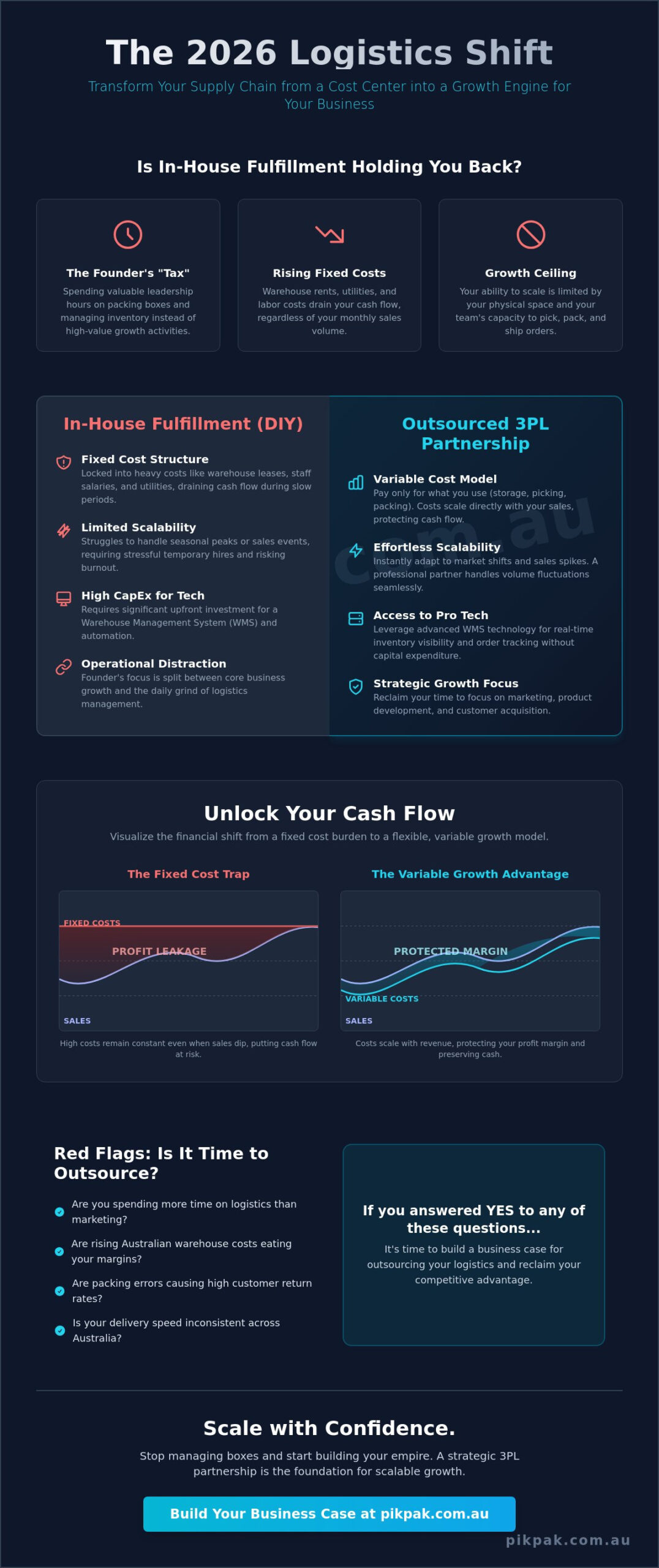
Identifying the tipping point is critical for your business case for outsourcing logistics. If you’re spending more time managing inventory than you are on marketing or product development, you’ve reached it. The opportunity cost of a founder packing boxes is one of the most overlooked expenses in small to medium enterprises.
Signs of profit leakage are often subtle. High return rates due to packing errors, the rising cost of Australian warehouse rentals, and the “founder’s tax” are all red flags. When you delegate these tasks, you reclaim your most valuable asset: your time. This shift allows you to focus on high-value growth while your logistics partner handles the backend with automated efficiency and reliable delivery systems.
Financial Impact: Turning Fixed Costs into Variable Growth
Managing your own warehouse is often a financial trap. It’s easy to look at the monthly rent and think that’s the total cost. But you have to account for the utilities, the equipment leases, and the rising insurance premiums that come with running a physical facility. When you build a business case for outsourcing logistics, you’re looking at how to shed these heavy fixed burdens. Moving to a variable cost model means your expenses align perfectly with your sales. If you have a slow month, your costs drop automatically. You don’t pay for empty pallet spaces or idle staff. Many businesses are increasingly recognizing the strategic advantages of outsourcing to mitigate these financial risks and improve their bottom line.
Labour management is another hidden drain on your resources. Beyond the basic hourly rate, you’re paying for recruitment, training, and the high cost of turnover in the logistics sector. When an experienced packer leaves, your productivity drops and your error rates climb. A professional partner absorbs these risks. They maintain a trained workforce ready to handle your volume, no matter how much it fluctuates. This stability turns a chaotic operational hurdle into a predictable, per-order expense that makes your financial forecasting much simpler.
Fixed vs. Variable Cost Analysis
Eliminating long-term warehouse leases is a massive win for your cash flow. In the current Australian market, being locked into a five-year lease for space you might outgrow (or underutilize) is a significant risk. Outsourcing allows you to scale up or down without the friction of hiring or firing. You get a clear, per-action price for inventory storage and picking. This predictability allows you to reinvest capital into marketing and product development rather than warehouse racking.
Shipping and Freight Optimisation
A 3PL partner provides instant access to Tier-1 carrier rates that are usually reserved for the biggest retailers. Because they aggregate volume from hundreds of clients, they can negotiate better shipping deals across Australia. Strategic warehouse placement in hubs like Melbourne also reduces the “dead money” spent on long-haul shipping and excess packaging materials. You can view our full range of logistics services to see how these volume discounts can directly impact your per-order profitability. This ensures your business case for outsourcing logistics is built on tangible, immediate savings.
Strategic Advantages Beyond the Balance Sheet
Your time is the most expensive resource in your business. While the financial savings of a 3PL are compelling, the true value often lies in the hours you reclaim. When you stop managing packing stations and chasing couriers, you can refocus on high-value activities like product research and development or aggressive marketing strategies. A robust business case for outsourcing logistics recognizes that growth happens when leadership is freed from the warehouse floor. By delegating these operational burdens, you shift from being a fulfillment manager to a business builder.
Professional partnerships also allow you to elevate your customer’s unboxing experience. Through expert kitting and assembly services, you can deliver a premium, retail-ready presentation that builds brand loyalty. A recent systematic review of logistics outsourcing highlights how these specialized partnerships serve as a critical buffer against market volatility, allowing brands to maintain high service levels even during rapid growth. This level of precision is difficult to maintain in-house without a massive investment in specialized staff and space.
Technology as a Growth Lever
Accessing a sophisticated Warehouse Management System (WMS) usually requires a heavy capital expenditure. When you partner with a 3PL, you gain WMS platform access as part of the service. This technology provides real-time inventory visibility, which is essential for reducing stockouts and preventing the frustration of overselling. Our systems integrate seamlessly with major platforms like Shopify, WooCommerce, and Magento. This automation ensures that orders flow directly from your storefront to the packing bench without manual data entry. You gain data-driven insights through advanced reporting, allowing you to make smarter inventory decisions based on actual performance trends.
Risk Mitigation and Business Continuity
Transferring the burden of compliance, safety, and operational insurance to a professional partner significantly lowers your business risk. You no longer need to worry about fulfillment grinding to a halt due to staff illness or unexpected seasonal surges. A professional 3PL has the scale to absorb these fluctuations effortlessly. Managing returns management also becomes a tool for customer retention rather than a logistical headache. We handle the reverse logistics with the same precision as outbound shipping, ensuring that returned items are inspected and restocked quickly. This professional handling protects your reputation and ensures your business case for outsourcing logistics is built on long-term stability and customer trust.
Building Your Internal Pitch: KPIs and Stakeholder Buy-in
Securing approval for a major operational shift requires a narrative that balances hard data with emotional relief. Your business case for outsourcing logistics becomes undeniable when you quantify the hidden drain on your current resources. Start by auditing your “True Cost of Fulfilment.” This means looking beyond the monthly rent. Include the cost of packing tape, labels, warehouse insurance, and the “founder’s tax” of time spent on manual tasks. Once you have this number, you can clearly define the non-financial pain points. High error rates, shipping delays, and the sheer stress of peak seasons are all valid reasons to pivot toward a professional partner.
Research and shortlist potential 3PL partners who understand the Australian landscape. You need a team that can navigate local delivery routes with precision. Present a 12-month projection to your stakeholders that compares stagnant growth, limited by your current warehouse capacity, against the scalability of an outsourced model. Finally, address the “loss of control” objection head-on. Show them how real-time WMS visibility actually gives you more control over your stock than a manual spreadsheet ever could. It’s about moving from doing the work to overseeing the results.
The KPIs That Matter Most
Focus on three key metrics to prove ROI. Order Accuracy Rate is vital because fixing a mistake is often three times more expensive than getting it right the first time. Order Cycle Time measures your speed from click to doorstep, which is a major driver of customer reviews. Inventory Accuracy prevents capital from being tied up in “lost” stock that isn’t actually on the shelf. These numbers turn abstract promises into concrete business advantages.
Addressing Common Management Objections
Management often worries about maintaining brand standards when they can’t see the packing bench. Our pick and pack services include custom kitting and assembly options to ensure every box arrives exactly as you intended. Data security is another common concern, which is why we prioritize encrypted systems and high platform uptime. If the team is still hesitant, suggest a pilot program. Starting with a single product line reduces transition risk and allows you to prove the concept before a full-scale rollout. Ready to see the difference professional management makes? View our service priorities to see how we protect your brand during every delivery.
Scaling with Confidence: Why Pik Pak Logistics is the Right 3PL Partner
Finalising your business case for outsourcing logistics requires choosing a partner that aligns with your growth trajectory. Pik Pak Logistics provides a pragmatic, tech-first approach to Australian fulfillment that removes the operational friction holding your brand back. We don’t just store products; we provide the infrastructure that allows you to scale without the traditional growing pains of in-house management. Our systems are designed to bridge the gap between complex backend processes and simple user actions, ensuring you always feel in control of your inventory.
Seamless integration is the cornerstone of our service. Whether you use Shopify, WooCommerce, or Magento, the Pik Pak Logistics platform connects directly to your storefront. This automation means orders flow into our system instantly, triggering our pick, pack, and ship process without you lifting a finger. Our warehousing and fulfilment solutions are entirely flexible. You only pay for the space you use and the orders we process. This transparent pricing model ensures your margins remain protected as you expand into new markets or handle seasonal surges.
The Pik Pak Logistics Advantage: Simplicity and Control
We believe that outsourcing shouldn’t mean losing sight of your business. Our cloud-based WMS provides total visibility into your stock levels and order statuses in real-time. You keep the high-level control while we handle the heavy lifting. If you have unique requirements, the expert technology support team at Pik Pak Logistics is available to assist with custom integrations or complex kitting needs. This dedicated partnership ensures that your logistics strategy remains aligned with your broader business objectives. We act as a seasoned problem-solver in a chaotic field, allowing you to focus on marketing and R&D while we ensure every delivery is precise.
Next Steps: From Business Case to Reality
Moving from a theoretical business case for outsourcing logistics to a live operation is a straightforward process with the right guide. Start by requesting a tailored quote based on your specific SKU count and expected monthly order volume. This gives you the concrete numbers needed for final stakeholder approval. Our onboarding process is designed for speed and clarity. Within the first 30 days, we’ll sync your systems, receive your inventory, and begin shipping orders with professional accuracy. It’s time to stop packing boxes and start growing your empire. Ready to scale? Build your business case with Pik Pak Logistics today.
Take Control of Your Growth Strategy
The evidence is clear. Building a strong business case for outsourcing logistics isn’t just about finding a warehouse; it’s about securing the agility your brand needs to thrive. By shifting from restrictive fixed costs to a flexible variable model, you protect your margins while ensuring your operations can scale instantly. Professional management eliminates the “founder’s tax,” giving you back the hours needed to focus on marketing and product innovation rather than packing benches.
Delegating your fulfillment doesn’t mean losing control. With real-time WMS visibility and expert Australian-based support, you gain a level of precision that manual systems simply can’t match. You can trust our scalable pick, pack, and ship solutions to maintain your brand standards with every delivery. It’s time to stop managing operational friction and start leading your business toward its full potential. We’re ready to help you turn your logistical challenges into a seamless competitive advantage.
Get a Tailored 3PL Quote for Your Business
Frequently Asked Questions
Is it cheaper to outsource logistics or keep it in-house?
Outsourcing is typically more cost-effective once your business moves past the initial startup phase. While in-house fulfillment seems cheaper on the surface, it carries hidden burdens like warehouse rent, utilities, and specialized labor. By switching to a 3PL, you convert these heavy fixed costs into variable expenses. You only pay for the storage and shipping you actually use, which protects your margins during seasonal dips and rapid growth spurts.
What are the main risks of outsourcing logistics for a small business?
The primary risks involve the initial transition period and ensuring your sales platforms sync correctly with the provider’s system. If data doesn’t flow accurately, it can lead to inventory discrepancies. You can mitigate these risks by choosing a partner with robust technology support and a proven onboarding process. Starting with a pilot program for a specific product line is also a smart way to test the waters without risking your entire operation.
How do I calculate the ROI of logistics outsourcing?
To calculate ROI, you must first document your current total fulfillment spend, including rent, packing materials, and the hours you spend on manual tasks. Compare this to the projected 3PL fees for the same volume. A strong business case for outsourcing logistics also accounts for the revenue gained by reinvesting your reclaimed time into marketing. If delegating allows you to scale from 100 to 500 orders a month, that growth is your primary return.
Will I lose control over my customer service if I use a 3PL?
You don’t lose control; you gain a more sophisticated way to monitor it. Real-time WMS platform access allows you to track every order from the moment it’s picked to the second it reaches the customer’s door. This transparency gives you the data needed to answer customer inquiries faster and more accurately. You still set the standards, while your partner ensures those standards are met with professional consistency and automated tracking updates.
How long does it take to transition to an outsourced logistics provider?
Most businesses can complete a full transition within 30 days. This timeline includes integrating your eCommerce storefront, such as Shopify or WooCommerce, and physically moving your stock to the new warehouse. The first two weeks usually focus on system syncing and data testing, while the final two weeks involve inventory receiving and live shipping. A structured onboarding plan ensures your customers don’t experience any service interruptions during the move.
What should I look for in a 3PL contract?
Look for transparent pricing structures and clearly defined Service Level Agreements (SLAs) regarding order accuracy and shipping times. You want a contract that offers flexibility rather than locking you into rigid, long-term space commitments that don’t scale with your sales. Ensure there are clear protocols for returns management and inventory insurance. A good contract acts as a roadmap for the partnership, defining exactly how challenges are managed and resolved.
Can a 3PL handle custom packaging and branding?
Yes, many professional providers offer specialized kitting and assembly services to maintain your brand’s unboxing experience. You can provide your custom-branded boxes, tissue paper, or marketing inserts to ensure every package looks exactly as you intended. This allows you to deliver a premium feel without having to pack each item yourself. Professional packers ensure these elements are handled with care, protecting your brand’s reputation with every home delivery.