
It is 9:30 PM on a Tuesday, and instead of planning your next product launch, you are manually cross-referencing spreadsheets to find out why 14 orders are still “pending” after three business days. You know that logistics should be the silent engine of your eCommerce business, not a daily source of frustration that drains your energy. When hidden fees start eating into your A$ margins and stock discrepancies lead to negative reviews, identifying the signs of a bad 3pl partnership becomes a matter of survival for your brand.
We believe that fulfillment shouldn’t be a headache. You deserve to reclaim your time and focus on marketing while your logistics run like clockwork. This article identifies the critical red flags in your current warehouse setup and shows you how to reclaim your time by switching to a provider that actually scales with you. We will walk through seven specific indicators that it’s time to move on and how to find a partner that makes the entire process simple, secure, and automated.
Key Takeaways
- Understand how operational “firefighting” kills your growth by diverting your focus from marketing to fixing avoidable shipping errors.
- Identify the seven critical signs of a bad 3pl partnership, including the “Black Box” effect where you lose all visibility into your own inventory.
- Learn why relying on manual spreadsheets is a liability in the 2026 Australian market and how API-driven technology keeps your operations running like clockwork.
- Master a simple 30-day performance audit to track order accuracy and dispatch times, ensuring your provider meets the 99.8% gold standard.
- Discover how to reclaim your time and scale effortlessly with a flexible, “pay as you go” logistics partner that makes switching easy.
Why a Failing 3PL Partnership is Your Biggest Growth Bottleneck
A bad 3PL partnership isn’t just a minor inconvenience; it’s a silent killer for your Australian eCommerce business. You know you’re in one when your provider’s operational failures demand your constant intervention. Instead of scaling your brand, you’re stuck answering emails about missing parcels or incorrect SKUs. This is the opposite of why you outsourced in the first place. You hired a Third-party logistics (3PL) provider to buy back your time, not to become their unpaid warehouse supervisor.
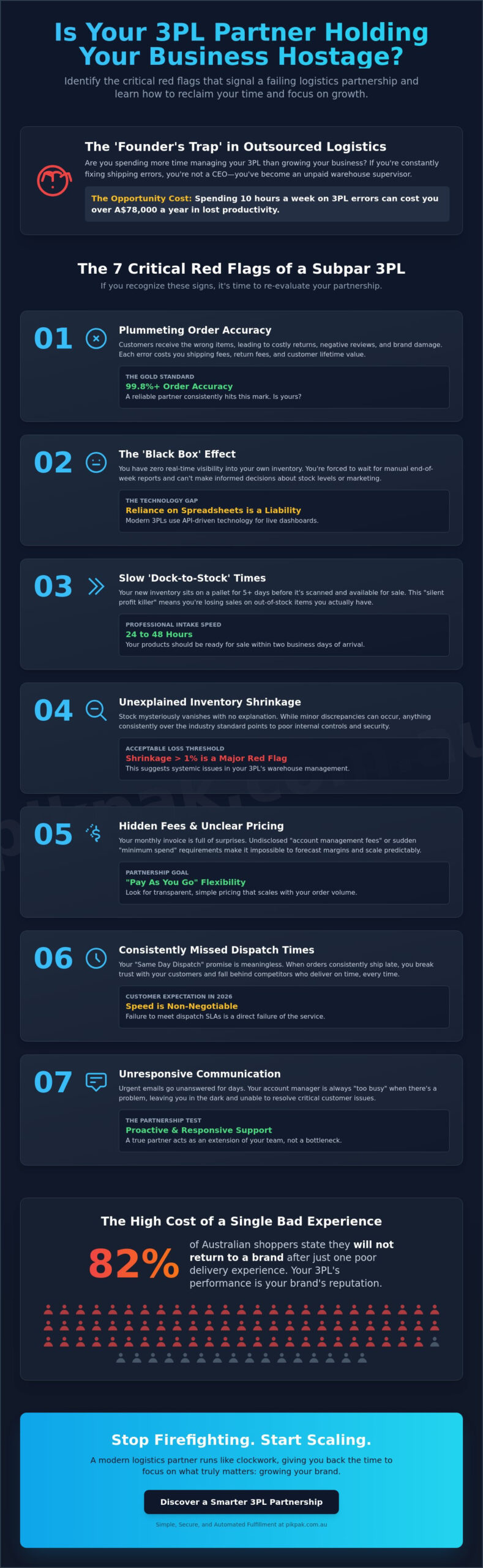
By 2026, eCommerce standards in Australia will be unforgiving. With 82% of Australian shoppers stating they won’t return to a brand after a single poor delivery experience, there’s no room for “average” performance. Every shipping error or delayed dispatch pulls you away from marketing and growth. This constant firefighting creates a heavy psychological toll. It drags you from your role as CEO back into the position of a warehouse manager by proxy, dealing with “headaches” you thought you’d left behind. It’s exhausting, and it’s one of the clearest signs of a bad 3pl partnership. When logistics doesn’t run like clockwork, your business hits a wall that no amount of ad spend can climb over.
The ‘Founder’s Trap’ in Outsourced Logistics
The “Founder’s Trap” happens when you spend more hours managing your logistics partner than you did managing your own garage-based shipping. If you’re manually checking tracking numbers or correcting manifests daily, your 3PL is failing you. Poor fulfilment directly erodes your brand’s long-term customer lifetime value (LTV) because customers don’t blame the warehouse; they blame you. To see how the process should actually function, compare your current experience with a healthy order fulfilment workflow designed for scale.
Opportunity Cost: What Your Business Loses While You Fix 3PL Errors
If your time is valued at A$150 per hour, spending 10 hours a week resolving warehouse errors costs you A$1,500 in lost productivity. Fulfilment should be an “easy game” that runs silently.
Ignoring the signs of a bad 3pl partnership means paying for a service that actively blocks your growth. Professional logistics should eliminate waste and ensure operations run like clockwork, leaving you free to focus on your business.
The 7 Critical Red Flags of a Subpar 3PL Provider
Spotting the signs of a bad 3pl partnership early can save your eCommerce business from a terminal decline in customer satisfaction. When your logistics provider fails, it doesn’t just affect your shipping; it erodes your brand’s reputation and drains your bank account. If your ‘Same Day’ dispatch promises are consistently missed, or if your account manager is ‘too busy’ to answer urgent emails, your growth is at risk. Reliable logistics should run like clockwork, not a daily guessing game.
The ‘Black Box’ effect is a major warning sign. You shouldn’t have to guess how much stock you have left or wait for a manual end-of-week report. Modern logistics requires real-time data. Many of these visibility issues arise from the operational challenges 3PLs face when they scale too fast without the right tech stack. Frequent inventory shrinkage is another red flag. While some minor loss is expected in large-scale operations, unexplained stock discrepancies over 1% suggest poor internal controls and a lack of warehouse security.
Operational Red Flags: Accuracy and Speed
Accuracy is the foundation of fulfilment. If your return rates are climbing because the ‘wrong item was sent,’ your 3PL is failing at the basics. This mistake costs you the original shipping fee, the return shipping fee, and likely the customer’s lifetime value. Speed is equally vital, specifically ‘dock-to-stock’ time. If your inventory sits on a pallet for five days before being scanned into the system, you’re losing sales. Professional intake follows clear Warehouse Receiving Guidelines to get your products ready for sale within 24 to 48 hours. Anything slower is a silent profit killer.
Financial and Contractual Warning Signs
Unclear pricing is a massive deterrent to scaling. You might start with a seemingly low quote, only to be hit with hidden A$150 monthly ‘account fees’ or A$500 minimum spend requirements that weren’t in the initial discussion. These ‘Gotcha’ structures make it impossible to forecast your margins accurately. Beware of long-term contracts that lock you in for 12 or 24 months without a clear exit clause. A partnership should be based on performance, not a legal hostage situation. If the sales pitch promised a dream but the warehouse delivers a nightmare, it’s time to evaluate your service priorities and find a partner that actually delivers on its word.
Technology and Transparency: Where Most 3PLs Break Down
By 2026, your logistics provider should feel like a tech company that happens to own a warehouse. If they don’t, you’re looking at one of the primary signs of a bad 3pl partnership. Technology is no longer a luxury; it’s the baseline for survival in the Australian eCommerce market. If your 3PL relies on manual workarounds or clunky spreadsheets, your inventory data is likely already wrong. Manual entry leads to a 2% to 5% error rate in stock levels, which might sound small until you have to tell 50 angry customers their “in-stock” item is actually missing.
The 2026 standard requires a robust Warehouse Management System (WMS) with open API access. This allows for a “point, click, and connect” setup with major AU platforms like Shopify, WooCommerce, and Magento. If your provider asks for weeks of “development time” just to sync your orders, they’re a liability to your growth. You need real-time visibility. You should never have to pick up the phone to ask “where is my stock?” or “has this order left yet?” If you do, your 3PL is a bottleneck, not a partner.
The Role of a Modern Warehouse Management System (WMS)
A high-quality Technology Support system acts as the nervous system of your eCommerce store. It handles the complex logic of fulfilment so you can focus on your brand. One of the biggest benefits is the drastic reduction in “Where Is My Order” (WISMO) tickets. Automated tracking updates sent directly to your customers can reduce support queries by up to 40%. This frees up your customer service team to handle actual sales inquiries instead of hunting down tracking numbers. Modern 3PL tech makes the entire process feel effortless, turning a logistical headache into a competitive advantage.
Data Integrity and Reporting
You can’t scale a business you can’t measure. A lack of transparent reporting is another of the subtle signs of a bad 3pl partnership that often goes unnoticed until a crisis hits. You need daily access to performance reports, shipping costs, and error logs. This data isn’t just for looking backward; it’s your best tool for forecasting. Accurate data helps you predict when to reorder stock, helping you avoid the out-of-stock scenarios that tank your conversion rates.
In 2026, a 3PL that cannot provide real-time data is effectively managing your business in the dark.
- Instant Sync: Your inventory should update across all sales channels the moment a unit is scanned.
- Error Transparency: If a mistake happens, you should see it in an error log immediately, not three weeks later on an invoice.
- AU Localisation: Ensure the system integrates with local carriers like Australia Post, StarTrack, and Aramex without custom coding.
How to Audit Your 3PL Performance (Before the Damage is Permanent)
You can’t fix what you don’t measure. Waiting for a flood of negative Google reviews is a recipe for disaster. To keep your brand growing, you must conduct a rigorous performance audit every 30 days. This proactive approach helps you identify the early signs of a bad 3pl partnership before your reputation takes a hit.
Start by following these five practical steps to evaluate your current provider:
- Step 1: Track the Order Accuracy Rate. Your target is 99.8% or higher. If your provider hits 97%, it sounds good until you realise that’s 30 botched orders for every 1,000 sent. That represents 30 angry customers and 30 costly return shipments.
- Step 2: Measure Time to Dispatch. Speed is the standard in 2026. Calculate the exact time from the customer’s “buy” click to the carrier’s first scan. If this exceeds 24 hours for standard orders, you’re losing the logistics game.
- Step 3: Conduct a Ghost Inventory Check. Pick five high-volume SKUs and match your Shopify or Magento data against a physical warehouse count. If the numbers don’t align, your 3PL has a shrinkage or data sync problem.
- Step 4: Review Customer Support Tickets. Filter your helpdesk for “where is my order” or “damaged on arrival” tags. High volumes in these categories are clear signs of a bad 3pl partnership that lacks attention to detail.
- Step 5: Compare Invoices Against Quotes. Take your initial A$ quote and place it next to your latest invoice. Look for “admin fees,” “system access charges,” or unexpected “manual handling” costs. If the math doesn’t add up, transparency is missing.
The 3PL Scorecard: Key Metrics to Watch
Every niche has different requirements for a “perfect order.” A fashion brand might focus on tissue paper wrapping and return speed, while an electronics retailer needs serial number tracking and anti-static packaging. Use your customer feedback as a direct proxy for 3PL quality. If customers complain about crushed boxes, the warehouse is likely skimping on dunnage. For a complete list of industry benchmarks, check these Warehousing Questions to see if your provider is making the grade.
Evaluating the ‘Human’ Element of the Partnership
A great 3PL is proactive, not reactive. They should tell you about a potential carrier delay in Melbourne or Sydney before you notice the tracking status yourself. Test their responsiveness during high-pressure events like Black Friday or Boxing Day. If their support team goes silent when you need them most, they aren’t a partner; they’re a bottleneck. It’s essential to work with a team that aligns with the Service Priorities of a scaling Australian business.
Don’t let poor logistics stall your business. If your current provider fails this audit, it’s time to switch to a partner who makes fulfilment easy.
Transitioning to a Reliable Partner: The Pik Pak Way
Identifying the signs of a bad 3pl partnership is the first step toward reclaiming your brand’s potential. If you’ve dealt with hidden costs, delayed shipping, or poor communication, it’s time for a change. At Pik Pak, we operate on a “Logistics Made Easy” philosophy. We don’t believe in adding layers of complexity to your day. Instead, we remove the operational headaches that prevent Australian eCommerce brands from scaling. Our system is designed to be an invisible, high-performing engine for your business.
Many Australian retailers feel trapped by rigid agreements. We do things differently. Our “Pay as you go” model offers the ultimate flexibility for growing brands. You aren’t locked into long-term, restrictive contracts that don’t account for seasonal shifts. We’ve eliminated software fees entirely. You get access to our advanced technology without a monthly subscription tax. This transparency ensures your margins stay protected while you grow. We handle the heavy lifting, allowing you to focus on your business and your customers.
Making the Switch Without the Stress
The fear of downtime often keeps businesses stuck in failing partnerships. We’ve solved this with a simple, secure, and automated onboarding process. Our team manages the technical heavy lifting by integrating directly with your existing e-Storefront. Whether you use Shopify, WooCommerce, or BigCommerce, the connection is seamless. We ensure your order flow remains uninterrupted during the physical move of inventory. You can follow our step-by-step transition plan to see how we maintain 100% operational continuity. We aren’t computer geeks who speak in code; we provide a “point, click, and connect” solution that works from day one.
Reclaiming Your Time for Growth
When your logistics run like clockwork, your business changes. We’ve helped founders who were previously spending 20 hours a week packing boxes or managing carrier disputes. After switching to Pik Pak, many of these brands doubled their sales within the first 12 months. They didn’t do this by working harder; they did it by reallocating their time to marketing and product development.
Outsourcing to a reliable partner provides more than just warehouse space. It provides the mental freedom to think strategically. You can stop worrying about whether a parcel left the warehouse and start focusing on your next big campaign. Our commitment is to ensure your operations are efficient, professional, and scalable. Get a quote and see how Pik Pak can free up your time today.
Reclaim Your Growth and Scale With Confidence
Your logistics provider should act as a catalyst for your expansion, not a bottleneck that stalls your progress. Identifying the signs of a bad 3pl partnership before the 2026 peak season is the most effective way to protect your bottom line. A reliable partner replaces chaos with clarity, ensuring every order flows seamlessly from checkout to customer. You need absolute visibility into your inventory and a support team that answers the phone when you need them. Pik Pak eliminates the friction by offering real-time WMS transparency and dedicated, Australian-based expert support. We don’t believe in hidden hurdles, so you won’t find any complex software fees here. It’s about making fulfilment easy so you can get back to what you do best. Let’s turn your logistics into a competitive advantage that works for you every single day. You’ve worked hard to build your brand, and you deserve a partner that treats your inventory with the same level of care and precision.
Ready to stop firefighting and start scaling? Get your Pik Pak quote today.
The road to a more efficient business starts with a single step toward better transparency and reliable local support.
Frequently Asked Questions
How do I know if my 3PL is actually bad or if it’s just carrier delays?
Check the “order to ship” timestamp in your dashboard to see how long the warehouse takes to process a parcel. If an order sits for more than 24 hours before a carrier like Australia Post scans it, the fault lies with the warehouse. Carrier delays happen after the hand-off, but consistent lag in picking and packing is one of the clear signs of a bad 3pl partnership.
What is a reasonable order accuracy rate for a 3PL in Australia?
A high-performing 3PL should maintain an order accuracy rate of 99.8% or higher. In the Australian eCommerce sector, dropping below 98% accuracy is a major red flag that indicates poor quality control. These errors lead to expensive return shipping costs and damage your brand reputation. Pik Pak uses smart scanning technology to ensure your operations run like clockwork every time.
Can I switch 3PL providers during my peak sales season?
It’s possible to switch, but we recommend a 60-day buffer before major events like Black Friday or Christmas. Moving stock during a peak period is complex and can lead to 15% to 20% inventory discrepancies if not handled carefully. If your current provider is failing, a phased migration of your top 20% best-selling SKUs is the safest way to protect your revenue.
What are the most common hidden fees in a 3PL contract?
Common hidden costs include “account management” fees, software subscription charges, and pallet storage minimums that apply even if your stock is low. You might also find unexpected surcharges for “manual handling” or “inbound receiving” that aren’t mentioned in the initial quote. Always look for transparent, pay-as-you-go pricing to avoid these budget-breaking surprises.
How long does it typically take to onboard with a new fulfillment partner like Pik Pak?
Onboarding with Pik Pak typically takes between 5 and 10 business days depending on your SKU count. Our “point, click, and connect” system allows for rapid API integration with platforms like Shopify or WooCommerce. This fast-paced setup means you can stop worrying about logistics and focus on your business growth almost immediately.
Is it cheaper to keep logistics in-house or move to a better 3PL?
For most Australian businesses shipping over 100 orders per month, a 3PL is more cost-effective than leasing a warehouse. In-house logistics involve fixed costs like rent, utilities, and WorkCover insurance that stay high even during slow months. A 3PL converts these into variable costs, so you only pay for the space and labor you use.
What should I look for in a 3PL service agreement to avoid being ‘trapped’?
Look for a clear exit clause that doesn’t include punitive fees or long-term lock-in periods exceeding 12 months. Some providers charge upwards of A$5,000 just to release your stock, which is a major red flag. You want a partner that earns your business through performance, not through legal fine print that keeps you stuck in a bad 3pl partnership.
How does Pik Pak handle returns compared to a standard 3PL?
Pik Pak automates the returns process to eliminate the stress of reverse logistics. While standard providers often let returns sit in a corner for 14 days, we process them as they arrive to get sellable stock back on the shelves. This efficient system ensures your customers get their refunds faster and your inventory levels remain accurate without the manual headache.