

During the last Black Friday sales period, a Sydney-based merchant spent 18 hours manually chasing order updates because their warehouse lacked a real-time data link. This type of friction is exactly why learning how to improve 3pl communication is the most critical step for any brand aiming for serious eCommerce growth. You likely agree that logistics should be the engine of your business, not a constant source of stress. It’s exhausting to deal with slow response times and shipping errors when you should be focused on your next big marketing campaign.
We’re here to help you master the art of seamless logistics collaboration to eliminate errors, reduce costs, and finally reclaim your time. You’ll learn how to turn your fulfilment into a “hands-off” operation that runs like clockwork even during the busiest Australian shopping events. This guide covers everything from setting up automated data syncs between your store and warehouse to establishing clear escalation paths for when things go wrong. It’s time to stop the manual data entry and start scaling your business with confidence.
Key Takeaways
- Identify and eliminate the hidden costs of poor logistics coordination, from customer churn to the mental load of managing unreliable data.
- Discover how to improve 3pl communication by leveraging WMS and API integrations that replace manual spreadsheets with a single, real-time source of truth.
- Establish a professional framework with clear SLAs and dedicated points of contact to ensure your operations run like clockwork without message fragmentation.
- Master the “No Surprises” rule for Australian peak events like Black Friday and EOFY by providing accurate forecasts that keep your supply chain moving.
- Reclaim your time and focus on business growth by utilizing a platform that removes the middleman and simplifies complex eCommerce fulfilment.
The Real Cost of Poor 3PL Communication in 2026
Poor communication isn’t just a minor administrative annoyance; it’s a direct drain on your bottom line. When you partner with a Third-party logistics (3PL) provider, you expect a seamless flow of data. Instead, many Australian founders find themselves trapped in a “headache” model defined by manual spreadsheets and frantic emails. This lack of transparency leads to “hidden” costs like customer churn and expensive return shipping fees. If a customer receives the wrong item due to a data sync error, the cost to rectify that mistake often exceeds the original profit margin on the sale.
Beyond the financial impact, there’s a heavy psychological toll on business owners. You can’t scale what you can’t trust. If you’re constantly second-guessing your logistics data, you’re stuck in the weeds of daily operations instead of focusing on your business growth. In the competitive Australian market, miscommunication creates a ripple effect that damages your brand reputation. One bad delivery experience can lead to a lost customer for life. Understanding how to improve 3pl communication is the difference between a brand that struggles to survive and one that runs like clockwork.
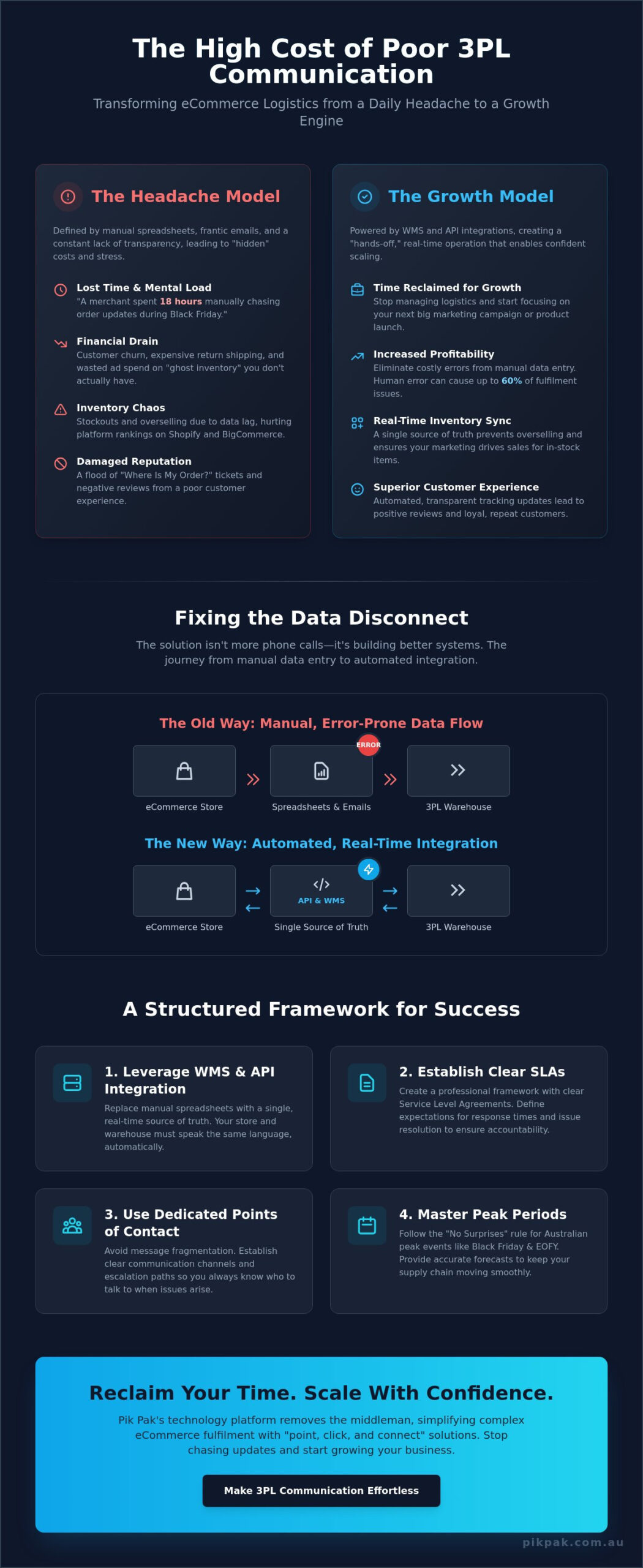
Contrast the manual update model with an automated sync. Instead of chasing your warehouse for tracking numbers, the information flows directly into your system. It’s about moving from a state of constant anxiety to a feeling of total control. Let Pik Pak do the hard work for you so you can reclaim your time.
Inventory Discrepancies and Overselling
When your warehouse and your online store aren’t talking, you’re flying blind. Delayed communication results in stockouts that hurt your Shopify or BigCommerce rankings. If these platforms see you regularly failing to fulfil orders, your search visibility drops. This creates “ghost inventory” where your marketing budget is wasted on ads for products you don’t actually have in stock. Inventory lag is the primary killer of eCommerce scalability.
- Stockouts lead to immediate loss of revenue and decreased platform trust.
- Ad spend efficiency plummets when driving traffic to out-of-stock pages.
- Manual inventory checks consume hours of time that should be spent on strategy.
The Customer Experience Gap
Slow updates from your warehouse create a flood of “Where is my order?” (WISMO) tickets that overwhelm your support team. This friction directly impacts your public image. There’s a clear link between transparent logistics and positive product reviews on platforms like Trustpilot. In Australia, customers expect fast, reliable delivery updates. To meet these high standards, direct freight options require precise communication to meet specific delivery windows. Automating these touchpoints ensures your operations stay secure and simple while keeping your customers happy.
Automating Communication Through WMS and API Integration
Effective logistics isn’t about making more phone calls; it’s about building better systems. A Warehouse Management System (WMS) acts as the single source of truth for your entire operation, ensuring that the merchant and the warehouse are always looking at the same data. When you are researching how to improve 3pl communication, the first step is moving away from the “manual era” of spreadsheets and fragmented emails.
Traditional 3PL setups often rely on manual CSV uploads or daily check-in calls to verify stock levels. These manual processes are prone to human error, which can account for up to 60% of warehouse fulfilment discrepancies. API integrations eliminate this friction by allowing your eCommerce store to talk directly to the warehouse software. We know that not every business owner is a computer scientist. That is why we prioritise “point, click, and connect” solutions. This approach makes advanced logistics tech accessible for everyone, not just the geeks, allowing you to focus on your business while the systems handle the heavy lifting.
Building a successful relationship with your third-party logistics provider requires total transparency. Automation ensures that data flows naturally between platforms, removing the “he-said, she-said” roadblocks that stall growth. It turns a complex logistical challenge into an easy game where everyone stays informed without lifting a finger.
Real-Time Inventory and Order Tracking
The journey from a customer’s click to a warehouse pick-slip should happen in seconds, not hours. With real-time integration, an order placed at 10:00 AM in Sydney appears on a warehouse handheld device almost instantly. This flow requires zero human intervention, reducing the risk of lost orders. For fast-moving Australian brands, real-time data is far superior to “end-of-day” reports. It provides an accurate snapshot of stock levels at any moment, preventing the dreaded “out of stock” notification after a customer has already paid. You can see exactly how this works through our cloud-based technology support, which offers 24/7 visibility into your inventory movement.
Automating the Returns Process
Reverse logistics is often the most communication-heavy part of eCommerce. You can eliminate the headache by using automated status triggers. When a returned item arrives at the warehouse, the system scans it and automatically triggers a notification to your store. This keeps the customer informed and allows for faster refund processing. A tech-savvy 3PL follows strict warehouse receiving guidelines that are baked into the software. This means items are inspected, graded, and put back into sellable inventory without a single manual email being sent. It is a secure, simple way to ensure your operations run like clockwork even when products are coming back through the door.
Establishing a Structured 3PL Communication Framework
Building a solid framework is the fastest way to learn how to improve 3pl communication and stop wasting time on endless email chains. Without a clear structure, vital information gets lost between your office and the warehouse floor. Follow these five steps to create a system that runs like clockwork.
- Step 1: Define a primary point of contact. Assign one Account Manager on the 3PL side and one lead on your team. This prevents message fragmentation and ensures accountability. When everyone talks to everyone, no one is responsible for the outcome.
- Step 2: Set clear Service Level Agreements (SLAs). Don’t leave response times to chance. Define specific windows, such as a 2-hour response for critical shipping blocks and a 24-hour window for general inventory queries.
- Step 3: Choose the right channels. Use Slack or instant messaging for quick, “right now” queries. Reserve email for formal requests, contract changes, or anything requiring a permanent paper trail.
- Step 4: Schedule Quarterly Business Reviews (QBRs). Stop talking only when things go wrong. Use a 45-minute meeting every three months to discuss long-term strategy, upcoming sales events, and volume forecasts.
- Step 5: Document SOPs in a shared digital space. Use a shared drive or a tool like Notion to store your Standard Operating Procedures. If a process changes, update it once in the shared space so everyone stays on the same page.
The Communication Matrix: Who, When, and How
A communication matrix categorises issues by severity to manage expectations. Critical issues, like a complete API sync failure, require immediate phone or “Urgent” Slack alerts. Medium issues, such as a single damaged pallet, should be handled within 4 to 8 business hours. Low-priority tasks, like requesting new packaging samples, can wait for a daily summary email. This system ensures your 3PL isn’t distracted by minor pings while trying to solve major bottlenecks. Transitioning to a “no-blame” culture is equally vital. When an error occurs, focus on fixing the process rather than pointing fingers. This transparency allows for faster resolutions and honest reporting.
Building an Escalation Path
Minor hiccups shouldn’t become crises. A clear “who-to-call-next” list ensures that if your primary contact is unavailable or an issue remains unresolved, you know exactly who to contact in management. For recurring errors, don’t just fix the symptom; implement a formal Corrective Action Plan (CAP). A CAP identifies the root cause of a mistake and documents the steps taken to ensure it doesn’t happen again. You can see how we structure these levels of urgency by reviewing the Pik Pak service priorities. Having this roadmap ready means you can focus on your business while your logistics partner handles the heavy lifting with total precision.
Managing Peak Periods and Seasonal Communication
Peak seasons in Australia, particularly the Black Friday through Cyber Monday window and the End of Financial Year (EOFY) rush, test the limits of every supply chain. Success during these high-pressure weeks depends entirely on how to improve 3pl communication before the first order is even placed. The golden rule for any growing brand is “no surprises.” Your logistics partner needs a clear view of your sales roadmap to ensure your customers aren’t left waiting while orders pile up.
Forecasting and Capacity Planning
Sharing your marketing calendar is the most effective way to help your partner allocate staff correctly. If you plan a 30% off sitewide sale, your 3PL needs an accurate sales forecast at least 4 to 6 weeks in advance. Surprise promotions might drive short-term revenue, but they often crush warehouse morale and can lead to a 12% increase in picking errors when teams are under-resourced and stressed.
Effective communication also involves planning for physical preparation. You should provide significant lead times for kitting and assembly services to ensure promotional bundles are ready before the rush begins. During the actual peak weeks, move to daily “stand-up” communications. A quick 10-minute morning call or a brief status update allows you to monitor warehouse capacity in real-time. This high-frequency contact helps you understand how to improve 3pl communication by identifying issues before they impact your delivery KPIs.
Post-Peak Debriefs
The week immediately following a major sale is the best time to refine your communication SOPs. Don’t wait until the next season to discuss what worked. Sit down with your partner to identify where data flow slowed down or where manual interventions were required. Use the reporting tools and inventory data from your 3PL warehouse to pinpoint specific bottlenecks.
- Review if the 4-week forecast matched the actual order volume within a 10% margin.
- Identify if specific SKUs caused delays during the packing process.
- Assess whether the daily stand-up calls successfully resolved floor-level issues.
This proactive review turns seasonal stress into a repeatable, efficient system. It ensures that your next peak period runs like clockwork, allowing you to stay calm while your business scales. Let Pik Pak do the hard work for you so you can stay focused on your growth strategy.
The Pik Pak Approach: Making 3PL Communication Effortless
Logistics shouldn’t feel like a second job. Many eCommerce founders spend over 10 hours every week chasing tracking numbers or clarifying stock levels via email. This constant back-and-forth creates a bottleneck that stifles growth. At Pik Pak, we’ve designed a system that removes the middleman entirely. Our robust web-based platform serves as your single source of truth. This is exactly how to improve 3pl communication in a modern business: you replace manual updates with real-time, self-service data visibility.
We understand the Australian market because we live in it. You won’t have to wait for a support team in a different time zone to wake up before your questions get answered. We operate on your schedule, ensuring your Australian customers receive their orders without delay. Our team acts as the calm expert in a chaotic field, ensuring your operations run like clockwork while you focus on your core strategy.
A Partner, Not Just a Provider
We believe in total transparency. That’s why we offer a “Pay as you go” model with no complex software to install. You don’t need to be a technical expert to get started. Our system uses a simple “point, click, and connect” process to integrate with platforms like Shopify and eBay. These integrations don’t just link stores; they sync inventory levels and order statuses automatically. This prevents overselling, a problem that affects roughly 30% of growing retailers during peak seasons. By choosing a partner that prioritises technology support, you eliminate the guesswork from your daily operations. Our promise is simple: Pick, Pack & Ship Made Easy.
- No Software: Access everything through a secure web browser.
- Automated Sync: Shopify and eBay orders flow directly to our warehouse.
- Transparent Costs: Know exactly what you are paying with no hidden fees.
- Local Expertise: Support that understands Australian shipping lanes and regional nuances.
Ready to Reclaim Your Time?
Take a moment to evaluate your current logistics setup. If you’re still drowning in spreadsheets and “where is my order” email threads, your communication strategy needs an overhaul. Learning how to improve 3pl communication is the first step toward scaling your brand. Don’t let logistics headaches hold you back from finding new customers or developing new products. Let us handle the heavy lifting while you reclaim your schedule. It’s time to stop managing shipping and start managing your growth. Get started with Pik Pak Logistics today and see how simple fulfilment can be.
Take Control of Your eCommerce Growth Today
Mastering how to improve 3pl communication isn’t just about sending more emails; it’s about building a tech-driven foundation that works while you sleep. By 2026, manual tracking will be a relic of the past. Shifting toward automated WMS visibility and API-led workflows eliminates the communication gaps that stall fulfillment. Implementing a structured framework now means your operations will run like clockwork during the high-pressure November and December peak periods.
Pik Pak makes this transition effortless. As a proudly Australian owned and operated partner, we provide real-time WMS visibility and seamless API integrations for Shopify and eBay. You don’t need to be a computer geek to get results. Our system ensures your data flows perfectly, eliminating the headaches of lost orders or delayed updates. It’s time to stop worrying about the warehouse and start scaling your brand.
Focus on your business and let Pik Pak handle the hard work. Get a Quote Today
Your logistics shouldn’t be a challenge. With the right partner, it’s an easy game.
Frequently Asked Questions
How often should I meet with my 3PL provider?
You should meet with your 3PL for a formal performance review once every 30 days. Use this monthly window to review order accuracy rates and shipping speeds in detail. For long-term strategy and peak season planning, a deeper strategy session every 90 days is essential. Regular touchpoints ensure your logistics run like clockwork and allow you to address minor issues before they become expensive headaches.
What is the best communication tool for 3PL management?
A cloud-based Warehouse Management System (WMS) with an integrated API is the most effective tool for managing your logistics partner. Relying on email alone leads to a 25% increase in communication delays according to industry benchmarks. Using a WMS allows you to see live inventory levels and order statuses without picking up the phone. This transparency is key to how to improve 3pl communication and keeps your operations efficient.
How do I tell my 3PL their communication is poor without ruining the relationship?
Present a log of delayed responses or missed notifications during your monthly review to keep the conversation professional and objective. Focus on the impact on your business, such as a 10% drop in customer satisfaction scores due to slow updates. Framing the issue as a mutual goal to eliminate waste makes it a collaborative fix. It’s about finding a solution that helps you scale as you grow.
What information does my 3PL need from me to be successful?
Your 3PL requires accurate SKU dimensions, weight data, and a rolling 90 day sales forecast to manage warehouse space effectively. Provide clear Standard Operating Procedures (SOPs) for special packaging or fragile items to ensure a 99% pick accuracy rate. When you share upcoming promotion dates at least 14 days in advance, the warehouse can staff up to handle the volume effortlessly. This data keeps your supply chain secure.
Can I integrate my Shopify store directly with a 3PL WMS?
You can integrate your Shopify store with a 3PL WMS in less than 15 minutes using a direct API connection. This automation removes the need for manual data entry and reduces shipping errors by 30%. Once connected, your orders flow directly to the warehouse for immediate fulfilment. It’s a simple way to automate your logistics and ensure your store and warehouse stay perfectly synced without needing a team of computer geeks.
What should I do if my 3PL is not responding to urgent emails?
You must establish a tiered escalation protocol that includes direct phone numbers for the warehouse floor manager and your account lead. If an email goes unanswered for more than 4 hours during business hours, trigger your level two contact. Having a documented “urgent” flag in your subject lines helps the team prioritise your requests. This structure is a vital part of how to improve 3pl communication during peak periods.
How can I track my 3PL’s performance and communication accuracy?
Track performance using a dashboard that monitors specific KPIs, such as a 99.8% shipping accuracy rate and a 24 hour dock-to-stock window. Most Australian 3PLs provide these metrics through their portal for total transparency. Reviewing these numbers weekly allows you to spot trends and hold your partner accountable. It turns what seems like a challenge into an easy game of data management and steady growth for your brand.
Is it possible to automate 3PL communication for returns?
You can automate returns by using a dedicated portal that syncs directly with the warehouse system. This setup notifies the 3PL of an incoming return the moment your customer submits a request online. It reduces the manual processing time by 50% and speeds up customer refunds significantly. Automating this flow ensures returns are handled with the same ease as your outbound orders, freeing up your time to focus on sales.