
Are you building a global brand, or have you accidentally built a full-time packing and shipping department? It’s a common trap for successful founders. You start in a spare room or a small office, but suddenly your workspace is a sea of bubble wrap and your weekends are lost to seasonal sales peaks. Managing logistics in-house often feels like running in place, but understanding the benefits of outsourced warehousing for ecommerce can change your trajectory and help you regain control.
We know that the friction of shipping can stall your momentum. The good news is that you don’t have to manage the chaos alone. Transitioning to a professional partner can slash your operational overhead and achieve next-day delivery speeds without the headache of managing a physical facility. This article explores how modern 3PL solutions provide real-time inventory visibility and reclaim the hours you need to focus on scaling. We will break down exactly how to transition from a manual packing station to an automated, professional-grade fulfillment engine that grows with you in 2026.
Key Takeaways
- Learn how to escape the “Founder’s Trap” by delegating fulfillment, allowing you to reclaim your time for high-level marketing and brand strategy.
- Discover the financial benefits of outsourced warehousing for ecommerce, including the elimination of warehouse rent and the conversion of fixed costs into flexible variable assets.
- Explore how automated pick and pack technology reduces human error and ensures your customers receive their orders faster and more accurately.
- Master seasonal sales surges like Black Friday by leveraging a partner that scales labor and space instantly to meet peak demand.
- Gain total transparency over your stock levels with a cloud-based WMS that integrates directly with your existing sales channels.
The ‘Founder’s Trap’: Why In-House Warehousing Limits eCommerce Growth
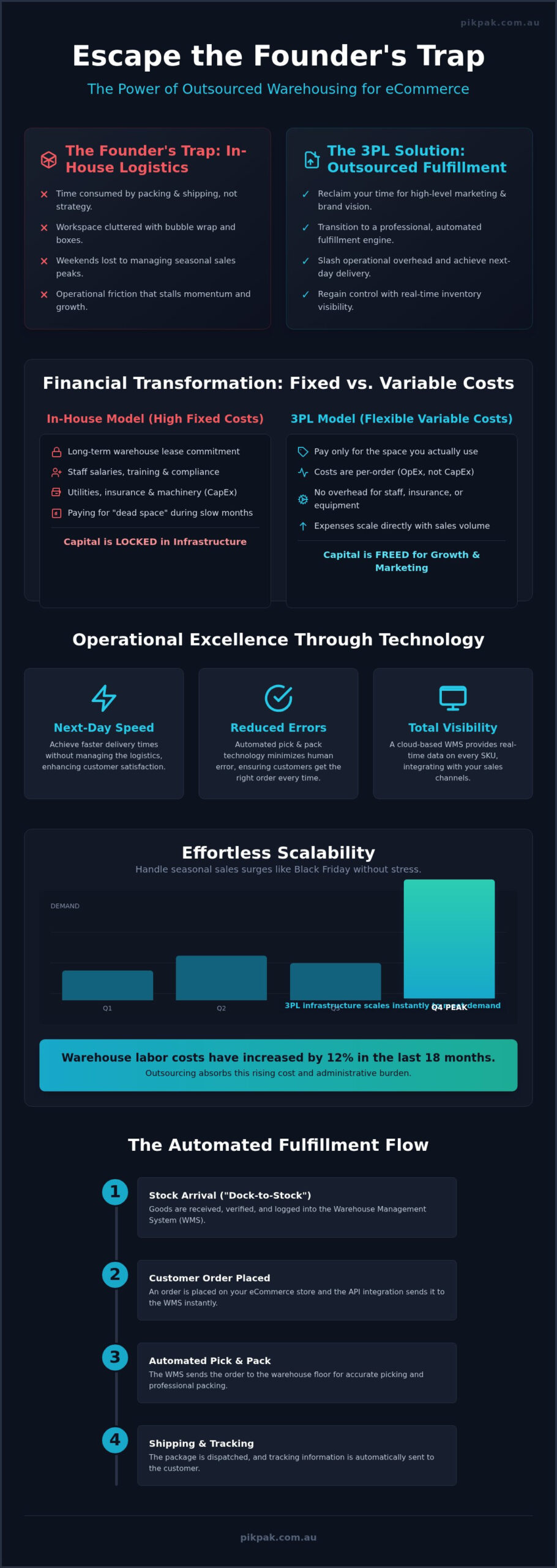
Success in ecommerce often leads to a strange paradox. The more you sell, the less time you have to actually grow your business. This is the “Founder’s Trap.” It happens when a business owner spends their day managing packing tapes, bubble wrap, and courier pickups instead of focusing on product development or marketing strategy. One of the primary benefits of outsourced warehousing for ecommerce is the immediate removal of this operational friction. By delegating these tasks to a partner like Pik Pak Logistics, you transition from a warehouse manager back to a visionary brand leader.
Outsourced warehousing is often referred to as Third-party logistics (3PL). It’s a comprehensive service where a professional partner handles the storage, picking, packing, and shipping of your goods. Many founders fear that outsourcing means losing control. In reality, modern logistics technology provides more visibility than a manual in-house system ever could. You trade a chaotic garage or a cramped office for a streamlined, tech-enabled operation that offers real-time data on every SKU in your inventory.
The financial shift is equally significant. When you manage your own space, you’re locked into a fixed cost. You pay for the entire lease, the utilities, and the staff even during your slowest months. A 3PL model converts these into variable costs. You only pay for the space you use and the orders you ship. This flexibility is essential for maintaining healthy cash flow while you scale your operations.
What is Outsourced Warehousing for eCommerce?
This process is an end-to-end solution that starts the moment your stock arrives at the facility. This is known as “dock-to-stock,” where items are received, verified, and logged into a digital system. Unlike a traditional storage warehouse where goods sit idle, a warehousing and fulfilment center is built for movement. The essential tech stack includes a Warehouse Management System (WMS) that integrates via API with your Shopify or WooCommerce store. This ensures that as soon as a customer clicks “buy,” the warehouse team is already printing the label and picking the item.
The Hidden Costs of Managing Your Own Space
The price of a warehouse isn’t just the rent. There are dozens of “invisible” costs that eat into your margins. Think about warehouse insurance, electricity, packing machinery, and the time spent training temporary staff for peak seasons. Then there’s the risk of “dead space.” If you lease a 500-square-meter unit but only fill half of it during the off-season, you’re essentially burning capital. Outsourcing eliminates these overheads, allowing you to pay only for the results you achieve.
Financial Benefits: Turning Logistics into a Variable Asset
Financial stability in ecommerce isn’t just about high sales volume. It’s about how efficiently you manage your expenses. For many growing brands, the biggest drain on capital is warehouse infrastructure. One of the major benefits of outsourced warehousing for ecommerce is the ability to shift from high Capital Expenditure (CapEx) to a flexible Operating Expenditure (OpEx) model. Instead of sinking thousands into racking, forklifts, and security systems, you pay only for the logistics services you actually use.
Managing a warehouse involves significant labor-related overheads. You aren’t just paying wages; you’re responsible for recruitment, training, payroll tax, and WorkCover compliance. Verified data from April 2026 shows that warehouse labor costs have increased by 12% over the last 18 months. When you outsource, these administrative burdens and rising costs disappear from your balance sheet. The 3PL provider absorbs the complexity of staffing, leaving you with a predictable invoice based on activity.
Fixed vs. Variable Cost Models
Consider the difference between a traditional five-year commercial lease and a month-to-month 3PL agreement. A lease is a rigid commitment. You pay for the entire square footage regardless of whether your shelves are full or empty. This can be devastating during seasonal lulls. A 3PL model turns warehousing into a “per-order” cost. This means your expenses shrink when sales are slow and only expand when you’re making money. Ultimately, your cost per order becomes the ultimate metric for your ecommerce health, protecting your profit margins and simplifying your financial forecasting.
Leveraging Group Buying Power for Shipping
Small to medium businesses often struggle to secure competitive shipping rates because they lack high-volume leverage. 3PL providers solve this by aggregating the volume of all their clients to negotiate deep discounts with major carriers. These savings are passed directly to you, often resulting in lower “last-mile” delivery costs than you could achieve on your own. Additionally, 3PLs use multi-carrier shipping software to automatically select the most cost-effective route for every package. You can explore these logistics services to see how they integrate with your current shipping strategy. Bulk purchasing of packaging materials also reduces waste and lowers the unit cost of every box and mailer used to protect your products.
Operational Excellence: Speed, Accuracy, and Technology
Operational excellence isn’t just a corporate buzzword; it’s the difference between a loyal repeat customer and a damaging negative review. When you manage logistics in-house, human error is an expensive, inevitable reality. One of the core benefits of outsourced warehousing for ecommerce is the immediate transition to precision-driven, automated systems. By utilizing professional Pick and Pack services, you replace manual checklists with barcode scanning and digital picking paths. These tools are engineered to achieve 99%+ accuracy, ensuring the right item reaches the right door every single time.
Efficiency doesn’t end when the package leaves the dock. Professional returns management, also known as reverse logistics, is a critical pillar of customer trust. In 2026, buyers expect a return process that is as easy as the initial purchase. A 3PL partner handles these incoming items with the same rigor as outgoing orders, inspecting stock and updating your digital records instantly. This keeps your inventory levels accurate and ensures your customers feel supported, even when a product isn’t the right fit.
The Power of WMS Integration
Your online storefront shouldn’t exist in a vacuum. Through robust technology support, your Shopify or WooCommerce store can communicate directly with the warehouse in real-time. This seamless integration ensures that your inventory levels are always “live.” When an item sells out, it is instantly updated across all your sales channels, which prevents the frustration of overselling and customer disappointment. For you, this cloud-based visibility means you can monitor stock levels or track order progress from any device, anywhere in the world.
Faster Delivery Times and the ‘Amazon Effect’
Modern consumers expect rapid fulfillment as a standard feature. Meeting this expectation requires centralized customer delivery hubs that are strategically positioned to minimize transit times. By outsourcing, you tap into an operational engine built for same-day dispatch. Orders received before a specific cutoff are processed and handed to carriers within hours, which is a competitive necessity in today’s market. This speed, combined with automated tracking notifications, drastically reduces “Where is my order?” (WISMO) inquiries. When customers can see their package moving in real-time, they feel a sense of control and security. Ultimately, the benefits of outsourced warehousing for ecommerce allow your brand to provide a “big business” delivery experience without the big business overhead.
Scalability: Handling Seasonal Peaks Without the Stress
For many Australian brands, the final quarter of the year is both a dream and a nightmare. Events like Black Friday, Cyber Monday, and the Christmas rush can lead to a 500% increase in order volume overnight. If you manage your own space, this surge usually requires a frantic search for temporary staff and a desperate reorganization of a cramped garage or warehouse. One of the primary benefits of outsourced warehousing for ecommerce is the ability to scale your operations instantly without the stress of hiring or the risk of burnout. A professional partner provides an elastic infrastructure that expands and contracts based on your real-time demand.
This scalability also facilitates effortless geographic expansion. Instead of being limited by your physical location, you can leverage a distribution network that reaches customers across Australia more efficiently. This ensures that a buyer in Perth receives their order as quickly as a buyer in Sydney. By delegating the heavy lifting to a 3PL, you ensure that logistics remains a growth lever rather than a bottleneck. You can partner with Pik Pak Logistics to transform your fulfillment from a source of anxiety into a competitive advantage.
Elastic Logistics: Growing Without Growing Pains
In a traditional warehouse model, you are limited by the four walls of your lease. During a stock build-up for a major promotion, you might run out of shelf space, forcing you to turn away inventory or store it in suboptimal conditions. A 3PL environment offers essentially “infinite” shelf space because you are part of a shared facility. When your stock levels peak, you simply use more of the existing infrastructure. You only pay for the pallets you occupy, which ensures your cash flow remains protected. You can finally sleep through the holiday rush knowing every order is moving toward a customer’s door without you needing to lift a single roll of packing tape.
Value-Added Services: Kitting and Assembly
Growth often requires more than just shipping single items. Kitting and assembly allow you to create unique bundles, such as “Gift Sets” or “Starter Packs,” without needing to change your manufacturing process. Your 3PL partner can take individual SKUs and combine them into a single new SKU on-demand. This is a powerful tool for increasing your average order value during promotional periods. Professional teams also manage custom packaging and “unboxing” experiences, ensuring that your brand’s premium feel is maintained even at high volumes. You can review our service priorities to see how Pik Pak Logistics handles these specialized projects with precision. This level of customization allows you to test new marketing offers quickly and pivot your strategy based on what your customers actually want to buy.
Choosing the Right Partner: The Pik Pak Logistics Advantage
Selecting a logistics partner is about more than just finding a shelf in a building. It’s about finding a tech-forward extension of your own brand. At Pik Pak Logistics, we operate with a pragmatic, results-driven approach that prioritizes your growth. Our “time-reclamation” philosophy is simple: we handle the box so you can grow the brand. When you weigh the benefits of outsourced warehousing for ecommerce against the mounting stress of in-house management, the strategic choice becomes clear. We help you move from the day-to-day operational chaos of packing stations and courier delays to a position of strategic oversight.
Transparency is the foundation of a reliable partnership. Pik Pak Logistics provides clear, straightforward pricing without the burden of long-term lock-in contracts. This flexibility ensures that our services stay aligned with your business needs as you scale. By choosing a partner that values your agility, you ensure that your logistics remains a scalable asset rather than a restrictive overhead.
Why an Australian-Based 3PL Matters
Navigating the Australian landscape requires local expertise. From understanding the vast distances between state capitals to managing specific regional carrier networks, having a partner on the ground is essential. You benefit from local time zones and dedicated support that understands your market. This local presence simplifies communication and ensures that any challenges are addressed quickly by a team that speaks your language. Additionally, our warehouse receiving guidelines make it easy for your local suppliers to get stock onto our shelves without delays. This local integration minimizes friction and keeps your inventory moving through the supply chain with precision.
Next Steps: Transitioning to Outsourced Warehousing
Moving your inventory to a 3PL is a significant step toward professionalizing your brand. To ensure a smooth transition, start by auditing your current SKUs and ensuring your product data is clean and organized. When evaluating a potential provider, look beyond the basic storage fees. Focus on three critical pillars: technology integration, operational transparency, and the ability to scale labor during peak periods. By checking these boxes, you ensure you’ll capture the full benefits of outsourced warehousing for ecommerce from day one. Ready to reclaim your time and focus on your next big marketing move? Request a tailored logistics quote from Pik Pak Logistics today.
Future-Proof Your Fulfillment Strategy
Managing a growing brand in 2026 requires a shift from manual labor to strategic oversight. You’ve seen how the right logistics partner can turn rigid fixed costs into flexible assets while ensuring your customers receive their orders with 99%+ accuracy. By embracing the benefits of outsourced warehousing for ecommerce, you don’t just outsource a task; you gain a scalable engine that handles seasonal surges and complex kitting projects without the stress of managing a physical facility.
The path to scaling your brand shouldn’t be blocked by packing tape and courier delays. With real-time WMS visibility and dedicated Australian-owned support, you stay in total control of your inventory without being tied down by long-term contracts or hidden fees. It’s time to stop packing boxes and start building your legacy. Reclaim your time and scale your business with Pik Pak’s effortless fulfillment. Your brand is ready for the next level. We’re here to ensure your logistics never slow you down and always support your long-term vision for growth.
Frequently Asked Questions
How do I know when it’s time to outsource my eCommerce warehousing?
You should consider outsourcing when logistics tasks begin to cannibalize the time you need for marketing and product development. If you’re consistently running out of physical storage space or struggling to meet delivery deadlines during seasonal peaks, it’s a clear signal. Transitioning early allows you to capture the benefits of outsourced warehousing for ecommerce before operational friction stalls your brand’s momentum.
Will I lose control over how my orders are packed if I use a 3PL?
You don’t lose control; you gain professional oversight. You provide the packing specifications and brand requirements, and the warehouse team executes them using standardized digital processes. With real-time WMS access, you can monitor every stage of the fulfillment cycle from your own dashboard, ensuring your brand standards are met consistently without you needing to be physically present.
How much does outsourced warehousing typically cost for a small business?
Costs are structured as a variable expense rather than a fixed monthly lease. You generally pay for the storage space your inventory occupies and a per-order fee for picking and packing. This model protects your cash flow because your expenses scale directly with your sales volume. It’s an efficient way to access professional infrastructure without the heavy capital investment of a private warehouse.
Can a 3PL integrate with my specific eCommerce platform like Shopify or eBay?
Yes, modern 3PL providers prioritize seamless tech integration. Our systems connect directly to major platforms like Shopify, eBay, and WooCommerce via API. This ensures that orders flow automatically to the warehouse the moment a customer checks out. It also allows for real-time inventory syncing, which prevents you from selling stock that isn’t physically available on the shelf.
What happens if a customer wants to return a product to an outsourced warehouse?
The warehouse team manages the entire reverse logistics process for you. When a return arrives, it’s inspected according to your specific guidelines to check for damage or use. Depending on the item’s condition, it is either returned to active stock, refurbished, or disposed of. This professional handling speeds up customer refunds and keeps your inventory counts accurate.
Is there a minimum order volume required to work with a 3PL in Australia?
Requirements vary depending on the provider’s focus and facility size. Some 3PLs cater to enterprise-level clients, while others, like Pik Pak, offer flexible models designed to support growing small-to-medium businesses. It’s best to discuss your current volume and growth projections with a partner to ensure their infrastructure aligns with your specific business stage.
How long does the transition from in-house to outsourced warehousing take?
A standard transition typically takes between two to four weeks. This timeframe allows for the secure transport of your inventory, the integration of your sales channels with the WMS, and the establishment of your specific packing protocols. A structured onboarding process ensures that your shipping remains uninterrupted while you move your stock into a professional facility.
Does Pik Pak handle international shipping from their Australian facilities?
We focus on providing comprehensive home delivery shipping options through our established carrier networks. Our systems are designed to navigate the complexities of the Australian geography while ensuring your customers receive their orders as quickly as possible. By leveraging professional carrier partnerships, we help you achieve competitive transit times and reliable delivery performance for your domestic audience.