Renting a self storage unit feels like the smart, affordable move when your spare room is buried under bubble wrap and your dining table has become a packing station. And honestly? That instinct makes complete sense. When you’re weighing up self storage vs 3PL for eCommerce, the upfront cost of a storage unit looks a lot friendlier than handing your fulfilment over to a third-party logistics provider. But here’s the counterintuitive truth: the cheaper option on paper is often the most expensive one in practice, and the currency it drains fastest isn’t money. It’s time.
If you’re spending four or more hours a day packing orders, chasing tracking numbers, and manually updating spreadsheets, you already know something isn’t working. The real question isn’t just about storage space. It’s about whether your current setup is actually built to grow with your business, or quietly holding it back.
This guide cuts through the noise and gives you a clear, practical framework for making the right call. We’ll break down exactly what each option costs you in time, money, and scalability, so you can make a confident decision heading into 2026.
Key Takeaways
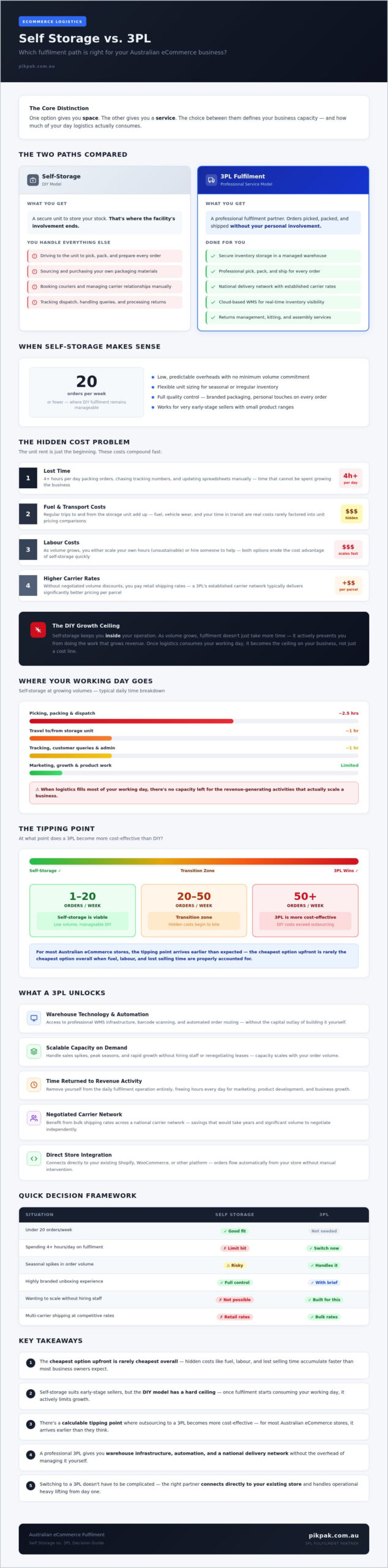
- When comparing self storage vs 3PL for eCommerce, the cheapest option upfront is rarely the cheapest option overall — hidden costs like fuel, labour, and lost selling time add up faster than most business owners expect.
- Self-storage suits early-stage sellers with low order volumes, but the DIY model has a hard ceiling — once fulfilment starts consuming your working day, it actively limits your growth.
- There’s a calculable tipping point where outsourcing to a 3PL becomes more cost-effective than renting a unit and doing it yourself — and for most Australian eCommerce stores, it arrives earlier than they think.
- A professional 3PL gives you access to warehousing infrastructure, automation, and a national delivery network without the overhead of managing it yourself — freeing you to focus on marketing and product development.
- Switching to a 3PL doesn’t have to be complicated — the right partner will connect directly to your existing store and handle the operational heavy lifting from day one.
Self Storage vs. 3PL: Defining the Two eCommerce Logistics Paths
Before you can make the right call, you need to understand what you’re actually choosing between. The self storage vs 3PL for eCommerce decision isn’t just about where your stock sits. It’s about who does the work, what systems are in place, and how much of your capacity gets consumed by logistics every single day.
At its core, the difference comes down to this: one option gives you space, the other gives you a service.
What is Self-Storage for eCommerce?
Self-storage means renting a secure unit at a local facility, think providers like Kennards Self Storage or Storage King, and managing every part of your fulfilment operation yourself. The unit holds your inventory. That’s where the facility’s involvement ends.
Everything else falls on you:
- Driving to and from the unit to pick, pack, and prepare orders
- Sourcing and purchasing your own packaging materials
- Booking couriers and managing carrier relationships manually
- Tracking dispatch, handling customer queries, and processing returns
For very low-volume sellers or businesses with highly irregular inventory, this model can make practical sense. If you’re dispatching ten orders a week and your product range is small, the DIY approach is manageable. The problem is that “manageable” has a hard ceiling, and most growing eCommerce businesses hit it faster than they expect.
What is 3PL Fulfilment?
A 3PL logistics provider is a professional fulfilment partner. Your stock is stored in a shared warehouse facility, and when an order comes in, their team picks, packs, and ships it on your behalf. The entire process is driven by technology and operational expertise, not your personal availability.
A credible 3PL partner typically provides:
- Secure inventory storage in a managed warehouse environment
- Professional order fulfilment, including pick, pack, and ship
- Access to a national delivery network with established carrier rates
- A cloud-based warehouse management system (WMS) for real-time stock visibility
- Returns management and, where needed, kitting and assembly services
The critical distinction is that you’re not just outsourcing storage. You’re outsourcing an entire operational function, one that would otherwise consume hours of your working week.
This is why the choice between the two paths defines your business capacity heading into 2026. Self-storage keeps you in the operation. A 3PL removes you from it, so you can focus on the work that actually grows your business.
The Self-Storage Model: Pros, Cons, and the DIY Reality
For most Australian eCommerce founders, the journey follows a familiar arc. Stock starts in the spare bedroom, spills into the garage, and eventually outgrows both. For a growing brand like Bakyard Australia, managing outdoor lifestyle inventory often necessitates moving beyond the home, making a self-storage unit feel like the logical next step. It’s affordable, accessible, and for a while, it works.
The self-storage model isn’t a bad idea. It’s just a model with a very specific use case, and understanding where it fits, and where it breaks down, is essential when weighing up self storage vs 3PL for eCommerce.
The Advantages of Staying Small
If your store is dispatching fewer than 20 orders per week, the DIY approach has genuine merit. Overheads are low and predictable. There’s no minimum volume commitment. You can upsize or downsize your unit as stock levels shift, which is particularly useful for businesses with seasonal product ranges or irregular buying cycles.
There’s also a quality control argument worth taking seriously. When you’re packing every box yourself, you see exactly what leaves your warehouse. Custom tissue paper, branded stickers, handwritten notes — these personal touches are easy to execute when you’re hands-on with every order. For premium product brands where unboxing is part of the experience, that level of control matters.
Proximity is another underrated advantage. If your unit is close to home or your office, a quick inventory check doesn’t derail your day. For sellers managing a small, curated product range, that convenience is real.
The Scalability Ceiling
Here’s where the model starts to crack. Growth doesn’t arrive gradually. It arrives in spikes — a viral post, a successful promotion, a feature in a major publication. And when it does, the self-storage model has no capacity to absorb it without consuming your entire working week.
The operational drag builds quietly at first. Then suddenly you’re making two trips to the unit a day, spending evenings printing labels, and manually cross-referencing your Shopify dashboard against a spreadsheet to track what’s been dispatched. There’s no integration. No automation. Every order is a manual task.
Seasonal peaks are particularly punishing. A Black Friday surge that doubles your order volume doesn’t come with extra hours in the day. Without systems and staff, you’re either scrambling to hire temporary help at short notice or watching dispatch times blow out, and your reviews with them.
- No platform integration: Manual data entry between your store and courier bookings creates errors and eats time
- No inventory visibility: Stock counts rely on physical checks, not real-time data
- No scalable labour: Volume spikes require hiring, training, and managing people yourself
- Hidden costs accumulate: Fuel, packaging materials, and your own time rarely appear in the original cost calculation
This is the ceiling that catches founders off guard. The unit itself is affordable. The operation surrounding it is not. If you’re approaching the point where logistics is consuming more of your week than marketing or product development, it’s worth exploring what a professional fulfilment partner could actually free you up to do.
The 3PL Advantage: Leveraging Automation for Rapid Scaling
There’s a version of your business where you’re not packing boxes. Where orders flow out the door without you touching a single roll of tape. Where a spike in sales is something to celebrate, not dread. That version isn’t a fantasy. It’s what happens when you hand the operational heavy lifting to a professional fulfilment partner and redirect your energy toward marketing, product development, and the work that actually moves the needle.
The core advantage of a 3PL isn’t just storage space. It’s access to infrastructure, technology, and a national delivery network that would take years and significant capital to build independently. When you’re weighing up self storage vs 3PL for eCommerce, this is the structural difference that matters most: one option gives you a room full of stock, the other gives you an entire operational engine.
Shipping costs are a tangible example. A 3PL ships on behalf of hundreds of clients simultaneously, which means they negotiate carrier rates based on aggregate volume that a single small-to-medium eCommerce store simply can’t access alone. Those negotiated rates flow through to your business, reducing per-parcel costs without you having to manage a single carrier relationship.
Returns management is another area where the 3PL model pays dividends that rarely get discussed upfront. Reverse logistics, the process of receiving, inspecting, and restocking returned goods, is time-consuming and operationally complex. A professional warehousing and fulfilment partner handles this systematically, which keeps your inventory accurate and your customers confident that returns won’t disappear into a void.
Technology and System Integration
This is where the gap between self-storage and a 3PL becomes impossible to ignore in 2026. A cloud-based Warehouse Management System (WMS) connects directly to your Shopify, WooCommerce, or other eCommerce platform via API. When a customer places an order, it flows automatically into the fulfilment system, no manual entry, no copy-pasting between tabs, no room for human error. Stock levels update in real time, so your website always reflects what’s actually available. Overselling becomes a problem of the past.
Barcode scanning and professional picking processes add another layer of accuracy. Every item is scanned at pick and again at pack, creating a verified audit trail for every order that leaves the warehouse. For a business managing hundreds of SKUs, that precision isn’t a luxury. It’s the baseline standard your customers already expect.
The Power of Professional Packing
Branded unboxing experiences don’t require you to pack every box yourself. Kitting and assembly services allow you to pre-configure product bundles, gift sets, or custom-branded packaging at scale, consistently, regardless of order volume. Whether you’re shipping ten orders or a thousand, the presentation stays the same.
Standardised packaging also reduces dimensional weight, which directly impacts your shipping costs. A 3PL’s team knows how to pack efficiently. That knowledge compounds quickly across high volumes.
- Real-time inventory visibility: Know exactly what’s in stock without a physical site visit
- Automated order flow: Orders from your store trigger fulfilment instantly, without manual intervention
- Consistent branded packing: Kitting services deliver the same unboxing experience at any volume
- Professional returns processing: Returned stock is assessed and restocked accurately, keeping your inventory data clean
- Negotiated carrier rates: Access shipping pricing that reflects volume, not your individual order count
Scaling from 10 orders a day to 100 doesn’t require hiring a team, sourcing a bigger unit, or overhauling your process. The infrastructure is already there. That’s the point. When the self storage vs 3PL for eCommerce question comes down to scalability, a 3PL doesn’t just keep pace with your growth. It enables it.
Calculating the Tipping Point: When Self-Storage Costs More Than 3PL
Most cost comparisons in the self storage vs 3PL for eCommerce debate make the same mistake: they compare rent against fulfilment fees and stop there. That’s the wrong unit of measurement entirely. The metric that actually matters for an eCommerce business isn’t cost per square metre. It’s cost per order. And once you reframe the question that way, the numbers tell a very different story.
Start with what a self-storage setup actually costs. The monthly rent is just the entry fee. Add fuel for daily or twice-daily trips to the unit, packaging materials purchased at retail prices rather than volume rates, basic insurance for stock stored off-site, and the time you spend on every manual task between receiving an order and watching it leave your hands. That last item is the one most founders never put a number on, and it’s almost always the largest.
Here’s the question worth sitting with: what is your hour actually worth? If you’re the person responsible for growing your business, developing new products, and acquiring new customers, your time has a value that reflects those activities. Spending three hours a day on pick, pack, and dispatch doesn’t cost you three hours. It costs you the revenue, relationships, and strategic progress you didn’t make during those three hours. That’s the opportunity cost that competitors never quantify, and it compounds every single day.
Wrong shipments add another layer. A single incorrect order triggers a replacement shipment, a return label, a customer service exchange, and potentially a negative review. The direct cost of re-shipping is real. The reputational cost, measured in lost repeat purchases and reduced customer lifetime value, is harder to see but significantly larger.
The 3-Point Switch Checklist
If any of these three conditions apply to your business right now, the tipping point has likely already arrived:
- Order volume: You’re consistently dispatching 50 or more orders per month, and that number is growing rather than plateauing.
- Time spend: Logistics is consuming more than two hours of your working day, time that isn’t being spent on marketing, product development, or customer acquisition.
- Space constraints: Your current storage footprint is limiting your ability to introduce new SKUs or hold adequate safety stock ahead of peak periods.
Hit two out of three, and the economics of outsourcing almost certainly work in your favour. Hit all three, and you’re actively funding your own bottleneck.
A Direct Cost Comparison
When you factor in unit rent, packaging materials, fuel, and a conservative estimate of your own labour time, the true cost of DIY fulfilment typically exceeds a professional 3PL’s per-order pick-and-pack fee well before you reach 100 orders per month. Beyond that, 3PL providers access carrier rates through aggregated shipping volume that individual businesses can’t replicate independently. Those savings flow directly through to your cost per shipment, often reducing it meaningfully compared to retail courier rates. Faster, more reliable delivery also lifts customer satisfaction, which drives repeat purchases and increases the long-term value of every customer you acquire.
The maths isn’t complicated once you account for everything. Explore how professional fulfilment works and see what your operation could look like when logistics stops being the ceiling on your growth.
Future-Proofing Your Business: Making the Move to Pik Pak
At some point in the self storage vs 3PL for eCommerce decision, the question stops being theoretical. You’ve done the maths. You’ve tracked the hours. You know the DIY model has a ceiling, and you’re close to it. What comes next isn’t complicated. It’s a transition, and with the right partner, it’s a remarkably smooth one.
Pik Pak Logistics is built specifically for Australian eCommerce businesses that are ready to stop managing logistics and start growing past it. The infrastructure is already in place. The technology is already connected. What’s missing is your stock and your first order.
The Onboarding Journey
Switching to a 3PL doesn’t require a technical team or weeks of downtime. The process is straightforward by design:
- Step 1: System integration. Your store connects to Pik Pak’s cloud-based WMS platform via API. Whether you’re selling through Shopify, eBay, or Amazon, the integration is direct. Orders flow in automatically from the moment you go live. No manual imports, no spreadsheet workarounds.
- Step 2: Send your first shipment. Your stock arrives at our Melbourne facility and is booked into the warehouse against your live inventory. Every SKU is scanned, counted, and confirmed. You’ll have real-time visibility from day one, so you always know exactly what’s on hand.
- Step 3: Watch orders move without you. A customer places an order. It hits your store. It triggers fulfilment. It ships. You didn’t touch a single roll of tape. That’s the operational shift that changes how you spend your working week.
The fear of transition is real, but it’s almost always bigger than the transition itself. Pik Pak’s onboarding process is designed to eliminate that friction, not add to it.
Ready to Scale?
Seasonal peaks are where the self-storage model breaks down hardest. Black Friday, Christmas, and mid-year sales events don’t come with extra hours or extra hands. Pik Pak’s warehouse infrastructure absorbs volume spikes without the scramble. Your orders go out on time. Your customers don’t notice a thing.
Reliable customer delivery options mean your buyers get accurate tracking, consistent handling, and the kind of experience that earns repeat purchases. That’s not a small thing. It’s the foundation of a brand people trust enough to come back to.
Reclaiming your time isn’t a soft benefit. It’s the strategic unlock that lets you focus on marketing, product development, and the decisions that actually compound into growth. Logistics shouldn’t be where your energy goes. It should be handled, reliably and invisibly, while you build.
If you’re ready to make the move, request a quote from Pik Pak Logistics today and find out exactly what your fulfilment operation could look like when it’s running without you in the middle of it.
The Right Logistics Model Changes Everything
The self storage vs 3PL for eCommerce decision ultimately comes down to one question: is your current setup built to grow with you, or is it quietly capping what’s possible? Self-storage works at low volumes. But once logistics starts consuming your working day, it’s no longer a cost-saving measure. It’s a growth blocker.
The businesses that scale confidently into 2026 are the ones that stop treating fulfilment as something to manage personally and start treating it as an operational function to hand off. With cloud-based WMS technology giving you 24/7 inventory visibility, expert kitting and assembly services keeping your brand presentation consistent, and strategic Melbourne-based fulfilment putting your orders closer to your customers, the infrastructure is already there.
You don’t need to build it. You just need to connect to it.
Ready to stop packing and start growing? Get a custom 3PL quote from Pik Pak today.
The operational shift is simpler than you think, and the upside starts from day one.
Frequently Asked Questions: Self Storage vs. 3PL for eCommerce
Is 3PL more expensive than self-storage for a small business?
Not necessarily, and the comparison is more nuanced than it first appears. A storage unit’s monthly rent looks cheaper on paper, but that figure excludes fuel, packaging materials purchased at retail prices, and the hours you spend driving, packing, and managing courier bookings manually. Once you account for those real costs, a 3PL’s per-order fee often works out to be comparable, or lower, well before you reach significant monthly volumes.
The more useful question is: what is your time worth? If logistics is consuming hours that should go toward marketing or product development, the true cost of DIY fulfilment is far higher than any invoice will show.
Do I lose control over my packaging if I use a 3PL?
No. A professional 3PL works to your specifications, not theirs. You define the packaging standards, branded inserts, tissue paper, and any other presentation requirements. The fulfilment team executes those instructions consistently across every order, regardless of volume. In practice, many businesses find their packaging becomes more consistent after switching to a 3PL, because the process is standardised rather than dependent on whoever happens to be packing that day.
What is the minimum order volume required to move to a 3PL?
There’s no universal threshold, but a practical rule of thumb is around 50 orders per month as the point where the economics start to favour outsourcing. Below that, the DIY model is often manageable. Above it, especially when volume is growing rather than plateauing, the operational drag of self-storage tends to outweigh the cost savings. The more relevant trigger isn’t a specific number; it’s whether fulfilment is consistently consuming time you can’t afford to lose.
Can I still use my own custom-branded boxes with a 3PL?
Yes. You supply your branded packaging materials, and the 3PL’s team uses them when fulfilling your orders. This includes custom boxes, mailer bags, branded tissue paper, stickers, or any other inserts you specify. Kitting and assembly services take this further, allowing you to pre-configure gift sets or product bundles that ship in branded packaging at scale, consistently, without you being present for any of it.
How does a 3PL handle customer returns compared to self-storage?
This is one of the clearest advantages of outsourcing. With self-storage, returns land back on you: inspecting the item, deciding whether it’s resaleable, updating your inventory manually, and processing the customer’s refund. A 3PL handles reverse logistics systematically. Returned stock is received, assessed against your instructions, and either restocked or flagged for review. Your inventory data stays accurate, and the process doesn’t depend on your personal availability.
How long does it take to transition from self-storage to a 3PL like Pik Pak?
The transition is faster than most business owners expect. The core steps are: connecting your store to the WMS platform via API, shipping your existing stock to the warehouse, and confirming your inventory is booked in correctly. For most eCommerce stores, this process can be completed within a matter of days rather than weeks. The onboarding process at Pik Pak is designed to remove friction, not create it, so you’re not losing selling time during the switch.
Will a 3PL integrate with my Shopify or WooCommerce store?
Yes. Direct API integration with major eCommerce platforms is a core part of what makes the self storage vs 3PL for eCommerce comparison so one-sided on the technology front. When Pik Pak’s cloud-based WMS connects to your store, orders flow through automatically the moment a customer checks out. Stock levels update in real time, so your product listings always reflect what’s actually available. There’s no manual data entry, no spreadsheet reconciliation, and no lag between a sale and a fulfilment trigger.
Does 3PL storage include insurance for my products?
Insurance arrangements vary between providers, so this is a specific question worth raising directly with any 3PL you’re evaluating. Reputable fulfilment partners operate in secure, managed warehouse environments with professional handling standards that reduce the risk of loss or damage. That said, you should confirm what coverage applies to your stock while it’s in storage and in transit, and whether you need to arrange supplementary goods-in-transit insurance through your own broker. Don’t assume coverage; verify it before you send your first shipment.