What if your inventory visibility stopped being a guessing game and became your strongest financial asset? For high-value brands in 2026, a robust serial number tracking fulfillment strategy is no longer a luxury; it is a physical insurance policy against the rising tide of return fraud and warranty scams. We agree that the “headache” of tracking individual units can feel overwhelming, but it’s the only way to ensure your logistics run like clockwork.
In this guide, we’ll show you how to gain total control over every unit from the moment it arrives at the dock until it reaches your customer’s hands. You will learn how to automate warranty validation and reduce stock discrepancies while staying compliant with the latest 2026 safety regulations. At Pik Pak Logistics, we believe in making complex logistics simple, allowing you to reclaim your time and focus on scaling your brand securely across Australia and beyond.
Key Takeaways
- Learn the critical difference between SKU-level management and individual unit tracking to maintain 100% inventory accuracy for high-value goods.
- Discover how serial number tracking fulfillment acts as a safeguard against return fraud by ensuring the specific unit being returned is the one you actually shipped.
- Identify whether your product line benefits more from Lot tracking for perishables or Serial tracking for warranty and technical support precision.
- Master the two-step workflow for synchronising your online store with a WMS to automate receiving protocols and outbound unit logging.
- Scale your brand securely by using tech-enabled logistics that provide real-time visibility while simplifying complex compliance requirements.
What is Serial Number Tracking in Fulfillment?
Serial number tracking fulfillment is the practice of assigning and recording a unique alphanumeric identifier to every single item that enters your supply chain. While standard inventory management tracks quantities and product types, this method tracks specific identities. It allows you to trace the exact journey of a specific product, such as a high-end camera unit or a specific medical device, from the moment it arrives at the dock until it reaches the customer’s doorstep. This level of granularity ensures that your inventory data is never a matter of guesswork.
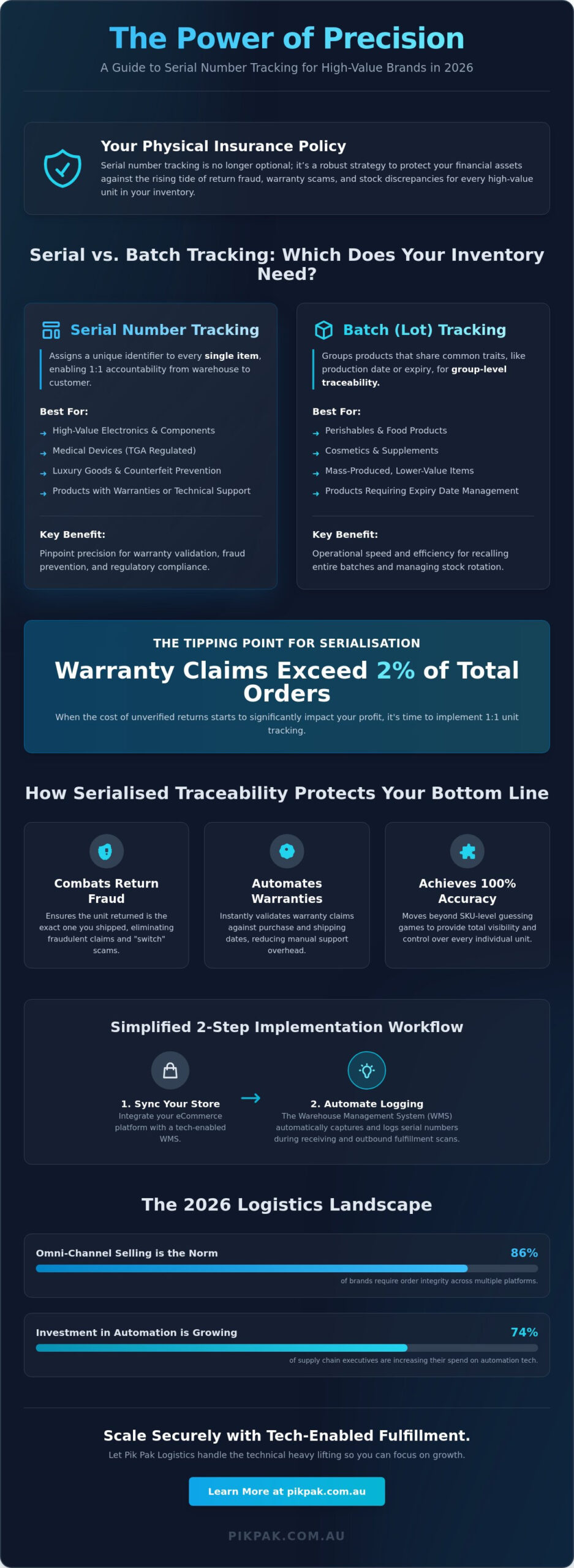
Distinguishing between a SKU and a serial number is a fundamental step for high-value brands. A Stock Keeping Unit (SKU) identifies the model or variant; if you sell ten identical laptops, they all share one SKU. However, a serial number identifies the specific unit. In 2026, where omni-channel selling is the norm for 86% of brands, this level of accountability is vital for maintaining order integrity across different platforms. The WMS platform at Pik Pak Logistics captures these IDs during the physical scanning process, making sure your records are accurate without complicating your daily workflow or slowing down your team.
The Anatomy of a Serial Number
Serial numbers use diverse alphanumeric formats tailored to specific industry standards. You’ll commonly see identifiers like IMEI for mobile phones, VIN for automotive components, or standard SN prefixes for general electronics. These strings are unique to a single unit and never repeat within a product line. To understand the encyclopedic roots of these identifiers and how they deter theft, you can read more about What is a Serial Number? and its role in quality control. Serialized inventory is the gold standard of stock control.
Industries That Require Individual Unit Tracking
High-value sectors like consumer electronics rely heavily on these numbers for technical support and warranty management. If a customer reports a hardware fault, you need to know exactly when that unit was manufactured and shipped. Medical devices under TGA regulation also require strict traceability for safety audits and potential recall management. Luxury brands use serialisation to combat counterfeiting, which remains a multi-billion dollar threat to retail margins in 2026. By partnering with Pik Pak Logistics for warehousing and fulfilment, these rigorous requirements become an easy game, allowing you to focus on growing your business while we handle the technical heavy lifting.
Serial Tracking vs. Batch Tracking: Which Does Your Inventory Need?
Choosing the right level of traceability is about balancing operational speed with financial security. You don’t want to overcomplicate your warehouse flow, but you can’t afford to leave high-value stock unprotected. Batch tracking, often called lot tracking, groups products that share a common production date or expiry. It’s the industry standard for cosmetics, supplements, or perishables. Serial tracking is the precision tool for 1:1 accountability. It allows you to monitor the specific lifecycle of one single unit, which is essential for technical support and high-end electronics.
Some brands even find success with hybrid models. Imagine kitting a high-value drone that requires a serial number with a spare battery pack that only needs batch tracking. A smart WMS platform handles these layers effortlessly, ensuring you have the right data for every component without the headache of manual logging. This flexibility is why 74% of supply chain executives are increasing their investment in automation through 2026; they need systems that can pivot between these tracking styles as their product lines grow.
When Batch Tracking is Sufficient
Batch tracking works best for mass-produced items where the cost of individual scanning outweighs the risk of fraud. If a product defect occurs, you can recall the entire batch based on its production date rather than hunting down specific units. For lower-value goods, this method keeps your logistics moving fast and your storage costs down. You can review our warehouse receiving guidelines to see how we help you categorise stock types to keep your operations running like clockwork.
The Tipping Point for Serialisation
When does the shift to full serialisation become a necessity for your brand? For many eCommerce owners, the tipping point arrives when warranty claims exceed 2% of total orders. At this stage, the inability to verify a unit’s specific history starts bleeding profit. High-ticket items, specifically those with a retail value over $200 AUD, almost always require serialisation to prevent “switch-and-return” fraud.
Regulatory pressure is another major driver for serial number tracking fulfillment. For instance, the FDA’s Unique Device Identification system mandates individual traceability for medical devices to ensure patient safety. If your industry requires this level of detail, implementing it now ensures you stay compliant as global online retail sales surpass $8 trillion by 2026. Making the switch to serialized tracking is an easy game when you have the right partner to handle the hard work for you.
The Business Case: How Serialised Traceability Protects Your Bottom Line
Protecting your margins in 2026 requires more than just high sales; it requires a defensive strategy against avoidable losses. Serial number tracking fulfillment provides the physical evidence needed to resolve disputes before they impact your bank account. By maintaining a 1:1 record of every outbound unit, you eliminate the ambiguity that often leads to financial leakage. It turns your logistics operation into a secure vault where every movement is verified and every asset is accounted for.
In the Australian market, this precision is particularly valuable for navigating Australian Consumer Law (ACL). While you must provide remedies for major failures, those obligations only extend to the specific items you actually supplied. Serialisation gives you the power to verify provenance instantly, ensuring you aren’t paying for another retailer’s faulty stock. This transparency builds a culture of trust with your buyers, showing them that Pik Pak Logistics treats their high-value purchases with the highest level of care. It’s a simple way to reclaim your time and focus on growth while we handle the hard work of inventory integrity.
Reducing stock shrinkage is another major win for high-value brands. When every unit has a unique identity, it becomes much harder for items to simply disappear during the kitting or shipping process. This level of accountability creates a clear paper trail for your internal audits and financial reporting. At Pik Pak Logistics, we help you eliminate waste by ensuring that every high-ticket item is tracked from warehouse arrival to the customer’s doorstep, effectively lowering your cost of goods sold over time.
Preventing Warranty and Return Fraud
The “old for new” swap scam can cost a brand thousands in a single quarter. By using our tech-enabled Returns Management solutions, your team can verify the unit’s ID at the returns desk. If the serial number doesn’t match the original order, the system flags the discrepancy immediately. This simple check stops fraud in its tracks and keeps your inventory pool clean and untainted by faulty swapped units.
Traceability and Recall Management
A product fault doesn’t have to trigger a mass panic or a total brand shutdown. With individual unit data, you can conduct surgical recalls that target only the specific customers holding affected items. This reduces the logistical burden and prevents unnecessary brand damage by avoiding blanket announcements. Serial tracking turns a logistical nightmare into a controlled process by allowing you to isolate risks without stopping your entire operation.
Implementing a Serial Number Workflow with Your 3PL Partner
Setting up a robust serial number tracking fulfillment workflow requires more than just a checkbox in your software settings. It’s a physical dance between your digital storefront and the warehouse floor. To keep your operations running like clockwork, data must flow seamlessly from the moment a customer clicks buy to the second the courier scans the parcel. This five-step process ensures nothing falls through the cracks and your high-value inventory remains secure.
- Data Synchronisation: Your e-store alerts our WMS that an order requires a serialised item, creating a digital placeholder for the specific unit.
- Receiving: Every unit is scanned individually upon arrival at the dock to log its unique ID into the system immediately.
- Secure Storage: Serialised goods are placed in designated zones with regular cycle counts to ensure 100% physical to digital accuracy.
- Scan-to-Pack: At the fulfillment station, our team scans the specific serial number again. This verifies that the exact unit assigned to the order is inside the box before the shipping label is applied.
- Post-Purchase Access: Once the order is out the door, that specific ID is stored in your cloud-based dashboard for instant access by your customer support team.
This level of precision is becoming the industry standard. With 74% of supply chain executives planning to increase automation investments through 2026, manual logging is a relic of the past. We handle the hard work of capturing this data so you can focus on your business.
Physical Handling: The Receiving to Packing Journey
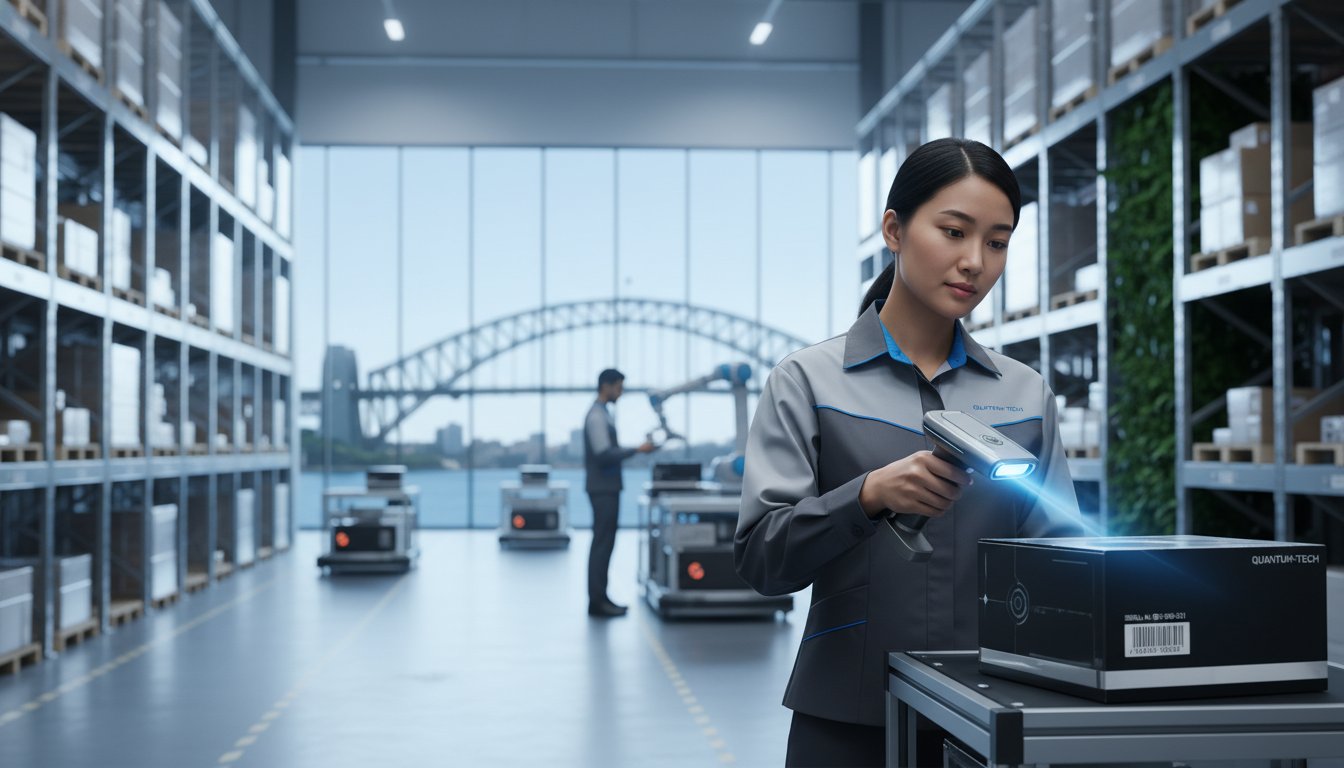
Accuracy starts at the dock. If the unique ID isn’t captured during inbound, the rest of the chain breaks. We use integrated hand-held scanners that communicate with our WMS in real-time to eliminate manual entry errors. This ensures every unit is born into the system correctly before it ever hits the shelf. For a deep dive into how we prepare your stock for this level of detail, check our Warehouse Receiving Guidelines.
Technology Integration: Making Data Flow
You don’t need to be a computer geek to connect your store to our warehouse. We use a point, click, and connect approach to sync with platforms like Shopify, Magento, and WooCommerce. Our Technology Support ensures that unique IDs are passed back to your store automatically. Recent updates, such as ShipStream version 2026.1 released on April 6, 2026, have even simplified how we track serial numbers for complex kitted products. This allows you to include the specific serial number in automated shipping emails, giving your customers immediate proof of authenticity. Ready to secure your high-value inventory? Get started with Pik Pak today and free up your time.
Scaling Securely with Pik Pak’s Tech-Enabled Fulfillment Solutions
Scaling a brand with high-ticket inventory requires a partner who understands that every unit counts. You’ve seen how individual accountability prevents fraud and protects your margins. Now, it’s about making that process scale without adding complexity to your daily routine. Pik Pak simplifies serial number tracking fulfillment for Australian SMEs by providing the technology and the physical expertise in one package. You get the peace of mind that your operations run like clockwork while you reclaim your time to focus on marketing and product development.
Our cloud-based WMS platform offers real-time visibility into every serialised unit in our care. You don’t need to install expensive software or maintain your own server racks. We provide a “Pay as you go” model that allows you to scale as you grow, ensuring you only pay for the storage and services you actually use. This flexibility is vital in a global e-commerce fulfillment market now worth $140.1 billion according to March 2026 estimates. We take the technical heavy lifting off your plate so your logistics feels effortless.
What seems to be a challenge is an easy game with Pik Pak. We act as your seasoned problem-solver, eliminating waste and ensuring your high-value stock is always accounted for. By outsourcing the “headache” of unit-level tracking to us, you can stop worrying about inventory discrepancies and start focusing on your next big launch. It’s all about delivering tangible results that help your business grow securely in an increasingly competitive market.
Tailored Solutions for High-Value Goods
Sensitive electronics and luxury items often require more than just a shelf. We offer custom kitting and serialized assembly services, ensuring that even complex product bundles maintain 1:1 traceability for every component. Our Warehousing and Fulfilment environments are designed for security, giving you a safe harbor for your most valuable stock. Whether you’re selling drones, medical devices, or limited-edition collectibles, we provide the specialized care your brand deserves.
Getting Started with Serialised Fulfillment
Moving to a serialized model is a simple transition with the right guidance. Start by auditing your current inventory to identify which SKUs require individual unit tracking based on their value or warranty risk. Once you’re ready, our onboarding process is designed for everyone. We aren’t all computer geeks, so we’ve made our integration a “point and click” experience. We’ll help you sync your store, set up your inbound protocols, and get your first serialized units scanned into the system. Free up your time and focus on your business with Pik Pak while we make your logistics an easy game.
Secure Your Brand’s Future with Precision Logistics
High-value brands can’t afford to leave inventory to chance. You now have the roadmap to move beyond simple batch tracking and implement a rigorous serial number tracking fulfillment strategy. This shift protects your bottom line by stopping return fraud and ensures you meet strict regulatory standards like the FDA’s UDI system. It’s about building a foundation where every unit is accounted for from the moment it hits the dock.
Pik Pak makes this transition simple. We’re specialists in high-value electronic fulfillment with Australian-based support and warehousing that keeps your operations local and accessible. Our WMS provides real-time visibility so you always know the status of your most expensive assets. You don’t need to be a tech expert to scale securely. You just need a partner who treats your inventory with the precision it deserves.
Let Pik Pak do the hard work for you. Let Pik Pak handle your high-value fulfillment—Get Started Today. Reclaim your time and focus on your business while we ensure your logistics run like clockwork. What seems like a complex challenge is an easy game with the right partner.
Frequently Asked Questions
What is the difference between a SKU and a serial number?
A SKU identifies a product model, while a serial number identifies one specific unit of that model. If you sell 50 identical laptops, they share a single SKU but have 50 unique serial numbers. This distinction is what enables precise serial number tracking fulfillment and individual unit history for every customer order.
Does serial number tracking slow down the fulfillment process?
It adds a few seconds to the packing stage, but it doesn’t create a bottleneck when using integrated hand-held scanners. Modern WMS platforms automate the data capture so the packer simply scans and moves to the next order. This minor time investment at the station prevents hours of manual investigation later when a return claim arrives.
How much extra does serial number tracking cost in a 3PL environment?
Costs typically involve a small incremental fee per scan or a monthly software access fee for the WMS platform. For context, cloud-based inventory software like Peach Software charged $365 per month for 3 users as of April 15, 2026. Most 3PLs bill this as a value-added service because it requires extra physical handling and data storage.
Can I track serial numbers for products I have already stored in the warehouse?
You can, but it requires a physical inventory audit to scan every unit currently on the shelf. This catch-up process involves a one-off labor cost to update your digital records. It’s much more efficient to implement serialisation during the initial warehouse receiving phase to ensure 100% data integrity from day one.
What happens if a manufacturer serial number is missing or damaged?
Our team can generate and apply an internal serial number if a manufacturer’s ID is unreadable or missing. We print a unique barcode label and affix it to the unit before it’s put away in storage. This ensures the unit remains trackable throughout its lifecycle even without the original factory markings.
Is serial number tracking necessary for all e-commerce products?
No, it’s generally reserved for items with a retail value over $200 AUD or products with long-term warranties. Low-cost consumables or apparel don’t typically justify the extra scanning costs. However, it’s essential for the 86% of brands selling on multiple channels in 2026 who need to manage technical support and high-ticket returns.
How does serial tracking help with Australian product recalls?
It allows you to identify the exact customers who bought units from a specific faulty batch. Instead of recalling every product sold over a six-month period, you can isolate the specific IDs affected. This surgical approach protects your brand reputation and drastically reduces the cost of reverse logistics.
Does Pik Pak integrate with Shopify for serial number tracking?
Yes, we use a point, click, and connect API integration to sync your Shopify store with our warehouse platform. When an order is placed, the data flows to us, and we pass the specific serial number back to your store once the item is shipped. This keeps your records updated automatically without any manual data entry.