
In 2026, 3pl compliance and certification isn’t just a set of technical boxes to tick; it’s the invisible insurance policy that determines whether your brand scales or faces a legal nightmare. With Australians spending over $69 billion online annually, the pressure to maintain a flawless supply chain has never been higher. You probably feel the weight of this responsibility, especially when trying to decode technical jargon like HACCP food standards or the upcoming ISO 9001:2026 update expected in September. It’s normal to worry about product spoilage or the legal liability of non-compliant shipping when you just want your operations to run like clockwork.
We believe logistics should be simple, not a source of stress. This guide shows you exactly how to identify compliant partners to protect your brand and ensure regulatory safety without needing a law degree. You’ll learn the difference between mandatory and optional certifications, the impact of the 12% superannuation guarantee on labor costs, and a clear framework to vet potential partners quickly. We’ll break down the technical requirements so you can stop worrying about the “what ifs” and focus on your business.
Key Takeaways
- Identify the essential certifications like ISO 9001 and HACCP to ensure your partner meets the global benchmarks for quality and safety.
- Understand the legal risks of non-compliance and why the brand owner is often held accountable for logistics failures under Australian Consumer Law.
- Implement a simple 5-step audit framework to verify 3pl compliance and certification so you never have to take a provider’s word at face value.
- Navigate the 2026 regulatory landscape with ease by focusing on new delivery standards and increased scrutiny from Australian watchdogs.
- Eliminate the logistical headache and reclaim your time by partnering with a provider that prioritizes secure, state-of-the-art Australian facilities.
What is 3PL Compliance and Why Does It Matter in 2026?
3PL compliance is the strict adherence to the legal, ethical, and industry-specific standards that govern how goods are stored and transported. It ensures that every step of your supply chain meets Australian regulations, from labor laws to safety protocols. When you partner with a Third-party logistics (3PL) provider, you’re trusting them with your brand’s physical footprint. In 2026, this matters more than ever. The Australian eCommerce market has surged, with projected growth exceeding $69.5 billion by 2029. With this massive volume comes increased scrutiny from regulators like the ACCC. They are looking closely at delivery standards and how Australian Consumer Law is applied to fulfillment promises. If your partner fails to meet these standards, it’s your brand on the line.
Getting your logistics right the first time is the only way to scale without a headache. If you want to understand the basics before diving into the legalities, check out our guide on What is 3PL? Your Complete Guide to Third-Party Logistics. Choosing a partner based on 3pl compliance and certification is essentially buying an insurance policy for your reputation. It allows your operations to run like clockwork while you focus on your business.
The Difference Between Compliance and Certification
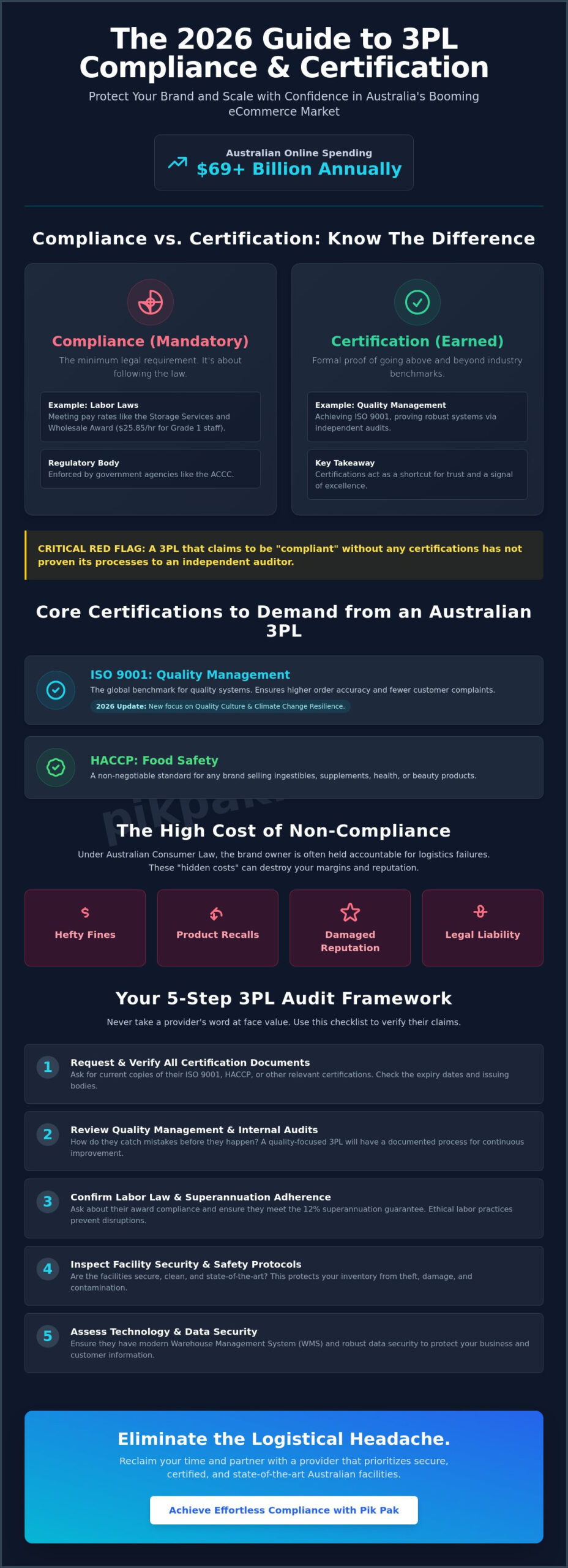
Compliance is mandatory. It’s the act of following the law, such as meeting the Storage Services and Wholesale Award pay rates for workers, which currently sit at $25.85 per hour for Grade 1 staff. Certification, however, is earned. It’s the formal proof that a 3PL has gone above and beyond to meet international benchmarks. For example, the ISO 9001:2026 update expected in September focuses heavily on quality culture and climate change resilience. Being “compliant” without certification is a major red flag for growing brands. It means the provider claims to follow rules but hasn’t opened their doors to independent auditors to prove it. Certifications act as a shortcut for trust, letting you skip the guesswork in a partner relationship.
How Compliance Protects Your Brand Reputation
In 2026, customers are hyper-aware of how their products are handled and stored. A single non-compliant shipment can lead to devastating consequences, including hefty fines, product recalls, or a flood of bad reviews. These aren’t just minor inconveniences; they are “hidden costs” that eat your margins and destroy customer loyalty. 3PL compliance is the foundation of a scalable eCommerce brand. By ensuring your 3pl compliance and certification are up to date, you eliminate waste and ensure your customers receive exactly what they ordered, safely and securely. Let Pik Pak do the hard work for you so you can reclaim your time and grow your business with peace of mind.
Core Certifications to Look for in an Australian 3PL
Choosing a partner based on 3pl compliance and certification is about more than just avoiding fines; it’s about ensuring your customers get the right product, every single time. In a market where 3PL costs per order can range from $3 to $17, you need to know that your investment is buying more than just shelf space. Certifications are the “audit trail” that proves a provider’s systems are robust enough to handle your growth. They align with the National Freight and Supply Chain Strategy, which prioritizes safety and efficiency across the Australian network. When a 3PL holds these credentials, they’ve proven to independent bodies that they don’t cut corners.
Quality Management: ISO 9001 and Beyond
ISO 9001 is the global benchmark for quality management, and it’s undergoing a significant shift. The ISO 9001:2026 update, expected to be published in September 2026, introduces a mandatory focus on quality culture and climate change resilience. For your eCommerce brand, this translates to higher order accuracy and fewer “where is my package?” emails. A 3PL with a quality-first culture uses internal audits to catch mistakes before they leave the dock. This proactive approach reduces your returns rate and protects your margins. It’s much easier to scale when you know your fulfillment is running like clockwork. Explore our warehousing and fulfilment services to see how we put these quality standards into practice.
Vertical-Specific Standards (Food, Health, and Beauty)
If you sell ingestibles, supplements, or skincare, generic compliance isn’t enough. You need specialized certifications to stay on the right side of Australian law. For food brands, HACCP (Hazard Analysis and Critical Control Points) is the “ticket to trade.” In Australia, this means adhering to Food Standards 3.2.1, 3.2.2, and 3.2.2A. These rules ensure that products are stored at the correct temperatures and handled to prevent contamination. Without this, a single storage error could lead to a massive product recall.
Health and beauty brands face even tighter regulations. If you sell therapeutic goods, your 3PL must meet TGA (Therapeutic Goods Administration) requirements for storage humidity and temperature controls. Similarly, if you stock perfumes or products with lithium batteries, ensure your partner has a Dangerous Goods (DG) certification. Handling these items incorrectly isn’t just a safety risk; it’s a legal liability that could shut down your storefront. 3pl compliance and certification in these specialized areas ensures your products remain safe for use and compliant with the law. By partnering with a tech-savvy expert, you can automate these complex requirements and focus on your business.
Finally, don’t overlook the Chain of Responsibility (CoR). This Australian transport standard means that everyone in the supply chain, including you as the brand owner, is responsible for transport safety. A compliant 3PL manages vehicle mass, load restraint, and driver fatigue to protect you from heavy penalties under the Heavy Vehicle National Law.
The Risks of Choosing a Non-Compliant 3PL Partner
Ignoring the fine print of your logistics contract is a gamble you can’t afford to take. While many founders focus on low rates, ignoring 3pl compliance and certification creates a house of cards that can collapse at the first audit. As the brand owner, you are legally the “face” of the product. If your 3PL fails to store goods correctly or mishandles customer data, the regulators will come to your door first. It’s your reputation on the line, not just theirs.
This risk extends to digital security. Your fulfillment partner handles sensitive customer details daily, including names, phone numbers, and home addresses. Failing to adhere to the Australian Privacy Principles regarding data collection and security isn’t just a technical slip; it’s a breach of trust that can lead to massive fines from the OAIC. Beyond the law, there’s the issue of insurance. Many insurers require proof that your warehouse partner meets specific safety benchmarks. If a fire occurs in a facility that lacked proper certification, your claim for lost stock might be rejected, leaving you with a total financial loss and no way to recover your investment.
Financial Risks and Hidden Operational Waste
Poor inventory management is a silent profit killer. Without the rigorous standards of a certified system, stock often goes missing or becomes “dead stock,” which is inventory that sits on a shelf until it’s unsellable or expired. This is particularly dangerous if you sell on marketplaces like Amazon Australia, where late deliveries or damaged items lead to immediate account penalties. A cheap 3PL often costs more in the long run due to compliance gaps. To avoid these pitfalls, you need a clear understanding of what is order fulfilment and how a compliant partner protects your bottom line by doing it right the first time.
Chain of Responsibility (CoR) and Legal Exposure
The Heavy Vehicle National Law (HVNL) in Australia is clear: you are part of the Chain of Responsibility. This means you share legal liability for transport safety, even if you don’t own the trucks or employ the drivers. If your 3PL partner pressures drivers to meet unrealistic deadlines or fails to secure a load properly, you can be held responsible for any resulting accidents or road damage. Ensuring your partner manages driver fatigue and load safety isn’t just a “nice to have”; it’s a legal requirement to protect your business from six-figure fines. Let Pik Pak handle the complexity of these standards so your operations run like clockwork and you can focus on your business.
How to Audit Your 3PL’s Compliance: A 5-Step Checklist
Auditing a potential partner is the only way to move from “hoping” everything is okay to “knowing” your brand is safe. Don’t let technical jargon or flashy sales presentations distract you. You need a pragmatic approach to verify that their 3pl compliance and certification claims are backed by reality. Use this 5-step checklist to vet any Australian provider before you sign a contract.
- Step 1: Request Current Certificates. Never take a verbal “yes” as proof. Ask for valid PDF copies of their ISO 9001 or HACCP certifications. Ensure the dates are current and the entity name matches the company you are hiring.
- Step 2: Review Receiving Guidelines. A provider’s Warehouse Receiving Guidelines act as a window into their operational soul. These rules dictate how they accept stock, check for damage, and log data. If these guidelines are vague, expect your inventory records to be just as messy.
- Step 3: Audit the Tech Stack. Ask specific questions about their Warehouse Management System (WMS). You need to know how they protect your data and whether their API connections use modern encryption standards.
- Step 4: Check Regulatory Records. Look for any history of Fair Work disputes or ACCC warnings. A 3PL that ignores labor laws, such as the $25.85 minimum hourly rate for Storeworker Grade 1 staff, is a liability waiting to happen.
- Step 5: See it in Action. Visit the facility or request a live video tour. Look for clean floors, organized racking, and clear safety signage. A chaotic warehouse is rarely a compliant one.
Technical Compliance: Data and Security
In 2026, the “invisible” layer of your supply chain is just as critical as the physical one. Your 3PL handles sensitive personal information, which means they must align with the Australian Privacy Principles. When you connect your store to a WMS, you’re opening a digital door. Ensure they use secure API integrations and have protocols like SOC 2 to prevent data breaches. Our technology and support team focuses on making this connection secure and simple, so you don’t have to be a computer geek to stay protected.
Operational Transparency and Reporting
Compliance isn’t a one-time event; it’s a daily habit. You need real-time visibility into your inventory and order status to ensure everything is running like clockwork. A compliant partner provides automated reports on damaged goods and fulfillment accuracy. While “point, click, and connect” systems make life easy, they must be backed by rigorous physical standards on the warehouse floor. If you’re ready for logistics that are handled correctly from day one, explore our logistics services to see how we simplify the complex.
Effortless Compliance with Pik Pak Logistics
Logistics shouldn’t be a source of anxiety. At Pik Pak, we’ve built our business around the idea that what seems to be a challenge for you is an easy game for us. We take the “headache” out of 3pl compliance and certification by maintaining state-of-the-art Australian facilities that adhere to the highest industry standards. You don’t need to spend your nights worrying about the ISO 9001:2026 update or whether your warehouse is meeting the 12% Superannuation Guarantee for its staff. We handle the complexity so your operations run like clockwork.
Our commitment to high standards isn’t just a promise; it’s baked into our infrastructure. From secure inventory storage to precise returns management, every task is executed with a focus on eliminating waste and protecting your brand reputation. We understand that in 2026, the regulatory environment is tighter than ever. Whether it is the increased scrutiny on Australian Consumer Law or the specific requirements of the Heavy Vehicle National Law, we stay ahead of the curve. You focus on your business. Let Pik Pak do the hard work for you.
Our Technology-Driven Approach to Quality
We aren’t all computer geeks, but we’ve built a WMS platform that makes high-level compliance feel like a “point, click, and connect” solution. Our system ensures 99.9% order accuracy and provides full inventory traceability, which is essential for meeting Australian food safety standards like HACCP 3.2.2. By automating the flow of information through secure API integrations, we eliminate the human error that leads to damaged stock or failed deliveries. Our “Pay as you go” model is designed for flexibility, but it never means a compromise on standards. Whether you’re shipping ten orders or ten thousand, you get the same secure, professional service that keeps your brand legally protected.
Your Partner in Scaling Safely
Scaling a brand in the $69.5 billion Australian eCommerce market requires a partner that can grow with you at every stage. We support small businesses as they transform into national brands by providing the dedicated support needed to navigate complex shipping and storage regulations. We understand the pressure of maintaining a flawless supply chain, especially when dealing with the “hidden costs” of damaged stock or insurance complications. We’re here to ensure your logistics are handled correctly so you can reclaim your time and focus on growth.
If you’re ready to stop stressing over the fine print of logistics law and start scaling with confidence, it’s time to make a move. Request a Quote from Pik Pak Logistics today and see how simple fulfillment can be. Let Pik Pak handle the hard work of compliance while you focus on what you do best: growing your brand.
Secure Your Brand’s Future with Compliant Logistics
The landscape of Australian eCommerce is changing fast; staying ahead of 3pl compliance and certification is the only way to ensure your business runs like clockwork. By prioritizing partners who meet the ISO 9001:2026 standards and local HACCP requirements, you protect your brand from legal liability and operational waste. Remember that you are part of the Chain of Responsibility. Choosing a certified partner isn’t just a smart move; it’s a necessity for safe scaling in a market projected to exceed $69.5 billion by 2029.
You shouldn’t have to spend your time worrying about technical jargon or regulatory audits. Pik Pak provides state-of-the-art secure warehousing and real-time WMS visibility to give you total control over your inventory. With expert Australian-based support, we make the complex world of fulfillment an easy game. Let us handle the hard work so you can reclaim your time and focus on your business.
Ready for headache-free logistics? Get started with Pik Pak today!
Frequently Asked Questions
What is the most important certification for a 3PL in Australia?
ISO 9001 is the most critical foundation for any Australian 3PL. It proves the provider has a rigorous quality management system in place to handle your inventory accurately. With the ISO 9001:2026 update arriving in September 2026, look for partners who prioritize quality culture and climate resilience. If you sell food or supplements, HACCP certification becomes equally vital to meet Australian Food Standards 3.2.1 and 3.2.2.
Can I be fined if my 3PL provider is not compliant with transport laws?
You certainly can be fined under Australia’s Chain of Responsibility (CoR) laws. Even if you don’t own the trucks, the Heavy Vehicle National Law (HVNL) holds you legally responsible for transport safety. If your 3PL ignores driver fatigue or load restraint rules, you could face six-figure penalties. It’s your job to ensure your partner follows these safety standards to protect your business from legal exposure.
How do I verify if a 3PL’s ISO 9001 certification is actually current?
You should always ask for a copy of the certificate and check the registration number on the JAS-ANZ register. This is the official body for accreditation in Australia and New Zealand. Verify that the company name matches your provider and check the expiry date. Real 3pl compliance and certification is never a secret; a transparent partner will provide these documents immediately to help you feel secure.
Does my small eCommerce business really need a certified 3PL partner?
Small businesses need certified partners even more than large corporations because they often lack the capital to survive a major legal fine. Your liability under Australian Consumer Law remains the same whether you ship ten orders or ten thousand. A certified partner ensures your logistics run like clockwork from day one. This lets you focus on your business while avoiding the hidden costs of damaged stock.
What is HACCP and why does my 3PL need it for food storage?
HACCP stands for Hazard Analysis and Critical Control Points. It is a systematic approach to food safety that prevents biological, chemical, and physical hazards in the supply chain. Your 3PL needs it to ensure ingestible products aren’t contaminated during storage. In Australia, this is often a requirement for supplying large retailers or distributors who demand proof of compliance with the Australia New Zealand Food Standards Code.
What happens to my stock if a 3PL loses its certification?
If a provider loses their certification, your insurance policy might become void for any claims related to stock damage or loss. Many insurers only pay out if the facility meets specific safety benchmarks. Additionally, marketplaces like Amazon Australia may suspend your seller account if you can’t prove your products are stored in a compliant facility. It’s a massive risk that can halt your growth overnight.
Is a WMS (Warehouse Management System) considered part of 3PL compliance?
A WMS is the digital backbone of 3pl compliance and certification. It ensures inventory traceability and manages sensitive customer data according to the Australian Privacy Principles. Without a secure WMS, you can’t accurately track batch numbers for recalls or ensure that personal information is protected from breaches. A simple point, click and connect system should always be backed by these rigorous data security protocols.
How often should a 3PL undergo a compliance audit?
Most international standards like ISO 9001 require an external audit every year to maintain certification. Full recertification typically happens every three years. However, a high-quality 3PL will perform internal audits much more frequently, often monthly or quarterly. These regular checks ensure that operations continue to meet the high standards required to eliminate waste and keep your supply chain moving without any unexpected headaches.