
Your living room isn’t a warehouse, and your kitchen table was never meant to be a packing station. If you find yourself tripping over shipping boxes before your first cup of coffee, you’ve hit the physical ceiling of home-based growth. You started this business for freedom, but right now, your inventory is the one in charge. It’s an exhausting way to work, and frankly, it’s holding your brand back from the professional stage it deserves.
We understand the hesitation to move. You’ve likely searched for how to reclaim my home from business inventory because the clutter is overwhelming, yet the thought of handing over your stock feels like losing a limb. It’s a common crossroads for successful founders. This guide provides the practical steps to move your stock into a professional 3PL environment while maintaining total visibility. You’ll discover how to trade the stress of manual packing for automated fulfilment, giving you back your home and the time to focus on marketing and growth. We will break down the 2026 logistics landscape and show you exactly how to scale without the physical limits of your own four walls.
Key Takeaways
- Identify the signs of “inventory creep” and understand why your home workspace is currently the biggest bottleneck in your scaling strategy.
- Discover how to reclaim my home from business inventory by calculating the hidden costs of DIY packing, including lost founder hours and premium residential shipping rates.
- Follow a pragmatic 5-step plan to audit your SKUs and prepare your data for a professional, technology-backed warehouse transition.
- Compare 3PL services against self-storage to find a solution that removes the manual labour from your daily schedule instead of just moving the boxes.
- Learn how cloud-based management systems provide real-time visibility, allowing you to scale your logistics while maintaining total control from any device.
The Reality of ‘Inventory Creep’: Why Your Home No Longer Feels Like Home
Inventory creep doesn’t happen overnight. It begins with a single shelf in the spare room and slowly migrates to the dining table, the hallway, and eventually the garage. Before you realize it, your sanctuary has become a makeshift shipping hub. This silent expansion erodes the boundary between your professional and personal life, making it nearly impossible to enjoy your home without seeing a reminder of your to-do list. When your living space is dominated by cardboard and bubble wrap, you aren’t just losing square footage; you’re losing the mental capacity to think strategically about your brand’s future.
This principle of visual clarity is shared by experts in real estate photography Las Vegas, who know that a home’s value is best communicated when it is free from the distractions of daily clutter. Reclaiming your home from business inventory isn’t just a logistical necessity; it’s a way to restore the professional and aesthetic integrity of your living space.
Many founders stay in this “home-office” phase because it feels free. However, storing stock at home carries a heavy price in lost productivity and operational friction. Professionalizing your operation means recognizing when you’ve outgrown the hobbyist setup. If you are constantly moving boxes just to find a clean plate or tripping over stock during your morning routine, it’s time to learn how to reclaim my home from business inventory. Shifting to a professional warehousing and fulfilment model is the first step toward a scalable, mature eCommerce business.
The Mental Toll of Living in Your Warehouse
Constant exposure to visual clutter leads to significant decision fatigue. When your stock is always in your line of sight, your brain never truly “switches off” from work mode. This lack of separation creates a persistent low-level anxiety that drains your energy. Inventory-induced stress is the psychological friction caused by constant exposure to unfinished work, which ultimately stifles the creative and strategic thinking required for business growth. By removing the physical burden of stock, you clear the mental space needed to focus on high-level marketing and product development.
The Physical Limits of Residential Logistics
Residential spaces aren’t designed for industrial activities. Storing heavy boxes in spare rooms or garages creates genuine health and safety risks, from poor ergonomics during packing to potential trip hazards for your family. There is also the logistical nightmare of residential courier pickups. Most couriers prioritize commercial zones, and residential addresses often face missed windows or limited access for larger vehicles.
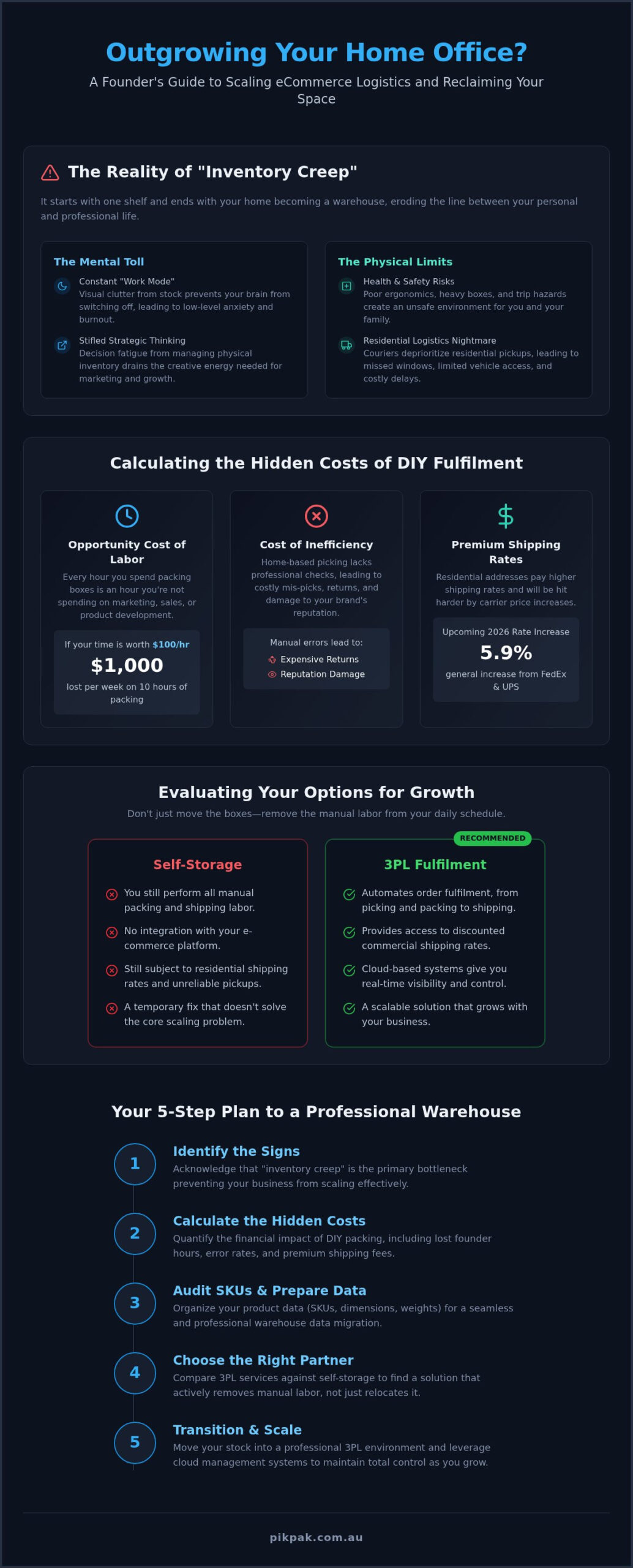
As you scale, these inefficiencies become expensive. With FedEx and UPS implementing a 5.9% general rate increase in 2026, every shipping error or missed pickup hurts your bottom line more than ever. Transitioning to Third-party logistics (3PL) provides access to professional loading docks and streamlined systems that residential locations simply cannot match. Reclaiming your home isn’t just about cleaning up; it’s about removing the physical bottlenecks that prevent your business from reaching its full potential.
Calculating the Hidden Costs of Home-Based Order Fulfilment
Staying at home feels like a cost-saving measure, but for a growing eCommerce brand, it’s often the most expensive way to operate. Many founders focus solely on the lack of a monthly rent check, ignoring the capital leaking through inefficient processes. Understanding the true financial impact is the first step in learning how to reclaim my home from business inventory without sacrificing your profit margins. When your living room becomes a dispatch centre, you aren’t just losing space; you’re paying a premium for every box you tape by hand.
The “Founder’s Hourly Rate” is a concept many entrepreneurs overlook. If you value your strategic time at $100 per hour but spend ten hours a week packing boxes, you’re effectively paying $1,000 weekly for manual labour. This doesn’t even account for the cost of errors. Home-based picking lacks the barcode verification and systematic checks of a professional warehouse, leading to mispicks that require expensive returns and damage your reputation. According to the U.S. Small Business Administration, the real danger lies in inefficient fulfillment, which bleeds capital through wasted time and avoidable shipping mistakes.
The Opportunity Cost of Manual Labour
Manual fulfilment creates a hard ceiling on your revenue. You can’t run a high-volume Black Friday sale or a viral product launch from a two-bedroom unit without causing an operational collapse. Every hour spent counting stock or managing returns is an hour not spent on marketing, product development, or customer acquisition. These “hidden hours” are the biggest barrier to scaling. By delegating these tasks, you transition from a warehouse worker to a business owner, allowing you to manage higher order volumes without increasing your personal workload.
Residential vs. Commercial Shipping Rates
Individual sellers pay retail rates for postage, which are significantly higher than the commercial contracts held by logistics providers. Professional pick and pack services leverage massive shipping volumes to secure deep discounts. Bulk shipping discounts achieved through a 3PL partner can often entirely offset the monthly cost of professional storage fees.
Furthermore, professional logistics hubs provide superior customer delivery options that residential addresses cannot access, such as streamlined tracking and faster dispatch times. If these hidden costs are draining your growth, it’s time to explore how professional warehousing and fulfilment can protect your bottom line and give you your house back.
5-Step Plan to Move Stock to a Professional Warehouse
Transitioning from a home-based setup to a professional facility requires more than just a moving truck. It demands a logistical exit strategy that ensures your business remains operational while your inventory is in transit. If you’ve been wondering how to reclaim my home from business inventory, the answer lies in a structured migration that prioritizes data accuracy and physical organization. This move is your opportunity to shed the inefficiencies of residential storage and embrace a model built for high-volume growth.
Step 1: The Inventory Audit
Before you pack a single box, you must perform a rigorous stock audit. Categorising your items for a 3pl warehouse involves more than just counting units. You need to identify your “hero” products versus slow-moving SKUs. High-turnover items should be prioritised for the move, while obsolete stock or bulky marketing materials might be better off sold at a discount or recycled. Accurate SKU counts are non-negotiable at this stage; any discrepancy between your records and the physical count will cause friction when the warehouse begins the receiving process. Clear out the “dead wood” so you aren’t paying to store inventory that doesn’t sell.
Step 2 involves digital preparation. Moving from a manual spreadsheet to a professional system requires technology integration that syncs your online store with a Warehouse Management System (WMS). Standardising your data now prevents “ghost inventory” issues later. Step 3 is selecting a partner based on strategic location. For Australian brands, proximity to major hubs like Melbourne is critical for reducing “last mile” delivery times and costs.
Step 4: Warehouse Receiving Guidelines
Professional warehouses operate on strict schedules and specific protocols. Following established warehouse receiving guidelines is the only way to avoid costly delays or “unidentified stock” surcharges. Each box must be clearly labelled with SKU codes and quantities to allow for rapid ingestion into the WMS.
Ensure your stock is “ship-ready” before it leaves your driveway. If a 3PL has to individualise items or apply barcodes that you missed, you’ll face additional labour fees. Palletising your stock correctly for industrial transit protects your investment and ensures that the moment your inventory arrives at the dock, it can be scanned and made available for sale immediately.
Step 5 is the “Go-Live” moment. Once the warehouse confirms receipt, you simply toggle your fulfilment settings. Your home returns to being a sanctuary, and your business finally has the professional foundation it needs to scale without limits.
Evaluating 3PL vs. Self-Storage: Which is Right for Your Growth?
When the hallway is blocked by boxes, the first instinct for many founders is to rent a local storage locker. It seems like the quickest way to learn how to reclaim my home from business inventory. However, self-storage is often a trap that solves the space problem while doubling your workload. Moving stock into a locker doesn’t remove the burden of fulfilment; it just adds a commute to your packing routine. To scale effectively in 2026, you need to distinguish between simply “storing stuff” and implementing an automated supply chain.
Why Self-Storage Fails eCommerce Businesses
Self-storage creates a “double handling” nightmare. You drive to the unit, load your car, drive home, and then start the packing process. This is a massive drain on your most valuable resource: time. Additionally, standard storage units often lack the environment needed for sensitive stock. If your products require temperature regulation, research shows that climate-controlled units typically cost 20% to 50% more than standard lockers.
There is also a significant technology gap. A storage unit cannot integrate with Shopify, eBay, or WooCommerce. You are left managing stock levels on a manual spreadsheet, which leads to overselling and customer disappointment. Transitioning to professional warehousing and fulfilment eliminates these manual hurdles by syncing your physical stock with your digital storefront in real time.
The 3PL Advantage: Automation and Scale
A 3PL acts as a scalable extension of your team. Unlike self-storage, where you are the only employee, a logistics partner provides the labour, systems, and expertise to handle your orders as they arrive. You can leverage specialised 3PL services for complex tasks like kitting or returns management without ever touching a roll of tape. The per-order fee of a professional 3PL is often lower than the hourly value of the time you lose driving to a storage unit and hand-packing every box.
Cost efficiency is another major factor. In a self-storage model, you pay for the entire unit even if it is half empty. With a professional provider, you typically pay for the specific pallet spaces you occupy. This variable cost model protects your cash flow during slower months. Most importantly, a 3PL provides a cloud-based WMS, giving you total visibility over your inventory from your phone. You stop guessing what is in the locker and start managing your business with precision data.
Ready to stop being your own warehouse manager? Explore our comprehensive 3PL services and see how automation can fuel your growth while giving you your home back.
Reclaiming Your Life: Scaling with Pik Pak Logistics
Moving your stock to a professional facility doesn’t mean losing touch with your business. Our cloud-based WMS provides real-time visibility into every SKU and every order. You stay in the driver’s seat with data-driven insights, while we handle the heavy lifting. You can trust that your brand is in expert hands, allowing you to enjoy your reclaimed space without the nagging worry of unfulfilled orders. It’s about gaining peace of mind through established service priorities and a partnership built on reliability.
Control Without the Clutter
The shift from “packer” to “CEO” happens the moment you stop touching every box. With the Pik Pak platform, you can monitor your entire order flow from a café or even the beach. This level of mobility is only possible when you have a tech-savvy partner managing the backend. We handle the logistical friction, including the often-dreaded process of returns management. By moving the messiest part of eCommerce out of your house, you clear the way for more strategic thinking. You’ll find that once the physical clutter is gone, the mental clutter follows, leaving you free to focus on high-level brand building.
Your Growth Roadmap
Scaling requires a foundation that can handle sudden spikes in demand. Moving to a professional warehouse signals to the market that your brand is ready for wholesale and retail opportunities. You can add new product lines or experiment with kitting and assembly without worrying about where the extra pallets will fit. Space is no longer a constraint on your ambition. This is how to reclaim my home from business inventory while simultaneously building a legacy.
The transition is simpler than you think. We provide tailored solutions that fit your current business size while offering the room you need to grow. Don’t let your living room hold your revenue back any longer. It’s time to take the professional leap and see what your business can achieve with a dedicated logistics partner. Reclaim your home and scale your business with Pik Pak today by requesting a quote designed for your specific growth goals.
Take Back Your Space and Your Time
Scaling a business shouldn’t come at the cost of your personal sanctuary. You’ve seen how inventory creep creates a physical and mental ceiling on your success, and why traditional self-storage often fails to provide a real solution. By choosing a professional logistics partner, you move beyond the manual labour of packing boxes and step into a strategic role. You gain 24/7 visibility through a cloud-based WMS and the freedom to grow without square-footage limits. Discovering how to reclaim my home from business inventory is more than a cleaning task; it’s a vital pivot toward a scalable, professional future.
Imagine your lounge room without the clutter and your weekends without the stress of unfulfilled orders. With expert pick, pack, and ship services, you can focus on the marketing and product development that truly drives revenue. It’s time to stop living in a warehouse and start running a business. Ready to get your home back? Get a 3PL quote from Pik Pak today. We are here to help you make the transition effortless, giving you the space to breathe and the power to scale.
Frequently Asked Questions
Is my business too small for a 3PL?
No business is too small if your current setup is preventing you from growing. We work with eCommerce brands at various stages, focusing on your potential rather than just your current volume. If you are spending more time taping boxes than finding new customers, you’ve reached the point where professional fulfilment becomes a strategic necessity rather than a luxury.
How much does it cost to move inventory from my home to a warehouse?
The primary costs involve the physical transport of your stock and the initial warehouse receiving fees. You will need to account for palletising your goods and the cost of a commercial courier to move them to the facility. Once they arrive, the warehouse scans each item into the system, ensuring your digital records match the physical stock perfectly from day one.
Will I lose the personal touch in my packaging if I use a 3PL?
You retain full control over how your brand is presented to your customers. Professional kitting and assembly services allow you to use custom branded boxes, specific tissue paper, or promotional inserts. We follow your exact packing protocols to ensure that the unboxing experience remains consistent with your brand identity, just without you doing the manual labour.
Can I still see my inventory once it leaves my house?
You gain better visibility through a cloud-based WMS than you ever had with manual home tracking. Our platform provides real-time data on stock levels, order statuses, and shipping progress 24/7. This technology is the key to knowing how to reclaim my home from business inventory while actually increasing your oversight and control over every single SKU.
How long does the transition from home to 3PL take?
A typical transition takes between one and two weeks from the initial audit to going live. This period includes the time needed for digital integration with your online store and the physical arrival and ingestion of your stock at the warehouse. We provide a clear roadmap for this process to ensure your store remains open and your customers experience no delays.
What happens if a customer wants to return an item?
We manage the entire reverse logistics process so you don’t have to. Returns are sent directly to our facility, where our team inspects the items based on your specific quality standards. We then update your inventory levels and either return the item to the shelf for resale or handle disposal, keeping the mess of returns entirely out of your home.
Do I need to hire my own couriers if I use Pik Pak?
No, we provide a full suite of home delivery shipping options through our established carrier network. You leverage our pre-negotiated commercial rates, which are significantly lower than standard retail postage. We handle the carrier relationships, label generation, and tracking updates, allowing you to benefit from professional logistics without the administrative burden of managing multiple courier accounts.
What are the most common warehousing questions for beginners?
New founders often ask about SKU organisation, monthly storage minimums, and how to reclaim my home from business inventory without losing the “founder’s touch.” Other common warehousing questions involve the specifics of WMS integration and how to prepare stock for the first delivery. Most beginners find that the shift to professional storage is far more intuitive than they initially expected.