

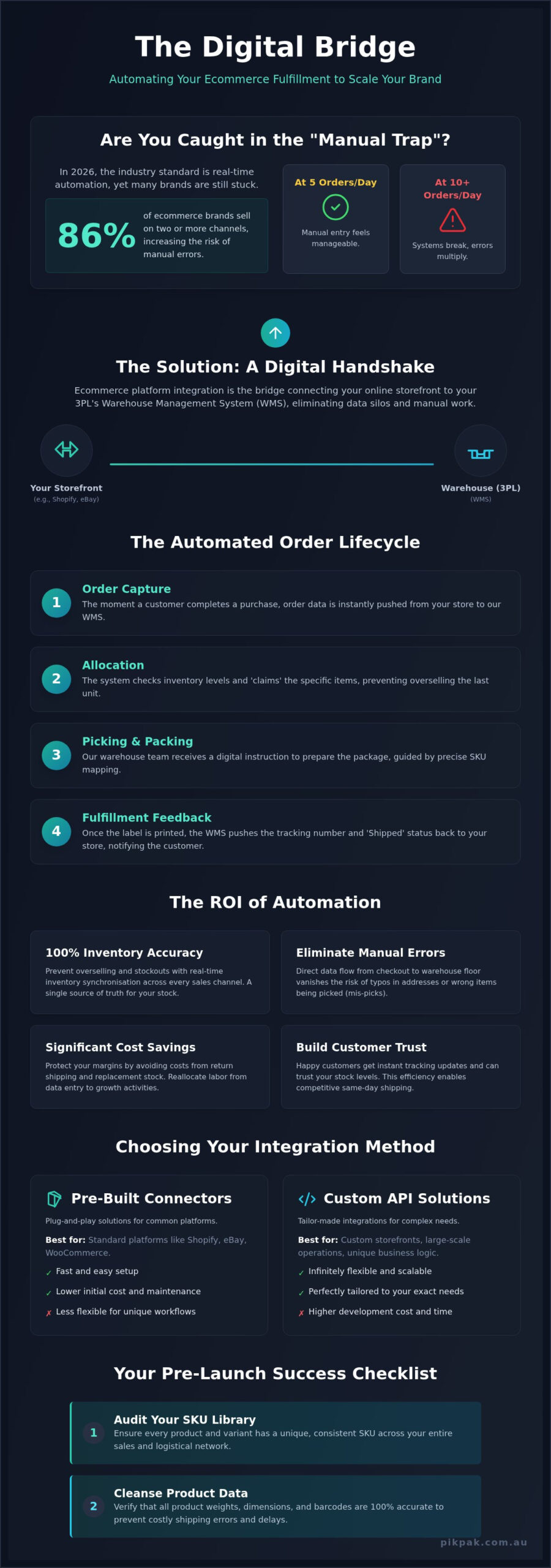
As of 2026, 86% of ecommerce brands are selling on two or more sales channels, yet many still find themselves trapped in a cycle of manual data entry. If you’re spending your mornings fixing inventory discrepancies or manually typing out shipping labels, you aren’t alone. Managing a growing brand shouldn’t feel like a constant battle against laggy systems and human error. Implementing a robust ecommerce platform integration for fulfillment is the key to transforming your warehouse from a simple storage space into a high-speed, automated engine for your digital storefront.
We know that the stress of overselling stock or delayed tracking updates is more than just a nuisance; it’s a barrier to your growth. This guide shows you how to bridge the gap between your online store and warehouse to eliminate manual errors and scale your operations effortlessly. You’ll learn how to achieve 100% real-time inventory accuracy, the benefits of API versus pre-built connectors, and how to automate your entire order-to-shipment lifecycle. It’s time to delegate the operational burden and reclaim your time to focus on the strategic goals that actually move the needle for your business.
Key Takeaways
- Move beyond manual data entry by understanding how an ecommerce platform integration for fulfillment automates the connection between your storefront and warehouse.
- Prevent overselling and stockouts with real-time inventory synchronisation that keeps your stock levels accurate across every sales channel.
- Evaluate the differences between pre-built connectors and custom API solutions to determine the most efficient way to scale your unique operations.
- Prepare for a successful launch by auditing your SKU library and cleansing product data to ensure consistency across your entire logistical network.
- Leverage cloud-based WMS technology to reclaim your time and focus on growth while your 3PL handles the complexities of Australian fulfillment.
Understanding eCommerce Platform Integration for Seamless Fulfillment
Successful scaling begins with a digital handshake. In simple terms, ecommerce platform integration for fulfillment is the bridge connecting your online storefront to a third-party logistics (3PL) provider’s Warehouse Management System (WMS). Without this bridge, your data sits in silos. Orders stay in your store, while your stock levels stay in the warehouse. Manual intervention becomes the only way to move information between the two.
Many business owners fall into the “Manual Trap.” When you’re processing five orders a day, copying and pasting customer details into a shipping portal feels manageable. Once you scale past 10 orders a day, this process breaks. Human error creeps in. You might mistype an address or forget to update a stock level on your site. By 2026, the industry standard has moved away from slow batch processing. Modern brands now rely on real-time, event-driven data. This means the moment a customer clicks “buy,” the warehouse receives the pick instruction instantly.
The ROI of Automation in 2026
You also gain significant labor cost savings. Instead of paying staff to spend hours on data entry or label printing, you can reallocate that talent to customer service or product development. Automation allows you to reclaim your time and refocus on growth. Customers also benefit from instant tracking updates and accurate stock levels, which builds the long-term trust necessary for repeat business. When your systems work, your customers stay happy.
Why Integration is the Foundation of Modern 3PL
Modern logistics has evolved into “Logistics-as-a-Service.” It’s no longer just about renting shelf space for boxes. A sophisticated Omnichannel order fulfillment strategy relies on a single source of truth for inventory. Whether you sell on Shopify, eBay, or a custom storefront, your integration ensures every channel reflects the same real-time stock count. This eliminates the stress of overselling and allows you to expand into new markets with confidence.
This deep connectivity is what enables faster dispatch times. When orders flow automatically, our team can begin picking and packing within minutes of a sale. This efficiency is the key to offering competitive same-day or next-day shipping options. If you want to understand the broader impact of these systems, explore our approach to warehousing and fulfilment to see how we turn complex logistics into a simple, manageable advantage for your brand.
How eCommerce Integrations Power the Data Bridge
Integration is more than just a digital link. It’s a logic engine. While your storefront focuses on the customer experience, the backend ensures every promise made at checkout is physically possible to keep. A seamless ecommerce platform integration for fulfillment ensures that these two worlds remain in perfect sync. This data bridge moves information in a continuous loop, turning a customer’s click into a physical delivery without you ever touching a keyboard.
The bridge operates through four critical data steps in the order lifecycle:
- Order Capture: The moment a customer completes a purchase, the order data is instantly pushed from your store to our WMS.
- Allocation: The system checks your inventory levels and “claims” the specific items for that order, preventing another customer from buying the last unit.
- Picking and Packing: Our warehouse team receives the digital instruction to prepare the package, guided by precise SKU mapping.
- Fulfillment Feedback: Once the label is printed, the WMS pushes the tracking number and “Shipped” status back to your store, triggering the customer notification.
SKU mapping is the silent translator in this process. It ensures that “Product A” on your Shopify store perfectly matches “Location B” in our warehouse. This precision eliminates the guesswork that leads to shipping the wrong size or color. Our technology support team helps you map these complex data flows so you can stop worrying about the “how” and focus on the “what.”
Mapping Complex Inventory: Kitting and Bundles
Selling bundles is a great way to increase average order value, but it can be a logistical headache. If you sell a “Summer Wellness Pack” (Bundle A), your store sees it as one item. However, our warehouse sees three: a water bottle, a beach towel, and a tote bag. Smart integration decomposes these bundles into individual pick-tasks for our team. It also ensures your inventory levels reflect the availability of the individual components, so you don’t oversell a kit when you’re actually out of towels.
Real-Time Visibility and Reporting
Comparing Integration Methods: Pre-Built vs. API vs. CSV
Choosing the right way to connect your store is a business decision, not just a technical one. Your choice of ecommerce platform integration for fulfillment defines how quickly you can scale without hitting a technical ceiling. You don’t need to be a developer to make the right choice, but you do need to understand which method aligns with your current volume and growth plans. Most brands start with simplicity and move toward complexity as their needs evolve.
Pre-built connectors are the “plug-and-play” heroes for brands using mainstream platforms like Shopify, WooCommerce, or BigCommerce. These tools are designed for speed. They offer a reliable, standardized connection that can often be set up in a single afternoon. Because they are native to the WMS, they are cost-effective and require very little maintenance. For most growing Australian businesses, this is the most pragmatic starting point.
Flat file uploads, such as CSV or Excel spreadsheets, remain useful when manual control is necessary. You might use these for ad-hoc projects, one-off marketing campaigns, or special VIP distributions that don’t sit in your regular store inventory. While not a permanent solution for scaling, they provide a safety net for unique scenarios. The goal is to match the method to your technical resources so you don’t over-engineer a simple process.
The Rise of No-Code and Low-Code Connectors
No-code and low-code tools like Zapier or Make have changed the landscape for niche platforms. These services bridge the gaps between systems that don’t have a native handshake. Using third-party middleware can be a flexible way to link your store without paying for expensive developer hours. However, keep in mind that every extra layer in your tech stack is a potential point of failure. Native 3PL connectors are usually more stable, but middleware is a fantastic problem-solver for unique software combinations.
When to Invest in a Custom API Integration
For enterprise-level brands, a custom API (Application Programming Interface) is the gold standard. It allows for bespoke logic that pre-built tools simply can’t match. If you need to integrate your warehouse data with a complex ERP system or a proprietary storefront, an API is the way to go. It handles massive order volumes with precision and allows for highly specific automation rules. If you’re unsure which path to take, our Pik Pak Technology Support team can guide you through the technical requirements to ensure your systems are future-proof and ready for the next stage of your growth.
A Step-by-Step Checklist for Successful Platform Integration
While some providers claim you can “connect in minutes,” a truly scalable ecommerce platform integration for fulfillment requires deliberate preparation. Rushing the process often leads to “ghost” inventory or shipping delays that frustrate your customers. To ensure your data bridge is solid from day one, follow this structured approach to the integration lifecycle.
- Audit your SKU library: Before connecting, ensure every product has a unique SKU. Consistency between your store and our WMS is the only way the system knows exactly which item to pick.
- Cleanse your data: Remove discontinued products from your storefront. Correct any errors in product weights or dimensions, as these directly impact your shipping costs and box selection.
- Map your shipping carriers: Align your store’s shipping methods (e.g., “Standard Shipping”) with our specific courier options. This ensures that an express order actually travels via an express service.
- The Sandbox Test: Run “dummy” orders through the system. This allows you to verify that the data loop is closed and that tracking numbers are flowing back to your store correctly.
- Go-Live and Hyper-care: Monitor the first 48 hours of automated flow closely. We recommend a “hyper-care” period where you check every order to ensure the automation is performing as expected.
Preparation is the difference between a chaotic launch and a seamless transition. If you are ready to move beyond manual entry and start scaling your operations, explore our logistics services to see how we can manage this transition for you.
Common Integration Pitfalls and How to Avoid Them
The most common hurdle is the “Duplicate SKU” error. If two different products share the same code, the fulfillment process will halt to prevent a mis-pick. You should also watch for international characters in customer names or addresses, as some older systems struggle to process non-standard symbols. Finally, decide how your integration will handle partial shipments. If one item is on backorder, does the system ship the available items or wait for the full order? Setting these rules early prevents customer service headaches later.
Setting Up Automated Returns (Reverse Logistics)
Logistics doesn’t end when the package leaves the warehouse. Industry data shows that approximately 20% of eCommerce orders are returned, making automated reverse logistics essential for your survival. A smart integration handles the “Return to Sender” data flow automatically. When our team receives and inspects a return, the WMS updates your store’s inventory levels instantly. This ensures that resalable stock is back online within minutes, not days. By automating this loop, you turn a potential loss into a manageable, efficient process.
Scaling Your Australian Store with Pik Pak’s Integrated Solutions
Choosing the right partner means finding a team that understands the local landscape. At Pik Pak, our cloud-based WMS serves as your operational command center. It doesn’t just store data; it orchestrates your entire supply chain. We specialize in the Australian market, offering deep integration with Australia Post and leading domestic couriers. This local expertise ensures your packages move through the most efficient networks possible, reducing transit times and keeping your customers satisfied.
Effective ecommerce platform integration for fulfillment is about more than just software. It’s about having a seasoned team to guide you through the technical setup. We provide pragmatic support to ensure your API or pre-built connectors are configured correctly from the start. This human element removes the intimidation factor from complex logistics. It allows you to delegate the operational burden with total confidence, knowing your backend is in expert hands.
Multi-Channel Integration: Selling Everywhere, Fulfilling from One Hub
Scaling in 2026 often means moving beyond a single storefront. Whether you are expanding into Amazon Australia, eBay, or Catch, our system centralizes every order into one dashboard. You no longer need to log into multiple platforms to check stock or ship orders. By maintaining a single source of truth for inventory across all channels, you eliminate the risk of overselling. You can grow your footprint across the web while keeping your physical operations lean and centralized in our warehouse. This unified approach provides the clarity you need to make fast, data-driven decisions.
Get Started with Effortless eCommerce Logistics
Pik Pak is the pragmatic choice for growing Australian brands that value precision and efficiency. We offer transparent pricing and secure, cloud-based technology designed to scale alongside your business. Our goal is to help you reclaim your time so you can focus on brand strategy and customer acquisition. We handle the complexity of the backend while you drive the growth of the frontend. Our systems are built to grow with you, from your first automated order to your thousandth. Simplify your fulfillment today with Pik Pak Logistics and take the first step toward a more automated, hands-off future.
Future-Proof Your Logistics with Smart Integration
Scaling your brand in 2026 requires moving beyond the friction of manual data entry and laggy inventory updates. By bridging the gap between your storefront and warehouse, you eliminate the human errors that stall growth and frustrate customers. You’ve seen how precise SKU mapping and real-time data loops transform a chaotic back-office into a streamlined, automated engine. Implementing a robust ecommerce platform integration for fulfillment isn’t just a technical upgrade; it’s a strategic move to reclaim your time and refocus on what truly matters: growing your business.
Pik Pak Logistics provides the expertise and technology to make this transition effortless. With our real-time WMS visibility and dedicated Australian-based support, we ensure your operations remain accurate and efficient. Whether you’re using Shopify, WooCommerce, or expanding across multiple sales channels, we provide the reliable infrastructure you need to succeed in a competitive market.
Ready to automate your fulfillment? Request a Pik Pak quote today and experience the confidence of a partner who handles the complexity for you. We’re here to help you turn your logistical hurdles into a seamless competitive advantage.
Frequently Asked Questions
How long does it take to integrate my online store with Pik Pak?
Most pre-built integrations are active within 24 to 48 hours. If you’re using a standard connector for a platform like Shopify, the digital handshake happens quickly once your SKUs are mapped. Custom API integrations or complex ERP setups can take several weeks depending on your technical requirements. We prioritize a clean data sync over a rushed launch to ensure your orders flow correctly from day one.
Which eCommerce platforms does Pik Pak support for automated fulfillment?
We provide a robust ecommerce platform integration for fulfillment across all major sales channels. This includes native support for Shopify, WooCommerce, and BigCommerce, as well as marketplaces like Amazon Australia, eBay, and Catch. Our cloud-based WMS is designed to centralize these diverse streams into a single dashboard. This allows you to manage multi-channel growth without adding operational complexity.
Do I need a developer to set up my eCommerce platform integration?
You don’t need a developer if you’re using our pre-built connectors for mainstream platforms. These are designed as “plug-and-play” solutions that most business owners can manage with our guidance. However, if your brand requires bespoke logic or a connection to a proprietary storefront, a developer will be needed to work with our API. Our support team is available to assist your technical staff during this process.
What happens to my inventory levels when I sell on multiple platforms like Shopify and Amazon?
Our system acts as the single source of truth for your stock levels. When an order is placed on one platform, the WMS instantly “claims” those items and pushes the updated inventory count to all other connected stores. This real-time synchronization is the most effective way to prevent the nightmare of overselling. It ensures that your digital storefront always reflects what is physically available on our warehouse shelves.
Can I still manually enter orders if I have an automated integration?
Yes, you can manually create orders directly within the Pik Pak WMS dashboard. This is particularly useful for wholesale orders, phone sales, or sending out VIP influencer kits that don’t pass through your online store. The system treats these manual entries with the same priority as automated ones. It ensures your inventory remains accurate regardless of how the order originated.
How does the system handle tracking numbers and customer notifications?
The tracking loop is entirely automated to save you time. Once our team prints a shipping label, the WMS pushes the tracking number and carrier details back to your ecommerce store. This trigger then prompts your store to send the “Order Shipped” email to your customer. This seamless ecommerce platform integration for fulfillment ensures your customers are kept informed without any manual effort from your side.
Is my customer data secure during the integration process?
Data security is a core priority in our technology stack. We use secure, encrypted API handshakes and cloud-based protocols to ensure your customer information is protected at every step. Our WMS is built to industry standards, providing a safe environment for your business data. You maintain full control over your information while benefiting from the efficiency of an automated logistical chain.
What is the cost of setting up an eCommerce integration for fulfillment?
Costs vary based on the complexity of your tech stack and the number of sales channels you’re connecting. Most standard pre-built integrations involve a one-time onboarding and setup fee to ensure your SKU mapping and carrier rules are perfect. Ongoing access to the WMS platform is usually covered by a standard monthly fee. We provide transparent pricing tailored to your specific scaling needs during the initial consultation.