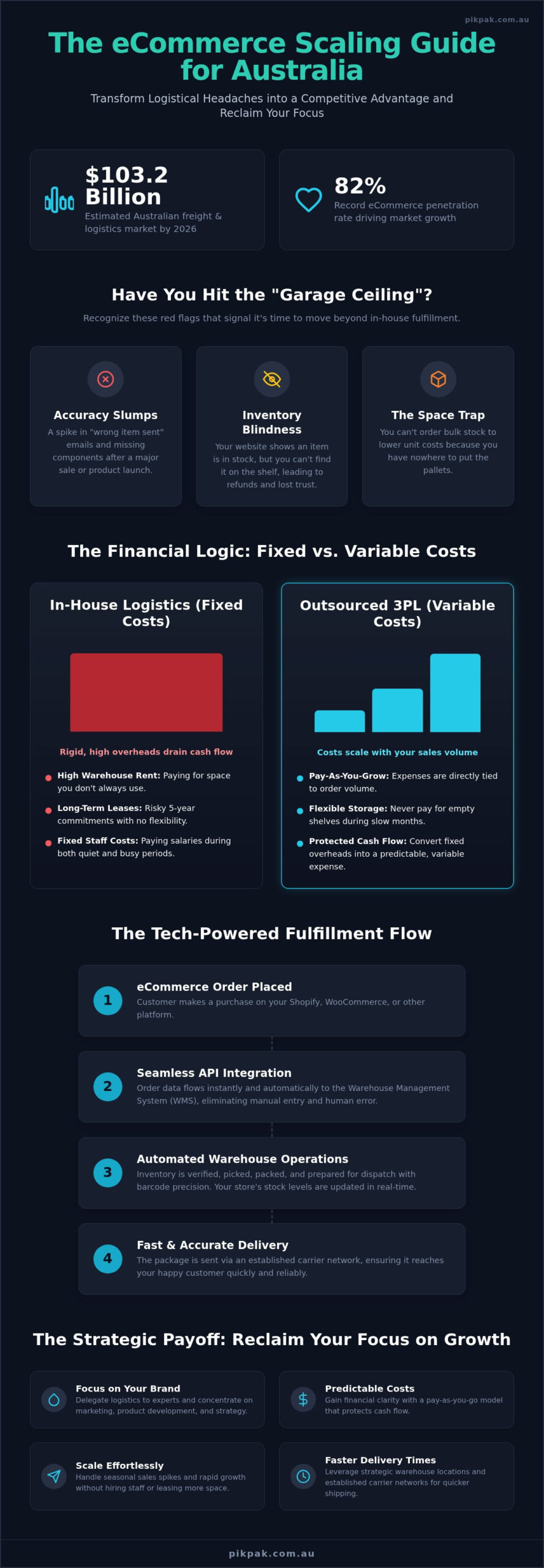
By 2026, the Australian freight and logistics market is estimated to reach $103.2 billion, driven by a record 82% eCommerce penetration rate. It is a massive opportunity for growth, but for many business owners, scaling feels more like a burden than a win. You are likely tired of juggling high warehouse rents, restrictive long-term lease commitments, and the constant fear of overselling because your inventory data doesn’t match your online store. These operational hurdles don’t just cost money; they steal the time you should be spending on marketing and product development.
This growth guide reveals how to transform these logistical headaches into a competitive advantage. By moving to a professional model of outsourced warehousing and shipping in Australia, you can eliminate friction and reclaim control over your schedule. We will break down how modern 3PL solutions provide the real-time visibility and seamless tech integration you need to scale effortlessly. You’ll learn how to transition from fixed overheads to a flexible, tech-driven strategy that ensures faster delivery times and predictable costs through 2026 and beyond. It is time to delegate the heavy lifting to the experts so you can focus on building your brand.
Key Takeaways
- Identify the “garage ceiling” and other physical bottlenecks that signal it is time to move beyond in-house fulfillment.
- Understand how API-driven integrations between your eCommerce store and a WMS eliminate manual data entry and inventory errors.
- Learn the financial logic of switching to outsourced warehousing and shipping in Australia to convert fixed lease costs into a flexible, variable expense.
- Discover why location strategy in major hubs like Sydney or Melbourne is essential for achieving faster, more predictable delivery times.
- Reclaim your focus for high-level marketing and product development by delegating complex logistics to a seasoned fulfillment partner.
The Logistics Bottleneck: When to Outsource in Australia
Every eCommerce founder eventually hits the “garage ceiling”. It is that frustrating moment when your spare room, hallway, and dining table are buried under inventory and packing tape. While DIY fulfillment works in the early days, it quickly becomes a bottleneck that prevents you from scaling. As customer expectations for delivery speed intensify, the pressure to maintain accuracy while managing your own stock becomes a major distraction from your core business goals. If you are spending your evenings packing boxes instead of refining your marketing strategy, you aren’t running a business; you are running a warehouse.
The risks of staying in-house are growing as the market evolves. Commercial warehouse space remains at a premium, and locking yourself into a five-year commitment for a fixed space is a massive gamble when your order volume fluctuates. Adopting outsourced warehousing and shipping australia allows you to trade these rigid overheads for a flexible, pay-as-you-grow model that protects your cash flow. This shift ensures you are never paying for empty shelf space during quiet months or scrambling for room during a sudden sales spike.
Signs Your Business Has Outgrown In-House Logistics
Recognizing the tipping point is crucial for survival. You don’t want to wait until your customer service is underwater before making a move. Look for these clear red flags:
- Accuracy Slumps: You notice a spike in “wrong item sent” emails or missing components after a major sale or product launch.
- Inventory Blindness: Your website says an item is in stock, but you can’t find it on the shelf, leading to awkward refund conversations and lost trust.
- The Space Trap: You want to order bulk stock to lower your unit costs, but you have nowhere to put the pallets, forcing you to buy in smaller, more expensive quantities.
The Strategic Shift to Third-Party Logistics (3PL)
Transitioning to third-party logistics (3PL) is more than just a storage move; it’s a strategic pivot. It shifts your focus from operational chores to brand growth. By leveraging outsourced warehousing and shipping australia, you gain instant access to established carrier networks and sophisticated technology that would be too expensive to build or manage yourself.
Professional providers like Pik Pak Logistics offer a warehousing and fulfilment solution that scales with your sales volume. Instead of worrying about hiring and training casual staff during the Christmas rush, you rely on a partner with the infrastructure already in place. A move to outsourced warehousing and shipping australia provides the operational stability you need to focus on high-level strategy. Pik Pak Logistics acts as your seasoned partner, ensuring that as your orders grow, your stress levels don’t grow with them.
How Outsourced Warehousing Works: The Tech Behind the Box
The technical framework of outsourced warehousing and shipping australia is what makes modern eCommerce possible. It starts with a “digital handshake” where your store connects via API to a Warehouse Management System (WMS). Pik Pak Logistics ensures this integration is effortless, allowing every order to flow directly to the warehouse floor without manual intervention. This removes the need for manual data entry and effectively eliminates the risk of human error during high-volume periods.
When stock arrives at the facility, it undergoes a rigorous verification process. Each item is assigned a specific location using barcode scanning to ensure absolute precision. In 2026, automation is the standard for outsourced warehousing and shipping australia, starting the moment a pallet hits the dock. This level of accuracy allows you to scale confidently, knowing that your digital inventory matches the physical reality on the shelves. It provides a foundation of trust between your brand and your customers.
The Role of a Cloud-Based Warehouse Management System (WMS)
A cloud-based WMS provides real-time sync across major platforms like Shopify, WooCommerce, and eBay. Visibility is the engine behind outsourced warehousing and shipping australia, ensuring your store never over-promises on stock levels. By using advanced technology support, you gain precision that manual spreadsheets simply cannot match. Following standards from the Australasian Supply Chain & Logistics Association, Pik Pak Logistics ensures their systems offer the transparency required for rapid business growth.
Value-Added Services: Kitting and Assembly
Promotional bundles and subscription boxes require more than just basic storage. Kitting and assembly services allow Pik Pak Logistics to assemble gift sets or apply custom labels based on your specific marketing needs. This flexibility lets you launch new campaigns without the operational headache of physical assembly. Additionally, we manage reverse logistics, processing returns efficiently so that sellable items are back in stock quickly. By choosing outsourced warehousing and shipping australia, you aren’t just buying space; you are buying a tech-driven workflow designed for speed. Explore our full range of integrated logistics services to see how we simplify these complex steps.
Fixed vs. Variable Costs: The Financial Logic of 3PL
Running your own warehouse is often more expensive than it looks on a spreadsheet. Most business owners focus on the monthly rent, but the true cost of in-house fulfillment includes a long list of hidden overheads that erode your margins. By switching to outsourced warehousing and shipping in Australia, you move from a fixed cost structure to a variable one. It means your expenses align perfectly with your sales volume. You pay more when you sell more, and your costs drop during quieter months.
The 2026 Australian labor market presents a specific challenge. With rising wages and updated compliance requirements, managing a dedicated warehouse team is a significant financial commitment. Outsourcing mitigates this risk. You also benefit from the collective buying power of a 3PL. Because professional providers ship thousands of orders daily, they access bulk freight rates that are simply unavailable to individual small businesses. These savings often offset a large portion of the service fees.
In-House Warehouse Expenses You Might Be Overlooking
Managing a physical space involves constant “leakage” of capital. Beyond rent, you’re responsible for several ongoing costs that add up quickly:
- Warehouse insurance, security system maintenance, and escalating utility bills.
- Packaging materials, tape, and the depreciation of equipment like forklifts and scanners.
- WorkCover premiums and payroll tax for dedicated warehouse staff, which are particularly volatile in 2026.
The 3PL Fee Structure Explained
A transparent fee structure is the foundation of a healthy partnership. Instead of a massive monthly lease, you typically encounter two main categories of costs:
- Storage Fees: You only pay for the specific pallet spaces or shelf units your inventory occupies.
- Transaction Fees: These are the “pick and pack” costs charged per order, ensuring you only pay for the work actually performed.
If you have specific concerns about how these costs compare to your current setup, our warehousing questions page provides deeper clarity on what to expect. This model eliminates the risk of long-term commercial lease liabilities. It allows you to scale up or down without the threat of a heavy financial anchor dragging on your growth.
Critical Selection Criteria for Australian 3PL Partners
Selecting a partner for outsourced warehousing and shipping australia is a decision that defines your customer experience. While the previous sections detailed the technical and financial benefits of the 3PL model, the physical location of your partner is just as critical. A provider with hubs in Melbourne or Sydney ensures your stock is closest to the highest density of Australian consumers. This strategic placement reduces transit times and shipping costs, which are the two biggest factors in cart abandonment. If your partner is too far from these major population centers, your brand will struggle to compete on delivery speed.
You must also evaluate how a provider handles pressure. A reliable partner like Pik Pak Logistics must prove they can manage a 10x surge in volume during peak sales events like Black Friday or Cyber Monday without compromising accuracy. Transparency is the key here; you shouldn’t have to wait for a monthly report to know your order status. You need a partner that offers an open window into their operations, allowing you to monitor real-time performance and inventory health. If you can’t see what is happening on the warehouse floor, you lack the control needed to scale effectively.
Evaluating Shipping and Delivery Networks
A robust delivery network goes beyond just having a contract with a single courier. You need a partner that offers diverse customer delivery options, including direct freight for larger items and reliable reach into regional and rural Australia. This diversity ensures that your brand remains accessible to all Australians, regardless of their postcode. Ask potential partners about their carrier mix; a multi-carrier approach protects your business from delays if one specific courier network becomes overwhelmed during peak seasons.
Service Level Agreements (SLAs) and Accuracy
Precision is the only metric that truly matters in fulfillment. When vetting Pik Pak Logistics or any other provider, interrogate their Service Level Agreements (SLAs) for picking accuracy and dispatch times. An industry-leading dispatch cut-off, such as 1:00 PM or 2:00 PM, is essential for meeting modern consumer expectations for same-day processing. Furthermore, ensure you have access to dedicated account support rather than a generic support ticket system. You need to know that if an urgent inventory query arises, you have a direct line to someone who understands your business. Ready to see how a professional network can transform your business? Contact Pik Pak Logistics today to discuss a tailored logistics strategy for your brand.
Scaling Effortlessly with Pik Pak’s Australian Fulfillment Network
2026 is a defining year for Australian eCommerce. With penetration rates holding at record highs, the gap between businesses that scale and those that stagnate is defined by operational efficiency. You can’t grow a brand if your head is stuck in a shipping carton. Choosing outsourced warehousing and shipping in Australia isn’t just about moving inventory; it’s about reclaiming your time. Pik Pak provides the infrastructure and expertise to turn your logistics from a source of stress into a silent, high-performing engine.
Our workflow is designed for total simplicity. It begins with a digital handshake between your store and our WMS, ensuring every order flows through without manual intervention. From there, our team handles the heavy lifting of receiving, storage, and precise pick and pack. This seamless transition from your online checkout to the customer’s doorstep means you stop managing boxes and start growing your brand. We’ve built a system that removes the operational friction that usually slows down growing businesses.
Why Pik Pak is the Strategic Choice for AU Brands
Our facilities are built specifically for the fast-moving world of eCommerce. We don’t just store products; we optimize their movement. If your marketing strategy includes promotional bundles or subscription boxes, our expertise in kitting and assembly ensures these complex projects are executed perfectly. We prioritize accuracy and speed because we know your reputation depends on them. You can learn more about how we align our operations with your business goals by reviewing our service priorities.
Next Steps: Transitioning to Outsourced Fulfillment
Moving your logistics to a 3PL shouldn’t be a painful process. Our onboarding team guides you through every step, from initial setup to live shipping. You can set up your first API integration in minutes, not days. This “plug and play” approach ensures there is zero downtime for your store during the transition. If you are ready to eliminate operational friction and focus on your core objectives, the path forward is clear. Request a tailored logistics quote from Pik Pak and discover how effortless scaling can be.
Future-Proof Your Logistics Strategy for 2026
Transitioning to a professional logistics model is the most effective way to protect your margins and your sanity. By converting rigid warehouse leases into a flexible, pay-as-you-grow system, you ensure your business remains agile as the Australian market continues to evolve. You now understand how real-time cloud WMS visibility and seamless Shopify and WooCommerce integrations eliminate the operational friction that causes overselling and customer frustration.
Making the strategic switch to outsourced warehousing and shipping australia allows you to delegate the heavy lifting to a seasoned partner. Whether you require expert kitting and assembly services or a high-speed national delivery network, the infrastructure is ready to support your next stage of growth. It’s time to stop managing boxes and start focusing on your core brand objectives. You’ve built the product; now let a professional team handle the delivery.
Get an Instant Quote for Your Australian Fulfillment Needs
Your business deserves a partner that handles the complexity so you can enjoy the results. Reclaim your time and scale with confidence.
Frequently Asked Questions
How much does it cost to outsource warehousing in Australia?
Costs typically follow a “pay-as-you-grow” structure, consisting of receiving fees, storage fees per pallet or shelf, and pick-and-pack charges per order. While specific rates vary based on your product dimensions and volume, most businesses find that outsourced warehousing and shipping in Australia is more cost-effective than a commercial lease. It transforms your logistics into a scalable expense that aligns perfectly with your monthly sales revenue without the burden of long-term financial liabilities.
Is outsourced shipping faster than doing it in-house?
Yes, professional 3PLs often achieve faster delivery times by utilizing optimized warehouse locations and high-volume carrier partnerships. Because facilities are strategically placed near major hubs like Sydney or Melbourne, the “last mile” delivery is significantly shorter for most customers. Automated systems also ensure that orders are processed and dispatched within hours of being placed, often beating the manual processing speeds of a small in-house team that might be overwhelmed during peak periods.
Can I still use my own custom branded packaging with a 3PL?
You can absolutely maintain your brand identity while using outsourced warehousing and shipping in Australia. Most providers allow you to supply your own custom boxes, mailers, and tissue paper to ensure a premium unboxing experience. The warehouse team follows your specific packing guidelines to maintain consistency across every order. This allows you to delegate the physical labor without sacrificing the personal touch that builds customer loyalty and keeps your brand’s aesthetic front and center.
How does a 3PL handle customer returns and exchanges?
Returns management, or reverse logistics, is a standard service provided by professional 3PLs. When a customer returns an item, it’s sent directly to the warehouse where the team inspects it for damage according to your criteria. If the item is in sellable condition, it’s processed back into your inventory and updated in your WMS immediately. This streamlined workflow ensures that returns are handled quickly, keeping your customers happy and your stock levels accurate without manual intervention.
What is the minimum order volume required to work with a 3PL?
Minimum volume requirements vary between providers, but many 3PLs are designed to support growing businesses at various stages. Some specialize in high-volume enterprise accounts, while others have flexible models that accommodate smaller brands looking to scale. The best approach is to discuss your current monthly order volume and growth projections with a potential partner. They can then determine if their infrastructure and fee structure are the right fit for your current operational needs and budget.
How do I track my inventory levels in real-time when it is in an outsourced warehouse?
You track your inventory through a cloud-based Warehouse Management System (WMS) that integrates directly with your online store. Every time an order is picked or new stock is received, the digital records update instantly across all your sales channels. This real-time visibility ensures you always know exactly what is on the shelf, preventing overselling and allowing you to make data-driven decisions about when to reorder stock from your manufacturers or suppliers.
What happens if a 3PL makes a mistake in an order?
Professional providers operate under strict Service Level Agreements (SLAs) that define acceptable accuracy rates. If a mistake occurs, such as a wrong item being sent, the 3PL typically has a clear process for rectifying the error at their expense. This often includes covering the return shipping and the cost of resending the correct item. High-quality partners use barcode scanning and automated verification to keep these errors extremely rare, often achieving accuracy rates above 99.5 percent.
How long does it take to set up an outsourced warehousing solution?
The setup process is surprisingly fast, often taking between one and two weeks depending on the complexity of your inventory. Once you’ve selected a partner, the main steps involve integrating your eCommerce platform via API and shipping your initial stock to the warehouse. Professional teams guide you through this onboarding phase to ensure your digital store and physical inventory are perfectly synced. This allows you to start shipping orders almost immediately after your stock arrives at the facility.