
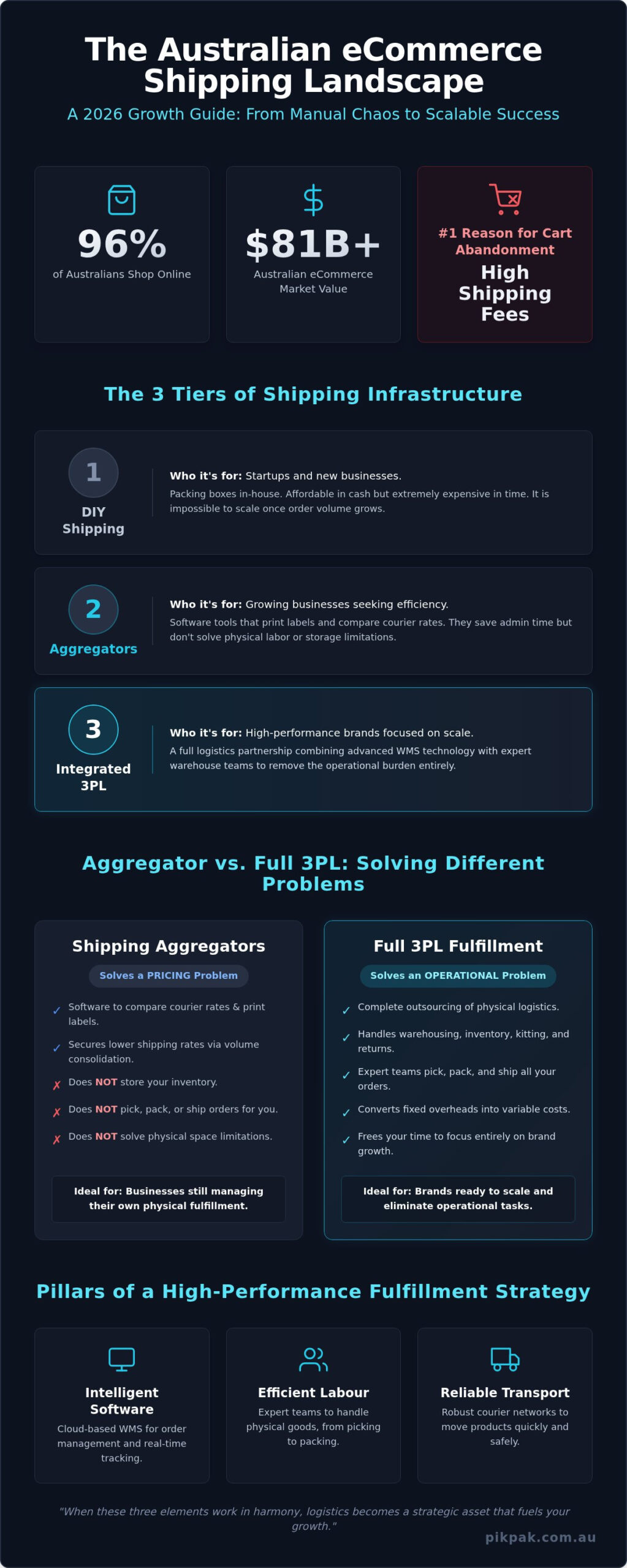
Did you know that 96% of Australians now shop online, yet high shipping fees remain the primary reason for cart abandonment? It’s a frustrating reality for many business owners who find themselves trapped between rising costs and the physical limits of their own warehouse space. You likely feel the weight of manual order processing and the constant struggle to keep up with customer expectations for fast, reliable delivery. Managing eCommerce shipping solutions Australia wide shouldn’t feel like a barrier to your success. It should be the engine that drives it.
We understand that your time is better spent on brand strategy than on printing labels. This 2026 growth guide will show you how to streamline your logistics and reduce overheads by leveraging the right mix of technology and 3PL expertise. You’ll discover how to automate your entire fulfilment process, from real-time tracking to seamless returns management. We’ll walk through the specific steps to transition from manual chaos to a scalable logistics partnership that grows with you, ensuring your customers get their orders faster while you regain total control over your business growth.
Key Takeaways
- Adapt to the “Amazon effect” by understanding why Australian consumers now demand faster, more transparent delivery options than ever before.
- Evaluate the true cost-benefit of software aggregators versus full-service eCommerce shipping solutions Australia to find the right fit for your store’s growth.
- Master the use of cloud-based Warehouse Management Systems (WMS) to eliminate manual errors, prevent stock-outs, and provide real-time tracking for your customers.
- Use our checklist to select a 3PL partner that supports your brand’s unique identity with flexible kitting and custom packaging options.
- Learn how to reclaim your time by delegating the physical “Pick, Pack, and Ship” process to a scalable logistics expert focused on your success.
The Landscape of eCommerce Shipping Solutions in Australia (2026)
The Australian digital marketplace has reached a level of maturity where growth now depends on operational precision rather than just acquiring new users. With the market valued at over $81 billion, the competition for eCommerce in Australia is fierce. Choosing the right eCommerce shipping solutions Australia offers is no longer a back-office task; it’s a front-line competitive strategy that determines whether a customer returns or disappears after their first click.
Global giants like Amazon and Temu have fundamentally altered consumer patience. Shoppers now expect the same level of speed and transparency from local boutique brands that they get from international marketplaces. This “Amazon Effect” means that if you can’t provide clear delivery windows and fast fulfilment, your customers will simply look elsewhere. You aren’t just competing with the shop down the street; you’re competing with the logistics standards of global leaders.
A modern shipping solution rests on three essential pillars: intelligent software to manage orders, efficient labour to handle the physical goods, and reliable transport networks to move them. When these three elements work in harmony, logistics becomes a strategic asset that fuels your growth instead of a business expense that drains your margins. It’s about moving from a reactive state to a proactive model where your operations are as polished as your marketing.
Consumer Expectations and the Cost of Inaction
High shipping costs remain the primary reason Australian shoppers abandon their carts. Today’s consumers demand “Day Definite” delivery, where they know exactly when a parcel will arrive, not just a vague range. Shipping friction is the total sum of operational delays and hidden costs that prevent a customer from completing a purchase. If your checkout process feels slow, expensive, or lacks real-time tracking, you’re actively losing revenue to more efficient competitors who have prioritised their logistics infrastructure.
The Three Tiers of Australian Shipping Infrastructure
Most businesses follow a predictable path as they scale their operations. Understanding where you sit helps you identify the right eCommerce shipping solutions Australia has available for your current stage.
- Tier 1: Manual/DIY Shipping. This is the startup phase. You’re likely packing boxes in a garage and driving to the post office. It’s affordable in terms of cash but expensive in terms of your time. It’s impossible to scale once you hit a certain order volume.
- Tier 2: Shipping Aggregators. These software tools help you print labels and compare courier rates. While they save time on administration, they don’t solve the problem of physical labour or storage space. You’re still the one packing the boxes.
- Tier 3: Integrated 3PL. This is where high-performance brands operate. By partnering with a third-party logistics provider, you combine advanced WMS technology with expert warehouse teams. This tier removes the operational burden entirely, allowing you to focus on scaling your brand.
Comparing Shipping Aggregators vs. Full 3PL Fulfillment
Many business owners mistake label-printing software for a complete logistics strategy. While both are technically eCommerce shipping solutions Australia provides, they solve fundamentally different problems. An aggregator solves a pricing problem; a 3PL solves an operational problem. Understanding where your business sits on this spectrum is the first step toward reclaiming your time and scaling your store.
DIY fulfilment often feels cheaper on paper, but it carries heavy hidden costs. You aren’t just paying for postage. You’re paying for warehouse rent, electricity, packing tape, and boxes. Most importantly, you’re paying with your own labour or the wages of staff who may not be fully utilised during slow periods. When you move to a professional partner, these fixed overheads become variable costs that only fluctuate with your sales volume.
Shipping Software: The Aggregator Model
Aggregators like Zappy or ShipStation are useful tools for startups. They work by consolidating shipping volumes from thousands of small users to secure lower courier rates than you could get on your own. This is a great way to reduce costs when you’re still packing boxes in your garage. However, the software has clear limits. It doesn’t store your inventory, it doesn’t kit your products, and it certainly won’t help you when you run out of physical space to grow. According to the Australian eCommerce market overview, businesses that rely solely on software often hit a “growth ceiling” where manual labour becomes their biggest bottleneck.
3PL Fulfillment: The Total Solution
A full-service logistics partner provides the physical backbone that software lacks. This model includes professional inventory storage and precise pick, pack, and ship services. If you’re still wondering what is 3PL?, think of it as an expert extension of your brand. It’s a “set and forget” system where orders from your store flow directly to a warehouse team who handles the physical work for you. This allows you to focus on high-level strategy while your logistics partner manages the daily grind of dispatch and returns. It’s the most effective way to ensure your eCommerce shipping solutions Australia wide remain consistent as you scale. If you’re ready to stop packing and start growing, exploring integrated fulfilment services is the logical next step for your brand.
The transition from a label printer to a warehouse partner usually happens when manual processing takes up more than 20% of your work week. At this point, the opportunity cost of your time far outweighs the service fees of a 3PL. Moving to an integrated model isn’t just about shipping boxes; it’s about building a scalable foundation for a multi-million dollar business.
The Anatomy of a High-Performance Fulfillment Strategy
A high-performance fulfilment strategy is the engine room of a successful online store. It’s not just about moving boxes from A to B. It’s an integrated system where technology, physical space, and transport networks work together to deliver a perfect customer experience. To build a scalable operation, you need a foundation that handles complexity without increasing your workload.
The brain of this operation is a cloud-based Warehouse Management System (WMS). This technology eliminates the guesswork by providing real-time visibility into your stock levels. When your inventory data is accurate, you prevent the dreaded “out of stock” notification at checkout, which is a major driver of cart abandonment. High-quality WMS access ensures that what your customer sees on the screen is exactly what is sitting on the warehouse shelf.
Technology Support and Store Integration
Automation is the key to reclaiming your time. Seamless Technology Support allows your e-storefront to communicate directly with the warehouse floor via API connectors. When an order is placed, the data flows instantly into the fulfilment queue. This removes manual data entry and ensures that your warehouse team starts picking and packing immediately. This level of integration provides the real-time data you need to make informed marketing decisions, such as which products to promote based on actual stock on hand.
Warehousing and Inventory Management
Your inventory is your most valuable asset. Storing it in a garage or a self-storage unit often leads to product damage, loss, and inefficient picking. Professional warehousing offers secure, state-of-the-art environments designed for speed and accuracy. To ensure your goods are processed and ready for sale quickly, it is vital to follow established Warehouse Receiving Guidelines. These standards ensure that your inventory is checked, logged, and shelved correctly the moment it arrives, reducing the time between a shipment landing and a product being available for purchase.
Beyond basic storage, a high-performance strategy includes value-added services like kitting and assembly. This allows you to create promotional bundles or gift sets without ever touching the product yourself. When combined with a multi-carrier network, your eCommerce shipping solutions Australia wide become incredibly resilient. You can choose the best carrier for each specific destination, ensuring that a customer in rural Western Australia receives their package as reliably as someone in Sydney. This flexibility is essential for navigating the unique geography of the Australian continent.
Key Criteria for Selecting an Australian Shipping Partner
Choosing between the various eCommerce shipping solutions Australia offers is a pivot point for your store. You aren’t just hiring a courier; you’re selecting a partner that represents your brand at the customer’s doorstep. A bad choice leads to late deliveries and damaged goods, while a great one allows you to scale without friction. To find the right fit, you need to look beyond the price per parcel and evaluate the physical and digital infrastructure of the provider.
Location is a critical factor in Australian logistics. Hubs based in Melbourne often provide superior national distribution due to their proximity to major freight routes and the Port of Melbourne, which is Australia’s largest container port. When vetting a partner, use this checklist to ensure they meet professional standards:
- Technology Integration: Do they offer seamless API connections to your specific eCommerce platform?
- Warehouse Standards: Is the facility secure, organised, and capable of handling your specific inventory type?
- Custom Branding: Can they use your branded boxes and inserts to maintain a premium unboxing experience?
- Account Support: Will you have a dedicated contact person or just an automated ticket system?
Many owners worry that outsourcing means losing their brand’s personal touch. This isn’t the case with a high-quality 3PL. You can maintain total brand control by using custom packaging and specific kitting instructions. The goal is to make the logistics invisible so the customer only sees your brand’s excellence. If you want to see how a professional team can help you maintain this control while you scale, contact our logistics experts for a tailored strategy.
Scalability and Service Priorities
Your logistics partner must be able to handle your quietest Tuesday and your busiest Black Friday with the same level of precision. A 10x surge in orders shouldn’t crash your system or delay your shipments. Look for partners that have clearly defined Service Priorities, such as guaranteed same-day dispatch for orders placed before a certain cutoff. This reliability builds the trust necessary for long-term customer loyalty and ensures your brand reputation remains intact during peak seasons.
Managing the Returns Challenge
Reverse logistics is often the most neglected part of a shipping strategy. A clear returns process is a powerful sales tool; customers are more likely to buy when they know returning a product is easy. A professional 3PL manages this by inspecting returned items, checking for damage, and getting them back on the shelves faster than you could do manually. This efficiency protects your margins and keeps your inventory moving. For a deeper look at how this fits into the bigger picture of your business, check our Order Fulfilment Guide.
Scaling Your Store with Pik Pak Logistics’ End-to-End Solutions
Pik Pak Logistics serves as the seasoned, tech-savvy expert that growing Australian brands need to navigate the complexities of modern commerce. We don’t just provide warehouse space; we offer a comprehensive “Pick, Pack, and Ship” total solution designed to remove the physical friction from your daily operations. By delegating these operational burdens to a dedicated partner, you can finally reclaim your time and refocus on the core objectives that drive your revenue. It’s time to stop acting as a warehouse manager and start leading your business as a CEO again.
Our approach is built on precision and the elimination of inefficiency. We understand that as your store grows, the manual processes that once worked become your biggest bottleneck. We replace that chaos with a calm, supportive infrastructure that treats your inventory with the respect it deserves. Whether you are dealing with a sudden surge in orders or planning a complex promotional campaign, our team is equipped to handle the heavy lifting while you maintain total strategic control.
Effless Integration and Automation
Our cloud-based platform ensures that your transition to a professional 3PL is seamless and stress-free. We offer direct API integrations with major storefronts like Shopify and WooCommerce, allowing your orders to flow to our warehouse floor without a single manual step. In addition to logistics, building social proof is essential for scaling, and digitaljunction.com.au helps eCommerce businesses grow by strengthening their customer feedback and review strategies. This automation reduces the risk of human error and ensures that your customers receive their tracking information the moment a label is printed. We provide transparent pricing that eliminates the anxiety of hidden warehouse fees, allowing you to forecast your margins with precision. Pik Pak acts as an enabling force for your business growth by transforming complex logistical hurdles into simple, automated tasks.
Choosing a local Australian partner is vital for maintaining the speed and reliability your shoppers expect. Our national coverage ensures that your Customer Delivery standards remain high across the entire continent, regardless of where your customers live. We provide the physical backbone that allows your brand to compete with global giants on a level playing field. We handle the boxes; you grow the brand. This partnership gives you the freedom to scale without the fear of outgrowing your infrastructure or compromising your service quality.
Don’t let logistics hold your brand back. Reach out to our team at 1300 745 725 for expert advice tailored to your specific needs. If you are ready to simplify your eCommerce shipping solutions Australia wide and build a scalable foundation for the future, contact us today for a tailored logistics consultation. Let us show you how effortless your operations can be when you have the right partner by your side.
Take Control of Your Store’s Growth
Scaling an online business in 2026 requires moving beyond manual labels and crowded garages. By integrating a professional 3PL partner, you transform your logistics from a source of stress into a scalable engine for success. You’ve learned how a high-performance Warehouse Management System (WMS) prevents stock-outs and why seamless API connections are vital for automating your daily workflow. The right eCommerce shipping solutions Australia has to offer should empower you to reclaim your time and focus on your brand’s core mission.
Pik Pak Logistics provides the physical precision and tech-savvy support you need to meet modern consumer expectations. With our state-of-the-art WMS for real-time tracking, seamless platform integrations, and a dedicated Australian support team, we make your operations feel effortless. Ready to eliminate operational friction? Request a Tailored eCommerce Shipping Quote from Pik Pak Logistics today and start building a more resilient business. We’re here to help you grow with confidence.
Frequently Asked Questions
What is the best eCommerce shipping solution for a small business in Australia?
The best eCommerce shipping solutions Australia provides depend entirely on your current volume and growth goals. For startups, simple label-printing software might be enough, but for brands looking to scale, a full-service 3PL is the superior choice. It allows you to move beyond manual packing and limited storage space. By outsourcing your logistics, you gain access to professional warehouse teams and advanced technology that ensures your customers receive their orders quickly.
How much does it cost to outsource eCommerce shipping to a 3PL?
Outsourcing to a 3PL involves a mix of storage fees, pick and pack rates, and shipping costs. This model is highly effective because it turns fixed overheads, like warehouse rent and staff wages, into variable costs that only fluctuate with your sales volume. You only pay for the space you use and the orders we process. This pragmatic approach helps you manage your cash flow better while providing a professional delivery experience for your customers.
Can I integrate my Shopify store with an Australian fulfillment center?
Yes, you can easily integrate your Shopify store with a professional Australian fulfilment centre using API connectors. This automation ensures that as soon as a customer completes a purchase, the order data flows directly to the warehouse floor. It eliminates manual data entry and reduces the risk of errors. Once the order is packed, the system automatically updates the tracking information in your Shopify dashboard, keeping your customers informed without any extra work from you.
What is the difference between a shipping aggregator and a 3PL provider?
A shipping aggregator is essentially a software tool that helps you access better courier rates and print labels, but you still have to pack the boxes yourself. In contrast, a 3PL provider offers a total physical solution. This includes inventory storage, professional pick and pack services, and comprehensive returns management. While aggregators solve a pricing problem, a 3PL provides the robust eCommerce shipping solutions Australia wide that allow you to focus entirely on growth.
How does a 3PL handle customer returns and reverse logistics?
A 3PL manages the entire reverse logistics process to make returns effortless for both you and your customers. When a product is returned, the warehouse team inspects the item for damage, logs the reason for the return, and updates your inventory in real-time. If the item is in good condition, it’s quickly placed back on the shelf for resale. This efficient system protects your margins and ensures your stock levels remain accurate at all times.
Why should I choose a Melbourne-based logistics company for national shipping?
Melbourne is often considered the logistics capital of Australia due to its proximity to the Port of Melbourne and major national freight routes. Choosing a Melbourne-based partner allows for efficient distribution across the country, as goods can be moved quickly to both the eastern seaboard and western states. This central positioning helps reduce delivery times and provides a more reliable service for your customers, making it a strategic choice for national eCommerce brands.
Is it cheaper to use Australia Post or a 3PL for eCommerce orders?
Australia Post is a carrier, but a 3PL is a comprehensive logistics partner that manages the entire fulfilment process. While you can ship directly with Australia Post, a 3PL often provides better value by using a multi-carrier network to find the most cost-effective option for every parcel. This approach saves you money on the hidden costs of DIY fulfilment, such as warehouse rent, packing materials, and the significant time spent on manual labour.
What are pick and pack services, and do I need them?
Pick and pack services involve the physical process of retrieving individual items from warehouse shelves and packing them securely into boxes for delivery. You definitely need these services if your daily order volume is taking up too much of your time or if you’ve run out of storage space. Delegating this task to experts ensures that orders are fulfilled with high precision, allowing you to reclaim your day and focus on high-level business strategy.