

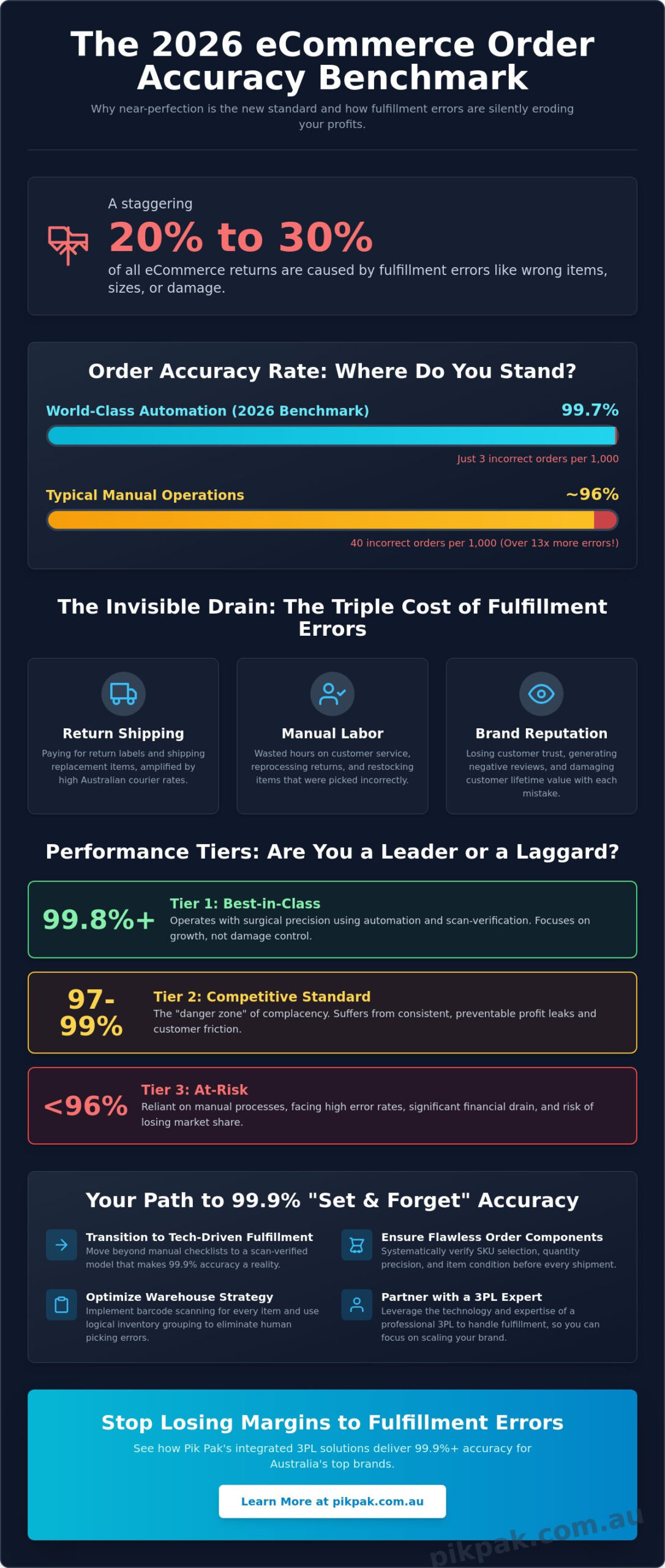
Approximately 20% to 30% of all eCommerce returns are caused by fulfillment errors such as the wrong item, size, or a damaged product. While manual operations often hover around 96%, the current 2026 order accuracy rate benchmark for automated, world-class facilities has climbed to a staggering 99.7%. If your business is stuck in the mid-nineties, you aren’t just losing customers; you’re losing significant margins to return shipping and manual labor costs.
It’s frustrating to waste hours fixing mistakes that should never have happened in the first place. You deserve a fulfillment process that runs reliably in the background so you can focus on scaling. This article breaks down the latest industry standards and shows you how to benchmark your performance against Australia’s top brands. You’ll learn how to achieve a 99%+ accuracy rate and transform your pick and pack process into a “set and forget” system that keeps your reviews positive and your customer service tickets low.
Key Takeaways
- Define what “perfect” fulfillment looks like in 2026 and why customer tolerance for shipping errors has reached an all-time low.
- Evaluate your current performance against the latest order accuracy rate benchmark to see if your brand is best-in-class or at risk.
- Uncover the hidden “Triple Cost” of fulfillment errors and how high Australian courier rates amplify the financial drain on your margins.
- Identify practical warehouse optimization strategies, such as barcode scanning and logical inventory grouping, to eliminate manual picking errors.
- Learn how to transition to a tech-driven, scan-verified fulfillment model that makes achieving 99.9% accuracy a “set and forget” reality.
What is Order Accuracy and Why Does it Matter in 2026?
In the high-stakes world of online retail, order accuracy represents the percentage of total orders that reach the customer exactly as intended: correct items, correct quantities, and in pristine condition. While it sounds simple, achieving a high What is Order Accuracy score is the difference between a thriving brand and one struggling with overheads. By 2026, the order accuracy rate benchmark for top-tier brands has shifted significantly. Customers no longer view a correct delivery as a “win.” They view it as the bare minimum requirement for their loyalty.
It’s vital to distinguish this metric from the “Perfect Order Rate.” While the latter is a broader KPI that includes on-time delivery and flawless billing, order accuracy is laser-focused on the physical pick and pack process. In 2026, customer patience for receiving the wrong item is at an all-time low. One mistake doesn’t just cost you a return; it often costs you the entire relationship. Accuracy isn’t just a warehouse metric to be buried in a spreadsheet. It’s a primary driver of long-term profitability and operational health.
The Components of a Flawless Order
Achieving a truly accurate order comes down to precision in three specific areas. First is correct SKU selection. In a warehouse with thousands of similar items, picking the wrong size or color is the most common pitfall. Second is quantity precision. Sending too many items bleeds your inventory dry, while sending too few triggers immediate customer service tickets. Finally, condition and packaging matter. If an item arrives damaged because of poor packing, it’s a failure. A correct item in a crushed box is still an inaccurate delivery in the eyes of the consumer. You can learn more about how we handle these standards in our warehousing and fulfilment overview.
The Link Between Accuracy and Customer Lifetime Value
Marketing costs continue to rise, so losing a customer over a preventable shipping error is a tragedy for your margins. Research indicates that approximately 20% to 30% of all eCommerce returns are caused by fulfillment errors. A single mistake can eliminate the chance of a second purchase for over half of your first-time buyers. In the age of TikTok and Instagram, the “wrong item” unboxing video has a ripple effect that can tarnish your brand’s reputation faster than any ad campaign can build it. When you stabilize your order accuracy rate benchmark, you protect your marketing investment. Order accuracy is the silent engine of eCommerce retention.
Order Accuracy Rate Benchmarks: Where Does Your Business Stand?
Benchmarking your performance isn’t just about spreadsheets; it’s about understanding your brand’s survival in a crowded market. In 2026, the order accuracy rate benchmark has stratified into three distinct tiers that separate the leaders from the laggards. While some older industry reports might suggest that 90% or 95% is acceptable, those numbers are disastrous for modern eCommerce. High customer expectations and rising logistics costs mean that anything less than near-perfection is a direct hit to your bottom line.
The “99% Rule” is now the standard for healthy businesses. If you ship 1,000 orders a month at a 98% accuracy rate, you are effectively sending out 20 “disappointment packages” every four weeks. In the Australian context, where shipping a replacement item from Sydney to Perth can cost more than the product’s profit margin, those 20 errors represent a massive financial drain. During peak seasons like Black Friday or Cyber Monday, these benchmarks often come under pressure. Best-in-class operators maintain their precision even when volumes triple, whereas unoptimized warehouses often see their accuracy plummet just when the stakes are highest.
Tier 1: Best-in-Class (99.8% – 99.9%)
Top-tier performers operate with surgical precision. These brands have moved beyond manual checklists and rely on automated barcode scanning and professional 3PL partners to eliminate human error. By hitting these numbers, you virtually eliminate “where is my order” (WISMO) tickets related to wrong items. This allows your team to focus on growth rather than damage control. Achieving this level of excellence requires a robust system for warehousing and fulfilment that prioritizes technology over guesswork.
Tier 2: Competitive Standard (97% – 99%)
This is the danger zone of complacency. Many Australian brands sit at 98% and feel “okay” because the majority of customers are happy. However, this tier still suffers from consistent, preventable leaks in profitability. Common bottlenecks include grouping similar-looking items too close together or relying on “tribal knowledge” instead of digital workflows. If you find yourself stuck in this bracket, it might be time to audit your current logistics services to identify where the friction lies. Moving from 98% to 99.9% doesn’t just improve your stats; it fundamentally changes your customer’s perception of your brand’s reliability.
Industry-specific nuances do play a small role. For example, a fashion brand with 500 SKUs across varying sizes and colors faces more complexity than an electronics retailer selling five distinct products. Regardless of your niche, the goal remains the same: making the warehouse process so reliable it becomes “set and forget.”
The Invisible Drain: The High Cost of Fulfilment Errors in Australia
Falling below the recommended order accuracy rate benchmark doesn’t just annoy customers; it imposes a literal tax on your growth. When a picker grabs the wrong SKU, the financial damage ripples through your entire operation. This “Triple Cost” includes the loss of the initial shipping fee, the expense of the return labels, and the labor cost of your customer service team. In the Australian context, these errors are particularly punishing. High courier rates for cross-state deliveries, such as shipping from Perth to Sydney, mean that a single mistake can be twice as expensive as it would be in smaller, more densely populated markets.
Beyond the shipping labels, there’s the “Inventory Ghost” to consider. Every pick error creates two data inaccuracies. Your system thinks an item was sold when it’s actually still on the shelf, and it thinks another item is in stock when it’s actually in a customer’s hands. This leads to phantom stock and the nightmare of overselling. For founders, the emotional cost is just as high. Spending your mornings answering angry emails and manually fixing shipping labels leads to burnout. It pulls your focus away from strategy and keeps you trapped in the “stress of the mess” instead of scaling your brand.
Calculating Your Own “Error Tax”
To understand the true impact, you need to look beyond the surface. A pragmatic framework for calculating your error tax includes the cost of the replacement packaging, the labor for re-packing, and the value of “unsellable” stock that returns damaged. Statistics show that customer service resolutions for shipping errors average 8 to 12 minutes of labor per ticket. When you add up the lost time and the physical costs, the math is clear. The cost of an error is often 3x the original shipping cost.
- Forward Shipping: The initial investment that yielded zero return.
- Reverse Logistics: The high cost of bringing the wrong item back to the warehouse.
- Restocking Labor: The time spent inspecting and re-shelving returned goods.
- Opportunity Cost: The marketing dollars wasted on a customer who likely won’t return.
The Reputation Tax: Beyond the Balance Sheet
In 2026, your performance on marketplaces like Amazon Australia and eBay is tied directly to your accuracy. These platforms use your shipping data to determine your search ranking. If your error rate spikes, your visibility drops. In extreme cases, a low order accuracy rate benchmark can lead to account suspension, cutting off your revenue overnight. Protecting your brand requires a reliable partner. Exploring professional Pik Pak Logistics Services can help you reclaim your time and eliminate these invisible drains on your profitability.
5 Proven Strategies to Boost Your Order Accuracy Rate
Closing the gap between your current stats and the 2026 order accuracy rate benchmark requires more than just telling staff to work harder. It requires a resilient system that removes the possibility of human error. When you shift from manual “eye-balling” to tech-enforced workflows, you transform your warehouse from a source of stress into a competitive advantage. Maintaining a competitive order accuracy rate benchmark is about building a scalable foundation that doesn’t break when your order volume doubles.
- Implement Barcode Scanning: This is the single most effective way to end manual errors. If the scanner doesn’t beep, the item doesn’t go in the box. It’s that simple.
- Optimise Warehouse Layout: Never group similar-looking items together. Space out variations in size or color to prevent pickers from grabbing the wrong SKU by mistake.
- Double-Verification Packing: Add a second scan at the packing station. This ensures that what was picked actually matches the customer’s order before the box is sealed.
- Real-Time Inventory Syncing: Automated syncing prevents the “out of stock” error that ruins customer trust and creates manual work for your support team.
- Outsource to a Specialized 3PL: Leverage existing high-tier infrastructure. A professional partner already has the tech and the team to hit 99.9% accuracy from day one.
Leveraging Technology Without the Capital Expense
Large enterprises spend millions on proprietary software, but growing brands don’t have to. Cloud-based WMS platforms now provide elite accuracy levels through accessible models. By using API integrations, you eliminate manual data entry, which is a common source of shipping errors. Our Technology Support for Logistics gives you these tools without the heavy lifting. You get the benefit of high-end automation while keeping your capital free for marketing and product development.
Standard Operating Procedures (SOPs) for Pick and Pack
A “Zero-Error” culture starts the moment stock arrives. If your inventory is logged incorrectly at the start, every subsequent step will be flawed. Following clear Warehouse Receiving Guidelines ensures that your accuracy starts at the door. For seasonal staff, use simple training hacks like color-coded bin labels or digital pick-paths. These small adjustments make the process intuitive, even for someone on their first day. It’s about making the right way the easiest way.
Ready to stop managing the mess and start growing your brand? Explore how our Pick, Pack, and Ship Services can automate your accuracy today.
Achieving 99.9% Accuracy with Pik Pak’s Integrated 3PL Solutions
Reaching the top-tier order accuracy rate benchmark requires more than just a barcode scanner; it requires a culture of precision. At Pik Pak, we take the “stress of the mess” off your hands by providing a fulfillment system that’s built for speed and engineered for accuracy. Our process isn’t just about moving boxes. It’s a tech-driven workflow where every item is scan-verified at multiple stages and human-checked by a team that treats your inventory like their own. By delegating your operations to a Tier 1 provider, you stop being a warehouse manager and start being a brand owner again.
Being based in Melbourne gives us a strategic advantage for national distribution. We can reach major hubs across Australia efficiently, ensuring that your near-perfect accuracy is matched by reliable delivery times. When you partner with us, you aren’t just outsourcing a task. You’re gaining an enabling force that removes the operational hurdles preventing your growth. We’ve designed our systems to be “set and forget,” giving you the freedom to focus on marketing, product development, and scaling your business.
Why Our 3PL Warehouse Outperforms In-House Fulfilment
Most small to medium eCommerce brands struggle to hit the 99.9% order accuracy rate benchmark because the capital expense for enterprise-level tools is too high. Our facility gives you immediate access to high-speed sorters and an advanced WMS that provides real-time visibility. Unlike in-house teams that might be juggling multiple roles, our dedicated staff focuses on accuracy as their primary KPI. This specialization ensures that errors are caught before the parcel ever leaves the dock. You can explore our full range of Warehousing and Fulfilment Solutions to see how we maintain these standards.
Ready to Scale Without the Shipping Headaches?
Transitioning from a garage or a small, manual warehouse to a professional 3PL is a major milestone for any brand. We make this move seamless by integrating directly with your store. You’ll gain the peace of mind that comes with knowing every order is 99.9% likely to be perfect, which drastically reduces your customer service burden. It’s time to reclaim your schedule and stop fixing shipping errors. Take the first step toward a more efficient operation and Request a Quote from Pik Pak Logistics Today.
Master Your Logistics and Reclaim Your Time
Navigating the complexities of eCommerce in 2026 requires a shift from reactive fixes to proactive systems. We’ve seen how falling behind the order accuracy rate benchmark leads to an “invisible tax” on your profits through high return costs and customer churn. Achieving a 99%+ accuracy rate isn’t just a goal; it’s the foundation for scaling without the constant friction of shipping errors. By implementing tech-enforced workflows and logical warehouse layouts, you move from managing chaos to driving growth.
You don’t have to build this infrastructure alone. Pik Pak offers a Tier 1 fulfillment solution with a 99.9% order accuracy rate and real-time WMS visibility. Our systems provide seamless Shopify and WooCommerce integration, allowing you to delegate the operational burden and focus on what you do best. It’s time to stop answering “wrong item” emails and start building your brand’s future.
Eliminate shipping errors and scale your brand with Pik Pak Logistics
Your business deserves a fulfillment partner that values precision as much as you do. Let’s make your logistics effortless.
Common Questions About eCommerce Order Accuracy
What is a good order accuracy rate for eCommerce in 2026?
A competitive order accuracy rate benchmark for 2026 is 99.5% or higher. While manual operations often struggle to stay between 96% and 98%, automated facilities using barcode scanning regularly hit 99.9%. If you fall below these levels, you’re likely losing substantial margins to returns and customer service overhead. Aiming for world-class performance means keeping your error rate below 0.3%.
How do you calculate the order accuracy rate formula?
To calculate your rate, divide the number of accurately fulfilled orders by the total number of orders shipped, then multiply by 100. For a precise result, ensure your definition of an “error” includes wrong items, incorrect quantities, and damaged goods. Tracking this monthly helps you identify if you’re meeting the current order accuracy rate benchmark or if your warehouse processes require a digital overhaul.
What are the most common causes of shipping errors in online stores?
Most errors stem from human picking mistakes, such as grabbing a similar-looking SKU or the wrong size variant. Inadequate warehouse labeling and manual data entry also play major roles. When staff rely on memory rather than scan-verification, the risk of “double-shipping” or “short-shipping” increases significantly. These small lapses quickly add up to a high volume of preventable customer service tickets.
How can a 3PL improve my business’s order accuracy?
A professional 3PL uses advanced Warehouse Management Systems (WMS) and barcode scanning to eliminate the guesswork from fulfillment. By leveraging high-speed sorters and tech-driven pick paths, a 3PL can achieve precision levels that are difficult to reach in-house. This allows you to scale your brand without the capital expense of buying enterprise-grade technology or managing a growing warehouse team yourself.
What is the difference between order accuracy and perfect order rate?
Order accuracy measures whether the correct items were shipped in the right condition. Perfect order rate is a broader metric that includes on-time delivery, accurate invoicing, and flawless documentation. While accuracy is a physical warehouse KPI, the perfect order rate reflects your entire supply chain’s health. You should prioritize accuracy first, as physical errors are the most expensive and frustrating to fix.
How much does a shipping error actually cost an Australian business?
A single error typically costs an Australian business three times the original shipping fee. You lose the initial shipping cost, pay for the return leg, and then pay to ship the replacement. On top of that, resolving a shipping error takes an average of 8 to 12 minutes of customer service labor. In a high-cost market like Australia, these hidden expenses can easily wipe out the profit from multiple successful orders.
Can I achieve 100% order accuracy?
While 100% accuracy is the ideal, even the world’s most automated facilities consider 99.9% to be the peak of performance. Human error can never be entirely eliminated, but it can be minimized through technology and rigorous Standard Operating Procedures (SOPs). Focus on hitting the 99.7% to 99.9% range, as this level of precision makes errors so rare they won’t impact your brand’s growth or reputation.
Is barcode scanning necessary for small eCommerce businesses?
Yes, barcode scanning is essential for any business that wants to remain competitive in 2026. Relying on “eye-balling” items leads to a higher error rate that small brands simply can’t afford. Modern, cloud-based scanning tools are now affordable for smaller operations. Implementing these systems early prevents the “stress of the mess” and ensures your fulfillment process is ready to handle sudden spikes in order volume.