

What if the secret to doubling your growth isn’t a bigger ad budget, but finally cracking the code on your warehouse operations? For many business owners, logistics feels like a black box that swallows profits and generates constant customer complaints. With eCommerce now accounting for 16.9% of all retail sales, you can’t afford to guess about your performance. Identifying and tracking the right key metrics for fulfillment success is the only way to move from reactive firefighting to proactive scaling.
It’s frustrating to deal with shipping delays or inventory discrepancies that result in embarrassing stockouts. These challenges are even more complex in 2026 with new regulations like the mandatory CPSC electronic filing and the permanent suspension of de minimis duty-free shipping. This guide will give you back your time and your confidence. You’ll get a clear checklist of essential KPIs and learn how to automate your logistics to eliminate operational friction. We’re breaking down complex supply chain data into simple, manageable tasks so you can stop worrying about the warehouse and start focusing on your core business objectives.
Key Takeaways
- Identify the “Perfect Order” rate as your primary goal to ensure every customer receives their package accurately and on time.
- Master the key metrics for fulfillment success to bridge the gap between your digital store and physical inventory levels.
- Learn how to monitor shipping costs per order to protect your margins while maintaining competitive delivery speeds.
- Discover how automation and real-time WMS dashboards remove the manual burden of logistics reporting.
- Shift your operational focus from manual tasks to a data-driven growth engine that supports rapid scaling.
Why Fulfillment Metrics are the Pulse of Your eCommerce Growth
Stop thinking of fulfillment as just “packing boxes.” In the high-stakes environment of 2026, your warehouse isn’t a storage unit; it’s your growth engine. When you treat logistics as a series of data points rather than a manual chore, you gain the clarity needed to scale. With U.S. eCommerce sales hitting $326.7 billion in the first quarter of 2026 alone, the sheer volume of orders makes “managing by feel” impossible. Tracking key metrics for fulfillment success allows you to move from reactive firefighting to proactive leadership. It’s about turning a chaotic back-office operation into a predictable, automated system that runs while you focus on your next big product launch.
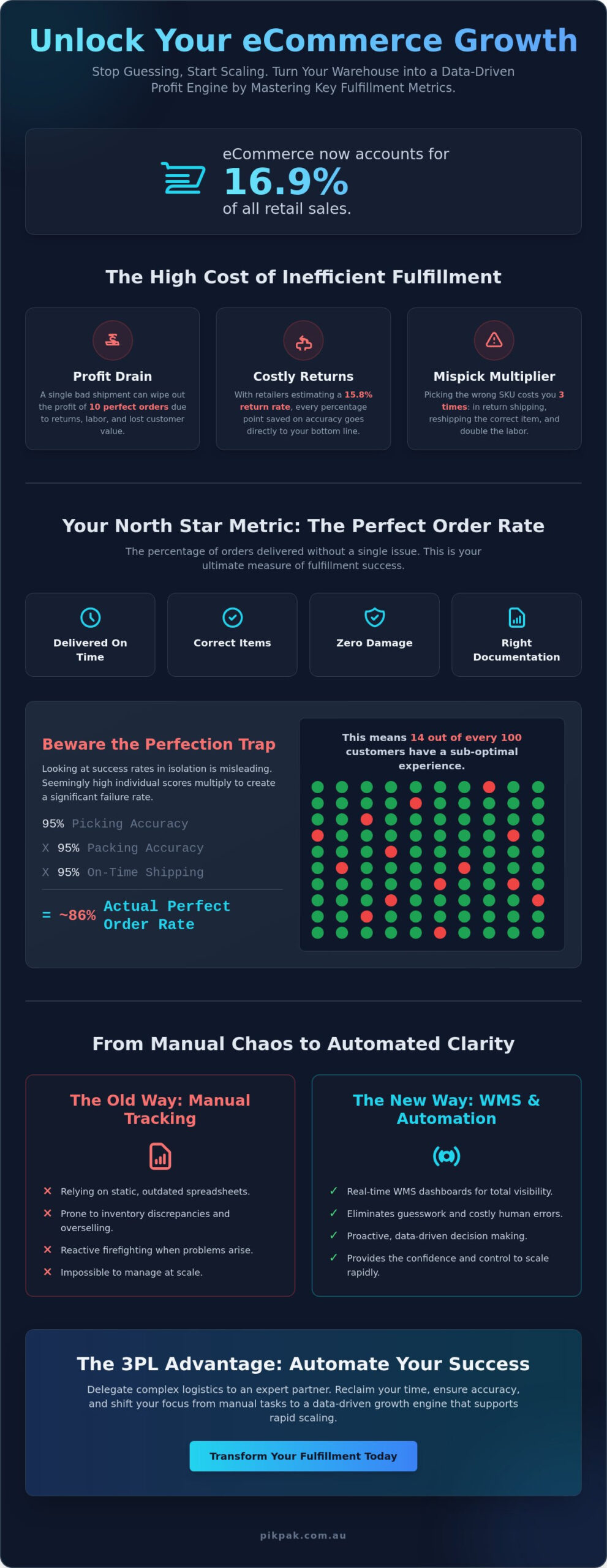
Data-driven fulfillment eliminates the guesswork that often leads to expensive mistakes. Consider the cost of “invisible” errors. A single bad shipment isn’t just a lost sale; it’s a drain on your resources. Between the cost of shipping the item back, the labor required for returns management, and the potential loss of a customer’s lifetime value, one mistake can wipe out the profit of ten perfect orders. Since retailers estimated a 15.8% return rate for annual sales recently, every percentage point you can shave off through better accuracy goes directly to your bottom line. Metrics aren’t just warehouse reports; they are the tools that grant you the freedom to step away from the daily grind.
Moving Beyond Manual Tracking
Relying on spreadsheets to manage your inventory and shipping is a recipe for disaster in 2026. Static files can’t keep up with the fast-paced order fulfillment process, leading to inventory discrepancies and overselling. Real-time visibility is now non-negotiable for anyone serious about growth. When you utilize WMS platform access, you gain an immediate psychological benefit. There’s a profound sense of relief in knowing your operations are healthy without having to physically count every pallet. You can see your stock levels and order statuses at a glance, giving you total control over your business health.
The ROI of Fulfillment Accuracy
Calculating the true ROI of accuracy requires looking beyond the immediate pick fee. A mispick triggers a chain reaction of costs: extra postage, warehouse labor, and the high price of customer support time. Improving your key metrics for fulfillment success by even 1% can have a massive impact on your annual profitability. Precision in the warehouse translates to confidence in the market. Fulfillment speed is the direct bridge to customer retention, as every hour saved in the warehouse builds trust at the doorstep. By delegating these complex tasks to a partner who prioritizes accuracy, you reclaim your time and ensure your brand reputation remains spotless.
The ‘Perfect Order’ Rate: Your North Star for Fulfillment Success
If you only track one number this year, make it the Perfect Order Rate. This metric represents the percentage of your orders that meet every delivery requirement without a single hitch. To understand What is Order Fulfilment? in a modern context, you must view it through the lens of total precision. A perfect order is defined by four non-negotiable pillars: it must be delivered on time, arrive with the correct items, sustain zero damage, and include the right documentation. While these seem like basic expectations, they are the key metrics for fulfillment success that separate high-growth brands from those struggling with high churn.
Many business owners fall into a dangerous math trap by looking at these pillars in isolation. If your warehouse achieves a 95% success rate in picking, a 95% rate in packing, and a 95% rate in on-time shipping, you might think you’re doing well. In reality, your overall Perfect Order Rate would be roughly 85%. That means 15 out of every 100 customers are having a sub-optimal experience. The International Trade Administration highlights that monitoring eCommerce Key Performance Indicators is essential for international competitiveness, especially as global trade rules tighten. Achieving a high score requires a holistic view of your operations rather than checking individual boxes.
Order Picking Accuracy
Picking errors are the primary killer of eCommerce margins. Every time a warehouse staff member grabs the wrong SKU, you pay for it three times: in the initial labor, the return shipping, and the cost of re-sending the correct item. In 2026, relying on paper lists is no longer viable. High-performing stores use barcode scanning and WMS platform access to hit 99.9% accuracy. You can identify danger zones by looking for “high-velocity” periods where staff might rush, or SKUs with similar packaging that frequently lead to confusion. Automation removes the human element of doubt, ensuring the right product leaves the shelf every time.
Order Cycle Time
Speed is no longer a luxury; it’s a baseline requirement. You should measure your cycle time in two distinct phases: “click to ship” and “click to door.” The first phase is entirely within your control. It tracks how long an order sits in your system before it’s processed and handed to a carrier. If you notice bottlenecks during the warehouse receiving or processing stages, it’s often a sign of manual data entry delays. By 2026, customers expect same-day or next-day dispatch as a standard. If your current setup can’t meet this pace, it may be time to outsource your pick and pack services to a partner with the infrastructure to move faster. Reducing this cycle time directly improves customer satisfaction and boosts your overall key metrics for fulfillment success.
Inventory Metrics: Balancing Stock Levels and Capital
Your inventory represents your business capital in its most physical form. If you can’t see exactly where that capital is, you can’t grow. In a market where 86% of brands now sell on two or more channels, maintaining a single source of truth for your stock is vital. If your eStore says you have ten units but your warehouse shelf is empty, you’re heading for a customer service crisis. One of the primary key metrics for fulfillment success is your Inventory Accuracy Rate. This represents the percentage of match between your digital records and your physical reality. High accuracy prevents the stress of overselling and ensures your scaling efforts aren’t undermined by data gaps.
Inventory Turnover is equally critical. It measures how fast you move capital through your warehouse by selling and replacing stock. “Dead stock” is more than just a storage nuisance; it’s a drain on your marketing budget. Every dollar tied up in a product that doesn’t move is a dollar you can’t spend on customer acquisition or new inventory. Professional 3PL Warehousing Solutions provide the real-time visibility needed to spot these laggards before they become a liability. By delegating your inventory storage to a tech-enabled partner, you can stop manual counting and start making data-driven purchasing decisions.
SKU-Level Performance Tracking
You need to identify your “hero” products and distinguish them from “shelf-warmers.” Use your WMS data to inform your next manufacturing run so you don’t over-invest in low-performers. If you find yourself with slow-moving stock, consider using kitting and assembly to bundle those items with top-sellers. This strategy clears shelf space and turns stagnant inventory back into liquid cash without requiring a massive discount. It’s a simple, pragmatic way to optimize your warehouse footprint while boosting your average order value.
Warehouse Capacity and Storage Efficiency
Your storage footprint should scale with your business. Fixed-lease warehouses are often inefficient, forcing you to pay for unused space during quiet periods or leaving you cramped during seasonal peaks. A flexible 3PL model allows you to adjust your space requirements based on actual demand, turning a fixed overhead into a manageable, variable cost. This adaptability is essential for maintaining healthy margins as you expand into new markets. Inventory accuracy is the foundation of all other metrics because you cannot fulfill an order that doesn’t exist or manage a cycle time for a missing product.
Customer-Centric KPIs: Delivery and Post-Purchase Success
Your relationship with a customer doesn’t end at the checkout button; it truly begins when the package arrives. On-Time Delivery (OTD) is a critical component of key metrics for fulfillment success because it measures your ability to keep the promises made during the sale. If your OTD rate slips, your brand reputation follows. In a market where 44% of brands plan to expand internationally in 2026, maintaining delivery precision across borders becomes even more complex. Monitoring this metric ensures you’re selecting the right home delivery shipping options to meet rising consumer expectations without sacrificing your operational standards.
Shipping cost per order is often a brand’s largest operational expense. You must track this carefully to protect your margins, especially as major carriers like FedEx have announced average rate increases of 5.9% for 2026. Beyond the initial outbound cost, you must account for the “silent” metric: your return rate. Recent industry data shows that retailers estimated 15.8% of annual sales would be returned. High return rates often point to deeper issues like poor product descriptions or shipping damage. By analyzing reverse logistics data, you can identify patterns and fix root causes before they drain your profits.
The Impact of Shipping Speed on Reviews
There’s a direct correlation between your dispatch times and your Net Promoter Score (NPS). While speed is important, Australian customers often value tracking transparency over raw speed. They want to know exactly where their order is at every stage of the journey. Using integrated technology to provide real-time updates can turn a potential delay into a positive touchpoint. Proactive communication reduces the burden on your support team and builds long-term trust. When customers feel informed, they’re far more likely to leave a positive review, even if the transit time wasn’t instant.
Managing the Returns Loop
Reverse logistics is a complex task that many brands overlook until it becomes a major bottleneck. You should measure your “Return to Origin” (RTO) rates to identify address accuracy issues or delivery failures. Processing these returns isn’t cheap; industry benchmarks for 2026 suggest costs ranging from $3 to $7 per unit processed. An efficient returns management system ensures items are inspected and returned to active stock quickly. This keeps your capital moving and prevents good products from gathering dust. If you’re ready to streamline your shipping and boost customer satisfaction, explore our customer delivery services today to see how automation can simplify your post-purchase workflow.
The 3PL Advantage: Automating Your Fulfillment Success
Tracking key metrics for fulfillment success shouldn’t be your full-time job. While the data points discussed in this guide are essential for growth, manual reporting is a drain on your most valuable resource: time. In 2026, 84% of brands utilize a third-party fulfillment company for at least a portion of their orders. This shift isn’t just about outsourcing labor; it’s about accessing the sophisticated technology required to manage a modern supply chain. A partner like Pik Pak Logistics removes the burden of manual data entry by providing real-time dashboards that show your Perfect Order Rate at a glance. You gain total visibility without the headache of managing complex spreadsheets.
Automation is the only way to scale without stress. When your brand experiences a sudden 10x spike in order volume, manual systems often buckle under the pressure. Professional logistics systems are built to handle these fluctuations effortlessly. In fact, AI-guided workflows have been shown to reduce order processing times by nearly 40% in recent warehouse environments. By delegating the “how” of your operations to an expert, you can refocus on the “what” of your business growth. You stop being a warehouse manager and start being a CEO again.
Integrated Technology Support
The secret to effortless reporting is a direct connection between your eStorefront and a cloud-based WMS. When you utilize Pik Pak Technology Support, your orders flow seamlessly from the customer’s click to the warehouse floor. API access ensures that your metrics are always up to date, providing a live look at your inventory levels and shipping statuses. This integration eliminates the data gaps that lead to overselling and shipping delays. It creates a closed loop where information moves as fast as your products, giving you the confidence to make quick, data-driven decisions.
A Partner in Continuous Improvement
A professional logistics partner does more than just move boxes; they act as a consultant for your operational efficiency. Beyond the numbers, a seasoned provider can suggest optimizations like better kitting strategies or more efficient inventory placement. Delegating the management of key metrics for fulfillment success to a tech-savvy partner means you can focus on your core business objectives like marketing and product development. Our “Effortless” promise is designed to give you back your time while ensuring your logistics engine runs with precision and security. Discover how Pik Pak Logistics can streamline your fulfillment today.
Master Your Operations and Scale with Confidence
Mastering your logistics starts with moving away from the “black box” of manual tracking. You now have a clear roadmap for using the “Perfect Order Rate” and inventory turnover to drive your business forward. By consistently monitoring these key metrics for fulfillment success, you transform your warehouse from a source of friction into a high-performance growth engine. You don’t need to be a logistics expert to achieve professional results; you just need the right data and a tech-forward approach to manage your supply chain.
We provide the tools you need to reclaim your time and focus on your core objectives. Our real-time WMS dashboard and seamless eCommerce integrations offer total visibility, while our Australian-based support team ensures your operations run smoothly every day. It’s time to stop firefighting and start scaling with precision. Ready to automate your logistics? Get a tailored quote from Pik Pak today. You’ve built a great brand. Now, let’s build a fulfillment strategy that helps it reach its full potential.
Frequently Asked Questions
What is the most important fulfillment metric for small businesses?
The Perfect Order Rate is the single most critical metric because it provides a holistic view of your operational health. It measures the percentage of orders that arrive on time, are fully accurate, and sustain no damage. While individual stats like picking speed matter, this aggregate score tells you if the customer is actually satisfied. Focusing on this keeps your team aligned on the end goal rather than just isolated warehouse tasks.
How do I calculate my Perfect Order Rate?
To calculate your Perfect Order Rate, divide the number of orders that met all “perfect” criteria by the total number of orders shipped, then multiply by 100. For example, if you shipped 1,000 orders but 150 had errors like delays or damages, your rate is 85%. This calculation is one of the key metrics for fulfillment success that highlights exactly where your supply chain is leaking profit and customer trust.
Can a 3PL help me improve my order picking accuracy?
Yes, a professional 3PL significantly improves picking accuracy by replacing manual paper lists with digital barcode scanning and AI-guided workflows. These systems virtually eliminate the risk of a staff member grabbing the wrong SKU. By utilizing a partner’s WMS platform access, you benefit from industrial-grade precision that is difficult to achieve in a small, manual warehouse setup. This shift ensures your “Perfect Order” pillars remain strong as you scale.
What is a good inventory turnover ratio for eCommerce?
A healthy inventory turnover ratio generally falls between 4 and 6 for most eCommerce brands, meaning you sell and replace your stock every two to three months. A lower ratio suggests you’re holding too much “dead stock,” while a much higher ratio might lead to frequent stockouts. Balancing this number ensures your capital isn’t trapped on shelves and that you’re moving products fast enough to maintain fresh inventory levels.
How does order cycle time affect customer satisfaction?
Order cycle time directly impacts your brand’s reputation and Net Promoter Score (NPS). Customers view the time from their initial click to the arrival at their door as a single experience. If your warehouse processing takes two days before the carrier even receives the package, you’ve already lost the chance for a five-star review. Reducing this time builds immediate trust and encourages repeat purchases by meeting the modern demand for speed.
Is same-day dispatch necessary for fulfillment success in Australia?
Same-day dispatch is rapidly becoming the baseline expectation for fulfillment success in Australia, particularly in major metropolitan areas. While raw shipping speed depends on carriers, your internal processing speed is entirely within your control. Brands that offer same-day dispatch for orders placed before a specific cutoff time often see higher conversion rates. It’s a pragmatic way to stand out in a crowded market and demonstrate reliable service.
What happens if my fulfillment metrics start to decline?
Declining metrics are an early warning sign that your current processes can no longer handle your growth volume. You should immediately audit your warehouse “danger zones,” such as the packing station or the receiving dock, to identify where bottlenecks are forming. If manual errors are the cause, it’s often a signal that your business has outgrown its current infrastructure. This is the ideal time to consider automating through a professional logistics partner.
How often should I review my fulfillment KPIs?
You should monitor operational KPIs like picking accuracy daily, while strategic key metrics for fulfillment success like shipping cost per order should be reviewed monthly. Daily checks allow you to fix small issues before they become customer service disasters. Monthly reviews help you spot long-term trends and adjust your inventory or carrier strategies. Consistent oversight ensures you stay in control of your margins and your customer experience.