
Is your current logistics setup a growth engine or a silent profit killer? With 85% of Australian consumers reporting that reliable delivery is the most important factor in trusting a retailer, the stakes for your backend operations have never been higher. You’ve likely felt the sting of overselling due to inventory lag or watched your margins vanish into high shipping fees from multiple providers. It’s a common struggle for growing brands, but it doesn’t have to be your reality. Managing a multi-channel fulfillment strategy australia requires a shift from fragmented chaos to a unified, tech-driven approach that puts you back in control.
We understand that scaling across Shopify, eBay, and Amazon is a balancing act of brand identity and operational efficiency. This guide is designed to help you master these complexities by creating a single source of truth for your inventory and automating your entire order flow. You’ll learn how to lower your per-order costs and protect your brand with a consistent unboxing experience. Reclaim your time and refocus on your core business goals by delegating these operational burdens to a system that works. We’re breaking down the essential steps to transition from manual hurdles to a seamless, scalable system that prepares your business for 2026 and beyond.
Key Takeaways
- Understand the shift from fragmented logistics to a unified model where one inventory pool serves all your sales channels.
- Discover how a tech-driven multi-channel fulfillment strategy australia eliminates inventory lag and prevents costly overselling.
- Compare Amazon MCF with independent 3PL providers to find the right balance between market reach and brand preservation.
- Follow a clear roadmap to standardize your SKUs and integrate your platforms for a truly automated order flow.
- Learn how to reclaim your time by delegating complex logistics to a partner that prioritizes your brand’s unique unboxing experience.
What is a Multi-Channel Fulfilment Strategy?
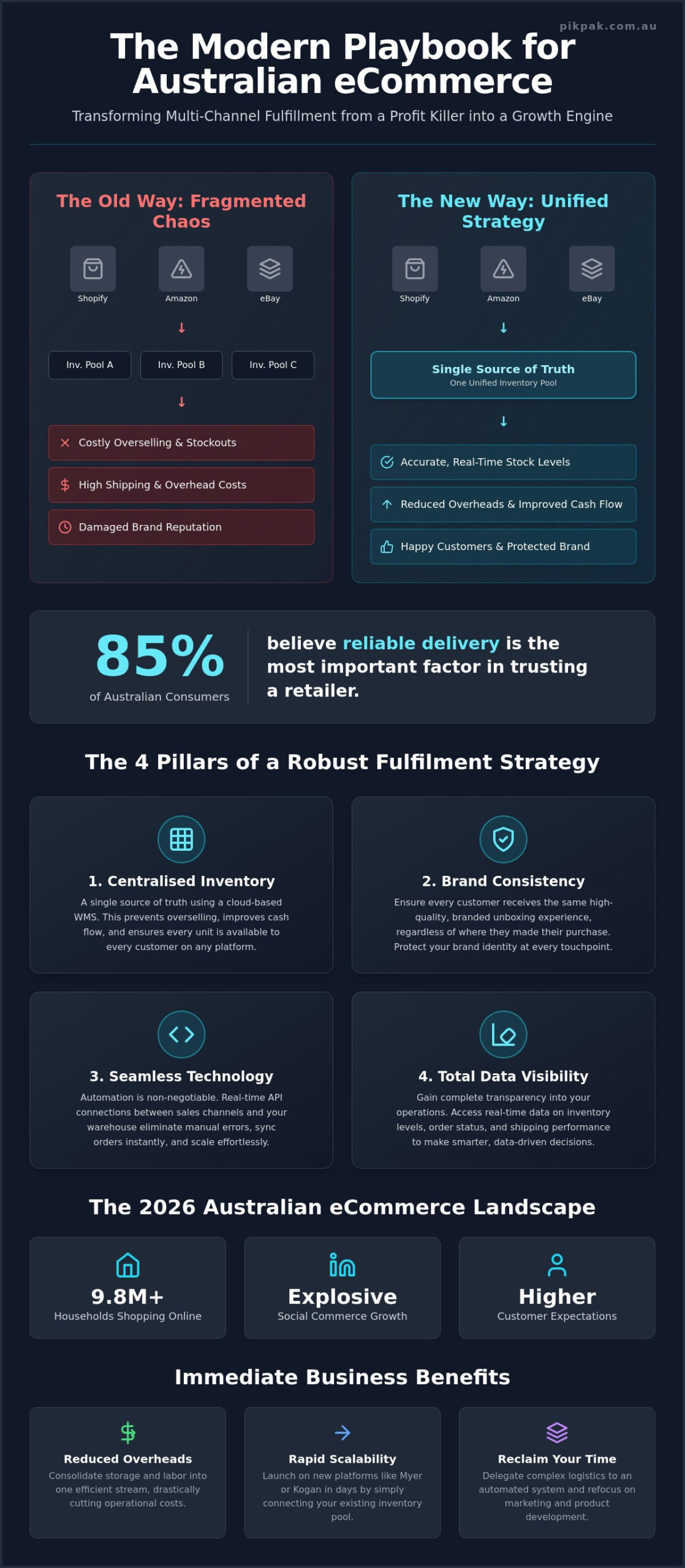
A multi-channel fulfillment strategy australia is a centralized logistics model where a single, unified pool of inventory serves every sales platform you use, from Shopify and eBay to Amazon and Catch. Instead of splitting your stock into different piles for different websites, you maintain one “single source of truth.” This ensures that when a customer buys your last item on eBay, your Shopify store updates instantly to prevent a double-sale. It’s about creating a backend system that is as dynamic as your sales front.
In 2026, the industry is moving away from fragmented, multi-channel setups toward an integrated Omnichannel order fulfillment strategy. This shift is critical because modern shoppers expect a seamless experience. Whether they find you on a marketplace or your own site, the delivery speed and packaging quality must be identical. For Australian businesses, this is particularly challenging due to our massive geographic spread and high last-mile delivery costs. A unified multi-channel fulfillment strategy australia helps you manage these variables without losing your mind or your profit margins.
The 2026 Australian eCommerce Landscape
The way Australians shop has changed. Social commerce via platforms like TikTok Shop and Instagram has exploded, requiring fulfillment speeds that keep up with viral trends. With 9.8 million Australian households now shopping online, the pressure on your warehouse is immense. Research shows that 85% of consumers believe reliable delivery is the top factor in trusting a retailer. If you manage separate stock pools for each channel, you risk “out-of-stock” errors that damage your reputation and trigger marketplace penalties. In the current market, “Standard” shipping isn’t enough for metro areas; customers expect precision as the baseline.
Key Benefits of a Unified Strategy
Centralizing your operations offers immediate financial and operational relief. You can stop paying for multiple warehouse spaces or managing separate logistics teams. With industrial lease rates in major coastal hubs reaching $12 to $18 per square foot in 2026, consolidating your footprint is a financial necessity. This efficiency directly improves your inventory turnover and cash flow.
- Reduced Overheads: Consolidate your storage and labor costs into one efficient stream.
- Rapid Scalability: Launch on new platforms like Myer Market or Kogan in days by simply connecting your existing inventory pool.
- Brand Protection: Focus on service priorities that ensure every customer gets the same high-quality unboxing experience.
By delegating the heavy lifting to a single system, you reclaim your time to focus on marketing and product development. It’s about working smarter, not harder. When your logistics are automated and transparent, you can scale your brand with total confidence.
The 4 Pillars of a Robust Fulfilment Strategy
Building a successful brand across multiple platforms requires more than just listing products. It demands a structural foundation that ensures your operations don’t crumble under the weight of your own growth. A robust multi-channel fulfillment strategy australia is built on four critical pillars: centralized inventory, seamless technology, brand consistency, and total data visibility. When these elements work in harmony, they transform your logistics from a source of stress into a competitive advantage.
Centralising Your Inventory Pool
When you sell across four or more platforms simultaneously, calculating safety stock becomes a precision task. You must account for the lead time of your suppliers and the maximum daily sales volume across all channels to avoid stockouts. A cloud-based Warehouse Management System (WMS) acts as your single source of truth, preventing the dreaded “out of stock” notification after a customer has already paid. Inventory synchronisation is the heartbeat of multi-channel success. By maintaining one stock pool, you improve your cash flow and ensure that every unit is available to every customer, regardless of where they shop.
Technology: The Glue of Your Operations
In 2026, manual CSV uploads and spreadsheet tracking are relics of the past. They’re slow, prone to human error, and impossible to scale. Automation is now non-negotiable. Seamless API connections allow your sales platforms, like Shopify or eBay, to talk directly to your warehouse in real time. This integration extends to robust ERPs like NetSuite, commerce operations platforms like Ommni, and local Australian platforms, ensuring that every order flows through an automated pipeline without manual intervention. When an order is packed, the tracking information should instantly flow back to the original sales channel, keeping your customers informed and significantly reducing “where is my order” enquiries.
Beyond the technical integrations, your strategy must prioritize brand consistency. Many businesses fear losing their identity when outsourcing, but a sophisticated partner allows you to maintain custom packaging and specific inserts that reflect your brand’s voice. This ensures the unboxing experience is identical whether the customer bought from your direct storefront or a marketplace. Finally, data visibility gives you the insights needed to make informed decisions. Real-time dashboards allow you to monitor stock levels, order status, and carrier performance at a glance. If you’re looking to streamline these complex moving parts, exploring our WMS platform access is a practical first step toward reclaiming your time and refocusing on business growth.
Amazon MCF vs. Independent 3PL: The Great Dilemma
Choosing between Amazon Multi-Channel Fulfilment (MCF) and an independent 3PL is a pivotal decision for your brand’s future. Amazon offers a massive logistics network, and as of June 10, 2026, they’ve even reduced MCF fees in Australia to stay competitive. For example, a standard 1-unit order under 2kg that previously cost $16.80 now sits at $13.17. While these price drops are tempting, they come with a significant trade-off: the loss of your brand’s unique identity. When you rely on a marketplace giant to handle your off-platform orders, you risk becoming a “ghost brand” in the eyes of your customers.
A successful multi-channel fulfillment strategy australia requires a balance between cost and control. Independent 3PLs provide a level of customization that Amazon simply cannot match. From unbranded shipping boxes to personalized packing slips, an independent partner ensures your brand remains front and center. This approach protects your relationship with the customer and builds long-term loyalty that survives beyond a single transaction. It’s about moving from a rigid, one-size-fits-all model to a flexible system that adapts to your specific business needs.
Hidden Risks of Platform-Locked Fulfilment
The “Ghost Brand” effect is a real threat to growing businesses. When a customer buys from your Shopify store but receives an Amazon-branded box, they often assume they bought from Amazon. This confusion dilutes your brand equity and makes it harder to drive repeat traffic to your own site. There’s also the issue of data ownership. In an MCF model, you’re essentially feeding your customer data into a competitor’s ecosystem. Furthermore, navigating Amazon’s strict SKU requirements can be a headache for specialized products. Switching to independent 3PLs removes these restrictions and gives you full control over your inventory and customer experience.
When to Choose an Australian 3PL Partner
If your business model relies on more than just “pick and ship,” an Australian 3PL is usually the superior choice. This is especially true if your strategy involves complex kitting and assembly or the curation of subscription boxes. Amazon is built for high-speed, standardized shipping, not for the delicate touch required for custom gift wrapping or eco-friendly packaging initiatives. When you need high-touch customer service and local, Melbourne-based support, an independent partner provides a level of accountability that a global platform can’t replicate. You can pick up the phone and speak to an expert who understands the Australian market and your specific operational goals. This human element is what transforms a vendor into a strategic partner.
Implementing Your Strategy: A Step-by-Step Roadmap
Establishing a successful multi-channel fulfillment strategy australia isn’t a one-day task; it’s a series of calculated moves designed to build a scalable foundation. Start by auditing your current sales channels. You shouldn’t treat every platform the same. Identify your high-volume marketplaces that drive cash flow and your high-margin direct storefront that builds brand loyalty. This clarity allows you to prioritize which channels need the most aggressive inventory sync and which can be managed with higher safety stock levels.
Standardizing your SKUs across all platforms is your next priority. Mapping errors are the fastest way to damage your reputation, so ensure every SKU is identical across Shopify, eBay, and Amazon before you sync. A single SKU code must represent the same physical item everywhere to avoid shipping the wrong product. You also need a logistics partner that offers flexible receiving guidelines. This ensures your inbound stock is processed and shelved quickly, making it available for sale across all channels without delay. Before you migrate your entire operation, run a pilot channel to iron out any technical kinks in a controlled environment.
Carrier Selection for the Australian Market
Australia’s geography creates unique shipping challenges that a single carrier rarely solves. While couriers often provide superior speed in metro areas, Australia Post remains essential for reaching PO Boxes and regional postcodes. A multi-carrier approach allows you to find the best rate and delivery time for every specific order. Strategically placing your inventory closer to your customers through zone skipping can save 15-20% on freight costs by reducing the number of shipping zones a parcel must cross. This pragmatic approach keeps your shipping costs low while maintaining the delivery speed your customers expect.
Managing the ‘Reverse’ Logistics
Returns are an inevitable part of eCommerce, but they don’t have to be a drain on your resources. A unified strategy must include a centralized returns process where all items are sent to one location, regardless of where they were purchased. You need to automate the return-to-stock workflow so your inventory levels stay accurate across every platform in real time. Fast, local refund processing is the key to maintaining customer trust even when a product doesn’t work out. If you’re ready to simplify your Australian logistics and reclaim your time, explore our pick, pack, and ship services to see how we can help you scale.
Why Pik Pak is the Strategic Choice for Australian Brands
Choosing the right partner is the final piece of your multi-channel fulfillment strategy australia. At Pik Pak, we don’t just provide warehouse space; we offer a tech-driven ecosystem designed to protect your brand while you scale. Our platform features direct integration with Shopify, eBay, Amazon, and Catch, ensuring your order flow is truly effortless. By centralizing your operations with our Melbourne-based team, you gain access to local expertise and service priorities that keep your customers happy and your reputation intact.
Our technology is built to grow alongside your ambition. Whether you’re processing your first 100 orders or managing a surge of 10,000+, our system handles the volume with precision. We believe in transparent, pragmatic communication. This means you’ll never face hidden “platform” traps or confusing fee structures that eat into your margins. We provide the security and automation you need to compete in the 2026 market without the operational friction that usually comes with expansion. It’s about results, not excuses.
Reclaim Your Time to Focus on Growth
Logistics shouldn’t be a source of constant stress. When you delegate the pick, pack, and ship grind to seasoned experts, you’re not just outsourcing a task. You’re reclaiming your schedule. Our tech-savvy problem-solvers handle the backend complexities so you can move from being a warehouse manager to a true CEO. This shift allows you to focus on high-level strategy, product development, and customer acquisition. We turn complex logistical hurdles into simple, manageable workflows, giving you back the freedom to lead your business with total confidence.
Get Started with a Future-Proof Strategy
Transitioning to a unified model is a strategic investment in your brand’s longevity. We invite you to request a tailored consultation where we can audit your current multi-channel setup and identify opportunities for automation and cost savings. Our promise is simple: precision in every pack, security for your stock, and total automation of your order flow. Don’t let operational friction hold your brand back another year. Contact Pik Pak Logistics today to simplify your 2026 fulfilment and build a foundation for sustainable growth.
Take Control of Your Growth with a Future-Proof Strategy
Mastering a multi-channel fulfillment strategy australia is no longer just about moving boxes; it’s about building a resilient, tech-driven foundation that protects your brand identity. By centralizing your inventory into a single pool and automating your order flow, you eliminate the friction of manual SKU mapping and the constant risk of overselling. You’ve already explored how decoupling from platform-locked logistics allows you to reclaim your time and refocus on what truly matters: scaling your business and reaching new markets with total confidence.
Transitioning to a unified model doesn’t have to be an intimidating task. With our Melbourne-based support, real-time WMS visibility, and seamless eCommerce integrations, we make complex logistics feel manageable and precise. You deserve a partner that acts as a calm expert in a chaotic field, providing the security you need to grow without operational hurdles. Scale your business with Pik Pak’s effortless multi-channel fulfilment and take full control of your operational future today. Your brand’s growth is waiting, and we are ready to help you capture it with ease.
Frequently Asked Questions
What is the difference between multi-channel and omni-channel fulfilment?
Multi-channel fulfilment involves selling across various platforms, while omni-channel integrates these sales points into a single, unified customer experience. In 2026, the focus is on breaking down operational silos. A unified multi-channel fulfillment strategy australia ensures that whether a customer buys on eBay or your direct site, the inventory and delivery data are synchronized in real time. It’s the difference between managing separate piles of stock and using one central pool.
Can I use Pik Pak for my Amazon orders as well as my Shopify store?
Yes, you can use Pik Pak to fulfill orders from both Amazon and Shopify simultaneously. Our WMS platform integrates directly with major marketplaces and eCommerce stores. This allows you to manage all your sales from one central location. You don’t have to choose between platforms; you can scale across both while maintaining a single source of truth for your inventory levels and shipping status.
How long does it take to integrate my online store with a 3PL WMS?
Integration times vary based on the complexity of your tech stack, but standard API connections for platforms like Shopify or eBay can often be established in a few days. Our team guides you through the setup to ensure your SKU mapping and order flows are correctly configured. We focus on making the transition as smooth as possible so you can start shipping without lengthy operational delays or technical friction.
Is multi-channel fulfilment more expensive than single-channel?
Managing multiple channels involves more moving parts, but it’s often more cost-effective than running separate warehouses or multiple logistics teams. By consolidating your stock into one 3PL facility, you lower your per-order shipping costs and eliminate the need for multiple leases. A well-executed multi-channel fulfillment strategy australia protects your margins by reducing the hidden costs of overselling and the labor required for manual data entry.
Do I need to change my SKU codes to start a multi-channel strategy?
You don’t necessarily need to create new SKU codes, but they must be consistent across every platform you use. If your Shopify SKU is “BLUE-SHIRT-L,” it must be exactly the same on eBay and Amazon. This standardization is critical for our WMS to recognize the item and update your inventory levels correctly. We’ll help you audit your current SKUs to ensure they are ready for a unified system.
How does Pik Pak handle returns for orders placed on different platforms?
We provide a centralized returns management service that processes items from all your sales channels in one place. When a return arrives at our warehouse, we inspect the item according to your specific guidelines and update your inventory levels immediately. This automated reverse logistics flow ensures that resellable stock is back online quickly, maintaining accuracy across all your storefronts without any manual intervention from your team.
Is there a minimum order volume required for multi-channel fulfilment in Australia?
Pik Pak is designed to be a scalable partner for growing Australian brands. While some logistics providers require massive monthly volumes, we focus on providing a professional service that grows with you. Whether you are moving 100 orders or 10,000, our systems and team adapt to your needs. This flexibility allows you to outsource your logistics early and focus your energy on driving more sales instead of packing boxes.
Can I use my own branded packaging with Pik Pak?
Yes, you can use your own branded mailers, custom boxes, and specific inserts with Pik Pak. We prioritize brand preservation because we know the unboxing experience is a vital part of your marketing. Unlike generic marketplace fulfillment, we use your supplied packaging materials to ensure your brand remains front and center for every delivery. This helps you build a loyal customer base across every platform you sell on.