
With nearly one in every four retail dollars in Australia now spent online, staying ahead of the latest ecommerce fulfillment trends australia 2026 is no longer optional. It’s your most powerful competitive weapon. You’ve likely felt the pressure of rising shipping costs and the relentless customer demand for next-day delivery. It’s exhausting to manage complex inventory across multiple channels while watching your margins shrink. We know that the friction of manual dispatch and stock discrepancies can feel like a constant weight on your business growth.
This guide explores the essential logistics shifts and technological innovations that will define the coming year to help you reclaim your time. You’ll discover how to achieve faster dispatch times and clear inventory visibility without the need to hire more staff. We’ll show you how hyper-local hubs, AI-driven automation, and strategic 3PL partnerships are turning logistics from a cost center into a seamless growth engine. By the end of this article, you’ll have a clear roadmap to eliminate operational friction and scale your brand with total precision.
Key Takeaways
- Understand how delivery speed has become the primary driver of brand trust in Australia’s rapidly expanding digital marketplace.
- Identify the essential ecommerce fulfillment trends australia 2026 that are shifting the focus from single national warehouses to hyper-local distribution hubs.
- Learn how to stop growth-killing manual data entry by syncing your sales channels with automated, real-time inventory systems.
- Discover how to transform your returns process into a profit-recovery stream while meeting strict consumer demands for sustainable packaging.
- See how delegating complex logistics to a tech-savvy partner lets you reclaim your time to focus on scaling your business.
The State of Australian eCommerce Fulfillment in 2026
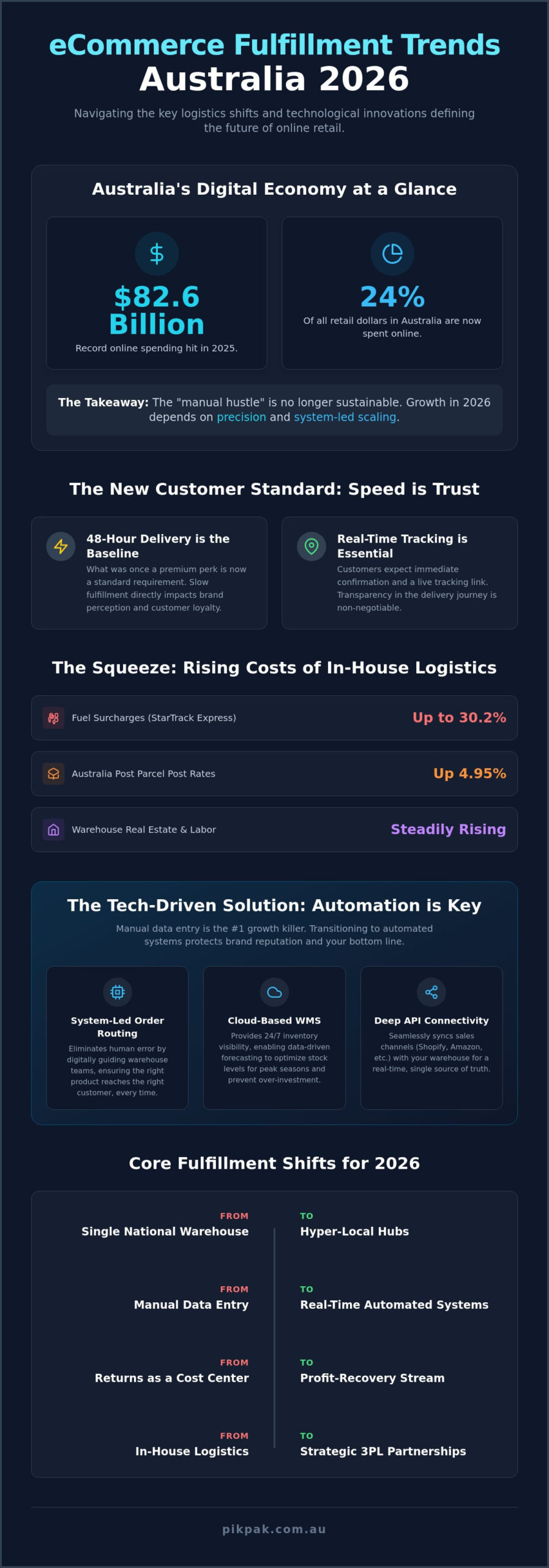
Australia’s digital economy has reached a massive scale. In 2025, online spending hit a record $82.6 billion, representing 24% of all retail dollars. As we look at ecommerce fulfillment trends australia 2026, it’s clear that the “manual hustle” of packing boxes in a garage or small backroom is no longer sustainable. Growth now depends on precision and system-led scaling. If you’re still relying on manual data entry, you’re likely losing ground to competitors who have automated their backend. The market continues its upward trajectory, making it vital for brands to optimize their logistics today to capture tomorrow’s revenue.
The transition from manual operations to automated systems is about reclaiming your time. Many business owners find themselves trapped in the “packing trap,” where every new sale creates a new manual task. In 2026, the most successful brands are delegating these operational burdens. This allows them to refocus on their core objectives like product innovation and brand storytelling. If you are looking to accelerate your product development cycle, you can learn more about VPrint3D Limited and their integrated prototyping solutions. Efficiency is no longer just a backend goal. It’s the primary engine for business survival.
Consumer Expectations: The New Baseline
The “Amazon Effect” has permanently altered how Australians shop. In 2026, 48-hour delivery isn’t a perk; it’s a standard requirement. When a customer clicks “buy,” they expect immediate confirmation and a tracking link they can refresh in real time. Speed has become synonymous with brand trust. If your fulfillment process is slow or opaque, your customers will simply find a brand that offers more transparency. They want to know exactly where their parcel is at every stage of the journey. This psychological shift means that your logistics strategy is now a core part of your marketing and customer retention plan.
Economic Pressures on Logistics
Running your own warehouse is becoming increasingly expensive. Fuel surcharges for contract parcel customers surged to 19.5% in June 2026, while StarTrack Express surcharges hit 30.2%. These costs, combined with rising labor rates and the skyrocketing price of warehouse real estate in Sydney and Melbourne, are squeezing margins. From 1 July 2026, Australia Post Parcel Post rates also rose by an average of 4.95%. These incremental increases add up quickly for brands handling their own shipping.
Beyond transportation, energy management is another critical overhead; many warehouse operators now explore C&I BESS to hedge against rising utility prices and improve facility resilience.
Many SMEs are finding that partnering with a 3PL provider is a financial necessity rather than an optional service. By leveraging Third-party logistics (3PL), you can tap into shared infrastructure and bulk shipping rates that are impossible to achieve on your own. It’s the most pragmatic way to insulate your brand from volatile overheads and ensure your operations remain effortless as you scale.
Automation and Real-Time Data: The 2026 Baseline
Manual data entry is the number one growth killer for online stores in 2026. It’s slow, prone to error, and keeps you stuck in the operational weeds when you should be focused on scaling. As the State of Australian eCommerce continues to evolve, precision is the only way to stay competitive. If your sales data isn’t moving instantly from your storefront to your warehouse, you’re already falling behind. Transitioning to an automated system isn’t just about saving time; it’s about protecting your brand’s reputation and your bottom line.
System-led order routing eliminates the human error inherent in traditional pick and pack methods. Instead of relying on memory or paper lists, digital systems guide warehouse teams through the most efficient routes. This level of automation ensures that the right product reaches the right customer every single time. It removes the stress of potential shipping errors and creates a reliable foundation for your business to grow without friction.
The Rise of the Cloud-Based WMS
Modern logistics requires robust Technology Support to manage the complexity of multi-channel selling. A cloud-based Warehouse Management System (WMS) acts as the brain of your operation. It provides 24/7 visibility into your stock levels, whether you’re at your desk or on the move. This visibility is crucial for data-driven forecasting. It ensures you have exactly what you need for peak seasons like Black Friday without over-investing in dead stock that ties up your capital. You gain total control over your inventory without needing to be physically present in the warehouse.
Seamless Integration Ecosystems
We’ve moved beyond simple plugins that only occasionally sync data. In 2026, deep API connectivity is the standard for ecommerce fulfillment trends australia 2026. Your Shopify, WooCommerce, or eBay store must talk directly to your fulfillment partner’s system in real time. Automated synchronization between your storefront and the warehouse floor reduces dispatch lag by up to 40%. This seamless flow of information prevents the “out of stock” revenue leak. When a customer buys the last item on eBay, your Shopify store updates instantly. It creates a feeling of effortlessness for both you and your buyers. If you’re ready to stop the manual grind, exploring tech-enabled fulfillment solutions is the most logical next step for your brand’s growth.
The Race for Speed: Hyper-Local Hubs and 3PL Synergy
The “one-warehouse-fits-all” model for national coverage is officially a thing of the past. Shipping from a single central location in a country as vast as Australia simply doesn’t work if you want to meet 2026 delivery standards. To stay ahead of ecommerce fulfillment trends australia 2026, your inventory needs to live closer to your customers. Strategic positioning in 3PL Melbourne and Sydney hubs is now a requirement for any brand serious about national growth. These locations allow you to bypass long-haul transit times and get products into customers’ hands significantly faster.
Proximity to major carrier depots is another critical factor. When your warehouse is located just minutes from a primary sorting facility, it reduces the “time to first scan.” This is the crucial moment when a customer receives their tracking notification. It builds immediate trust and eliminates the anxiety of a “pending” status. By leveraging hyper-local hubs, you aren’t just moving boxes; you’re managing customer expectations with precision. It’s about creating a feeling of control for your buyer from the second they click the buy button.
Optimizing the Last Mile in Australia
Australia presents unique geographic challenges that can stall your growth if not managed correctly. Dense urban centers are separated by thousands of kilometers of regional terrain. Navigating this requires sophisticated multi-carrier shipping software that automatically selects the fastest, most cost-effective route for every single parcel. Providing diverse Customer Delivery options at checkout is proven to increase conversion rates. According to the eCommerce Market Growth Forecast, the expansion of micro-fulfillment centers in urban areas is the primary solution for overcoming these last-mile hurdles in 2026.
Reducing Dispatch Latency
Same-day dispatch has moved from a premium service to a baseline expectation. Orders must leave the warehouse floor within hours of being placed to keep pace with the market. One way to achieve this is through kitting and assembly services. By pre-staging high-velocity items or popular bundles, you eliminate the time spent picking individual components during peak periods. This level of preparation ensures your operations remain effortless even during high-volume sales events. By using a 3PL’s scale, you gain access to premium courier rates and priority lanes that are typically reserved for the country’s largest retailers. This allows you to compete on speed and price without sacrificing your margins or your sanity.
Sustainability and Strategic Returns Management
Sustainability is no longer a marketing choice. By 2026, eco-friendly packaging has become a non-negotiable requirement for Australian shoppers. Brands that ignore this shift risk alienating a significant portion of the market. This is a central pillar of ecommerce fulfillment trends australia 2026. It’s about moving toward plastic-free, compostable, and right-sized packaging that respects both the customer and the planet. When you use packaging that fits the product perfectly, you reduce waste and lower your shipping costs simultaneously. It’s a pragmatic win for both your brand and the environment.
Consolidated shipping is another way modern fulfillment partners are helping brands reduce their carbon footprints. By grouping orders and optimizing delivery routes, logistics providers minimize the number of vehicles on the road. This isn’t just about ethics; it’s about operational logic. Consolidation reduces total freight movements. This helps protect your margins from the rising fuel surcharges and parcel rates we’ve seen across the country. You can scale your impact without scaling your environmental footprint.
Reverse Logistics as a Competitive Edge
Returns don’t have to be a drain on your resources. “Circular Logistics” is the growing trend of turning returns into a profit-recovery stream. A frictionless process encourages repeat purchases and builds long-term loyalty. Under Australian Consumer Law, consumers have a clear right to a refund or replacement for faulty products. Meeting these obligations through a structured Returns Management system ensures that items are inspected and returned to stock quickly. This maintains inventory accuracy and prevents your capital from being tied up in unsellable goods. It turns a potential headache into a simple, manageable task.
Green Fulfillment Practices
Waste reduction starts at the packing table. Smart “pick and pack” algorithms now calculate the smallest possible box for every order. This minimizes the need for void fill and reduces the total shipping volume. Many brands are switching to paper-based void fill and water-activated tapes to eliminate plastic entirely. These small changes lead to a feeling of effortlessness for the customer during the unboxing experience. Communicating these sustainable efforts to your customer base builds trust and positions your brand as a leader in the 2026 digital economy. If you’re ready to streamline your returns process and adopt greener practices, delegating to a tech-enabled partner is the most logical path forward.
Future-Proofing Your Brand with Pik Pak Logistics
Pik Pak Logistics is built for the future. We’ve designed our systems to align perfectly with the ecommerce fulfillment trends australia 2026 that we’ve discussed throughout this guide. Precision and automation aren’t just buzzwords for us; they’re the foundation of how we help you scale. By delegating your logistics to a seasoned expert, you reclaim your time. You can stop worrying about packing tape and courier pickups. Instead, you can focus on the core objectives that actually grow your brand. We handle the backend complexity so you can enjoy the results.
Our integrated WMS Platform provides the real-time visibility you need to make informed decisions. It connects your sales channels directly to our warehouse floor, eliminating the operational friction that often holds back ambitious Australian SMEs. We maintain a strict commitment to our Service Priorities, ensuring that every order is handled with the same level of care you would provide yourself. It’s about precision at every step of the journey. Choosing a partner that understands these technological shifts is the ultimate strategy for 2026.
Scaling Without the Stress
Growing a business usually means taking on more risk. Traditionally, that involved signing expensive long-term warehouse leases or managing a growing team of casual staff. Pik Pak removes these major operational hurdles. Our infrastructure is designed to grow with your order volume effortlessly. Whether you’re shipping fifty orders a day or five thousand, our system adapts to your needs without requiring you to hire more staff.
Professional Order Fulfilment gives you the peace of mind to sleep better at night. You don’t have to manage the chaos of peak seasons or the stress of labor shortages. We act as a calm expert in a chaotic field, using language and systems that suggest precision and the elimination of inefficiency. It’s a pragmatic approach to scaling that prioritizes your mental energy as much as your profit margins.
Getting Started with Effortless Logistics
Onboarding with Pik Pak is a simple, logical process. We integrate your online store with our systems quickly, so you can start seeing the benefits of ecommerce fulfillment trends australia 2026 immediately. You get access to transparent pricing and dedicated, multi-channel support from the very first day. There are no hidden fees or complex contracts to navigate. Our communication rhythm is fast-paced and logical, designed to address your pain points and present a solution immediately.
We’re more than just a service provider; we’re your reliable partner in a competitive digital landscape. Our tech-savvy team is focused on delivering tangible results for your brand. By choosing a partner that leads with automation and efficiency, you’re not just outsourcing a task. You’re enabling your business to reach its full potential. Partner with Pik Pak Logistics to lead the 2026 trends.
Master Your Growth Strategy for 2026
The shift toward automated, data-driven logistics is the current reality for successful brands. By embracing hyper-local distribution and prioritizing sustainable, frictionless returns, you position your business to thrive in a crowded market. These ecommerce fulfillment trends australia 2026 demonstrate that precision and speed are the new benchmarks for customer loyalty. You’ve seen how manual processes can stall your progress; now is the time to implement systems that work as hard as you do.
You don’t have to navigate these complexities alone. Pik Pak Logistics provides secure, state-of-the-art warehouse facilities and real-time visibility via our cloud-based WMS. Our dedicated Australian-based support team ensures your transition to modern logistics is completely effortless. It’s time to stop the manual grind and refocus on your long-term vision. Reclaim your time and scale your business with Pik Pak Logistics today. We’re ready to help you lead the way and turn every shipment into a tangible growth opportunity for your brand.
Frequently Asked Questions
What is the biggest eCommerce fulfillment trend in Australia for 2026?
The biggest trend is the move toward hyper-local fulfillment powered by real-time AI data. This shift ensures inventory is stored closer to the end consumer, which is essential for meeting 2026 delivery speed standards. It transforms logistics from a backend cost into a front-facing competitive advantage. By positioning stock strategically, you eliminate the long transit times that often frustrate Australian buyers.
How much does 3PL fulfillment cost for a small business in Australia?
Costs for 3PL fulfillment typically involve a combination of storage fees, pick and pack charges, and shipping rates. For a small business, this model is often more cost-effective than managing a private lease because you only pay for the space and labor you actually use. It removes the fixed overhead of warehouse rent and staff management. You should look for a partner with transparent, activity-based pricing to maintain clear control over your margins.
Can I integrate my Shopify store directly with a 3PL warehouse?
Yes, you can seamlessly integrate your Shopify store with a 3PL warehouse using automated API connections. This is a key part of the ecommerce fulfillment trends australia 2026 landscape. Once connected, your orders flow directly to the warehouse floor for immediate picking and packing. This synchronization ensures your inventory levels are updated in real time across all sales channels, preventing overselling and reducing manual data entry.
What is the difference between a fulfillment center and a standard warehouse?
A fulfillment center is an active hub designed for high-velocity order processing, whereas a standard warehouse is primarily for long-term storage. Fulfillment centers are optimized for the “pick, pack, and ship” cycle, focusing on getting products out the door as quickly as possible. They use advanced technology to manage rapid inventory turnover. Standard warehouses are better suited for bulk goods or raw materials that don’t require daily dispatch.
How does sustainable packaging impact my shipping costs?
Sustainable packaging can actually lower your shipping costs by utilizing “right-sizing” techniques. When you use compostable or recycled materials that fit your product perfectly, you reduce the total volume and weight of the parcel. Many Australian carriers calculate rates based on cubic dimensions; smaller boxes mean lower fees. It’s a pragmatic way to meet consumer demand for eco-friendly practices while simultaneously protecting your bottom line.
What happens if a customer returns a product to a 3PL provider?
When a customer returns a product, a 3PL provider manages the entire reverse logistics process on your behalf. The items are received at the warehouse, inspected for quality, and then either returned to inventory or handled according to your specific instructions. This structured approach to ecommerce fulfillment trends australia 2026 ensures that your stock levels remain accurate. It also provides your customers with a professional, stress-free experience that encourages repeat business.
How can I ensure next-day delivery for my Melbourne customers?
To guarantee next-day delivery in Melbourne, you should store your high-velocity inventory in a strategic Melbourne-based fulfillment hub. Proximity to major carrier sorting facilities in the metro area allows for later order cut-off times and faster dispatch. This reduces the “time to first scan” and ensures the parcel stays within the local delivery network. It’s the most reliable way to meet the 24-hour delivery standard that urban shoppers now expect.
What are the benefits of kitting and assembly for promotional offers?
Kitting and assembly allow you to pre-stage popular product bundles or promotional offers before a sale even begins. This reduces the time spent picking individual items during peak periods, leading to much faster dispatch times. It’s an efficient way to manage high-volume events like Black Friday without hiring extra staff. By preparing these kits in advance, you ensure your fulfillment process remains effortless even when order volumes spike.