What if the fulfilment partner with the strongest green claims isn’t the best fit for your brand? Choosing logistics for ethical and sustainable brands sydney means looking past broad promises and checking what a provider can demonstrate. Shipping, packaging and returns should reflect your values while giving customers clear, dependable delivery expectations.
This guide offers a practical way to compare 3PLs serving Sydney. Learn what evidence to request about sustainability practices, how to clarify delivery coverage, and which questions reveal whether packaging and returns processes suit your commitments. You’ll also assess operational fit, including inventory visibility and service requirements, so you can build a shortlist based on more than brand alignment alone.
Use this framework to separate verifiable practices from vague claims, identify details that need direct confirmation, and make your next logistics decision with greater confidence.
Key Takeaways
- Assess logistics for ethical and sustainable brands sydney by checking evidence, service scope and operational fit, not relying on broad green claims.
- Ask what each sustainability claim covers, how it’s measured, when it was reported and what documentation supports it.
- Compare Sydney delivery coverage, packaging options, delivery visibility and returns handling. Confirm which details providers can document.
- Map your order volumes, product requirements, returns patterns and customer locations before requesting 3PL proposals.
- Pik Pak Logistics offers fulfilment, warehousing, shipping, returns, kitting and WMS visibility. Confirm Sydney coverage and ask directly about sustainability practices.
What ethical and sustainable logistics means for Sydney-serving brands
For brands assessing logistics for ethical and sustainable brands sydney, the useful question isn’t whether a provider calls itself “green”. It’s what happens at each stage of an order, who controls those actions and what evidence is available. The foundation of green logistics is considering and reducing logistics’ ecological impact, but environmental performance is only one part of an ethical supply chain.
A verified practice is a specific, documented action with a clear scope and supporting evidence. A broad sustainability claim is a promise that doesn’t explain what was done or how it was assessed. For example, ask whether a packaging claim applies to every order, a particular material or only one part of fulfilment.
Assess commitments separately. Environmental considerations include packaging materials, resource use and transport. Ethical considerations include worker treatment and supplier conduct. Customer-service responsibilities include clear delivery information and a workable returns process. A 3PL may control some activities, share control of others or rely on carriers and suppliers. Ask who is responsible for each part rather than assuming one provider controls the full journey.
Which parts of eCommerce logistics affect a brand’s commitments?
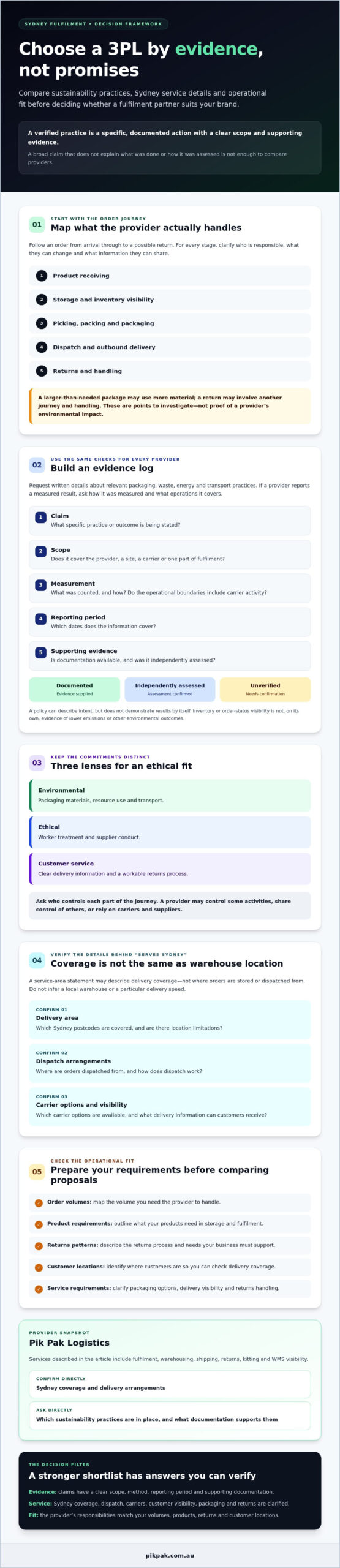
Map the order flow from product receiving and storage to picking, packing, outbound delivery and returns. Decisions at one stage can affect another. Packaging that’s larger than needed, for example, may use more material. A return can involve an additional journey and handling. These are points to investigate, not proof of a provider’s environmental impact.
Separate your choices from the provider’s. Product design, customer-facing claims and return policies may be yours to manage. A fulfilment partner may handle storage, pick and pack, shipping or returns processing. For each stage, ask what the provider does, what it can change and what information it can share.
What does Sydney service coverage actually mean?
“Serves Sydney” may describe delivery coverage, not warehouse location. A provider could dispatch orders from elsewhere and use one or more carriers to reach Sydney customers. Confirm the arrangements before setting delivery expectations.
Ask providers to specify:
- Which Sydney postcodes they deliver to, and whether any locations have limitations.
- Where orders are dispatched from and how dispatch arrangements work.
- Which carrier options are available and what delivery information customers can receive.
Don’t infer a local warehouse or a particular delivery speed from a service-area statement. Verify the details that matter to your customers, then assess environmental and ethical evidence against the parts of the operation the provider actually controls.
How to verify sustainability claims across warehousing and fulfilment
When comparing logistics for ethical and sustainable brands sydney, compare evidence, not adjectives. A provider’s claim may relate to its whole business, one warehouse, a transport carrier or just one stage of an order’s journey. These scopes aren’t interchangeable.
A sustainability claim is useful for comparison only when you can see what it covers, how it was measured, when it was assessed and what evidence supports it. Apply the same checks to every provider. A short written record makes gaps easier to spot and helps keep your own customer-facing statements accurate.
What evidence should a brand request from a logistics provider?
Ask for written descriptions of relevant packaging, waste, energy and transport practices. If a provider shares a measured result, request its methodology, reporting period and operational boundaries. For example, find out whether an energy figure covers one site or multiple facilities, and whether transport data includes carrier activity.
Use a simple evidence log:
- Claim: What specific practice or outcome is being stated?
- Scope: Does it cover the provider, a site, a carrier or part of fulfilment?
- Measurement: What was counted, and how?
- Period: Which dates does the information cover?
- Support: Is there documentation, and was it independently assessed?
Mark each item as documented, independently assessed or unverified. A policy can show what a provider intends to do, but it doesn’t demonstrate results by itself. Likewise, a warehouse management system can provide inventory and order-status visibility; that visibility isn’t evidence of lower emissions or other environmental outcomes.
How should brands assess ethical standards and certifications?
Check the detail behind each policy or certification. Ask which facilities, activities and workers it covers, who issued it, and whether it’s current. A certificate for one site shouldn’t be presented as applying to a provider’s entire network. Standards also measure different things: NABERS focuses on building energy and water performance, while Green Star assesses broader sustainability aspects of buildings. Neither should be treated as proof of every claim about fulfilment or transport.
Before relying on or publishing an environmental claim in Australia, consult current Australian Competition and Consumer Commission (ACCC) guidance and check the relevant standard’s current scope. Don’t imply a provider holds a certification unless you’ve verified it. Pik Pak’s service scope includes fulfilment and WMS services, but doesn’t establish sustainability certifications, emissions reporting or specific environmental practices.
For a clearer view of operational scope, review Pik Pak’s warehousing and fulfilment services, then verify any sustainability details directly with the provider.
Compare Sydney logistics options by packaging, delivery and returns
Use the same criteria for each provider so you’re comparing service scope and evidence, not polished sustainability language. For logistics for ethical and sustainable brands sydney, record who controls each activity and what information the provider can share. Don’t rank providers on environmental performance unless their evidence covers comparable activities and measurement periods.
| Area | What to check | Evidence to request |
|---|---|---|
| Sustainability evidence | Which environmental practices apply to the provider, a site, a carrier or a specific order stage? | Written practice details, scope, measurement method and reporting period. |
| Sydney coverage | Which postcodes can be served, where orders dispatch from and what limitations apply? | Confirmed coverage and dispatch arrangements, rather than an assumption of local warehousing. |
| Packaging | Can options suit product protection, parcel size and your brand requirements? | Available materials and formats, plus clarification of what the provider controls or supplies. |
| Delivery visibility | Which carriers and home delivery options are available, and what order updates can customers receive? | Carrier and service details, tracking information and any evidence behind environmental claims. |
| Returns and operations | How are returns received, recorded and inspected? Does the service fit your product and order needs? | Returns process, reporting examples, inventory visibility and details on handling exceptions. |
How do packaging and delivery practices compare?
Packaging should protect the product without defaulting to unnecessary space or materials. Ask whether the provider can accommodate your product dimensions and packaging requirements, and clarify who supplies and selects the materials. For delivery, confirm carrier choices and available options for your Sydney customers. Don’t assume a delivery service has a lower environmental impact. Request comparable transport evidence before making that claim.
Why include returns and technology in the comparison?
Returns can affect stock accuracy and create extra handling, so check how items are received, recorded, inspected and reported. Ask how exceptions, such as damaged goods or inventory discrepancies, are communicated and resolved. A warehouse management system (WMS) can help you monitor inventory and order status, but visibility is an operational benefit, not proof of environmental performance.
Pik Pak’s services include warehousing, pick and pack, shipping, returns processing and WMS access. Its platform supports real-time inventory and order visibility, with online store integrations. Confirm Sydney coverage, packaging practices and carrier options directly. For more context on service scope, see this order fulfilment guide.
Questions to ask before choosing a 3PL for Sydney customers
A structured shortlist helps you compare sustainability evidence with the practical demands of your business. Before requesting proposals, map your typical order volumes, product sizes and handling needs, returns patterns, and customer locations. This gives providers a clear brief and helps you assess whether their services can support your commitments and customer promises.
What should a Sydney-serving brand ask about service fit?
Confirm which Sydney postcodes a provider serves, where orders dispatch from, which home delivery options are available, and whether any locations are excluded. Ask how stock is received, stored, counted and reconciled in the warehouse management system (WMS). Clarify how online store integrations work, how exceptions are escalated, and who to contact when order or inventory information doesn’t match. Review the provider’s warehousing and fulfilment services to understand the scope you’ll need to discuss.
Use this due-diligence sequence with each provider:
- Set your requirements. Record your products, expected order patterns, packaging needs, returns process and delivery expectations.
- Confirm service coverage. Ask about Sydney postcodes, dispatch arrangements, available delivery options and any limitations. Don’t assume a Sydney delivery area means the warehouse is located there.
- Check operational fit. Discuss receiving, storage, pick and pack, returns handling, integrations, inventory controls and how service issues are escalated.
- Test sustainability claims. Request relevant documentation and ask what each claim covers, how it’s measured and whether the provider will support it in writing.
- Clarify onboarding. Ask what setup involves, what information or integration work is required, and whether a trial or staged onboarding plan is available. Don’t assume either is offered.
- Agree responsibilities. Document who selects packaging, manages delivery and returns, supplies evidence, and approves customer-facing sustainability statements.
How can a brand test claims before committing?
Compare each provider’s written commitments against your priorities, not just its proposal language. If recyclable packaging matters, establish what materials are available and who controls the choice. If delivery claims matter, verify coverage and supporting information before repeating them to customers. Mark gaps as unverified rather than treating an assurance as proof.
This process helps businesses assessing logistics for ethical and sustainable brands sydney choose on both values and operational fit. Review Pik Pak Logistics’s fulfilment services, integrations and the details you’ll need to confirm, including Sydney coverage and sustainability practices.
How Pik Pak can support ethical brands evaluating fulfilment
Choosing a fulfilment partner means matching confirmed services to day-to-day needs, then checking any claims you plan to rely on. For brands comparing logistics for ethical and sustainable brands sydney, assess Pik Pak against practical criteria such as service scope, order visibility and delivery coverage. Its services include eCommerce fulfilment, inventory storage, pick and pack, shipping, returns processing, kitting and assembly.
Which confirmed services may suit a growing eCommerce brand?
Storage, picking, packing and shipping can move routine order handling off your team’s plate, leaving more room to focus on products and customers. Returns processing and kitting are also available, so you can check whether these services fit your order and product requirements. Explore the logistics service overview to review the service scope.
Pik Pak’s cloud-based warehouse management system (WMS) provides real-time inventory and order-status visibility. API access and pre-built eCommerce connectors support automated order-data flow. These tools can help you monitor fulfilment activity and stock information, but they don’t demonstrate environmental performance. Ask how the technology support and integrations would work with your online store and reporting needs.
What should prospects confirm with Pik Pak before deciding?
Use the criteria you’ve set for your business. Confirm whether Pik Pak can support your Sydney delivery destinations, which delivery options fit your customer promises, and how its fulfilment services match your products, order patterns and returns needs. A Sydney delivery service doesn’t necessarily mean stock is stored in Sydney, so ask directly about dispatch arrangements and coverage.
If you’re assessing sustainability commitments, request current documentation for the specific practices that matter to your brand. Pik Pak’s described services don’t establish its sustainability certifications, packaging practices, emissions data or Sydney warehouse location. Treat those points as unverified until confirmed, and compare written evidence with your requirements rather than assuming a service capability proves an environmental outcome.
Discuss your fulfilment requirements with Pik Pak and ask for confirmation of service fit, Sydney coverage and any sustainability-related practices you intend to rely on. That lets you make a decision based on confirmed capabilities and keep your team focused on growing the brand.
Discuss your fulfilment requirements with Pik Pak.
Choose a fulfilment partner with confidence
The right 3PL should fit your operations and give you clear information to assess its practices. When comparing logistics for ethical and sustainable brands sydney, look beyond broad green claims: check what each commitment covers, what evidence supports it, and whether Sydney delivery coverage matches your customers’ needs. Packaging, shipping and returns all matter, so confirm who controls each part of the fulfilment journey.
Pik Pak provides eCommerce warehousing, pick and pack, shipping and returns services. Its cloud-based WMS offers real-time inventory and order-status visibility, while API access and pre-built eCommerce connectors support order-data flow. These capabilities help you assess operational fit, but they aren’t proof of environmental performance. Confirm Sydney coverage and request current documentation for any sustainability practices you plan to rely on.
Discuss your fulfilment requirements with Pik Pak and clarify how its services fit your products, customer destinations and brand priorities. With the right questions and evidence, you can make a considered choice and keep your attention on growing your business.
Frequently Asked Questions
How can I find sustainable logistics for my brand in Sydney?
Start by defining what sustainability and ethical operations mean for your brand, then shortlist providers that can serve your customers’ Sydney postcodes. Ask each provider for evidence about relevant packaging, warehouse, transport and returns practices. Check what each claim covers, how it was measured and when. Compare those details with service scope, dispatch arrangements, delivery options and the information available to help you manage orders.
What should ethical brands ask a 3PL about sustainability?
Ask which activities the provider controls and which depend on carriers, suppliers or your own decisions. Request written details about packaging, waste, energy and transport practices, plus the scope, method and reporting period behind any measured claims. For ethical commitments, ask which sites, activities and workers relevant policies cover. Record what’s documented, independently assessed or still unverified, and check current Australian guidance before relying on claims.
Does a Sydney logistics provider need a warehouse in Sydney?
No. A provider may deliver to Sydney customers while dispatching orders from a warehouse elsewhere. Confirm the difference before promising delivery arrangements to customers. Ask which Sydney postcodes are covered, where orders are dispatched from, which carrier and home delivery options are available, and whether any locations have limitations. Choose based on confirmed coverage and operational fit, not an assumption that “Sydney service” means local warehousing.
How can I tell whether a logistics company’s green claims are credible?
Look for specific claims supported by clear documentation. Check the claim’s scope, measurement method, reporting period and supporting evidence, then confirm whether it applies to the whole provider, a particular site, a carrier or one stage of fulfilment. Treat policies and certifications as evidence to examine, not automatic proof of every environmental outcome. Before publishing or relying on a claim in Australia, consult current ACCC guidance and verify certification details with the issuer.
Can a 3PL help an ethical brand manage product returns?
Yes, some 3PLs provide returns processing, but the precise steps vary. Ask how returned products are received, recorded, inspected and reported, and clarify how exceptions such as damaged items are handled. Pik Pak Logistics offers returns processing. Confirm that the process fits your products and return requirements. A returns service can support operational handling, but it doesn’t by itself establish an environmental benefit.
What should I compare when choosing a 3PL for sustainable eCommerce fulfilment?
Compare documented sustainability practices alongside Sydney postcode coverage, dispatch arrangements, packaging options, delivery visibility and returns handling. Check whether the provider’s warehousing, pick and pack, shipping and technology suit your products and order patterns. Ask about inventory and order-status visibility, integrations and how operational exceptions are communicated. Avoid ranking providers on environmental performance unless their evidence covers comparable activities and reporting periods.