

One RFP template can compare different logistics needs, but only if you tailor the scope. To write a 3PL request for proposal that produces comparable proposals, give every candidate the same operating brief, data set and response format, then adapt the required services and evaluation priorities to your needs. This keeps the comparison consistent without treating every operation as identical.
It’s reasonable to want a straightforward way to assess providers, especially when their proposals use different assumptions or present costs in different formats. A clear RFP helps each provider understand your business and respond to the same core requirements, so you can compare more than a headline price.
Learn what an RFP is designed to achieve, which company, order and inventory details to include, and how to assess proposals against your priorities. These steps also show how to set evaluation criteria that reflect your logistics needs, from fulfilment and technology to implementation and service.
Key Takeaways
- Share company, fulfilment and inventory details, including monthly order history for the past 12 months, so providers can build proposals around the same operating picture.
- Set the services, product handling, systems and responsibilities you need; tailor the scope to your logistics operation rather than relying on a generic template.
- Compare proposals against consistent requirements, including total cost, operational fit, technology, implementation and service expectations.
- Use the RFP to clarify the outcome you want from a 3PL partnership and give every provider the same brief and response format.
Company, order and inventory data to include
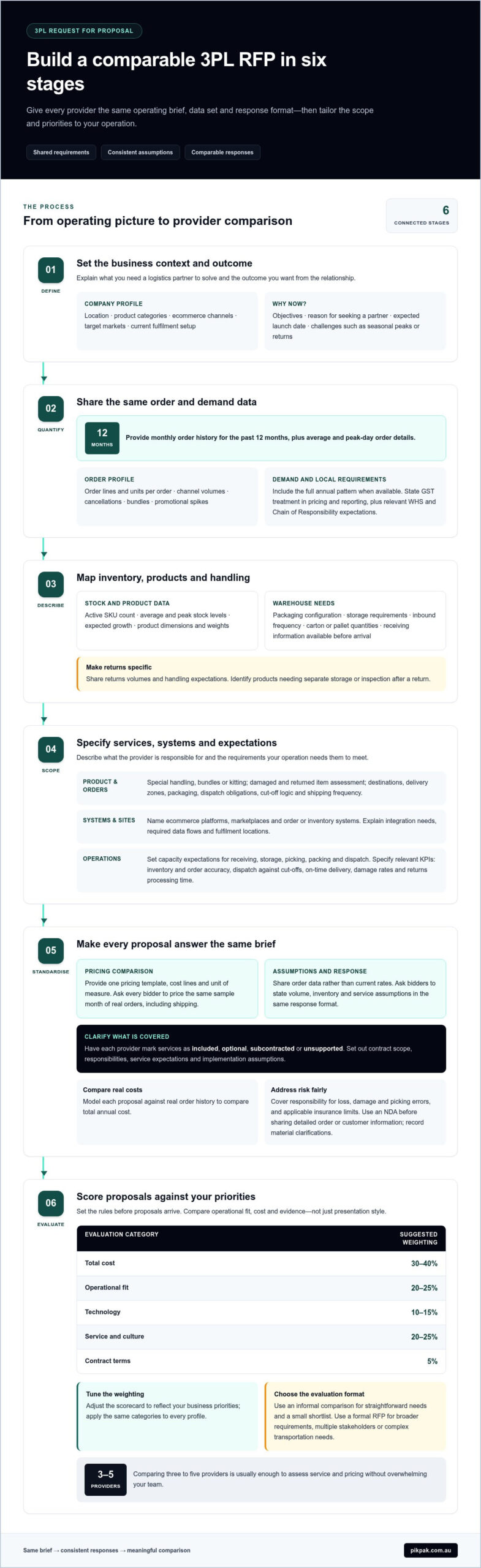
- To decide how to write a 3PL request for proposal for your operation, begin with a concise company profile. Include your location, product categories, ecommerce channels, target markets and current fulfilment setup. Explain why you’re seeking a logistics partner, your objectives and expected launch date. Describe supply chain challenges, such as seasonal peaks or returns handling, so providers can shape relevant proposals.
- Share monthly order volumes for the past 12 months, plus average and peak-day orders, order lines and units per order. Include channel volumes, cancellations, bundles and promotional spikes. If demand is seasonal, provide the full annual pattern when available. For Australian requirements, state how GST should be treated in pricing and reporting, and outline relevant workplace health and safety (WHS) and Chain of Responsibility expectations.
- Describe inventory by active SKU count, average and peak stock levels, expected growth, and product dimensions and weights. Add packaging configuration, storage requirements, inbound shipment frequency, carton or pallet quantities, and any receiving information available before arrival. Include returns volumes and handling expectations. For example, identify products that need separate storage or inspection after a return.
- Give every bidder the same pricing template, cost lines and unit of measure. Ask providers to price the same sample month of real orders, including shipping, and state their assumptions about order volume, inventory and services. Share order data rather than current rates. These details shape how to write a 3PL request for proposal that supports meaningful cost comparisons. Model each proposal against real order history to compare total annual cost.
- Set out the intended contract scope, responsibilities, service expectations and implementation assumptions. Ask bidders to identify services as included, optional, subcontracted or unsupported. Address risks through terms covering responsibility for loss, damage and picking errors, as well as applicable insurance policy limits. Use a non-disclosure agreement before sharing detailed order or customer information, and record material clarifications to support a fair comparison.
What is a 3PL RFP (request for proposal)?
A 3PL request for proposal describes a logistics project and invites third-party logistics providers to explain their approach and pricing. It gives prospective partners shared requirements, so their responses address the same operation rather than different assumptions.
- Define the outcome. State the problem you need to solve, such as slow dispatch, fragmented inventory or difficult returns handling. Specify the services required and the responsibilities you expect the provider to take on.
- Set SKU and product requirements. List active SKUs, product dimensions, weights, packaging and storage conditions. Describe special handling, bundles or kitting needs, and explain how damaged or returned items should be assessed, recorded and returned to saleable inventory.
- Describe delivery and dispatch. Identify customer destinations, delivery zones, packaging requirements and marketplace dispatch obligations. Explain order cut-off logic and shipping frequency, then state which delivery options matter to your customers. This helps providers plan around your actual delivery commitments.
- Specify systems and locations. Name ecommerce platforms, marketplaces, order or inventory systems, and required data flows. Describe integration needs and the locations from which orders must be fulfilled. Ask providers to identify required integrations and explain how inventory and order information will move between systems.
- Set operational expectations. Describe order volume, peak patterns, inbound frequency and expected inventory growth. Request capacity details for receiving, storage, picking, packing and dispatch. Specify warehouse and transport KPIs, such as inventory accuracy, order accuracy, dispatch against cut-offs, on-time delivery, damage rates and returns processing time.
- Standardise responses. Provide a response template covering scope, assumptions, capacity, implementation and service measures. Ask each party to mark services as included, optional, subcontracted or unsupported. For requirements involving warehouse capacity, review warehouse and fulfilment planning as part of defining your scope.
Proposal evaluation criteria
Set evaluation rules before proposals arrive, then apply them consistently. Compare operational fit, cost and evidence, not just presentation style.
-
Choose an Evaluation Approach
Use an informal evaluation when your needs are straightforward and you’re comparing a small shortlist, rather than coordinating a complex tender. Speak directly with prospective providers, document the same core questions and compare responses against your priorities. For broader requirements, multiple stakeholders or complex transportation needs, use a formal RFP with clear submission instructions and criteria.
-
Apply the Proposal Evaluation Checklist
Score each profile against the same categories: total cost, operational fit, technology, service and culture, and contract terms. A typical scorecard may assign 30-40% to total cost, 20-25% to operational fit, 10-15% to technology, 20-25% to service and culture, and 5% to contract terms. Adjust the weighting to match your business priorities.
- Compare three to five providers. This is usually enough to assess service and pricing without overwhelming your team. Identify deal-breakers first, such as unsuitable locations, insufficient capacity or missing system capabilities, then assess the remaining candidates in detail.
- Set a fair submission process. State the deadline, response format, question process and evaluation stages. Give providers time to clarify requirements, assign one contact point, and share material answers with all bidders. Ask about capacity, implementation responsibilities, integrations, service reporting and relevant operating references.
- Verify evidence before selecting. Check each proposal against your requirements, budget and implementation needs. Ask how the provider measures service performance, manages issues and handles changes. Record clarifications, involve relevant stakeholders, and compare references and contract terms alongside the score, not after making the decision.
Purpose of a 3PL request for proposal
- Use an RFP when structured comparison matters. A 3PL RFP explains a logistics project and invites providers to propose their approach and pricing. It’s particularly useful when approaching three or more providers, or when your operation has several channels, SKUs or special requirements. For a straightforward need, direct discussions may be simpler; use a formal process when proposals need consistent comparison.
- Give every candidate the same operating brief. Explain why you’re seeking a partner, what currently causes friction, and what a successful outcome looks like. Include your delivery philosophy, company differentiators and supply chain priorities. For example, if growth is putting pressure on warehouse capacity, define whether the goal is more space, smoother order processing or both.
- Make the opportunity clear to providers. An RFP lets your business assess each provider’s capabilities, while providers assess whether your requirements suit their operations. Share your business profile, product mix, order patterns and expected responsibilities. Send the request to candidates that appear aligned, and allow enough time to review each response rather than collecting proposals without a clear fit.
- Standardise the response. Use one shared brief and one response structure so every provider prices the same operation. A one-page document plus a data file can work for a focused project. Ask each candidate to describe its proposed solution, assumptions, capacity, implementation responsibilities and relevant references. Clear submission instructions help prevent gaps that make proposals difficult to compare.
- Turn the decision into an actionable scope. Record the selected provider’s agreed services, pricing assumptions, responsibilities and service requirements in the statement of work or contract. This connects the RFP’s goals to the operating relationship, rather than leaving expectations in separate proposal documents. If ecommerce orders are central to your brief, map your fulfilment requirements before issuing it.
Pik Pak Logistics: Pick, Pack, and Ship Services
Pik Pak Logistics supports ecommerce businesses that want to outsource order fulfilment and inventory handling. Its Pick, Pack, and Ship Services cover storing products, picking and packing orders, and shipping them to customers.
Include the services you need in your RFP scope. Inventory Storage can support businesses that need products held for fulfilment, while Returns Management (Reverse Logistics) covers returned orders. Home delivery shipping options matter when your proposal needs to account for delivery to customers.
A web-based platform integrates with online stores, helping businesses manage inventory and track orders in real time. If these fulfilment needs match your operation, contact Pik Pak Logistics or visit pikpak.com.au.
Turn Your RFP Into a Practical Next Step
Your RFP can do more than collect proposals. Use it to set a clear direction for the partnership, then carry agreed responsibilities and expectations into the working relationship. A useful next step is to decide which parts of fulfilment you want to manage internally and which you’re ready to hand over.
If your focus is ecommerce order fulfilment, Pik Pak Logistics offers Pick, Pack, and Ship Services, Inventory Storage and Home delivery shipping options. Define which of these align with your operational priorities, then use that scope to guide a focused discussion. A clear understanding of how to write a 3PL request for proposal gives you a practical starting point for that conversation.
Bring your order and inventory requirements together, and consider how external fulfilment could support your next stage of growth. Contact Pik Pak Logistics to discuss your fulfilment needs and take the next step with confidence.
Frequently Asked Questions
Can I use the same RFP template for different logistics needs?
Yes. Keep the core document consistent, then tailor the service schedule and operational requirements to each need. For example, an ecommerce fulfilment brief may focus on order processing and returns, while a warehouse project may prioritise storage profiles and inbound handling. Keep response fields and scoring categories consistent so you can compare proposals without assuming every logistics operation works the same way.
How many 3PLs should I evaluate?
Evaluate three to five 3PLs for a focused comparison. Start by removing candidates that miss essential requirements, such as the necessary operating model or systems capability. Then shortlist providers whose profiles fit your business and give your evaluation team time to assess each response. Include stakeholders who understand customer promises, warehouse operations and finance, so the final choice reflects practical needs.
Should I share my current 3PL pricing?
Usually, no. Share operational data so each provider can prepare a proposal using its own cost structure. For example, provide order patterns, product mix and delivery destinations, but leave existing rates out of the initial request. This can help distinguish a proposal based on your actual operation from one anchored to another provider’s pricing. Protect sensitive commercial details before sharing them.
What should a 3PL RFP include?
Include enough detail for a provider to understand the work and prepare a complete response. Add a concise business profile, the problem you’re solving, required services, operational data, technology needs and expected responsibilities. A useful extra is a data dictionary explaining spreadsheet fields, such as whether “units” means items ordered or items shipped. That clarification can prevent avoidable differences in interpretation.
Why does the 3PL RFP process matter?
The process helps both sides decide whether the proposed relationship is a good fit. Providers can assess the operation they would support, while your team compares their proposed approach against your priorities. It also gives you a clearer basis for later discussions: unresolved assumptions, responsibility gaps and service expectations become visible before they shape the working arrangement.
Do I need an NDA before sending a 3PL RFP template?
Use a non-disclosure agreement before sharing detailed confidential material, such as customer locations, order-level data or internal costs. A high-level template can describe the project without exposing those details. Once the agreement is in place, share the information needed for a meaningful proposal. This protects sensitive business and supply chain information while giving providers a clearer picture of the work.