

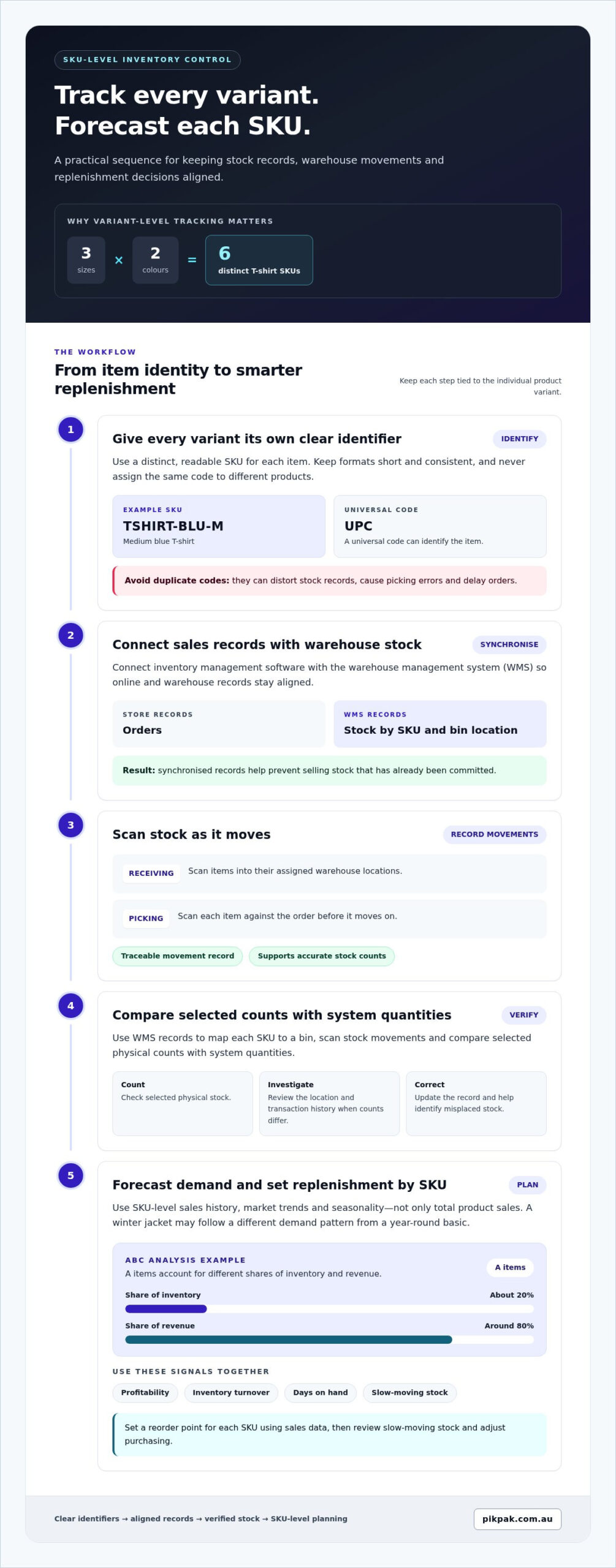
A broad product range can make fulfilment harder than it seems. Fulfillment for businesses with a high SKU count is more complex because each variant needs accurate tracking, a clear warehouse location and the right pick, pack and ship process. For example, a shirt in three sizes and two colours has six distinct SKUs.
If you’re managing a growing catalogue, you know that more choice means more to track. The answer isn’t simply to cut products. Organise inventory and workflows so staff can find, pick and pack the right item reliably.
This article explains how a high SKU count affects inventory tracking, demand forecasting, warehouse operations and order fulfilment. It covers practical ways to structure the process, from consistent SKU records to picking workflows that help orders move accurately.
Key Takeaways
- Give each product variant its own clear SKU and keep inventory records organised so stock movements are easier to track.
- Use sales patterns and SKU performance to guide replenishment, spot slow-moving stock and make forecasting more practical.
- Plan warehouse locations and picking space around the range of products, especially when similar items could be mistaken for one another.
- Review pick-pack-ship workflows for unnecessary handling and travel, helping orders move through the warehouse with greater accuracy.
1. SKU-level inventory tracking and demand forecasting
Fulfillment for businesses with a high SKU count starts with giving every item a distinct, readable identifier. For example, TSHIRT-BLU-M could identify a medium blue T-shirt, while a barcode such as a UPC is a universal code. Keep SKU formats short and consistent, and never assign one code to different products. Duplicate codes can distort stock records, cause picking errors and delay orders.
Connect inventory management software with the warehouse management system (WMS) to keep online and warehouse records aligned. The store records orders; the WMS tracks stock by SKU and bin location. Synchronised records help prevent selling stock that’s already committed. At receiving, staff can scan items into their assigned locations. During picking, they can scan each item against the order, creating a traceable movement record and supporting accurate stock counts. This is a practical foundation for fulfillment for businesses with a high SKU count.
How do 3PLs manage accuracy, bin locations and cycle counting across many SKUs? They use WMS records to map each SKU to a bin, scan stock movements and compare selected physical counts with system quantities. When a count differs, staff can investigate the location and transaction history, then correct the record. This can help identify misplaced stock before it disrupts an order.
Use SKU-level sales history, market trends and seasonality to forecast demand for each item, rather than relying only on total product sales. A winter jacket may follow a different demand pattern from a year-round basic, so replenishment decisions should reflect individual SKU performance. ABC analysis can help prioritise review: its example classifies A items as about 20% of inventory and around 80% of revenue. Combine that view with profitability, inventory turnover and days on hand to identify items needing closer attention. Set a reorder point for each SKU using sales data, then review slow-moving stock and adjust purchasing. This shared data helps make fulfillment for businesses with a high SKU count easier to plan across forecasting, storage and picking.
2. How do SKUs affect warehouse operations?
Each additional SKU needs a clear storage location, accurate stock records and a place in the picking workflow. In a warehouse, 100 cartons containing 10 SKUs occupy more slots and space than 100 cartons containing five SKUs. That extra complexity can increase receiving time, storage needs, handling labour and the chance of picking the wrong item.
Plan capacity around the product range, not just total inventory volume. Consider carton dimensions, units held per SKU, order frequency and whether similar products need separate bins. Inventory management software can connect these details to warehouse locations and stock levels. Review slow-moving items as well: stock that takes up space without regular orders can limit room for faster sellers.
How do in-house fulfilment and 3PL services compare for Australian businesses with many SKUs? In-house operations give a business direct control over storage space, staff and picking priorities, but require it to manage those resources. A 3PL can handle storage and fulfilment workflows, while the business focuses on sales, product decisions and demand planning.
What minimum order volumes or storage requirements do Australian fulfilment providers have? Requirements depend on factors such as SKU range, product dimensions, stock volume, order patterns and the warehouse capacity needed for safe, organised storage. Assess these together: a compact range with frequent orders has different space and picking needs from a broad product line with bulky, slower-moving items.
Storage also affects the cost of holding inventory. Inventory carrying costs generally range from 20% to 30% of a business’s total inventory value. More SKUs can add storage and packaging demands, while extra handling can raise labour needs. Track occupancy, order volume and stock movement to identify where space or processing time is being used inefficiently.
Match warehouse capacity to actual product dimensions and order patterns to support efficient operations. Explore warehouse and fulfilment operations for a useful view of how storage and order handling connect.
3. SKU proliferation and its operational effects
Catalogue growth can multiply the number of SKUs faster than the number of product names suggests. A business selling 100 products with three variations per product manages 300 SKUs. Apparel and footwear ranges often expand through sizes and colours, while customisation and regional assortments add further combinations. A business entering a new region may need different styles to match local customer preferences. Each addition can mean another stock record, storage decision and logistics task.
Unplanned expansion puts pressure on fulfilment operations. When staff need to distinguish similar products, more variants can make locations harder to remember and picking slower. The risk increases if descriptions or labels don’t clearly identify each item. Multiple fulfilment locations add complexity because stock must be allocated and tracked across sites. Slow-moving products also take up space and may become excess or obsolete inventory, tying up resources that could support better-selling items.
SKU growth can complicate forecasting and merchandising, too. A product family may sell well overall while individual colours or sizes move at very different rates. Review performance by SKU, not just by product line, so purchasing reflects actual demand. A wide catalogue gives customers more choice, but too many options can make product pages harder to navigate. Clear descriptions and focused merchandising help customers understand the differences.
Use a regular range review to connect customer needs with operational effort. Compare each SKU’s sales, profitability, seasonality and storage demands, then decide whether to retain, adjust or phase out weak performers. A review can flag the bottom 10% to 20% of underperforming SKUs for phase-out or discounting. Treat that as a shortlist, not an automatic cut: removing popular sizes or colours could frustrate customers. Test each decision against demand and service needs, and control new additions with a clear business case. That discipline keeps catalogue growth deliberate and makes logistics easier to plan accurately.
4. Fulfilment efficiency and pick-pack-ship workflows
For ecommerce and retail orders, speed depends on a clear process from order release to dispatch. A stock keeping unit identifies the exact product and variant, while a barcode scan helps verify it against the order. Keep the sequence consistent: release orders, pick items, check quantities, pack, label and dispatch. Record each handover so staff can see where an order is in the workflow.
Picking design matters as the number of stock keeping units grows. Grouping orders from nearby warehouse areas can help staff organise picking more efficiently. Task interleaving can guide workers along an efficient route instead of sending them back and forth. Place frequently sold products in convenient picking locations and clearly separate similar-looking variants. These workflow choices make fulfillment for businesses with a high SKU count easier to organise.
How do fulfilment providers handle kitting, bundles, product variants and barcode labelling? They can define each bundle’s component SKUs and required quantities, then pick and assemble the items for the order. A completed bundle can have its own identifier and label, while scans distinguish it from individual products and similar variants.
Packing needs the same discipline as picking. Match the order contents to the packing record before sealing the parcel, then apply the correct shipping label. For example, check each bundle component against the order before dispatch. Clear exception steps let staff pause and resolve a missing or mismatched item instead of sending an incomplete order. Reliable fulfillment for businesses with a high SKU count depends on making these checks part of the standard process.
Review the workflow using practical measures: picking errors, rework, processing delays and repeated warehouse travel. If errors cluster around one product family, inspect its bin placement, labels and order instructions. Kitting and assembly can support defined bundles, but changes to bundle contents require updated component records. Explore warehouse fulfilment workflows to see how picking, packing and dispatch fit together.
Pik Pak Logistics: Pick, Pack, and Ship Services
Pik Pak Logistics helps ecommerce businesses manage the work behind a broad product range with its Pick, Pack, and Ship Services. When inventory volume and variant handling make in-house order processing difficult, Pik Pak brings product storage, order picking, packing and dispatch together in one fulfilment workflow.
Inventory Storage supports organised stock holding, while home delivery shipping options help get orders to customers. Returns Management (Reverse Logistics) also helps businesses handle products coming back into inventory. Together, these services cover key stages of the order journey without requiring you to coordinate each task separately.
If managing a growing catalogue is taking time away from your core business, visit pikpak.com.au to learn about Pik Pak Logistics’ fulfilment services.
Make your next growth move with confidence
Growth brings new products, variants and customer expectations. Before expanding your range, consider how each addition will fit your fulfilment workflow, from stock records to order handling. A clear operating plan helps your team assess the practical impact of catalogue decisions before they become daily warehouse tasks.
For businesses with a high SKU count, effective fulfillment means treating product data and warehouse processes as one operation. Review new and existing items regularly, and use what you learn to guide decisions about assortment, storage and order handling. This keeps logistics aligned with business priorities as the catalogue changes.
Pik Pak Logistics can support the order fulfilment work behind your online store. Contact Pik Pak Logistics to discuss your fulfilment needs and next steps. A more organised approach can give you room to focus on building your business.
Frequently Asked Questions
Why are high SKU counts more complex?
Every distinct size, colour or configuration needs its own inventory record and fulfilment handling. The task becomes more complex when variants look alike or sell at different rates. For example, a retailer may have plenty of one shoe size but run short of another, even when the overall style appears well stocked. Clear product identifiers and sales reviews help teams manage each variant separately.
How do SKUs affect warehouse operations?
More SKUs mean more items for staff to receive, locate and distinguish in daily warehouse work. A new variant may need its own bin assignment and product label, even if it differs only by colour. Receiving teams must record the correct item, and dispatch teams must match each order line to the right stock. Organised locations and consistent product data make these handovers easier to manage.
What fulfillment providers in Australia specialise in businesses with high SKU counts?
Pik Pak Logistics provides eCommerce fulfilment for Australian online stores, including Inventory Storage and Pick, Pack, and Ship Services. Its web-based platform integrates with online stores and provides real-time visibility of inventory and order status. For a business with many variants, this helps keep online stock information connected to warehouse operations as orders are processed.
How do Australian 3PLs price storage and fulfillment for large product catalogues?
Pricing can reflect storage space, order volume and handling requirements, so a broad catalogue’s footprint and activity matter. Pik Pak Logistics offers transparent, pay-as-you-go pricing. To assess what your operation needs, consider product dimensions, stock levels and order patterns, then review the quote for the services and handling involved.
What warehouse management system features are essential for high-SKU fulfillment?
A useful WMS connects each product variant to accurate inventory records and warehouse locations. Look for item-level stock visibility, clear order status and integration with your online store, so information stays aligned between sales and warehouse operations. Receiving and dispatch records also help trace stock movements. These features give teams practical information for locating products and resolving discrepancies without relying on separate spreadsheets.
How should businesses evaluate pick-and-pack accuracy and order turnaround for high-SKU warehouses?
Review accuracy and speed separately. Compare order records with picked items, then identify where errors occur, such as variant selection, quantity checks or labelling. To assess turnaround, record the time from order release through picking and packing to dispatch, and pinpoint delays at each handover. Look for consistent results across product types, including similar-looking variants and bundled orders, rather than judging performance from a single straightforward order.