What if your growing eCommerce brand could match the 99.9% order accuracy of a retail giant without owning a single square metre of warehouse space? It’s a daunting thought when you’re currently tripping over stock or losing track of inventory in a cramped backroom. You likely look at the massive big w distribution service centre in Hoppers Crossing, which spans 89,000 square metres, and feel that such efficiency is reserved only for the biggest players in Australia.
We agree that the jump from a small storage unit to enterprise-level logistics often feels like an impossible leap. This guide will show you exactly how these massive hubs operate and how you can replicate their success. You’ll discover how to access professional-grade technology and automation through a strategic 3PL partnership. We’ll break down the difference between distribution and fulfillment while showing you how to focus on your business while the logistics run like clockwork. By the end, you’ll see how to scale your inventory management without the headache of a massive warehouse lease.
Key Takeaways
- Peek inside the big w distribution service centre at Hoxton Park to see how enterprise-level scale and strategic location anchor Australia’s retail supply chain.
- Learn how automated sorting and cross-docking techniques slash “human-touch” errors and ensure your inventory moves like clockwork.
- Identify whether your business requires a distribution centre for B2B replenishment or a fulfillment centre to handle high-volume B2C orders.
- Discover how to access enterprise-grade Warehouse Management Systems (WMS) and logistics technology without the massive upfront software costs.
- Reclaim your time and eliminate the “logistics headache” by applying the same smart efficiency used by retail giants to your own boutique eCommerce store.
What is the Big W Distribution Service Centre?
The big w distribution service centre is the high-performance engine room behind one of Australia’s most iconic retail brands. It isn’t just a place to store boxes; it is a sophisticated hub designed to ensure that products move from suppliers to store shelves with zero friction. To understand the complexity of these operations, it helps to look at the broader definition of What is a Distribution Centre? and how it differs from a traditional warehouse. While a warehouse might hold stock for long periods, this service centre is built for velocity and high-volume throughput.
Located in Hoxton Park, NSW, the primary facility serves as the strategic heartbeat of the Australian retail supply chain. This location was chosen specifically for its proximity to major transport industrial corridors, allowing Big W to service its national network of over 180 stores efficiently. The primary function of the site involves three critical stages: bulk receiving, inventory breakdown, and rapid dispatch. When thousands of shipping containers arrive annually, the facility must process them immediately to maintain the flow of goods. This keeps the retail “heartbeat” steady and ensures customers find what they need every time they walk into a store.
The Scale of Hoxton Park
The sheer physical size of the Hoxton Park facility is difficult to grasp without seeing it. It covers a staggering 89,000sqm footprint, making it one of the largest portal frame structures in the Southern Hemisphere. For a major retailer, this massive scale is a functional necessity rather than a luxury. The facility utilizes a Just-in-Time (JIT) delivery model, which reduces the need for long-term storage and focuses on moving inventory within 24 to 48 hours of arrival. This model minimizes waste and keeps capital fluid.
Managing this volume requires heavy-duty infrastructure. The site features expansive hardstands and massive car parks designed specifically for interstate freight. These areas must accommodate 25-meter B-double trucks and heavy rigid vehicles that arrive around the clock. Without this specialized structural design, the big w distribution service centre could not handle the 1.5 million cartons that often pass through such facilities during peak seasonal periods like Christmas or Click Frenzy.
Who Uses These Facilities?
Operation of a 89,000sqm hub requires a diverse workforce and a network of professional partners. The daily population of the site includes:
- Internal Logistics Staff: Woolworths Group employees who manage the complex Warehouse Management Systems (WMS) and oversee floor operations.
- Interstate Freight Providers: Long-haul drivers who move bulk stock between states, often operating on strict 15-minute arrival windows.
- External Couriers: Local delivery partners who handle smaller, time-sensitive shipments for regional store replenishment.
- 3PL Partners: Third-party logistics experts who assist with overflow or specialized inventory needs.
Efficiency at this scale depends entirely on following standard professional protocols. Every driver and supplier entering the site must adhere to strict warehouse receiving guidelines to prevent bottlenecks. When everyone follows the same playbook, the “headache” of logistics disappears, and the system runs like clockwork. This collaborative approach allows Big W to maintain its promise of stock availability for millions of Australian families every week.
How Modern Distribution Centres Drive Efficiency
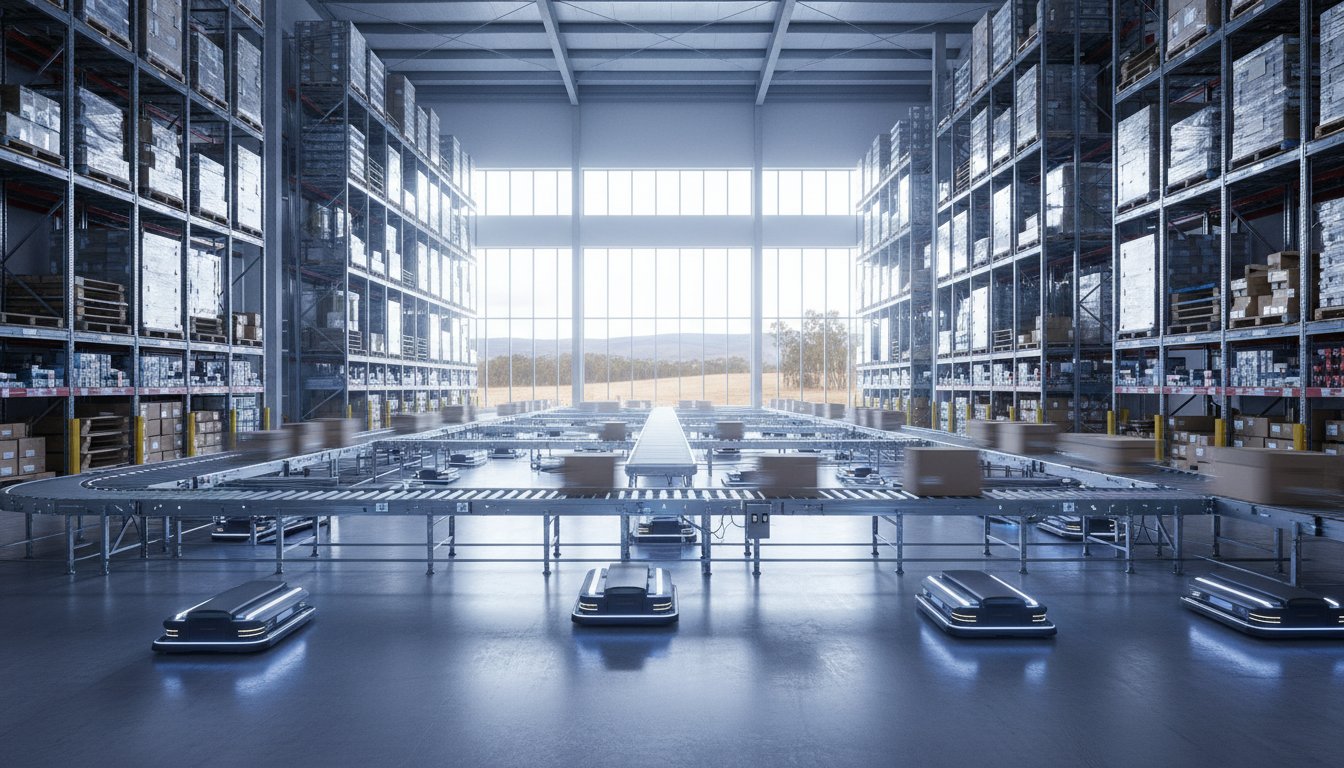
Efficiency in a massive hub like a big w distribution service centre isn’t accidental. It’s the result of precision engineering and smart tech. In high-volume environments, every second saved on a pick or pack translates to thousands of dollars in annual operational savings. Modern facilities now rely on automated sorting systems to handle the heavy lifting. These systems reduce “human-touch” errors by up to 98%, ensuring that the right product reaches the right store without manual intervention. By removing the need for workers to walk kilometres of aisles, robots and conveyors keep the flow constant and predictable.
Cross-docking is another pillar of modern speed. Instead of letting stock sit on shelves for weeks, goods arrive at the receiving dock and move almost immediately to the shipping area. This reduces storage time to less than 24 hours in many cases. It’s a lean approach that minimizes inventory holding costs and keeps the supply chain moving. While a Distribution Centre vs. Fulfillment Centre might focus on different end-users, the goal of rapid throughput remains identical. By bypassing the traditional storage phase, companies eliminate waste and get products into customers’ hands faster.
Sustainability is also driving design choices in 2024. Large-scale operations are moving toward carbon neutrality by installing massive solar arrays. For example, a 1-megawatt solar system on a warehouse roof can offset over 1,200 tonnes of CO2 annually. Combined with motion-sensor LED lighting and rainwater harvesting, these facilities reduce their environmental impact while lowering long-term utility costs. If you want to simplify your own logistics, adopting even a fraction of these efficiencies can make a massive difference to your bottom line.
The Role of Technology in Large Scale Logistics
Cloud-based systems have changed the game for real-time tracking. Instead of waiting for end-of-day reports, managers see stock levels across 1,000+ locations instantly. We’ve moved away from manual clipboards to digital API-led integrations that connect suppliers directly to the warehouse floor. The Warehouse Management System (WMS) acts as the digital brain of any modern distribution facility, coordinating every movement from dock to door. This connectivity ensures that the big w distribution service centre can track millions of SKUs with 99.9% accuracy, making stockouts a thing of the past.
Operational Standards and Safety
Safety is the foundation of any productive warehouse. High-density racking must meet strict Australian standards, such as AS 4084-2012, to prevent collapses under heavy loads. Regular inspections are mandatory, often occurring every 12 months to ensure structural integrity. Standardized labelling and packaging are equally vital. Without clear, machine-readable codes, automated systems can’t function. By enforcing strict protocols for heavy machinery and designated pedestrian zones, facilities ensure that high-speed operations don’t come at the cost of worker wellbeing. It’s about creating a secure environment where technology and people work in harmony to deliver results.
Distribution Centre vs. Fulfillment Centre: Which Do You Need?
Understanding the difference between these two hubs is the first step to scaling your business. While a big w distribution service centre is designed to move massive volumes of stock to retail storefronts, your needs might be more focused on the end consumer. A distribution centre (DC) acts as a long-term storage and transit point for bulk goods. Its primary goal is B2B replenishment. In contrast, a fulfillment centre (FC) is an agile environment built for B2C speed. It’s where individual orders are picked, packed, and sent directly to a customer’s front door.
Many Australian business owners start in a garage or a small storage unit. However, as soon as you hit a consistent volume of 40 to 50 orders per day, manual processing becomes a bottleneck. This is the point where you must increase operational efficiency by transitioning to a professional 3PL provider. Waiting too long to make this move often leads to shipping errors and unhappy customers. Moving to a professional facility ensures your logistics run like clockwork, regardless of order spikes.
The cost structure is the biggest hurdle for growing brands. Owning or leasing a private facility involves massive fixed costs. In 2023, industrial rent in major Australian hubs like Sydney and Melbourne saw double-digit growth. You’re stuck paying for the entire floor space, even if it’s half empty. A 3PL like Pik Pak offers a variable, “pay-as-you-go” model. You only pay for the specific shelf or pallet space you occupy and the number of orders we process. This keeps your capital free so you can invest it back into marketing and product development.
Scalability used to be a luxury reserved for giants. The big w distribution service centre model relies on 89,000sqm of space and high-tech automation to maintain efficiency. With Pik Pak, you get to mimic that level of precision without the terrifying lease. Our technology integrates directly with your store, allowing you to scale from 10 orders a week to 1,000 without ever picking up a roll of packing tape. It’s about giving your small business the backbone of a retail giant.
When to Choose a Distribution Model
This model is the right fit if your primary customers are other businesses or physical retail outlets. If you’re moving 20 pallets at a time to major retailers, you need a system built for bulk freight management and long-term storage. It’s less about individual parcel speed and more about inventory security and pallet-in, pallet-out efficiency. For more details on managing large-scale stock, explore our warehousing and fulfilment services.
When Fulfillment is the Smarter Move
Fulfillment is the essential choice for eCommerce brands. If you sell on Shopify, eBay, or Amazon, you need a “Pick, Pack, and Ship” workflow. Speed is the priority here. Customers expect their tracking numbers within hours, not days. An FC is optimized for this rapid turnover, ensuring that a single item can be found, packed, and dispatched to a customer in Perth or Brisbane with zero friction. It’s the most effective way to reclaim your time and focus on growth.
Replicating Enterprise Efficiency for Your eCommerce Store
Replicating the massive scale of a big w distribution service centre doesn’t require a multi-million dollar capital investment. Most eCommerce founders start in a garage or a small self-storage unit, but this quickly becomes a growth ceiling. When you’re spending 15 hours a week taping boxes, you aren’t spending that time on marketing or product development. Moving to a professional 3PL eliminates this logistical headache. It transforms your operations from a manual chore into a streamlined system that rivals major retailers.
By using a 3PL, you gain access to enterprise-grade Warehouse Management Systems (WMS) without the typical A$30,000 to A$80,000 upfront software costs. These systems track every SKU with 99.9% accuracy. This level of precision is exactly what happens inside a big w distribution service centre, and it’s now available to businesses of any size. Professional handling ensures that the right product reaches the right customer every time; this directly reduces return rates by up to 22% and builds long-term consumer trust.
Shipping across Australia presents unique challenges due to our geography. A single warehouse in Sydney can’t cost-effectively reach a customer in Perth or Darwin in under 48 hours. Using a 3PL with multiple nodes across the country reduces transit times and lowers shipping costs by an average of 18% per parcel. Your customers expect fast delivery. Providing it makes your brand look like a national powerhouse without the need for you to manage multiple leases or staff teams yourself.
Integrating Your Online Store
Automation is the secret to modern logistics. API connections allow orders to flow directly from Shopify, WooCommerce, or eBay into the warehouse queue. You can use technology support that lets you point, click, and connect your entire business in minutes. Automation eliminates the need for manual data entry in logistics, which is where the vast majority of shipping errors occur. It ensures your data remains clean and your fulfillment stays fast while you sleep.
Scaling Without the Risk
Fixed costs are the enemy of a growing brand. A scale as you grow model means you only pay for the pallet spaces or shelf slots you actually use each month. During seasonal peaks like Black Friday, you don’t need to scramble to hire 10 temporary staff members or rent extra warehouse space. The 3PL handles the surge for you. This flexibility can save an emerging business over A$4,000 in monthly overhead during slower periods, keeping your cash flow healthy.
Stop packing boxes and start growing your brand. Get started with Pik Pak today to streamline your fulfillment.
Why Pik Pak is Your “Boutique” Distribution Partner
You’ve seen how a big w distribution service centre operates at a massive scale to keep shelves stocked across Australia. These hubs are marvels of efficiency, using strict logic to move thousands of units every hour. Pik Pak takes that exact industrial-grade logic and scales it down for the growing eCommerce brand. You don’t need to move 50,000 pallets a month to access professional-grade logistics. We provide a “boutique” experience that gives you the same competitive edge as a national retailer, but with the personal touch your small business deserves.
Our facilities are designed for maximum inventory safety. We operate secure, state-of-the-art warehouses equipped with 24/7 CCTV monitoring and advanced fire suppression systems. While a big w distribution service centre focuses on bulk, we focus on the precision of your specific SKU count. Whether you have 10 products or 1,000, your inventory is tracked with 99.9% accuracy using our cloud-based management system. This level of detail ensures you never lose a sale due to “ghost” stock or inventory damage.
Pricing transparency is where we truly stand apart from traditional 3PL providers. Many logistics companies bury costs in complex 20-page contracts filled with “inbound handling” and “fuel surcharge” surprises. We don’t do that. Pik Pak operates on a clear “Pay as you go” model. You only pay for the shelf space you actually use and the orders we ship. There are no A$500 monthly “account management” fees or hidden software integration charges. This direct approach helps our clients maintain 15% to 20% better margins compared to managing a cluttered in-house garage operation.
Logistics shouldn’t be a headache; it’s a system that should run like clockwork. When we take over the “pick, pack, and ship” process, you regain roughly 15 to 25 hours every single week. That’s time you can reinvest into Instagram marketing, product sourcing, or customer acquisition. We handle the heavy lifting so you can focus on the high-level strategy that actually grows your bank balance. We make the hard work look easy so your brand can shine.
Our Commitment to Service
Our team understands the unique pressures of the Australian eCommerce market, from managing Australia Post shipping deadlines to navigating StarTrack collection times. We’ve built our service priorities around the belief that your growth is our primary metric for success. You aren’t just a number in a database. You get access to dedicated support staff who understand your specific products and packaging requirements. We currently maintain a 4.8-star service rating because we treat every parcel like it’s our own.
Ready to Scale?
It’s time to stop viewing logistics as a drain on your resources. Instead, see it as a growth lever. By outsourcing to a partner that mimics the efficiency of a major distribution hub, you’re preparing your business for 2x or 3x growth without the usual growing pains. Are you ready to stop packing boxes in your living room and start building an empire? Get a tailored quote from Pik Pak Logistics today and see how simple professional fulfilment can be.
Scale Your Fulfillment with Enterprise Precision
You don’t need a 50,000 square metre facility to achieve the operational excellence found at a big w distribution service centre. Enterprise level efficiency comes down to smart systems and reliable execution. By moving away from manual spreadsheets and adopting cloud based automation, Australian eCommerce brands can reduce shipping errors by up to 98%. It’s about making your logistics run like clockwork so you can scale without the usual growing pains.
Pik Pak brings this high level tech to businesses of all sizes. We make Pick, Pack & Ship Easy by providing real time inventory visibility through our cloud based WMS. This gives you total control over every SKU without the overhead of a massive warehouse. There’s no software to install; it’s a simple point, click, and connect setup that gets your store moving in minutes. Stop stressing over boxes and start growing your brand.
Focus on your business and let Pik Pak handle the hard work-Get Started Now
Building a successful retail brand in Australia is a marathon. With the right partner, your fulfillment becomes a competitive advantage instead of a daily headache. You’ve got this.
Frequently Asked Questions
Where is the main Big W Distribution Centre located?
Big W operates several major hubs across Australia, with its primary regional facilities located in Hoppers Crossing, Victoria, and Monarto, South Australia. The Monarto site is a massive 70,000 square metre facility that services hundreds of stores across the country. These centres are positioned near major transport arteries to ensure inventory moves from the big w distribution service centre to retail shelves in under 48 hours.
Can small businesses use the Big W Distribution Centre?
No, you can’t use these facilities for your own business because they’re private assets owned by the Woolworths Group. The big w distribution service centre is designed specifically to manage internal stock for their 176 retail stores nationwide. Small eCommerce brands should look for a 3PL provider like Pik Pak. We provide the same high-level logistics infrastructure but make it accessible for businesses of any size through a flexible, “pay as you go” model.
What is the difference between 3PL and a retail distribution centre?
A retail distribution centre is a single-user facility that only handles products for one specific brand, like Big W or Kmart. In contrast, a 3PL is a multi-user warehouse that manages logistics for dozens of different eCommerce businesses at the same time. This shared model allows you to split the costs of rent, staff, and technology. It gives you the power of a global supply chain without the A$10 million investment required to build your own facility.
How much does it cost to outsource my logistics to a 3PL in Australia?
Costs vary based on your volume, but you’ll typically pay between A$4.80 and A$6.50 per pallet per week for storage in 2024. Order fulfillment fees usually start at A$2.50 for a standard pick and pack service. While these fees might seem like an extra expense, most businesses save 25% on their total operational costs. You’ll also gain access to bulk shipping rates that are significantly lower than standard Australia Post retail prices.
What are the benefits of using a fulfillment centre for my online store?
The biggest advantage is the ability to reclaim your time and focus on marketing or product development. A professional fulfillment centre ensures 99.9% order accuracy, which virtually eliminates the headache of dealing with customer returns and complaints. It also allows you to scale instantly. If your orders jump from 10 to 500 a day during a flash sale, the warehouse handles the surge while you keep your operations running like clockwork.
How does a Warehouse Management System (WMS) help my business?
A WMS replaces manual spreadsheets with a secure, automated digital dashboard that tracks every single item in your inventory. It integrates directly with your sales channels, which reduces human picking errors by 85% and prevents you from selling stock that isn’t actually on the shelf. You don’t need to be a tech expert to use it. Our system offers a simple “point, click and connect” setup that gives you total control over your business data.
What should I look for when choosing a 3PL partner in Melbourne or Sydney?
You should prioritize a partner that offers transparent pricing and has no long-term lock-in contracts. Look for a facility that uses advanced automation and provides multi-channel customer support based right here in Australia. It’s vital to choose a provider with a warehouse located near major freight hubs like the Port of Melbourne or Port Botany. This proximity can reduce your last-mile delivery times by 24 hours or more, keeping your customers happy and loyal.