What if every hour you spent packing boxes was actually stalling your company’s growth by 40 percent? For many Australian founders, the reality of manual fulfilment is a cycle of late nights and shipping errors that cost an average of A$45 per mistake. It’s time to stop drowning in bubble wrap and start thinking about your pick and pack strategy as a growth engine rather than a chore.
You likely believe that handling orders yourself saves money, but the lack of warehouse space and rising customer complaints are probably holding your inventory hostage. We’re going to change that. This guide reveals how a professional Pik Pak strategy can streamline your operations, reduce shipping errors, and free up your time to focus on business growth. We’ll walk through the transition to a hands-off fulfilment process that utilizes 3PL volume discounts and provides real-time visibility into your stock levels so your business can finally run like clockwork.
Key Takeaways
- Master the five essential stages of a high-performance fulfilment cycle to ensure your Australian eCommerce operations run like clockwork.
- Learn how a professional p ik and pack strategy eliminates shipping errors and transforms complex logistics into a simple, manageable task.
- Identify the hidden costs of DIY fulfilment in the Australian market and discover exactly when it’s time to move to a 3PL partner.
- Understand how real-time inventory visibility and WMS technology act as the brain of your warehouse to prevent stock-outs and protect your brand.
- Reclaim your time to focus on business growth and marketing by letting experts handle the daily headache of packing and shipping.
What is Pick and Pack (Pik Pak) Logistics?
Pick and pack is the operational heartbeat of every successful eCommerce business. It is the specific process where individual items are pulled from warehouse shelves and prepared for shipment to the end consumer. While many people confuse this with simple storage, they are worlds apart. Storage is passive; it is just stock sitting in a room. Pick and pack is active order fulfillment. It is the high-speed transition from a digital “buy” button to a physical package landing on a doorstep. For Australian business owners, mastering the p ik workflow is often the difference between a stagnant side hustle and a rapidly scaling brand.
The emotional shift here is profound. When you first start, you are likely the one taping boxes on your living room floor at 11 PM. Moving to a professional 3PL model means you stop “doing it all” and start “managing growth.” You transition from a manual laborer in your own business to a strategic leader. This change eliminates the logistical headache that keeps 45% of small business owners awake at night, allowing you to focus on marketing and product development while the heavy lifting happens elsewhere.
The Core Components of the Process
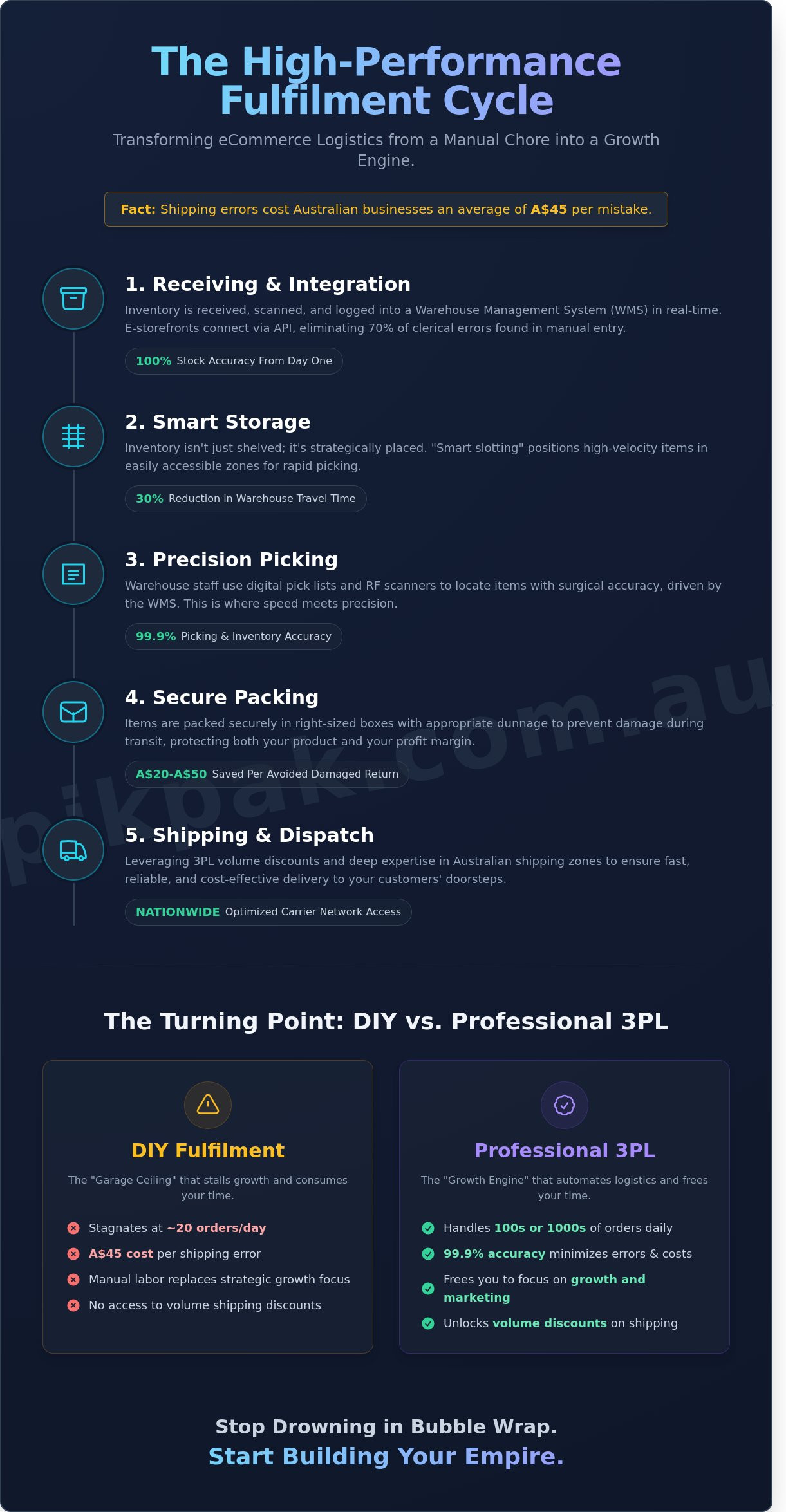
Receiving is the first critical step. Inventory does not just sit on the floor; it is logged into a Warehouse Management System (WMS) within hours of arrival. This ensures 100% stock accuracy from day one. Storage follows, but it is not about just finding a shelf. We use smart slotting, which places high-velocity items in easily accessible zones. This strategy can reduce warehouse travel time by up to 30%, directly impacting how fast your customers receive their orders.
The pick is where speed meets precision. Warehouse staff use digital pick lists to find items with surgical accuracy. Understanding What is Order Processing is essential here, as it highlights how picking is the most labor-intensive part of the supply chain. Finally, the pack stage ensures your goods are secure. We select the right-sized boxes and dunnage to prevent damage during the transit process across Australia. This reduces the A$20 to A$50 cost impact that typically follows every damaged return.
Why “Pik Pak” is More Than a Brand Name
In the Australian market, the term has become a phonetic shorthand for efficiency. It represents the rhythmic “click-clack” of a warehouse running like clockwork. As the Australian eCommerce sector surpassed A$63 billion in total spend recently, the demand for professional fulfillment has skyrocketed. Using a professional service helps you break through the “garage-based” logistics ceiling. Most home-based businesses hit a wall at 20 orders per day. A professional p ik system handles hundreds or thousands of orders without breaking a sweat.
- Scalability: You only pay for the space and labor you use, which is vital for seasonal peaks like Black Friday.
- Technology: Direct API integrations mean your store talks to the warehouse in real-time.
- Expertise: You gain access to a team that understands Australian shipping zones and carrier rates intimately.
The evolution of 3PL in Australia has moved from dusty warehouses to tech-driven fulfillment centers. This shift allows you to automate the mundane tasks. You don’t need to be a computer geek to make it work. With a simple point and click connection, your logistics run in the background. It is about making the complex feel easy, ensuring your operations are secure, and finally freeing up your time to build your empire.
The 5 Stages of a High-Performance Fulfilment Cycle
Efficient fulfilment is the engine room of your eCommerce brand. It’s a science. When you master the p ik and pack process, you turn a potential bottleneck into a competitive advantage. It’s about moving from manual chaos to a streamlined, five-stage cycle that runs like clockwork. This ensures your customers get what they ordered, exactly when they expect it, without the usual logistics headaches.
Step 1 & 2: Integration and Picking
Everything starts with a seamless digital handshake. Our technology support connects your e-storefront directly to the warehouse floor. This removes the need for manual data entry, which is where 70% of clerical errors usually occur. Once an order is placed, a Warehouse Management System (WMS) triggers the picking process. This is where p ik efficiency is won or lost. We don’t just wander the aisles; we use data to drive every movement.
The role of barcodes and RF scanners is central to this stage. By scanning each item at the bin location, we eliminate human error and maintain 99.9% inventory accuracy. We also focus heavily on pick paths. In a standard 5,000 square metre warehouse, an unoptimised picker might walk 15 kilometres a day. We use wave picking to group orders by location or zone picking for high-volume periods. This strategy often reduces warehouse travel time by 40%, allowing your business to handle 2024 peak season volumes without breaking a sweat. Speed is the goal, but accuracy is the requirement.
Step 3, 4 & 5: Packing to Delivery
Quality control is your final safety net before a parcel leaves the building. We implement a double-check phase where a second team member or an automated scanner verifies the contents against the packing slip. A single shipping error in Australia can cost a business upwards of A$35 when you factor in return freight, restocking fees, and warehouse labour. Preventing that return is the easiest way to protect your margins.
Packaging optimization is the next priority. We don’t just put items in a box; we right-size the packaging to reduce dimensional weight. If you ship air, you pay for air. By selecting the smallest possible footprint for a parcel, businesses frequently save 15% to 20% on their total freight spend. For brands looking to stand out, we also provide customised kitting and assembly. This is perfect for promotional bundles or subscription boxes that require a specific unboxing experience. It’s about making your brand look professional from the moment the tape is cut.
The final stage involves selecting the right courier via a Transport Management System (TMS). This software compares rates across major Australian carriers to find the best balance of price and speed for every post code. We know that customer delivery options are the final touchpoint of your brand. Whether it’s a standard drop-off or an express service, the handoff must be clean. If you’re ready to stop worrying about the logistics of your store, you can see how our team handles the heavy lifting so you can focus on growth. We make the complex task of shipping feel like an easy game.
Warehouse Management Systems: The Brain of Modern Logistics
Manual spreadsheets are the enemy of any growing eCommerce brand. While a basic table might suffice for a handful of orders, it quickly becomes a liability when you scale. Industry data shows that manual data entry carries a 15% error rate, leading to incorrect stock levels and frustrated customers. A Warehouse Management System (WMS) acts as the central brain of your operation. It ensures your p ik workflow is efficient and error-free. By ditching the manual logs, you stop reacting to problems and start managing growth. Real-time inventory visibility is the only way to prevent stock-outs during peak Australian shopping seasons like Click Frenzy or Boxing Day.
API integrations bridge the gap between your sales channels and the warehouse floor. Whether you sell on Shopify, WooCommerce, or eBay, a smart WMS syncs every sale instantly. You won’t have to worry about accidentally overselling an item that just left the dock. Data analytics then take this a step further. Detailed logistics reports allow you to forecast future sales based on historical trends. This prevents you from tying up A$10,000 or more in slow-moving stock, keeping your cash flow healthy and your shelves optimized.
Cloud-Based vs. Legacy Systems
Modern logistics has moved away from expensive, clunky software. Legacy systems often required A$20,000 or more in upfront licensing fees and dedicated on-site servers. Today, cloud-based platforms offer a flexible “pay-as-you-go” model that scales with your volume. You can access your dashboard from a home office in Melbourne, a warehouse in Sydney, or even while travelling. Security is a top priority too. These platforms use high-level encryption to protect sensitive customer data, ensuring you stay compliant with Australian privacy laws without the technical headache.
Automation and “Smart” Warehousing
Smart warehousing removes the guesswork from daily operations. Algorithms now determine the best box size for every order before the picker even reaches the shelf. This simple step can reduce your shipping costs by an average of 12% by avoiding “volumetric weight” surcharges. Automated tracking updates are another major win for your team. They send real-time notifications to customers, which reduces “Where is my order?” (WISMO) inquiries by up to 30%.
Linking your warehousing and fulfilment directly to your digital marketing creates a seamless loop. You can automatically pause your Facebook or Google Ads the moment an item hits a low-stock threshold. This level of control makes the entire p ik process feel effortless. It allows you to focus on your business while the technology does the heavy lifting. Everything runs like clockwork, giving you back the time you need to innovate and find your next best-selling product.
In-House vs. Outsourced: When to Move to a 3PL Partner
Scaling an eCommerce brand in Australia is exciting until you find yourself buried under a mountain of bubble wrap and cardboard. Many founders start by fulfilling orders from a spare room or garage to save money. This DIY approach works for a while, but it eventually hits a ceiling where the cost of your time far outweighs the savings. When you integrate a professional p ik strategy into your operations, you stop being a warehouse worker and start acting like a CEO again.
The hidden costs of DIY fulfilment are often higher than a 3PL invoice. Rent for a small industrial unit in Sydney or Melbourne now averages between A$210 and A$260 per square metre. On top of that, you have to factor in public liability insurance, warehouse equipment, and the “Fair Work” compliant wages for casual staff. A casual packer under the Storage Services and General Warehouse Award costs roughly A$30.91 per hour. These are fixed overheads that drain your bank account even during slow months.
There’s also the “Opportunity Cost” to consider. If your time is worth A$100 an hour and you spend four hours a day packing boxes, you’re effectively spending A$400 a day on manual labour. That’s A$2,000 a week that could have been spent on Meta ads, influencer outreach, or product development. Using p ik services allows you to reallocate those hours toward activities that actually drive revenue.
Scalability is the final hurdle. Peak periods like Black Friday or the December Christmas rush can break a small team. In 2023, Australian online sales saw a massive spike during the November sales week. Handling a 400% increase in order volume is impossible in a garage. A 3PL partner manages these peaks effortlessly, ensuring your customers get their parcels on time without you needing to hire and train temp staff for a three-week window.
Cost Comparison: The Real Numbers
A 3PL turns your fixed costs into variable ones. Instead of a A$3,500 monthly lease, you pay a transparent per-order fee. Shipping rates are another major factor. Most small businesses pay A$10.50 to A$15.00 for a standard 500g parcel through Australia Post. Because 3PLs move massive volumes, they access wholesale rates that are often 20% to 30% lower than what you can get on your own. This saving often offsets the entire pick and pack fee.
Signs You Are Ready to Outsource
You’ll know it’s time to move when your operations start to suffer. If you spend more than 120 minutes every day on physical packing, you’ve reached the tipping point. Watch your error rates too. If shipping mistakes exceed 1.5% of your total orders, your brand reputation is taking a hit. Finally, if you’re turning down new stock or cancelling sales because you don’t have the physical space to store inventory, your “free” garage has become a liability to your growth.
Stop letting logistics hold your brand back. Get a fast 3PL quote from Pik Pak and see how easy scaling can be.
Why Pik Pak Logistics is the Smart Choice for Australian Brands
Logistics often feels like a puzzle with missing pieces, but we believe it should be an easy game. Our team handles the heavy lifting so you don’t have to worry about warehouse space or courier delays. By adopting the “Pick, Pack & Ship Made Easy” philosophy, we’ve turned complex supply chains into streamlined systems for over 500 Australian businesses. It’s about more than just moving boxes; it’s about giving you the freedom to scale without the operational friction that usually stops growth in its tracks.
We provide a complete end-to-end solution that starts the moment your stock arrives at our door. Following our warehouse receiving guidelines ensures your inventory is logged and ready for sale within 24 to 48 hours. From that initial intake to managing reverse logistics and returns, every step is designed to be invisible to your customer but invaluable to your bottom line. When you master your p ik strategy with a partner who understands the local market, you reclaim roughly 15 to 20 hours of your work week. That’s time you can spend on marketing, product development, or simply taking a well-earned break.
Technology Meets Personal Service
Our technology is built for founders who value simplicity over complex coding. We use a point, click, and connect approach that integrates with Shopify, WooCommerce, and eBay in minutes. You don’t need to be a computer geek to see real-time stock levels or track shipments across the country. Our support team is based right here in Australia, providing expert advice that actually makes sense for the local eCommerce landscape. One Melbourne-based fashion retailer saw their order volume jump by 300% during a single Black Friday event. They didn’t hire a single extra staff member because our infrastructure absorbed the surge effortlessly. Their p ik accuracy remained at 99.9%, ensuring customers received exactly what they ordered without delay.
Getting Started with Pik Pak
Onboarding your inventory shouldn’t feel like a legal battle or a technical nightmare. We’ve simplified the process to get you up and running in as little as 72 hours. Our pricing is transparent and pragmatic. You won’t find any hidden software fees or long-term lock-in contracts that drain your A$ cash flow. We operate on a pay-as-you-go model, meaning your costs only scale when your sales do. This flexibility is vital for seasonal brands that need to manage lean periods without high overheads. It’s time to stop sweating the small stuff and start thinking big. You can focus on your business and let Pik Pak do the hard work while your operations run like clockwork every single day.
Take Control of Your Growth and Simplify Your Shipping
Managing your own warehouse often leads to 30% higher overhead costs compared to a streamlined 3PL model. Transitioning to an outsourced partner can save small Australian businesses up to A$2,000 per month in hidden storage and labor fees. By mastering the 5 stages of fulfilment and using a robust Warehouse Management System, you eliminate the shipping headaches that stall growth. Moving to Pik Pak means you stop paying for empty shelf space and start using a pay-as-you-go model that protects your margins. Whether you’re integrating with Shopify or eBay, our 1-click API connections ensure your orders flow without manual errors. It’s time to stop packing boxes and start scaling your vision. With our expert Australian-based support team available 5 days a week, your logistics will finally run like clockwork. Choosing p ik logistics ensures your brand is ready for the next peak season without the stress. Let us handle the heavy lifting while you focus on what you do best.
Ready to scale? Get a tailored Pik Pak quote today
We’re here to help your Australian business reach its full potential with ease.
Frequently Asked Questions
What is the difference between pick and pack and standard warehousing?
Standard warehousing focuses on long-term storage of bulk goods, while pick and pack involves selecting individual items from your inventory to fulfill specific customer orders. With Pik Pak, we turn your “p ik” process into a streamlined workflow. This means we don’t just store your pallets; we manage the entire journey from the shelf to the shipping label so your customers get exactly what they ordered.
How much does a 3PL service like Pik Pak typically cost?
Pik Pak operates on a transparent pay-as-you-go model where you only pay for the space and services you use. Pick and pack fees typically start at A$2.50 per order, with storage costs calculated daily based on pallet or shelf space. This eliminates the A$5,000 monthly overhead of a private warehouse lease. You get professional logistics without the fixed costs, making it easy to scale your budget as your sales grow.
Can I integrate my Shopify or eBay store with the Pik Pak system?
You can connect your Shopify or eBay store to the Pik Pak system in under 10 minutes using our “point, click, and connect” integrations. Our Warehouse Management System (WMS) syncs directly with 40+ major eCommerce platforms. This automation ensures your orders flow to our warehouse instantly. You don’t need to be a computer geek to set it up; we’ve made the tech side simple so you can focus on your business.
What happens if a customer wants to return an item?
We handle the entire reverse logistics process by receiving, inspecting, and restocking returned items back into your inventory. When a return arrives at our facility, our team checks the condition within 24 hours. If the item is in pristine condition, it’s added back to your “p ik” list immediately. This professional handling maintains your 5-star reputation while saving you the headache of managing returns at home.
Is there a minimum order volume required to work with a 3PL?
Pik Pak has no minimum order volume requirements, which means you can start shipping with us whether you have 5 orders or 5,000 per month. Many 3PLs demand a 500-order monthly minimum, but we believe in supporting businesses as they scale. This flexibility allows you to outsource your logistics early on. You’ll avoid the 40-hour work week spent packing boxes and can dedicate that time to marketing and growth instead.
How does Pik Pak ensure order accuracy?
We achieve a 99.9% order accuracy rate by using barcode scanning technology at every stage of the fulfillment process. Each item is scanned when it’s picked and again before it’s packed into the shipping box. Our system acts as a digital gatekeeper, preventing the wrong SKU from leaving the warehouse. This level of precision ensures your customers receive the right products every time, which reduces your refund rates by up to 15%.
What is kitting and assembly, and do I need it?
Kitting is the process of combining multiple separate items into a single new unit or bundle for sale. You need this service if you offer gift hampers, subscription boxes, or “buy two, get one free” promotions. Our team handles the assembly of these 1,000+ unit runs quickly. It transforms individual components into a ready-to-ship product, allowing you to offer complex deals without doing the manual labor yourself.
How long does it take to set up and start shipping?
You can be up and running with Pik Pak in as little as 48 hours after your stock arrives at our warehouse. The account setup and store integration take less than 60 minutes to complete online. Once we’ve received and logged your inventory into our WMS, we can begin shipping orders the same business day. It’s a fast, logical transition that ensures your delivery operations never miss a beat during the move.