The right ecommerce logistics Adelaide setup may not be the one with a warehouse closest to your customers. Location matters, but dispatch cut-offs, shipping options and order visibility also shape the service you can offer.
Outsourcing can feel like giving up control of your stock and orders. A connected fulfilment setup helps you stay informed while reducing the time your team spends storing, picking, packing and shipping products.
This guide explains what to compare before choosing a fulfilment partner: how an Australian warehouse can support Adelaide customers and national growth, what dispatch and shipping priorities mean for delivery and tracking, and how integrations and a web-based WMS keep inventory and order status visible. You’ll also find practical ways to assess returns handling and pay-as-you-go pricing. Pik Pak provides ecommerce fulfilment, shipping, returns processing and live WMS visibility, bringing these logistics tasks into one workflow.
Key Takeaways
- Choose ecommerce logistics adelaide based on how fulfilment, dispatch and delivery fit your customers, not postcode alone.
- Understand how orders move from your online store through picking, packing and dispatch, with live inventory and order status in a web-based WMS.
- Compare shipping options by delivery window, tracking and Proof of Delivery to match the service with customer expectations.
- Use your order patterns, stock complexity and returns needs to create a practical checklist for assessing fulfilment fit.
- See how Pik Pak connects Australian 3PL warehousing, order fulfilment, shipping and returns processing in one workflow.
Ecommerce logistics in Adelaide: does your fulfilment warehouse need to be local?
Not necessarily. A fulfilment warehouse’s location matters, but it does not show on its own how well the operation will serve your customers. For an Adelaide business, assess whether the service can store your stock, process orders, provide suitable shipping options and give you clear oversight as your business grows.
A warehouse’s postcode is only one part of fulfilment fit. Consider it alongside your customer locations, dispatch arrangements, shipping options and access to order and inventory information. An Adelaide brand can use a broader Australian fulfilment operation without having a warehouse in the city. Pik Pak provides warehousing and fulfilment for Australian ecommerce businesses.
What does ecommerce logistics cover for an Adelaide store?
Ecommerce logistics covers the movement and handling of stock and orders, from receiving products through to delivery and returns. The workflow can include storing inventory, picking each order, packing it, dispatching it and processing returned items. These steps are connected: an inventory or picking error can affect what the customer receives.
With outsourced fulfilment, a business can hand over warehousing and day-to-day picking, packing and dispatch rather than managing its own warehouse and fulfilment staff. This reduces the time your team spends on logistics and lets you focus on products, customers and growth. Pik Pak’s warehousing and fulfilment services bring these operational tasks together.
How should you assess an interstate fulfilment setup?
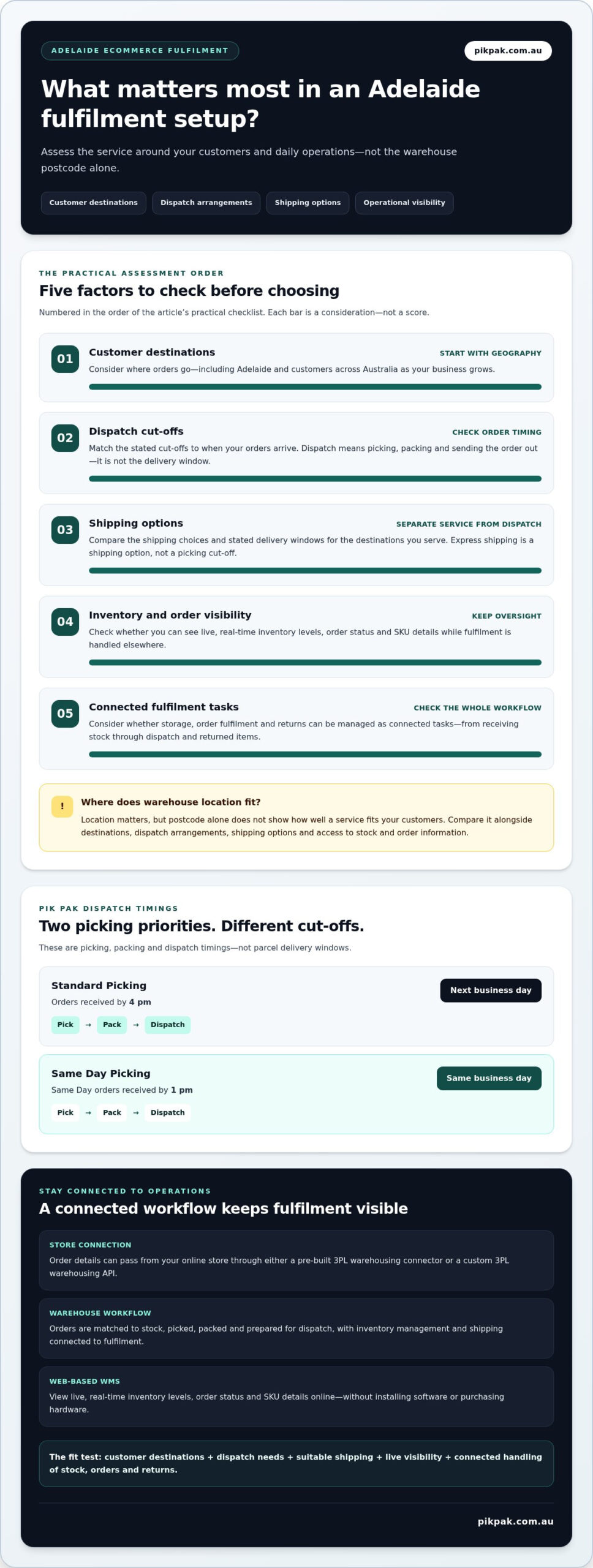
Start with your customer geography. If many orders go to Adelaide, compare the delivery options and stated windows for those destinations. If you are growing nationally, consider whether the operation can support customers across Australia as your order mix changes. Then assess service coverage and operational visibility. Live, real-time information on inventory and order status helps you keep oversight when your stock is stored elsewhere.
Keep dispatch and delivery separate in your comparison. Dispatch is when an order is picked, packed and sent out; the delivery window describes the time in transit. With Pik Pak’s Standard Picking, orders received by 4 pm are picked, packed and dispatched the next business day. With Same Day Picking, Same Day orders received by 1 pm are picked, packed and dispatched the same business day. These are dispatch timings, not delivery windows.
Map the practical fit against your current needs and likely growth:
- Where are your customers, and which shipping options suit their expectations?
- Do the dispatch cut-offs fit the times your orders typically come in?
- Can you view live, real-time stock and order status?
- Can storage, fulfilment and returns be handled as connected tasks?
This gives you a more useful comparison than postcode alone. A suitable setup should fit your customer destinations and dispatch needs while keeping stock and order progress visible, so outsourcing does not mean losing oversight.
How ecommerce order fulfilment works from Adelaide orders to dispatch
For an Adelaide order to move smoothly, each hand-off needs to be clear: the online store sends order details into the fulfilment workflow, the order is received and picked, items are packed, then the parcel is dispatched. Pik Pak’s warehousing and fulfilment services connect these steps with inventory management and shipping, so you can outsource warehouse work while keeping track of operations.
From online checkout to picked and packed order
The process starts with an integration that passes order information from your store to the fulfilment operation. Pik Pak offers two integration paths: “Simple – Pre-Built 3PL Warehousing Connector” and “Advanced – Custom 3PL Warehousing API.” Once an order is received, it can be matched to stock, picked from storage, packed and prepared for dispatch. Accurate order details help the fulfilment workflow reflect the customer’s purchase.
Dispatch timing depends on the picking priority:
- Standard Picking: Orders received by 4 pm are picked, packed and dispatched the next business day.
- Same Day Picking: Same Day orders received by 1 pm are picked, packed and dispatched the same business day.
These timings describe picking, packing and dispatch, not how long a parcel takes to arrive. Keep that distinction clear when setting customer expectations. Express shipping is a shipping option, not a picking cut-off. Dispatch timing and time in transit are separate parts of the order journey. The broader challenges in e-commerce logistics include coordinating fulfilment, warehousing and last-mile delivery, so it helps to understand each stage separately.
What inventory and order visibility should you expect?
Once fulfilment is underway, you still need to know what stock is available and where each order stands. Pik Pak’s web-based WMS provides live, real-time visibility of inventory levels, order status and SKU details. Access it online without installing software or purchasing hardware, so you can stay connected to daily operations while fulfilment tasks are handled externally.
The web-based WMS gives you live, real-time stock and order visibility. Viewing inventory and order progress together makes it easier to understand what is happening without relying on separate updates.
For ecommerce logistics Adelaide businesses can manage with operational oversight, a connected workflow matters as much as the hand-off itself. Explore Pik Pak’s logistics services to see how warehousing, fulfilment and WMS access work together.
Compare Adelaide ecommerce logistics by shipping, visibility and integration
Shipping choices shape what customers can expect after dispatch. Compare the delivery window with tracking and Proof of Delivery (POD), then consider whether the fulfilment system gives your team enough visibility to manage stock, orders and returns. These are practical details to weigh when comparing ecommerce logistics adelaide options, beyond the name of the shipping service.
Which shipping priority fits your customer promise?
Use the shipping priority summary below to match features with the expectations you set at checkout. Delivery windows are shown separately for Australian and international destinations.
| Shipping option | Type | Tracking and POD | Delivery window |
|---|---|---|---|
| S-Standard | Economy shipping | No tracking, no POD | 2-4 days AUS; 5-8 days INT |
| R-Regular | Economy shipping | With tracking, with POD | 2-4 days AUS; 3-8 days INT |
| E-Express | Express shipping | With tracking, with POD | 1-2 days AUS; 2-4 days INT |
Standard Shipping is the economy option, and it does not offer tracking or Proof of Delivery (POD). Regular Shipping is economy shipping with tracking and POD. Express Shipping includes tracking and POD with express delivery windows. If customers need visibility after dispatch, compare Regular and Express with Standard rather than assuming every economy option includes tracking.
How do integration and pricing affect the decision?
A shipping option works best as part of a connected order workflow. Pik Pak offers the “Simple – Pre-Built 3PL Warehousing Connector” and the “Advanced – Custom 3PL Warehousing API.” Choose the integration path that fits how your store needs to connect with fulfilment. Pik Pak’s technology and integration services connect order information with warehouse operations.
Operational visibility matters too. Pik Pak’s web-based WMS provides live, real-time information on inventory, order status and SKU details, helping you retain oversight while fulfilment is handled externally. Returns are another part of the service: Pik Pak handles returns and processes them competently, connecting post-delivery work with the wider fulfilment workflow.
Pik Pak’s pricing is pay-as-you-go and transparent. Compare the model alongside the shipping and operational features you need, rather than looking at pricing in isolation. Start with three questions:
- Do your customers need tracking and POD, or is economy shipping without them suitable?
- Which integration path fits your store’s connection requirements?
- Can you see live, real-time inventory and order status, and have returns processed competently?
Aligning these needs makes it easier to choose a setup that supports customer expectations and keeps internal oversight simple. Explore Pik Pak’s ecommerce logistics services to see how fulfilment, shipping and WMS access work together.
A practical Adelaide checklist for choosing ecommerce logistics
A good fulfilment fit starts with your actual operating pattern, not a guess about future order volume. Before comparing options, review how many orders you process on a typical day, when peaks occur, how many products and SKUs you manage, and where your customers are. This gives you a practical picture of what the service needs to handle now and what could change as your Adelaide business grows.
Match fulfilment priorities to your order pattern
Compare order cut-offs with when customers tend to buy and the dispatch expectations you set. A priority that suits a regular weekday flow may not fit a promotion or seasonal peak. Also separate dispatch timing from time in transit: dispatch tells you when an order leaves fulfilment, while the shipping option determines its delivery window and tracking features.
Priority 3 Picking
For orders using this priority, dispatch timing depends on when the order is received:
- Orders received by 1 pm are picked, packed and dispatched the same business day.
- Orders received by 3 pm are picked and packed the same business day and dispatched the next business day.
Check whether these cut-offs align with your order pattern, then assess which shipping options match your customers’ delivery expectations. Include tracking and Proof of Delivery in the comparison. This helps you set customer expectations without confusing the dispatch commitment with the shipping window.
Check operational fit before moving inventory
Clarify your fulfilment requirements before stock moves. Prepare an overview of your products and SKU details, how inventory is organised, product variations that affect picking, and how you want returned items handled. This can help surface operational complexity early. For inbound stock preparation, use the warehouse receiving guidelines as a reference for getting inventory ready to enter the fulfilment workflow.
Use this checklist to compare ecommerce logistics adelaide options with the work your business needs handled:
- Order patterns: Note typical volumes, busy periods and the times orders arrive.
- Inventory: Consider the number of SKUs, product variations and storage requirements.
- Customer delivery: Decide which delivery windows, tracking and POD features fit your customer promise.
- Returns: Include returns processing in the workflow rather than treating it as an afterthought.
- Visibility: Look for live, real-time inventory and order status so you can retain oversight.
- Integration: Describe how your online store handles orders in everyday terms. You do not need to be technical to explain what information should flow into fulfilment.
Use these points to create a simple requirements brief before making a change. Explore Pik Pak’s ecommerce fulfilment services and consider how they fit your order patterns, inventory and customer delivery needs.
How Pik Pak supports ecommerce logistics for Adelaide businesses
Adelaide brands can use an Australian fulfilment partner without treating warehouse postcode as the only measure of fit. Pik Pak supports ecommerce businesses with 3PL warehousing, order fulfilment, shipping and returns processing. It manages logistics for online stores, allowing you to focus your time on products, customers and growth.
What Pik Pak brings to an Adelaide ecommerce operation
Pik Pak’s warehouses are clean, safe and secure, and located near major ports and logistics infrastructure. For day-to-day oversight, the web-based WMS provides live, real-time visibility of inventory levels, order status and SKU details. Access this information online without installing software or purchasing hardware, keeping operational information available while fulfilment work is handled externally.
Store connections can use either the “Simple – Pre-Built 3PL Warehousing Connector” or the “Advanced – Custom 3PL Warehousing API.” Pik Pak’s website states “+100 Shopping cart integrations” and says it takes “48 Hours to get set up.” These details provide a starting point for understanding the integration options and setup process.
Shipping choices are another part of service fit. Compare delivery windows and tracking features with the expectations you set for Australian and international customers. Pik Pak’s customer delivery options outline the available choices. Returns are also part of the logistics workflow: Pik Pak handles returns and processes them competently, connecting post-delivery activity with fulfilment.
Take the next step with a fulfilment partner
Bring your key criteria together before deciding: service reach for Adelaide and national customers, live visibility, dispatch and shipping options, integration fit, and returns processing. Pik Pak’s pricing is pay-as-you-go and transparent, providing a clear model as you consider how outsourcing could fit your operations.
If the setup aligns with your order flow and customer needs, talk with Pik Pak about your fulfilment needs. A well-matched ecommerce logistics adelaide setup can take warehouse tasks off your team’s plate and give you more time to grow your business.
Make your next fulfilment decision with confidence
Your next step does not need to be a major operational change. Start by turning your priorities into a practical brief: what you want to hand over, where your customers are, and what you need to stay in control as orders grow. That gives you a clearer basis for assessing how a fulfilment setup fits your business now and can support its next stage.
The right ecommerce logistics Adelaide arrangement should make day-to-day operations easier to manage, not add another layer of work. Consider how fulfilment fits your order flow and growth plans, including dispatch and shipping requirements, visibility, returns processing and transparent pay-as-you-go pricing.
Talk with Pik Pak about your fulfilment needs and explore how its logistics services can help you spend more time building your business.
Frequently Asked Questions
Does an ecommerce logistics provider need to have a warehouse in Adelaide?
No. A warehouse does not have to be in Adelaide for a provider to support an Adelaide-based online store. For ecommerce logistics adelaide, consider your customers’ destinations, the shipping options available and how easily you can oversee stock and orders. Pik Pak supports Australian ecommerce businesses, so assess service reach and operational fit rather than assuming the warehouse must share your postcode.
Can an Adelaide online store use a fulfilment warehouse in another Australian city?
Yes. An Adelaide store can use a fulfilment warehouse in another Australian city. Consider how the operation serves your customer destinations and how its dispatch arrangements and delivery options fit your store’s promises. A business selling across Australia, for example, may weigh national service reach alongside its Adelaide orders. The warehouse being in a different city does not by itself determine whether the setup suits your business.
What is the difference between dispatch time and delivery time?
Dispatch time is when an order is picked, packed and sent out from fulfilment. Delivery time is the period it takes to reach the customer after dispatch. These are separate stages, so do not treat a dispatch cut-off as a delivery promise. When setting a delivery window on your store, account for both the fulfilment schedule and the selected shipping option.
Which Pik Pak shipping option includes tracking and Proof of Delivery?
Regular Shipping and Express Shipping include tracking and Proof of Delivery (POD). Standard Shipping is the economy option and does not include tracking or POD. This distinction can help you choose how much shipment visibility to offer. Match the option to your customer communication needs, and make sure the shipping features shown at checkout reflect the service selected.
Can Pik Pak integrate with my ecommerce store?
Yes. Pik Pak provides two integration paths: “Simple – Pre-Built 3PL Warehousing Connector” and “Advanced – Custom 3PL Warehousing API.” The connector is a pre-built route, while the API provides a custom integration path. You do not need to describe your store in technical terms to identify your needs. Start with how orders are captured and what information needs to flow into fulfilment.
How can I see my inventory and order status with a 3PL?
Use the 3PL’s web-based Warehouse Management System (WMS) to view inventory and order information. Pik Pak’s WMS provides live, real-time visibility of inventory levels, order status and SKU details. This helps you answer practical questions, such as whether a product is showing as available or where an order sits in the fulfilment process. Access is web-based, with no software installation or hardware purchase required.
Does Pik Pak process ecommerce returns?
Yes. Pik Pak handles ecommerce returns and processes them competently as part of its returns management and reverse logistics service. Returns are worth including in your fulfilment plan, not treating as an exception: they can affect the customer experience and how you manage products after delivery. Consider the returns workflow alongside outbound orders when deciding which logistics tasks to hand over.