

What if handing off warehouse work gave you more control over your Brisbane orders, not less? With outsourced warehousing Brisbane eCommerce businesses can delegate storage, picking, packing and dispatch while keeping a clearer view of stock and order progress. That matters when warehouse space and staffing take time to manage, and fulfilment tasks pull attention away from growth.
It’s reasonable to worry that adding a logistics partner could mean more handovers and less visibility. A well-organised setup can make day-to-day operations simpler, with connected systems helping you track inventory and orders without managing every warehouse task yourself. Pik Pak Logistics combines eCommerce fulfilment with cloud-based WMS visibility and online-store integrations.
This guide explains how outsourced warehousing works, what to compare when assessing fulfilment options, and how to prepare an arrangement for Brisbane customer demand. You’ll see how storage, pick and pack, shipping, returns and kitting can fit into one workflow, freeing up internal time to focus on your business.
Key Takeaways
- Outsourced warehousing Brisbane businesses use can cover more than storage, extending through order picking, packing and dispatch.
- Map the handovers from receiving stock to processing returns, and keep product and order data accurate to support organised fulfilment.
- Compare storage, receiving, order processing, returns, kitting, technology and delivery coordination against your business needs.
- Prepare product information, stock records, packaging requirements and returns processes to make the transition smoother.
- Connected WMS visibility and online-store integrations help you monitor inventory and order status while freeing up time for growth.
What outsourced warehousing means for Brisbane eCommerce businesses
As orders grow, the space, people and time needed to keep products moving can compete with the work that grows your business. Outsourced warehousing lets you delegate stock storage and related fulfilment tasks to a logistics provider instead of managing every warehouse process in-house. It can reduce daily operational demands and give you more time to focus on products, customers and growth.
Warehousing stores and manages stock, while fulfilment takes each customer order from selection and packing through dispatch. Some arrangements provide storage only; eCommerce fulfilment connects storage to the order journey. In the broader logistics context, Third-party logistics (3PL) describes the use of an external provider for logistics activities. For online retailers, outsourced warehousing Brisbane businesses use is most useful when the service covers the work that happens after stock arrives, too.
Before assessing a warehouse fit, map where your customers are and what delivery experience you promise them. Review actual order destinations and customer expectations to understand what your fulfilment process needs to support, rather than choosing based on storage space alone.
Which warehouse tasks can an eCommerce business outsource?
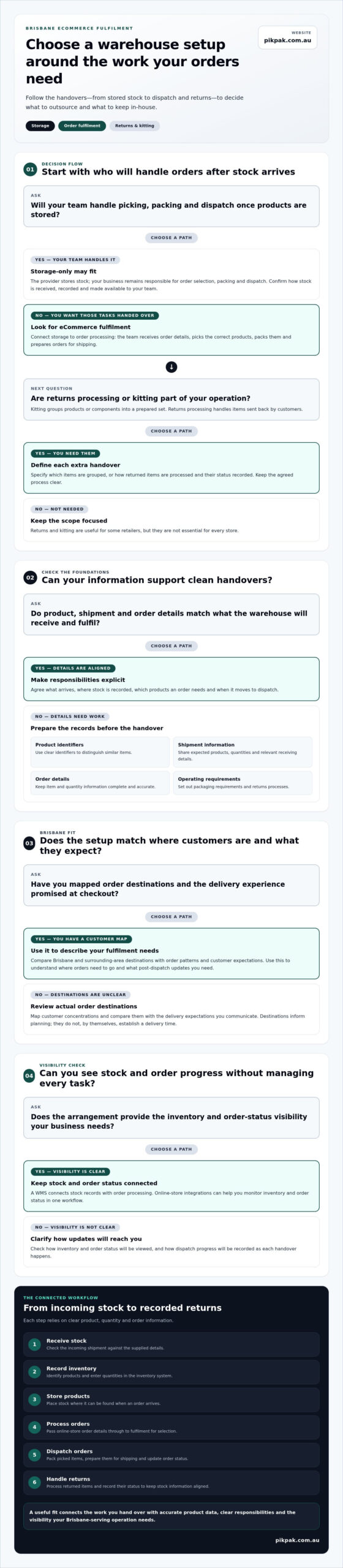
Think of warehouse work as a connected sequence. Stock is received and recorded, then stored until an order comes through. The team picks the correct products, packs them for dispatch and arranges shipping. When these steps are split across people or systems, mistakes and time-consuming handovers become harder to manage.
Returns processing and kitting can also be part of the workflow, depending on what you sell. Kitting groups products or components into a prepared set; returns processing handles items sent back by customers. These services are useful for some retailers, but not essential for every store. When you outsource, define the processes being handed over, while retaining responsibility for your products and the customer promises you make.
Why does Brisbane customer geography matter?
Use your order data to map customer concentrations across Brisbane and surrounding areas. Compare delivery destinations with order patterns and the expectations you communicate at checkout. This gives you a practical picture of demand and helps you describe the service your operation needs.
Destinations inform fulfilment planning by showing where orders need to go and what information you need after dispatch. They don’t, on their own, establish a delivery time. Compare your customer map with the fulfilment workflow and the updates you need to keep customers informed. For more context on the connected steps, explore this complete order fulfilment guide.
Keep the goal practical: choose a setup that connects stock handling to the needs of your Brisbane-serving customers. Clear processes for receiving, order handovers and returns can reduce internal workload and give your business a more organised view of fulfilment.
How outsourced warehousing moves Brisbane orders from receiving to dispatch
For outsourced warehousing Brisbane orders, a reliable workflow connects incoming stock with the information needed to pick, pack and dispatch each sale correctly. Make each handover clear: what arrived, where it was stored, which items an order needs and when that order moves to dispatch. Here’s how the process typically flows.
- 1. Receive stock. The warehouse receives the incoming shipment and checks it against the information supplied about the delivery.
- 2. Record inventory. Products are identified and quantities entered into the inventory system. Clear product identifiers help distinguish similar items.
- 3. Store products. Stock is placed in storage locations so it can be found when an order arrives.
- 4. Process orders. Order details pass from the online store into fulfilment. The team uses the item and quantity information to select the right products.
- 5. Dispatch orders. Picked items are packed and prepared for shipping, with order status updated as the handover progresses.
- 6. Handle returns. Returned items are processed and their status recorded, helping keep stock information aligned with what’s physically on hand.
Each step depends on accurate, useful information. A product description or identifier that doesn’t match the physical item can cause confusion during receiving or picking. Incomplete order details can also delay a handover or lead to an incorrect parcel. The Australian Logistics Council offers an industry-level perspective on Australia’s freight logistics sector. At the day-to-day level, clear data and defined responsibilities keep the workflow moving.
What happens when inventory arrives at a 3PL warehouse?
Before stock arrives, share advance shipment information, including the products and quantities expected and any relevant receiving details. On arrival, the goods are checked, identified and recorded so inventory records reflect what has been received. Consistent labels and matching product information make it easier to spot discrepancies early, rather than discovering them during picking. Use Pik Pak’s warehouse receiving guidelines to prepare for this handover.
How do WMS visibility and store integrations support fulfilment?
A WMS connects stock records with order processing, so inventory and order status can be viewed in one workflow. Cloud-based access provides real-time visibility into those records. API access and pre-built connectors link online stores with fulfilment systems, reducing the need to re-enter order details manually. This creates a clearer handover from sale to pick and pack, with teams working from consistent order information.
Use customer locations to understand where parcels are going and what delivery expectations your business has set. A connected fulfilment workflow makes it easier to track order progress through dispatch. If you’re mapping the process for your store, explore Pik Pak’s eCommerce logistics services.
How to compare outsourced warehousing options for Brisbane orders
Compare the whole fulfilment workflow, not just the available warehouse space. For outsourced warehousing Brisbane businesses need a setup that fits their products, order patterns and customer expectations. Assess three areas: the services included, the visibility you’ll have over stock and orders, and how well the operation fits your day-to-day needs.
Use this table to identify what matters to your store. The right mix depends on your products and how customers shop.
| Area | What to consider | Why it matters |
|---|---|---|
| Storage | How your inventory is stored and tracked | Products need to be identifiable and available for orders. |
| Receiving | How incoming stock is checked and recorded | Clear records help align physical stock with system quantities. |
| Order processing | How orders move into picking, packing and dispatch | Defined handovers help keep fulfilment organised. |
| Returns | Whether returned goods are received and recorded | A returns workflow can support a consistent customer experience. |
| Kitting | Whether products need to be grouped or assembled for orders | Useful for stores selling sets or prepared product combinations. |
| Technology | How you access inventory and order status, and how store data connects | Visibility and integrations can reduce manual tracking and reconciliation. |
| Delivery coordination | How dispatch status and delivery options align with customer expectations | Brisbane destinations influence what information customers need after ordering. |
Which service capabilities match your order profile?
Start with your order history. Review your product range, typical order contents, seasonal changes and any handling needs that affect storage or packing. A shop sending single-item orders has different workflow demands from one that regularly sells multi-item sets. Returns processing or kitting may matter if they’re part of the experience you promise customers. Match services to your actual operations rather than assuming every store needs the same model.
What technology and delivery visibility should you assess?
Look for a clear way to view inventory and order status, and consider how online-store integrations pass order information into fulfilment. Pik Pak provides cloud-based WMS access, with API access and pre-built connectors for online stores. For delivery coordination, assess how dispatch updates and customer delivery options support the expectations you set for Brisbane customers.
Delegating warehouse tasks doesn’t have to mean losing control. Agree on visible handovers: how stock records are maintained, where order status can be viewed, how store data flows into the workflow, and who handles exceptions such as a stock discrepancy or returned item. These practical checks show how the operation works, not just how much space it uses.
Map customer destinations across Brisbane and surrounding areas using your order data. This gives you a grounded view of delivery demand and helps you assess whether the workflow and visibility suit your customer promises. A well-matched setup should make fulfilment easier to oversee while freeing your team to focus on the business.
How to prepare your Brisbane business for outsourced warehousing
A smooth handover starts with information your fulfilment team can use without guessing. Before moving to outsourced warehousing Brisbane operations, organise product and stock records, document how orders flow, and use your customer data to describe demand. Clear preparation reduces avoidable questions and gives both teams a practical foundation to refine as the workflow settles.
What information should you organise before onboarding?
Prepare accurate product identifiers, dimensions, handling notes and current stock records. Include the details needed to distinguish similar products and match physical items to inventory data. For incoming stock, follow the warehouse receiving requirements so shipment information and product labelling support a clear handover. Keep records together and assign someone on your team to update them when product details change.
Use this checklist to bring the main operational details into one place:
- Product data: identifiers, descriptions, dimensions and any handling notes relevant to storage or packing.
- Stock records: current quantities and a clear record of stock expected to arrive.
- Order flow: sales channels, how orders are passed on, and the cut-off expectations your business communicates.
- Packaging: packing requirements that affect how orders should be prepared.
- Returns: how returned products are received, assessed and recorded, including who decides the next step.
- Brisbane demand: customer destinations, order patterns and seasonal changes drawn from your own order history.
Use your Brisbane order data to explain where demand is concentrated and what delivery expectations you set for customers. This helps define the operational need without relying on assumptions about customer locations or transit times.
How can you plan a controlled operational handover?
Document how order data enters fulfilment, how stock updates are recorded, and how dispatch status is shared. Name who handles exceptions such as an inventory mismatch, missing product information or an order that needs attention. Agree how your team will review inventory accuracy and order status through the WMS. A written workflow gives everyone a shared reference, and operational feedback can guide updates.
Keep the first version practical. Describe each handover in plain language, identify where information is recorded, and make escalation responsibilities clear. This reduces confusion when something falls outside the usual process and helps your team stay informed without recreating warehouse work internally.
For a clearer view of how an outsourced setup can align with your operational needs, explore Pik Pak’s fulfilment services.
Pik Pak outsourced warehousing for Brisbane-serving eCommerce operations
For an online store serving Brisbane customers, the goal is to connect warehouse work with customer orders while keeping stock and order information accessible to your team. Pik Pak Logistics handles eCommerce storage, picking, packing, shipping and returns processing as part of its fulfilment operation. You can delegate recurring warehouse tasks and spend more time on product, customer and growth priorities.
How Pik Pak connects warehousing with online order fulfilment
Inventory storage is the starting point, not the whole workflow. As orders come through, products are picked and packed for shipping, and returns are processed as part of the wider operation. Pik Pak also handles kitting and assembly for stores preparing product bundles or promotional orders. The service mix can reflect your products and operating needs.
Online-store integrations pass order information into fulfilment workflows, reducing reliance on manual handovers. Pik Pak provides API access and pre-built connectors, alongside a cloud-based WMS that gives clients real-time visibility of inventory and order status. Your team can use system information to follow stock and orders instead of piecing together updates from disconnected records. See how Pik Pak’s eCommerce fulfilment approach connects storage with order processing.
What are practical next steps for Brisbane businesses?
Before discussing a setup, bring together a useful picture of your operation. Include your order profile, product range, inventory needs, online-store systems, returns requirements and any kitting or promotional preparation. Add customer destinations across Brisbane and surrounding areas, based on your own order data. This helps frame delivery expectations using your actual customer patterns.
- Current workload: Note the warehouse tasks taking the most staff time, from receiving stock to preparing parcels.
- Order patterns: Describe common order types and how demand changes during promotions or seasonal periods.
- Systems and visibility: List the information your team needs to access about stock and order status.
- Operational priorities: Identify the handovers or recurring tasks you want to simplify, and what a clearer process would enable your team to focus on.
These details turn a broad request for outsourced warehousing Brisbane support into a practical conversation about your business’s workflow. Explain how returns are handled today, where information gets delayed, and which exceptions need a clear escalation path. A focused discussion can then centre on the work to delegate and the visibility your team needs to stay informed.
Ready to map out a more manageable fulfilment workflow? Discuss your eCommerce warehousing and fulfilment needs with Pik Pak Logistics.
Make fulfilment easier to grow with your business
Start by deciding what you want warehouse operations to make possible. You may want to spend less time coordinating daily orders, get a clearer view of stock, or make more room to plan your next growth phase. Use those priorities to shape an outsourced warehousing Brisbane setup that supports your business now and adapts as your needs change.
With Pik Pak, fulfilment combines warehouse processes with connected technology. Cloud-based WMS access provides visibility over inventory and order status, while API access and pre-built eCommerce connectors link store orders with fulfilment workflows. Storage, pick and pack, shipping, returns and kitting can all form part of the operation, based on what your business needs.
Bring your current workload, systems and priorities into the conversation. A clear starting point can turn operational friction into a more manageable process, giving you time to focus on customers and growth.
Explore a fulfilment setup with Pik Pak and take the next step towards a more manageable way to grow.
Frequently Asked Questions
What is outsourced warehousing?
Outsourced warehousing is an arrangement where an external logistics provider manages agreed stock and fulfilment activities instead of your business running every warehouse task itself. The scope can range from holding inventory to preparing customer orders and processing returns. For an online retailer, the key is to define which responsibilities are handed over and how your team stays informed. With outsourced warehousing Brisbane businesses can use, agree on those responsibilities before stock moves.
Is outsourced warehousing suitable for a small Brisbane online store?
It can suit a small store if managing stock and packing orders is taking time away from sales, product development or customer service. Consider whether your workload is predictable, whether space is becoming difficult to manage, and how much coordination fulfilment requires. Also account for the work involved in preparing product data and connecting order processes. The decision is about operational fit, not business size alone.
How much does outsourced warehousing cost in Brisbane?
There isn’t one standard cost because the total depends on the work involved. Storage needs, incoming stock handling, order volume, items per order, packaging requirements, shipping and returns can all affect the service mix. Kitting or other special handling may also be relevant. To compare a proposal with your current setup, consider the warehouse labour, space and systems you manage internally, not storage alone.
Can an outsourced warehouse integrate with my online store?
Yes. Pik Pak Logistics offers API access and pre-built eCommerce platform connectors to link online-store information with fulfilment workflows. Before orders begin flowing, make sure product identifiers in your store align with inventory records, and decide which order updates your team needs to monitor. A small test using representative products and order types can help reveal data or process issues before you rely on the connection day to day.
What happens if inventory records do not match the stock in storage?
Flag the difference and trace it before changing the record. Check the product identifier, expected delivery details, receiving record and any recent stock movements, then establish which information is accurate. Record the discrepancy and its resolution so the same issue is easier to investigate later. If an affected product is available for sale, review its availability in your store while the stock position is being clarified.
Do I need to move all my inventory to outsourced warehousing at once?
Not necessarily. A staged transition may be easier to manage, depending on your stock and order processes. You could plan around a product group or a defined range, while deciding how orders will be allocated between locations during the changeover. Keep quantities and stock status distinct in your records to avoid selling inventory that has moved or overlooking stock still held in-house. Document the transition steps before dispatching inventory.