

A lower fulfilment-cost percentage doesn’t always mean your logistics are more efficient. If your revenue definition or invoice categories change, the ratio can shift even when operations haven’t. That’s why calculating fulfillment costs as a percentage of revenue starts with consistent inputs, not a universal benchmark.
If fulfilment invoices bundle storage, pick and pack, packaging, shipping and less obvious charges, it can be hard to see what each order really costs. Sales growth can also change the ratio without showing whether fulfilment itself is improving. Compare like with like, using the same revenue basis and cost categories each time.
This guide explains which costs to include, how to calculate the ratio, and how to keep your definitions consistent across reporting periods. You’ll also learn how to interpret changes, trace cost drivers through order and inventory activity, and assess whether outsourced fulfilment fits your business. With clear categories and reliable visibility, the calculation becomes a practical decision-making tool rather than another number on a spreadsheet.
Key Takeaways
- Calculating fulfillment costs as a percentage of revenue starts with a clear formula and consistent definitions for both costs and revenue.
- Separate fulfilment expenses, such as storage, shipping and returns processing, from product costs, marketing, payment processing and general overhead.
- There’s no single ideal ratio for every business. Compare periods and product categories using the same cost scope and revenue basis.
- Reconcile invoices and warehouse management system activity with finance records before investigating changes in the ratio.
- Assess outsourced fulfilment as a different operating model, not a guaranteed way to lower costs. Review how its connected activities affect your overall ratio.
What Does Fulfilment Cost as a Percentage of Revenue Mean?
Fulfilment cost as a percentage of revenue shows how much of your sales revenue goes towards getting orders to customers. It lets you view fulfilment spend alongside sales instead of looking at an invoice total in isolation. The result can help you spot changes over time, provided you use consistent cost and revenue definitions.
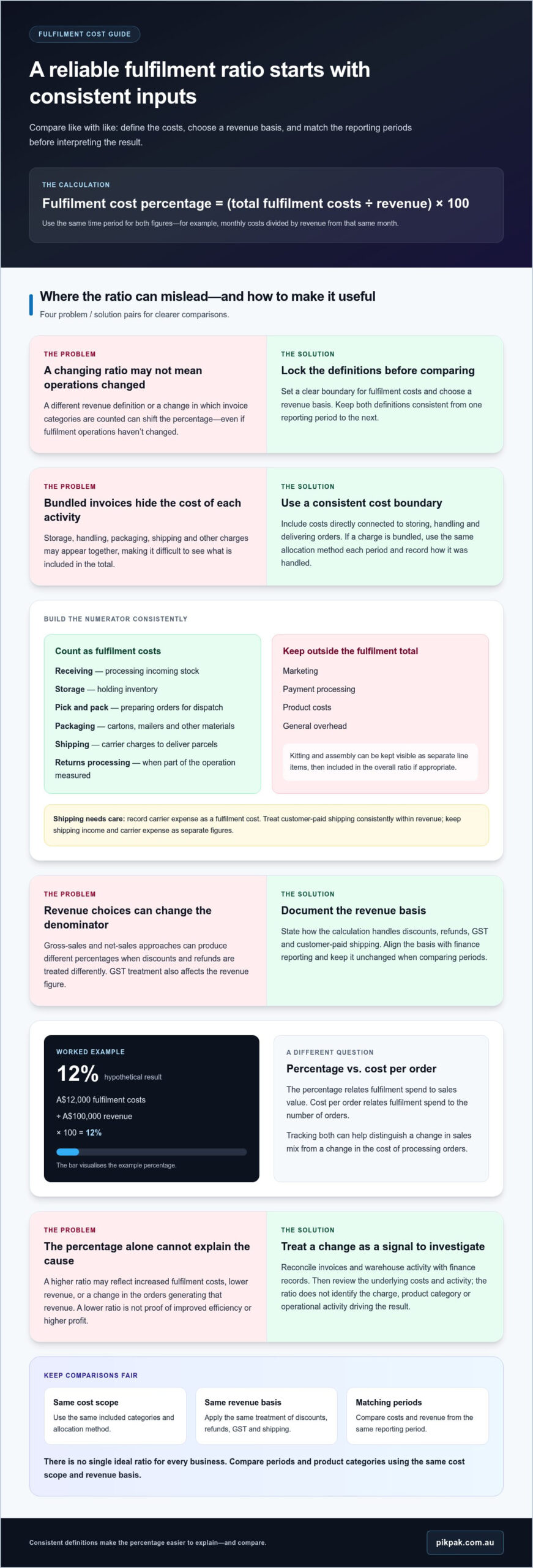
Definition: Fulfilment cost percentage = fulfilment costs ÷ revenue × 100. For example, if hypothetical fulfilment costs are A$12,000 and revenue is A$100,000 for the same period, the calculation is A$12,000 ÷ A$100,000 × 100 = 12%.
What is the formula for fulfilment costs as a percentage of revenue?
Fulfilment cost percentage = (total fulfilment costs ÷ revenue) × 100
Total fulfilment costs are the expenses you’ve chosen to include for preparing orders and getting them delivered. Revenue is the sales amount used as the denominator. Match the time periods: divide monthly fulfilment costs by revenue from that same month, not by an annual or differently timed figure. Choose a revenue basis and use it for every comparison.
This differs from cost per order, which divides fulfilment costs by the number of orders. The percentage relates spend to sales value; cost per order relates spend to order volume. Tracking both helps you distinguish a change in sales mix from a change in the cost of processing orders.
What does the percentage tell an eCommerce business?
The ratio shows how much fulfilment spend is absorbed by sales activity. If it rises, fulfilment costs may have increased, revenue may have fallen, or the orders generating that revenue may have changed. If it falls, that could indicate improved efficiency, but it isn’t proof on its own. Product margins, order size, delivery profile and sales mix all affect what the percentage means for your business.
Quotable takeaway: “Fulfilment cost percentage measures fulfilment spend relative to revenue, helping businesses track the relationship between logistics costs and sales.”
The metric has limits. It won’t identify which charge, product category or operational activity is driving the result, and a lower percentage doesn’t automatically mean higher profit. A high-value product can produce a lower ratio than a low-value product even when the fulfilment work is similar. Use the percentage as a signal to investigate, then review the underlying costs and activity.
It also helps to distinguish fulfilment from broader product costs. The concept of Total Delivered Cost includes manufacturing as well as logistics, so it covers a wider cost picture than a fulfilment-only ratio.
Which Fulfilment Costs and Revenue Belong in the Calculation?
The ratio is only useful if its numerator and denominator are clearly defined. Set a consistent boundary around the costs of storing, handling and delivering orders, then use a revenue figure that matches your finance reporting. This makes calculating fulfillment costs as a percentage of revenue easier to explain and compare.
Which expenses should count as fulfilment costs?
Include expenses directly connected to moving inventory through the fulfilment operation and getting orders to customers. Depending on how your invoices are structured, these may include:
- Receiving: Processing incoming stock into the warehouse.
- Storage: Holding inventory before it’s ordered.
- Pick and pack: Locating products, preparing orders and handling dispatch.
- Packaging: Cartons, mailers and other materials used to prepare orders.
- Shipping: Carrier charges for delivering parcels to customers.
- Returns processing: Inspecting and handling returned goods when this work is part of the fulfilment operation being measured.
Keep optional activities such as kitting and assembly visible as separate line items where practical. You can then include them in the overall ratio while still seeing how they affect the total. Exclude expenses from other parts of the business, such as marketing, payment processing, product costs and general overhead. If a charge is bundled, use the same allocation method each period and record how you handled it.
Shipping needs particular care. Record the carrier expense as a fulfilment cost, and treat any shipping amount collected from customers consistently within your revenue definition. Shipping income and carrier expense are separate figures, even if they relate to the same order. Don’t net one against the other in one reporting period and count them separately in another.
Should the calculation use gross or net revenue?
Choose the revenue basis that aligns with your reporting method. A gross-sales approach and a net-sales approach can produce different percentages if the latter accounts for discounts and refunds. GST treatment also affects the denominator: document whether your revenue figure includes or excludes GST, and apply that choice consistently with your finance records.
Write down the definition in plain language, including how you handle discounts, refunds, GST and customer-paid shipping. Then keep it unchanged when comparing months or quarters. If your business changes its method, note the change so a difference in the ratio isn’t mistaken for an operational shift.
For a broader view of the fulfilment process behind these cost categories, read our order fulfilment guide.
Is There a Good Fulfilment Cost Percentage? Compare Results Fairly
There’s no single fulfilment cost percentage that suits every business, product, sales channel or delivery profile. A store shipping compact, high-value items has a different cost and revenue mix from one handling bulky goods or frequent returns. Treat the ratio as a way to understand your own operation, not as a pass-or-fail score.
How can you compare fulfilment costs over time?
Make each comparison like for like. Keep the cost categories, revenue basis and reporting duration consistent, then review the ratio alongside total fulfilment spend, orders fulfilled and cost per order. These companion measures help show whether a change reflects higher costs, a different order volume or a shift in revenue.
| Comparison | What to compare | What to check |
|---|---|---|
| Monthly | Each month using the same cost and revenue definitions | Promotions, sales swings, launches or unusual returns |
| Quarterly | Quarter totals and ratios calculated on the same basis | Whether a monthly fluctuation continues or evens out |
| Product category | Fulfilment costs and revenue for comparable product groups | Differences in order value, parcel size, handling and returns |
Short reporting windows can be misleading. A promotion may lift sales before fulfilment costs appear in the same period, while a one-off inventory event can temporarily increase receiving or storage activity. Note promotions, product launches, returns spikes and other unusual events beside the figures. This context helps you decide whether a movement points to a lasting efficiency change.
Why do fulfilment percentages vary between stores?
Order value affects the denominator, while parcel dimensions and weight can influence handling and delivery expenses. The products in each order, storage needs, customer destinations and return rates also shape the result. Two stores with similar sales can therefore have very different fulfilment ratios, and neither figure alone proves that one operation is better.
“Cross-business fulfilment benchmarks are meaningful only when product mix, order profile, delivery destinations and cost definitions are comparable.”
A higher ratio is a prompt to investigate, not proof of poor performance. Use calculating fulfillment costs as a percentage of revenue to identify a change, then examine the underlying order, cost and product-category data to understand what’s driving it.
How to Calculate, Track, and Investigate Your Fulfilment Ratio
A repeatable process makes the ratio easier to explain and changes easier to trace. Use the same definitions each month, then check the operational records behind the numbers before deciding what a movement means.
What data do you need for a reliable calculation?
Gather fulfilment invoices and charges, shipping expenses, returns activity, order and inventory records, and the revenue figure for your chosen period. Align transaction dates and accounting periods before combining finance and warehouse data. WMS records can help you compare order volumes, inventory movements and fulfilment activity with the charges recorded in your reports.
Follow a consistent monthly workflow
- Select the period. Set the dates for the month and use the same cut-off each time.
- Define the scope. Confirm which fulfilment expenses and revenue basis you’re including.
- Gather the data. Collect invoices, shipping and returns records, WMS activity and finance reports.
- Reconcile the inputs. Check that invoice charges and warehouse activity align with finance records. Resolve timing differences or unusual entries before calculating.
- Calculate and review. Divide fulfilment costs by revenue, multiply by 100, then compare the result with prior periods and supporting measures.
Don’t interpret a movement until the inputs reconcile. A late invoice, a charge recorded in a different period, or a mismatch between fulfilment activity and finance records can create a misleading result.
How should you investigate a rising percentage?
Break the total into storage, receiving, handling, packaging, shipping and returns. Then check whether order volume or product mix changed, or whether a one-off charge affected the period. Review the ratio alongside cost per order, storage use and returns activity. Together, these measures can help distinguish a broad change from a specific operational driver.
Keep this monthly checklist with your reporting:
- Reporting dates and revenue definition are unchanged.
- Fulfilment invoices are reconciled with finance records.
- WMS order, inventory and returns activity has been reviewed.
- Fulfilment percentage, total spend and cost per order are recorded.
- Storage use and unusual charges or activity are noted.
Consistent records turn calculating fulfillment costs as a percentage of revenue into a useful review rather than a figure that raises more questions than it answers. For more on how warehousing and fulfilment activities fit together, see our warehouse and fulfilment services.
How Outsourced Fulfilment Can Support Clearer Cost Management
Outsourcing changes who manages fulfilment, how work is organised and how related expenses appear in your records. Clearly itemised storage, order handling and returns can make these activities easier to review, but outsourcing doesn’t guarantee a lower fulfilment-cost percentage. The value comes from comparing the full operating model and measuring it consistently.
What should you compare when assessing in-house and outsourced fulfilment?
Build a like-for-like comparison. Include the complete costs of your current operation, not just rent or warehouse wages, and compare them with the outsourced scope. Account for space, labour, systems, receiving, pick and pack, packaging, shipping and returns. Include the same activities on both sides, or make any differences in scope explicit.
Keep the revenue definition and reporting period consistent too. An outsourced model may change the timing or categorisation of charges, so a percentage shift can reflect a reporting difference rather than an efficiency gain. Review the ratio alongside service scope, order volumes and cost per order before deciding whether the model works for your business.
How can Pik Pak support fulfilment operations?
Pik Pak Logistics provides warehousing and inventory storage, pick and pack, shipping, returns processing, and kitting and assembly. These activities connect: inventory is stored, orders are picked and packed, parcels are dispatched, and returns may re-enter the operation. Viewing them as connected cost inputs helps you understand what sits behind the overall ratio.
Cloud-based WMS access provides real-time inventory and order visibility, supporting reviews of stock levels, order status and fulfilment activity. API access and pre-built connectors support store integrations, helping bring operational information into view alongside finance records. Read about fulfilment technology support and how visibility can support clearer tracking.
Use the same cost categories before and after a change in operating model. Then review the data regularly to see how storage, handling, shipping and returns contribute to your result. This makes calculating fulfillment costs as a percentage of revenue more useful for operational decisions, rather than treating the ratio as a promise of savings.
See how Pik Pak’s fulfilment support brings these activities together.
Turn Your Fulfilment Ratio Into a Clearer Business Decision
A useful fulfilment-cost percentage depends on consistent definitions, not a universal target. Include the right operating expenses, use the same revenue basis each period, and compare the ratio alongside measures such as cost per order and returns activity. When the percentage changes, investigate the underlying costs and order patterns before deciding what it means.
Calculating fulfillment costs as a percentage of revenue gives you a practical starting point for understanding how logistics spend relates to sales. Clear records and operational visibility help turn that figure into decisions about your fulfilment model.
Pik Pak brings warehousing, picking, packing and shipping together with returns processing and kitting. Its cloud-based WMS provides real-time inventory and order visibility, so you can review fulfilment activity with greater clarity. Explore Pik Pak’s eCommerce fulfilment services to see how they can support your operations.
Frequently Asked Questions
How do you calculate fulfilment costs as a percentage of revenue?
Divide fulfilment expenses for a chosen period by revenue from that same period, then multiply by 100. Before calculating, define which expenses count, such as storage, pick and pack, packaging, shipping and returns processing. Use one consistent revenue basis and document how you treat refunds, discounts and GST. The result helps track fulfilment spend relative to sales; it isn’t a universal performance grade.
What fulfilment costs should be included in the calculation?
Include expenses directly connected to storing and preparing orders, such as warehousing, receiving, picking, packing, packaging, dispatch and relevant returns processing. Keep marketing, product costs and general administration separate unless your reporting definition deliberately includes them. State the scope clearly, then apply the same categories each time you calculate the percentage. Consistency makes comparisons across reporting periods more meaningful.
Should fulfilment costs be divided by gross or net revenue?
Either basis can support internal analysis if it suits your reporting needs and is applied consistently. Define whether revenue is before or after discounts, refunds and GST, then use that same definition for every period. Align the calculation with your finance reporting approach and document the method. If different teams use different revenue figures, their percentages won’t be directly comparable, even if they’re analysing the same fulfilment costs.
What is a good fulfilment cost percentage for an eCommerce business?
There’s no single percentage that’s right for every store. Product dimensions, order value, shipping destinations, storage needs, sales channels and returns all influence the result. Start with your own consistent historical data. Compare similar periods and product groups, then investigate the cost drivers behind any change. Treat the ratio as a signal for review, not as a verdict based on an unsupported industry average.
Should customer-paid shipping count as fulfilment revenue?
Track the amount collected from customers for shipping separately from the carrier or delivery expense. Decide whether your chosen revenue denominator includes shipping revenue, and apply that decision consistently. Reviewing shipping income and shipping expense as separate lines can clarify how each affects the overall ratio. Don’t change the treatment between periods, as doing so can make the percentage appear to improve or worsen without an operational change.
How often should a business calculate its fulfilment cost percentage?
A monthly calculation is a useful starting point for many operators, while quarterly or longer reviews can help put short-term fluctuations in context. Choose a cadence that fits your order volume and financial reporting cycle. Each time, use the same cost scope and revenue basis. Note promotions, product launches or returns spikes, and review the component costs alongside the percentage to understand what’s driving movement.
Can a 3PL help a business manage fulfilment costs?
A third-party logistics provider can manage activities such as warehousing, picking, packing, shipping and returns processing, giving your business a different operating model to assess. Pik Pak Logistics provides these eCommerce fulfilment services, along with kitting and cloud-based WMS access for real-time inventory and order visibility. Any effect on your overall percentage depends on the complete costs, service scope, order profile and revenue basis, so compare like-for-like inputs.