Are you running a growing brand, or have you accidentally become a full-time warehouse manager? It’s a common trap for successful founders. You likely started this business to create and sell, but now you’re spending four or more hours every day buried in bubble wrap while your office disappears under a mountain of inventory. Knowing exactly when to outsource fulfillment is the difference between hitting a growth ceiling and scaling your operations to meet the record $82.6 billion Australians spent online in 2025.
This guide will help you identify the precise moment to transition from DIY packing to professional 3PL services so you can finally focus on your core objectives. We’ll explore five unmistakable signs that your current logistics are causing friction, from rising shipping errors to the stress of seasonal spikes. By the end, you’ll have a clear roadmap to reclaim your time and transform your delivery process into a seamless, automated engine for growth. It’s time to stop packing boxes and start leading your company again.
Key Takeaways
- Recognize the fulfillment tipping point where manual tasks begin to stall your brand’s growth and revenue potential.
- Identify the five specific operational red flags that tell you exactly when to outsource fulfillment to a professional partner.
- Calculate the true ROI of 3PL services by exposing the hidden costs of storage, packaging materials, and shipping errors.
- Prepare for a seamless transition by conducting a SKU audit and integrating your sales platform with cloud-based warehouse technology.
- Understand how delegating logistics allows you to reclaim your time and refocus on high-level business strategy.
Understanding the Tipping Point: When DIY Fulfillment Becomes a Burden
Every founder remembers the excitement of those first few sales. But as those orders grow from five a week to fifty a day, that excitement often turns into operational friction. You’ve reached what we call the fulfillment tipping point. This is the specific moment when the manual labor of the order fulfillment process stops being a cost-saving measure and starts hindering your revenue growth. Knowing exactly when to outsource fulfillment is the difference between a brand that scales and one that plateaus under the weight of its own success.
The transition from a home-based operation to a professional partner is a strategic milestone. Staying small by doing everything yourself might feel safe, but it often leads to a “growth ceiling.” If you’re too busy packing boxes to respond to wholesale inquiries or plan your next marketing campaign, your logistics have become a bottleneck rather than a bridge to your customers.
The True Cost of Your Time as a Founder
Think about your value to the business. A CEO’s focus should be on brand partnerships, product development, and high-level strategy. If you spend your afternoons bubble-wrapping products, you’re effectively paying a CEO’s salary for a warehouse picker’s job. This creates a massive opportunity cost. While you’re taping boxes, you’re losing the time needed to find new customers or optimize your conversion rates.
There is also a physical limit to what one person or a small team can achieve in a spare room. Once you hit your maximum packing capacity, your sales growth stops. You can’t sell more if you can’t ship more. Beyond the logistics, the psychological impact of founder burnout is a serious risk. Repetitive, manual tasks drain the creative energy you need to lead your company. Delegating these pick, pack, and ship services allows you to reclaim your mental bandwidth and refocus on the big picture.
Why 2026 Customer Expectations Change the Game
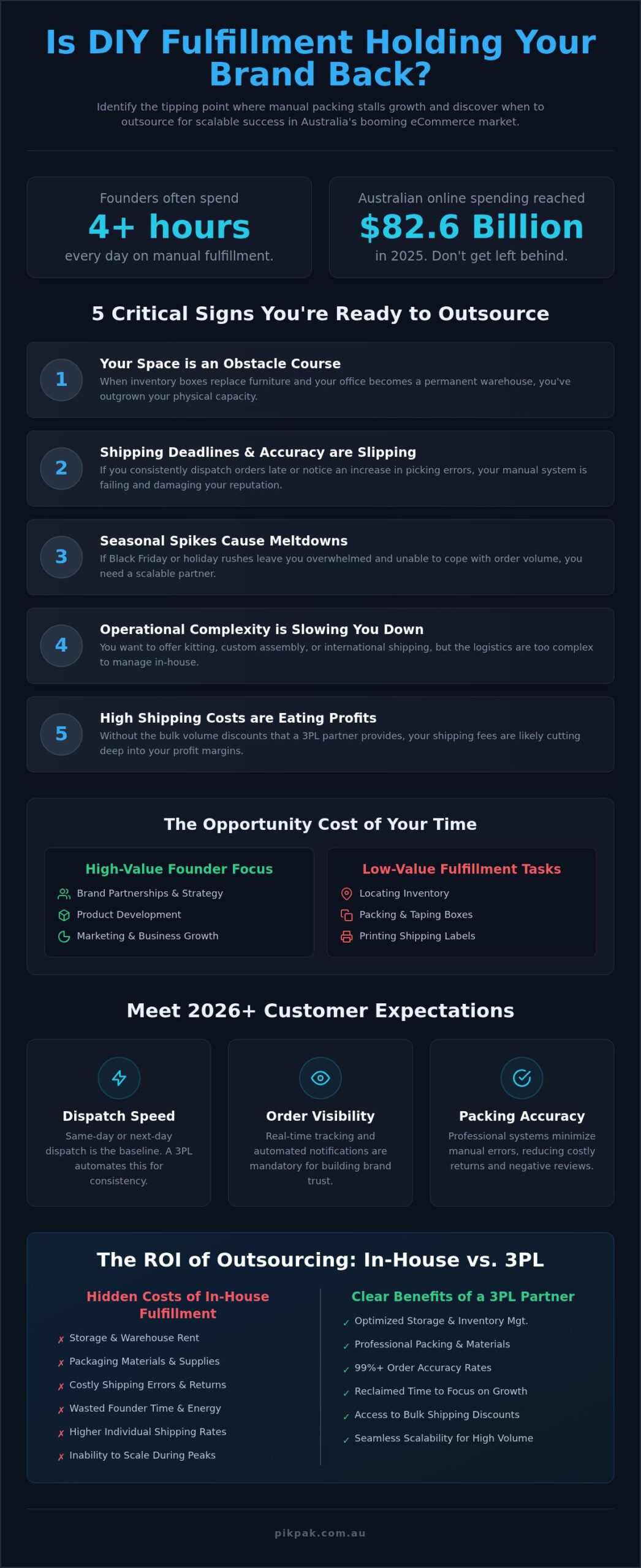
In 2026, the Australian eCommerce market is more competitive than ever. With online spending reaching record highs, customer patience has thinned. They don’t just want their items; they want them now. Meeting these expectations requires professional systems that a DIY setup simply cannot match. Consider these 2026 standards:
- Dispatch Speed: Same-day or next-day dispatch is now the baseline expectation for Australian shoppers.
- Visibility: Real-time tracking and automated notifications are mandatory for building brand trust and reducing “where is my order” inquiries.
- Accuracy: As your volume increases, manual errors become more likely, leading to costly returns and negative reviews.
Fulfillment efficiency is the primary competitive advantage for Australian brands looking to dominate their niche in 2026. By moving to a professional system, you ensure that every customer receives a consistent, high-quality experience that encourages repeat business. It’s about moving from a reactive “survival mode” to a proactive, scalable strategy.
5 Critical Signs Your eCommerce Business Is Ready to Outsource
Identifying the right time to transition is a strategic move that separates hobbyists from high-growth entrepreneurs. While the “do it yourself” approach works in the early days, it eventually becomes a liability. These five indicators show exactly when to outsource fulfillment to keep your momentum high and your operations professional.
- Your home or office is an obstacle course: When boxes replace furniture and your living room is a permanent warehouse, you’ve outgrown your space.
- Shipping deadlines are slipping: If you’re consistently dispatching orders late or noticing an uptick in picking errors, your manual system is failing.
- Seasonal spikes cause meltdowns: If Black Friday or Christmas periods leave you overwhelmed and unable to cope with order volume, you need a scalable partner.
- Shipping costs are too high: Without the volume discounts that a 3PL provides, shipping fees are likely eating into your profit margins.
Research on the key features of fulfillment services shows that accuracy and speed are the primary drivers of customer loyalty. If you can’t guarantee both, you’re risking your brand’s reputation with every order.
Space Constraints and Inventory Chaos
Unorganized home-based inventory is a recipe for disaster. Products get damaged, items go missing, and miscounts lead to overselling. Moving your stock to a secure warehouse facility eliminates these risks immediately. A professional environment provides the structure needed for precision. You gain real-time visibility through a WMS platform, which tracks every SKU from the moment it arrives until it leaves the dock. This level of control is impossible to maintain in a spare bedroom or a cluttered garage.
The ‘Marketing vs. Packing’ Dilemma
If your customer acquisition has stalled, it’s often because you’re too busy with tape and boxes. You cannot grow a brand while spending four hours a day on manual labor. Outsourcing allows you to refocus on product development and aggressive marketing strategies. Many founders find that delegating logistics is the catalyst for a major sales jump. For example, one Australian brand reported doubling their sales in just six months by reallocating the time previously spent on packing toward influencer outreach and ad optimization. You can explore how our logistics services help you reclaim that vital growth time.
Scaling smart means recognizing that you don’t have to do everything yourself. When you decide when to outsource fulfillment, you aren’t just offloading a task; you’re investing in a professional infrastructure that supports your future success.
The ROI of Outsourcing: Comparing In-House Costs vs. 3PL Efficiency
Many business owners view outsourcing as a luxury expense they’ll afford “someday.” In reality, calculating when to outsource fulfillment reveals that professional logistics is often more cost-effective than the DIY alternative. When you handle everything in-house, you pay for hidden inefficiencies that don’t appear on a standard invoice but definitely impact your bottom line.
Hidden Expenses of Self-Fulfillment
The true cost of self-fulfillment goes far beyond your time. Consider these common financial drains:
- Packaging Supplies: Small brands often purchase boxes, tape, and void-fill in low volumes, paying a premium per unit.
- Fixed Rent: If you’re renting a storage unit or office, that’s a fixed monthly cost regardless of whether your inventory is full or low.
- Insurance Risks: Residential insurance often won’t cover commercial stock, leaving you vulnerable to total loss if damage occurs.
Inefficient inventory management also leads to “dead capital.” This is money tied up in stock that isn’t moving because it’s buried at the back of a cluttered room or garage. A professional warehouse environment ensures every item is tracked and accessible, freeing up cash flow for more productive uses like marketing or product development.
The 3PL Variable Cost Advantage
One of the most powerful reasons to outsource is the move from fixed to variable costs. If you hire a part-time staff member, you owe them wages every week, even during slow sales periods. A 3PL operates on a “pay-as-you-ship” model. When sales are quiet, your costs drop. When sales spike, you have the infrastructure to handle the volume without scrambling to find extra help. A variable cost model is inherently safer for growing brands because it aligns your operational spending directly with your actual revenue.
Beyond storage, 3PLs leverage massive economies of scale to secure lower shipping rates from major couriers. These are discounts a single brand could never achieve alone. You also have to factor in the cost of mistakes. A single shipping error involves the cost of the original shipping, the return shipping, the replacement product, and potentially the loss of a customer. By utilizing professional returns management and automated picking systems, you drastically reduce these drains on your profit. Precision isn’t just about good service; it’s about protecting your margins.
Preparing for the Move: How to Successfully Transition to a Partner
Deciding when to outsource fulfillment is a major milestone, but the actual transition requires a pragmatic, step-by-step approach to ensure your customers don’t experience a single hiccup. Moving your operations from a home office to a professional 3PL isn’t just about moving boxes; it’s about shifting your data and standards into a scalable system. A smooth migration ensures that your brand momentum continues without interruption.
- Step 1: Conduct a thorough inventory audit. Before you ship anything, clean up your SKUs. Standardize your naming conventions and purge any dead stock that isn’t worth the storage fees.
- Step 2: Connect your sales channels. Ensure your Shopify, WooCommerce, or marketplace platform is ready for technology integration. This link allows orders to flow directly to the warehouse.
- Step 3: Establish clear SOPs. Create “Standard Operating Procedures” for your brand. If you have specific kitting requirements or assembly needs, document them clearly so the warehouse team can replicate your exact process.
- Step 4: Ship your stock correctly. When sending your first inbound shipment, strictly follow the warehouse receiving guidelines. Proper labeling and documentation prevent delays during the “booking in” phase.
Tech Integration: The Secret to Seamless Fulfillment
API connections are the backbone of modern logistics. They remove the need for manual data entry, which is where most human errors occur. When your store is integrated with a cloud-based WMS, orders are received and processed in real time. This automation ensures that stock levels are synced across all your sales channels. If you sell your last item on Shopify, the system immediately updates your other channels to prevent overselling. Look for a partner that provides a user-friendly cloud dashboard so you can monitor your inventory levels from your phone while you focus on growing the business.
Managing the ‘Unboxing’ Experience
You don’t have to sacrifice your brand identity when you move to a 3PL. Many founders worry that a third party won’t care as much about the “reveal” as they do. However, professional partners can manage custom inserts, branded tape, or specific kitting arrangements to maintain your unique unboxing experience. Communicate this change to your customers as an upgrade. Let them know they’ll now receive faster delivery times and more accurate tracking notifications. Setting clear KPIs for your partner, such as “99% same-day dispatch,” ensures that your high standards are met every single day. Ready to make the move? Start your journey with Pik Pak Logistics today.
Scaling Your Australian Online Store with Pik Pak Logistics
Once you’ve identified the signs and decided when to outsource fulfillment, the next step is choosing a partner that understands the Australian eCommerce landscape. Pik Pak Logistics specializes in end-to-end pick, pack, and ship services designed specifically for brands ready to move beyond the garage. We don’t just provide shelf space; we offer a tech-first infrastructure that removes the operational friction holding you back from your next revenue milestone.
Our approach is grounded in pragmatism. We use cloud-based WMS technology to provide real-time visibility into your stock levels, ensuring you always have total control without the manual labor. Because we’re based in Australia, you benefit from local expertise and a support team that understands your carrier network and customer expectations. Whether you need specialized kitting for a new marketing campaign or assembly for complex bundles, our team handles the precision work so you can stay focused on your brand strategy.
Effortless Operations for Growing Brands
Pik Pak acts as the calm expert in the center of your operational storm. We manage the chaos of daily dispatch, seasonal spikes, and the complexities of returns management so you don’t have to. Our platform simplifies reverse logistics, making it easy for your customers to send items back while keeping your inventory records accurate. We believe in building trust through transparency, which is why we offer clear pricing structures without the burden of long-term restrictive contracts. This flexibility allows you to scale your costs up or down in direct alignment with your sales volume, protecting your cash flow as you grow.
Next Steps: Reclaiming Your Growth Trajectory
The transition to a 3PL is about more than just logistics. It’s about reclaiming your time and refocusing your energy on high-value tasks that actually move the needle for your business. By delegating the heavy lifting to a professional team, you’re investing in the future scalability of your store. You’ll no longer be limited by how many boxes you can pack in an afternoon or how much stock you can fit in a spare room.
Ready to see how a professional partner can transform your operations? You can get a tailored quote based on your current order volume to see exactly how our systems fit your brand. Remember, you aren’t just hiring a warehouse; you’re gaining a dedicated partner committed to your success. Visit our logistics services page to start your journey toward a more efficient, automated, and profitable business today.
Take the Next Step Toward Operational Freedom
Transitioning your logistics to a professional partner is the most effective way to remove the growth ceiling on your brand. By moving from fixed overheads to a variable cost model, you protect your margins while ensuring every order is handled with precision. You’ve now seen the critical signs and understand exactly when to outsource fulfillment to stay ahead of 2026 customer expectations. It’s time to stop taping boxes and start leading your company again.
Pik Pak Logistics makes this transition simple. Our real-time WMS tracking gives you total visibility, while our seamless Shopify and WooCommerce integrations automate your order flow from day one. With specialist Australian eCommerce support, you have a local partner that understands your market and your goals. Don’t let operational friction hold your brand back any longer.
Ready to scale? Get an effortless fulfillment quote from Pik Pak today.
Your business deserves the space to grow. We’re here to handle the heavy lifting so you can focus on the big picture. Let’s build something great together.
Frequently Asked Questions
Is there a minimum order volume required to outsource fulfillment?
Most 3PL providers don’t have a strict minimum order volume, but the financial benefits usually become clear once you’re processing around 50 to 100 orders per month. If your volume is lower, you might find that storage fees eat into your margins. It’s best to look for a partner that offers a variable cost model so your expenses scale alongside your actual sales growth without high fixed overheads.
How much does it cost to outsource fulfillment in Australia?
Fulfillment costs in Australia typically include three main components: storage fees, pick and pack rates, and courier shipping costs. Storage is often billed per pallet or shelf space used, while packing fees apply to each unit processed. Because every business has unique requirements for weight and volume, we recommend requesting a tailored quote to understand your specific ROI when deciding when to outsource fulfillment.
Will I lose control over my inventory if I use a 3PL?
You won’t lose control; you’ll actually gain more precise visibility. Professional 3PLs use cloud-based Warehouse Management Systems (WMS) that provide real-time data on stock levels, order status, and tracking. You can log into a dashboard at any time to see exactly what’s on the shelf and what’s in transit. This automated oversight is far more accurate than manual spreadsheets or home-based counting.
Can a 3PL handle custom packaging or ‘kitting’ for my brand?
How long does it take to set up and integrate my online store with a 3PL?
Setting up a modern 3PL integration is surprisingly fast, often taking just a few days once your inventory is booked in. Most providers use API connections that link directly to platforms like Shopify or WooCommerce. This allows orders to flow automatically from your store to the warehouse. The longest part of the process is typically the physical audit and transport of your stock to the new facility.
What happens if a customer wants to return a product to the 3PL?
A 3PL manages the entire reverse logistics process for you. When a customer initiates a return, the item is sent directly back to the warehouse where it is inspected for damage. If the product is in good condition, it’s restocked and added back to your live inventory. This automated return handling saves you hours of manual work and ensures your stock levels stay accurate without your intervention.
Is it better to use Amazon FBA or an independent 3PL like Pik Pak?
The choice depends on your sales strategy. Amazon FBA is excellent for reaching Prime members, but it often limits your ability to use custom branding and can be expensive for non-Amazon orders. An independent 3PL like Pik Pak offers more flexibility for multi-channel selling and allows you to maintain total control over the unboxing experience across your own website, eBay, and other marketplaces.
How do I know if my business is ‘too small’ for professional fulfillment?
Your business isn’t too small if your current logistics are preventing you from focusing on growth. If you’re spending your most productive hours packing boxes instead of marketing your brand, it’s time to scale. Even smaller brands benefit from professional systems that prevent shipping errors and provide faster delivery times to customers. The goal is to move to a partner before your operational friction causes a total burnout.