Imagine it’s 10:00 PM on a Tuesday, and instead of reviewing your 2026 growth strategy, you’re surrounded by bubble wrap and packing tape. You started your brand to create something meaningful, yet you’re currently spending four hours a day acting as your own warehouse manager. It’s a common trap for Australian store owners, but manual packing is the single biggest bottleneck preventing you from reaching that next revenue milestone. Switching to a professional 3pl for ecommerce isn’t just about outsourcing a chore; it’s a strategic move to reclaim your time and professionalize your operations.
We understand the stress of inaccurate inventory counts and the frustration of watching high shipping rates eat your margins. You deserve a system that works while you sleep. This guide will show you exactly how to transition from manual fulfillment to an automated, tech-driven model that handles everything from storage to returns management. You’ll learn how to access better shipping rates, gain real-time visibility into your stock levels, and finally find the freedom to focus on the high-level marketing that actually grows your business.
Key Takeaways
- Identify the “garage ceiling” and physical operational limits that signal it is time to move beyond self-fulfillment.
- Trace the end-to-end journey of an order through a 3pl for ecommerce to see how automation replaces manual packing errors.
- Compare the costs of fixed overheads like warehouse rent and staff against variable fulfillment fees to determine your potential ROI.
- Use our practical checklist to vet potential partners on critical factors like tech stack integration and facility security.
- Discover how to maintain unboxing quality and brand standards while delegating logistics to a professional partner.
The Tipping Point: When Does Your eCommerce Business Need a 3PL?
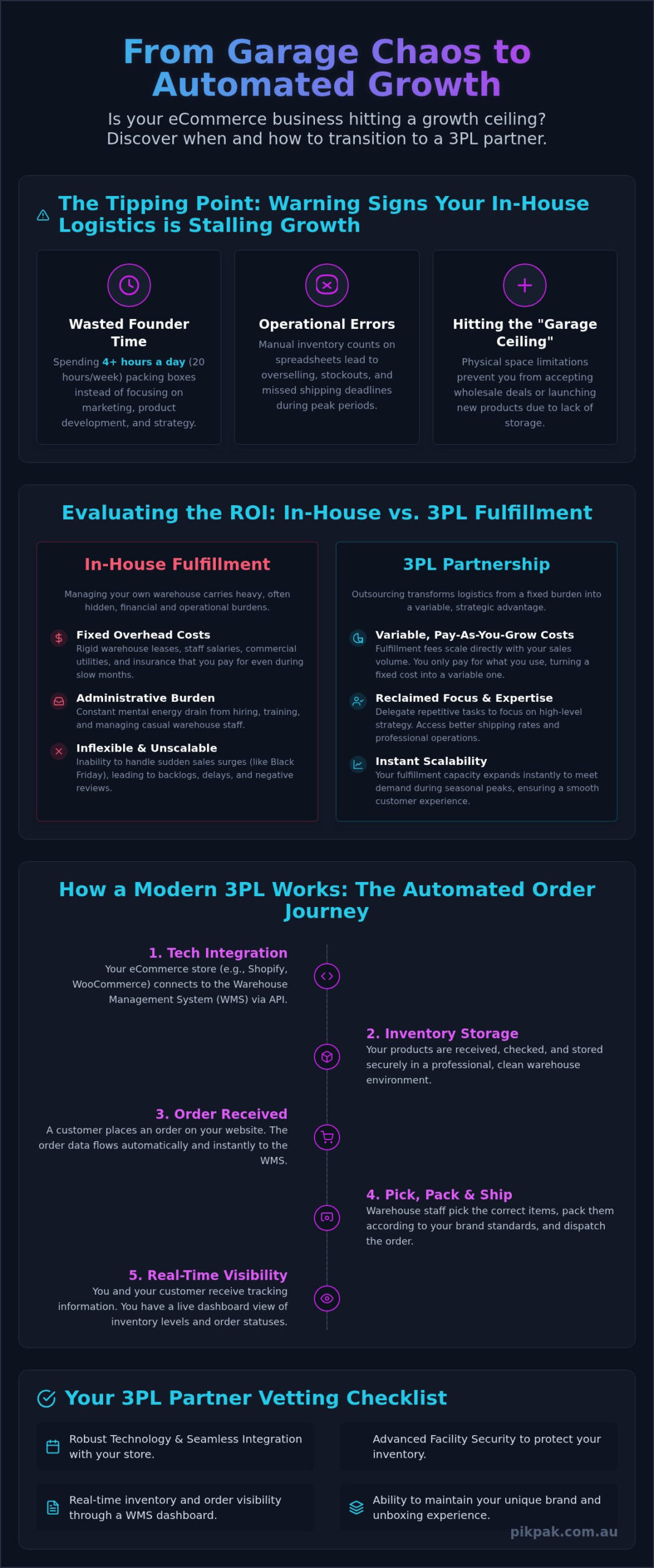
Every successful Australian eCommerce brand eventually hits a wall. You likely started in a spare room, a garage, or a small office. It worked for a while. But as your order volume increases, your physical space transforms into a chaotic maze of boxes and bubble wrap. This is the “garage ceiling.” It’s the point where your environment and manual processes actively stop you from scaling. When you reach this stage, transitioning to Third-party logistics (3PL) is no longer a luxury; it’s a necessity for survival.
Think about the time you spend packing every day. If you’re spending four hours each afternoon on fulfillment, that’s 20 hours a week taken away from marketing, product development, or customer acquisition. You’re effectively paying yourself a founder’s salary to tape boxes. That is a massive opportunity cost that stunts your brand’s potential. Finding a reliable 3pl for ecommerce allows you to delegate these repetitive tasks so you can focus on the high-level strategy that actually moves the needle.
Seasonal peaks like Black Friday or the December rush are the ultimate stress tests. Without professional support, a sudden surge in orders leads to backlogs, exhausted staff, and shipping delays. Instead of celebrating a record sales day, you’re left dealing with frustrated customers and negative reviews. A professional partner ensures your capacity scales instantly with your demand.
Signs Your In-House Logistics is Stalling Growth
Your business usually sends out warning signals before a total operational breakdown occurs. Look for these red flags in your daily routine:
- Missed Shipping Deadlines: You can no longer guarantee same-day or next-day dispatch during busy periods, leading to customer inquiries about “where is my order?”
- Manual Inventory Errors: You’re still using spreadsheets to track stock levels, which inevitably leads to overselling items you don’t actually have in the room.
- Turning Down Opportunities: You’ve had to decline a wholesale deal or delay a new product launch because there’s simply nowhere left to store the pallets.
The Hidden Costs of Managing Your Own Warehouse
Many owners hesitate to outsource because they want to avoid a new monthly invoice. However, managing your own space carries heavy financial weight that isn’t always obvious. Fixed warehouse leases are rigid. You pay for the entire square footage even if it’s half empty during your slow months. Moving to a warehousing and fulfilment model turns these fixed burdens into variable costs that only scale when your sales do. Hidden logistics costs include commercial utilities, specialized insurance, and the accumulated expense of packaging waste. Beyond the money, the administrative burden of hiring, training, and managing casual warehouse staff is a significant drain on your mental energy. Outsourcing to a 3pl for ecommerce replaces these headaches with a single, predictable service flow.
How 3PL for eCommerce Works: From Store Sync to Customer Door
A modern 3pl for ecommerce operates like a high-speed digital nervous system for your brand. It isn’t just a place where your products sit on shelves. It’s a synchronized environment where software and physical labor work in perfect harmony to move products from your digital checkout to your customer’s doorstep. This process eliminates the friction of manual data entry and the physical exhaustion of packing individual boxes. When the system is set up correctly, your only job is to watch the orders roll in while the heavy lifting happens behind the scenes.
The role of secure warehousing is fundamental here. Your inventory is stored in a clean, professional environment protected by advanced security systems, ensuring product integrity is never compromised. In this environment, real-time data becomes your most valuable asset. You’ll always know exactly how much stock you have left and where every package is in the delivery cycle. This transparency builds the confidence you need to scale without fear of operational collapse.
Seamless API and WMS Technology Integration
The magic begins with a digital handshake. Your eCommerce platform connects directly to our Warehouse Management System (WMS) through a pre-built API connector. When a customer clicks “buy,” the order details flow instantly to the warehouse floor. This automation removes the need for you to send daily spreadsheets or manual emails. You gain total visibility through Technology Support, which provides real-time updates on order status and stock levels. If an item sells out, your store knows immediately, preventing the headache of overselling and keeping your customer trust intact.
The Pick, Pack, and Ship Workflow
Once the order is in the system, the physical journey starts. Professional order fulfillment services rely on standardized picking routes that maximize speed and accuracy. Warehouse staff use handheld scanners to verify every SKU, ensuring the right product goes into the right box every single time. This precision is how top-tier providers maintain a 99.9% accuracy rate.
Packing is where your brand personality shines. You don’t have to sacrifice the “unboxing experience” just because you aren’t doing it yourself. You can provide custom tissue paper, branded stickers, or specific kitting instructions to ensure the package feels personal. Finally, the “ship” phase leverages the massive shipping volume of the 3PL. Because we send thousands of parcels daily, we access competitive rates with major Australian carriers that individual stores simply can’t get on their own. By moving to a 3pl for ecommerce, you turn a complex logistical puzzle into a streamlined, hands-off process. If you’re ready to see how this looks for your specific store, you can explore our tailored fulfillment solutions.
Evaluating the ROI: 3PL vs. In-House Fulfillment
Deciding to outsource your logistics is a financial calculation as much as an operational one. Many business owners view fulfillment as a cost center, but when managed correctly, it becomes a lever for growth. The true ROI of a 3pl for ecommerce is calculated by combining the hours of founder time reclaimed with the significant reduction in costly packing errors and missed shipping windows. When you stop tape-gunning boxes, you’re free to invest that energy into high-impact activities like product sourcing and customer acquisition that actually drive revenue.
Professional fulfillment also has a direct impact on your customer lifetime value (LTV). In 2026, Australian shoppers expect precision. A single wrong item or a three-day delay in dispatch can permanently damage your brand reputation. By ensuring every order is accurate and out the door quickly, you build the trust necessary for repeat purchases. Additionally, a professional 3PL helps you reduce shipping “zone” costs. By storing your inventory in a strategically located hub, you can often reach major metropolitan areas faster and cheaper than shipping from a remote home office or a rural storage unit.
Variable Costs vs. Fixed Overheads
In-house fulfillment is heavy with fixed costs. You pay for your warehouse lease, electricity, and staff insurance every month, regardless of whether you sell ten items or ten thousand. This creates “dead cost” during slow periods that eats your cash flow. Switching to Warehousing and Fulfilment services moves you to a variable cost model. You only pay for the shelf space you use and the orders we actually pack. This flexibility is vital for seasonal brands, as it ensures your margins stay protected during the quieter months of the year.
Scaling for Seasonal Peaks and Promotions
Choosing Your Australian 3PL Partner: A Practical Checklist
Selecting the right 3pl for ecommerce is a decision that defines your operational success for years to come. It’s a partnership that requires more than just a signed contract; it requires a technological and cultural fit. To avoid the common pitfalls of a messy transition, you need a structured framework to evaluate potential providers. Don’t settle for vague promises of “efficiency.” Demand transparency and proof of capability before moving a single pallet of stock.
Start with a deep dive into their tech stack. A modern provider must offer seamless integration with your specific eCommerce platform, whether you use Shopify, WooCommerce, or a custom build. If the provider relies on manual file uploads or delayed data syncing, they aren’t a true tech-driven partner. You need a system that offers automated order downloads and real-time inventory updates to prevent the risk of overselling.
Physical standards are just as critical as software. Visit the facility if possible, or request a video walkthrough. Assess the physical security, including 24/7 monitoring and access controls, and look for a high standard of cleanliness. Your inventory is your capital; it should be stored in a secure, state-of-the-art warehouse that protects its value. Finally, review their Warehouse Receiving Guidelines. A professional 3PL has clear rules for how stock must arrive to ensure it’s processed and shelved without delay. If you’re ready to professionalize your setup, you can review our full range of logistics services.
Location Strategy: Why Melbourne is a Logistics Hub
In the Australian market, location is everything. Melbourne has established itself as the nation’s primary logistics heart, offering a centralized base for national distribution. Storing your goods in a Melbourne-based warehouse provides a strategic advantage due to its proximity to major shipping ports and the massive courier hubs at Tullamarine. This central position allows for faster transit times to Sydney, Adelaide, and Hobart, effectively lowering your overall shipping costs. By partnering with a provider that understands these local service priorities, you ensure your brand stays competitive on delivery speed across the country.
Reverse Logistics and Returns Management
Returns are an inevitable part of online retail, but they don’t have to be a drain on your resources. A clear, automated returns process is essential for building customer trust in 2026. A professional 3pl for ecommerce handles the entire “Reverse Logistics” cycle for you. When a customer sends an item back, the warehouse team receives the package, inspects the product for damage, and either restocks it or flags it for your review. This turns the traditional pain of returns into a seamless customer service win, keeping your inventory levels accurate and your customers satisfied without you ever having to touch a return label.
Scaling Your Brand with Pik Pak’s Effortless 3PL Solutions
Pik Pak Logistics acts as more than just a warehouse provider; we are a strategic extension of your brand. We focus on removing the operational friction that keeps you trapped in low-value tasks like tape-gunning boxes and printing labels. Our approach to 3pl for ecommerce is built on the foundation of precision and simplicity. By delegating your logistics to a partner that understands the Australian market, you transform your supply chain from a source of stress into a competitive advantage.
Our commitment to “Pick, Pack, and Ship” precision ensures that your customers receive exactly what they ordered, every single time. Accuracy isn’t just a metric for us; it is the core of our service. We also provide customized solutions that go beyond standard fulfillment. Whether you require specialized kitting for promotional bundles, custom labeling for retail compliance, or support for unique eCommerce projects, our team has the expertise to execute your vision. You gain access to a dedicated support team that understands local courier networks and consumer expectations, ensuring your brand stays grounded in the Australian landscape.
Our State-of-the-Art Melbourne Fulfillment Center
Our Melbourne-based facility is designed for high-speed dispatch and total inventory security. We employ a technology-first approach that sets us apart from traditional, manual warehouses. This means your stock is stored in a secure, organized environment where every SKU is tracked in real-time. Our high-speed dispatch capabilities allow us to process orders quickly, meeting the fast delivery expectations of 2026 shoppers. For more details on how we can build a custom solution for your store, visit Your Logistics Service.
Start Your Effortless Logistics Journey Today
Onboarding with a 3pl for ecommerce should not feel like a technical hurdle. We have refined our process to make the transition as smooth as possible. Our team guides you through the initial sync between your store and our Warehouse Management System, ensuring your inventory is live and ready for sale without delay. You can request a tailored quote based on your specific order volume and storage needs, giving you a clear view of your variable costs from day one.
It is time to step away from the packing table. Reclaim your schedule and redirect your energy toward the high-level marketing and product development that truly grows your brand. Let us handle the complexity of the warehouse while you focus on your vision. Contact us today to see how we can simplify your operations and help you scale with confidence.
Future-Proof Your Fulfillment Strategy
The transition from manual packing to an automated 3pl for ecommerce is the defining moment for any growing Australian brand. By moving away from the operational friction of the “garage ceiling,” you gain the freedom to focus on high-level growth. You’ve seen how a professional partner provides real-time visibility through WMS tracking and how variable costs protect your margins during seasonal spikes. Scaling doesn’t have to be a source of stress. It’s a manageable task when you have the right infrastructure in place.
Pik Pak Logistics provides the secure, Melbourne-based warehousing and seamless eCommerce platform integrations you need to compete in 2026. We’re here to ensure your orders are handled with precision, allowing you to reclaim your schedule and your mental energy. It’s time to delegate the heavy lifting to the experts and watch your brand reach its full potential.
Request a tailored 3PL quote from Pik Pak Logistics today and take the first step toward effortless operations. Your business is ready for the next level, and we’re ready to help you get there.
Frequently Asked Questions
What is the difference between a 3PL and a standard warehouse?
A standard warehouse primarily provides space for storage, while a 3PL offers a comprehensive suite of integrated fulfillment services. While a warehouse is a passive storage solution, a 3pl for ecommerce is an active partner that handles the technology sync, picking, packing, and final delivery to your customer. It acts as a tech-driven extension of your store rather than just a place to keep pallets.
How much does 3PL for eCommerce typically cost in Australia?
Pricing is generally structured as a variable model to help you manage cash flow. You typically pay for three main components: storage based on the space you occupy, a pick and pack fee per order, and the actual shipping cost. This model is highly efficient for growing brands because your expenses only increase when your sales do, eliminating the heavy burden of fixed warehouse rent and permanent staff wages.
Will I lose control over my packaging and brand experience with a 3PL?
You maintain complete control over how your brand is presented to the customer. You can provide your own branded boxes, custom tissue paper, and specific kitting instructions to ensure the unboxing experience remains identical to your in-house process. If you require specialized bespoke solutions for health or beverage products, you can check out Prest Packaging to see how professional-grade packaging can be integrated into your fulfillment setup. Professional partners follow your exact assembly guidelines to ensure every package meets your brand standards before it leaves the facility.
Can a 3PL integrate with Shopify, WooCommerce, and eBay simultaneously?
Modern fulfillment systems are designed to manage multi-channel sales from a single source of truth. A professional 3pl for ecommerce uses advanced WMS technology to sync with Shopify, WooCommerce, eBay, and other platforms at the same time. This ensures your inventory levels are updated across every channel instantly, which prevents the risk of overselling an item on one platform when it just sold out on another.
What happens if a 3PL makes a mistake in an order?
Professional providers use barcode scanning and rigorous WMS checks to maintain accuracy rates of 99.9% or higher. If a rare error occurs, such as a wrong item being packed, the 3PL typically has a clear remediation process to correct the issue for the customer. This often includes prioritized reshipping and managing the return of the incorrect item to minimize the impact on your brand reputation.
Is there a minimum order volume required to work with a 3PL?
Minimum requirements vary depending on the provider’s specific focus and facility size. Some 3PLs cater exclusively to enterprise-level brands with thousands of orders a month, while others are specifically built to help smaller eCommerce stores scale. It’s best to discuss your current volume and growth projections during your initial consultation to ensure the partnership is a good operational fit for your current stage.
How long does it take to set up and sync my store with Pik Pak?
The technical integration is often very fast thanks to our pre-built API connectors for major platforms. Once you provide access to your store, the software sync can happen almost immediately. The physical onboarding process, which includes receiving and cataloging your stock in our Melbourne facility, typically takes a few business days. We focus on a streamlined setup so you can start shipping orders as quickly as possible.
How does a 3PL handle international shipping for Australian stores?
A 3PL simplifies global expansion by leveraging established relationships with international carriers. They handle the generation of international shipping labels and the necessary customs documentation for you. Because they ship in high volumes, they can often provide more competitive international rates than a small business could secure independently, making it much easier for you to reach customers in New Zealand, the US, or Europe.