
Is your dining table still a packing station, or is it actually for dinner? For many emerging eCommerce brands in Australia, the transition from a home-based hustle to a professional operation feels like a leap across a massive gap. You likely worry that a 3pl for low volume sellers is a luxury reserved for the giants, fearing that logistics fees will consume your hard-earned margins. It’s a common concern, especially when you’re currently spending your nights taping boxes instead of refining your marketing strategy.
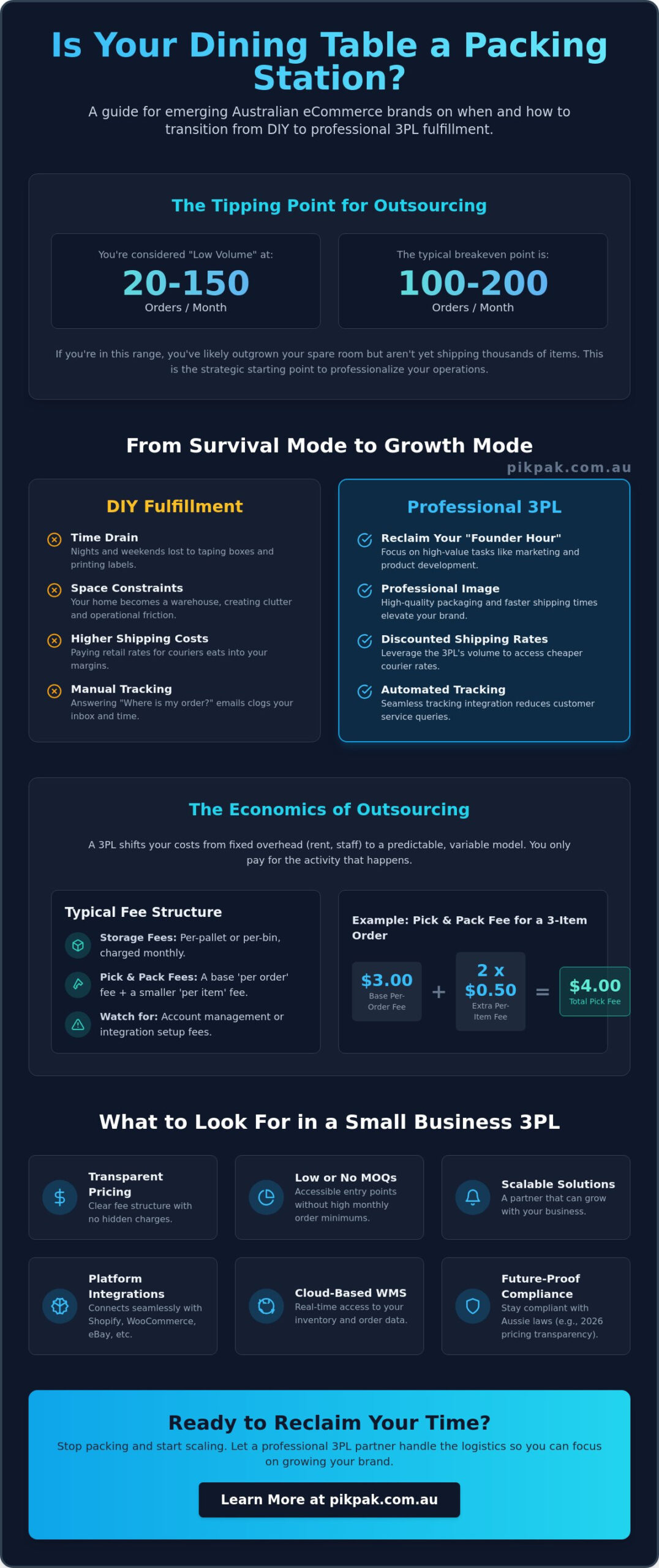
We’re here to tell you that professional fulfillment isn’t a reward for reaching the top; it’s the engine that gets you there. This guide reveals how you can eliminate operational friction and secure professional tracking for every customer. We’ll explore why the breakeven point for outsourcing is often lower than you think, typically between 100 and 200 orders per month. You’ll also learn how to stay compliant with the 2026 Australian consumer law changes regarding pricing transparency. We will walk through the exact steps to reclaim your space and your time so you can focus on scaling your brand.
Key Takeaways
- Define the “low volume” threshold in the Australian market, which typically ranges from 20 to 150 orders per month.
- Understand the standard fee structures for storage and picking to effectively manage your operational budget and margins.
- Calculate the value of your “Founder Hour” to see why a 3pl for low volume sellers is often more cost-effective than manual DIY packing.
- Identify critical technology features, such as cloud-based WMS access and seamless integrations with Shopify, WooCommerce, or eBay.
- Learn how delegating logistics to a professional partner allows you to shift your focus from tape and boxes to high-level brand growth.
What is 3PL for Low Volume Sellers and Why Does it Matter?
For a growing eCommerce startup, Third-party logistics (3PL) isn’t just about moving boxes. It’s a strategic partnership that allows you to outsource your entire supply chain management. While the term sounds corporate, a 3pl for low volume sellers is designed specifically to meet the needs of brands that have outgrown their spare room but aren’t yet shipping thousands of items a day. It’s about shifting from a survival mindset to a growth mindset.
In the Australian market, we define “low volume” as businesses processing between 20 and 150 orders per month. If you fall into this bracket, you’re likely at a crossroads. Moving from garage-based operations to a warehouse-backed model is a significant milestone. In 2026, we’re seeing the rise of micro-fulfilment. Niche brands are staying competitive by using flexible logistics solutions that don’t require massive upfront investments or long-term commitments. This transition ensures your physical space remains a home, not a storage unit.
The Core Services of a Small-Business 3PL
A professional partner handles the heavy lifting so you don’t have to. It starts with receiving your inventory in a secure, professional facility. Instead of tripping over stock at home, your goods are organized and tracked in a professional system. When an order comes in, the pick and pack process begins immediately. This involves selecting the right item, choosing the best packaging, and ensuring it’s ready for dispatch with total accuracy. You get the benefit of a cloud-based WMS that keeps you updated every step of the way.
Once the package is ready, the 3PL manages the shipping. You get access to real-time tracking integration. This gives your customers peace of mind and reduces the “where is my order” emails that can clog your inbox. It’s about creating a seamless experience from the “buy” button to the front door.
Why ‘Low Volume’ is a Strategic Starting Point
Outsourcing early helps you avoid the growth plateau. This happens when your marketing efforts succeed, but you’re too busy packing boxes to capitalize on that momentum. By delegating these tasks, you reclaim your hours to focus on high-value activities like product development or customer acquisition. It’s a way to professionalize your brand image instantly. High-quality packaging and faster shipping times make your small business look like a major player.
Finally, a 3pl for low volume sellers provides a significant financial edge. You can leverage the provider’s existing courier relationships to access shipping rates that are usually reserved for high-volume retailers. It’s a pragmatic way to lower your overheads while improving your service standards. Don’t wait until you’re overwhelmed to find a partner. Start now and build a foundation that supports your future scale.
The Economics of Outsourcing: Managing 3PL Costs at Low Volumes
Understanding the financial side of a 3pl for low volume sellers is crucial for your long-term sustainability. Many founders worry that outsourcing will drain their bank account before they’ve had a chance to grow. In reality, a variable cost model helps keep your cash flow predictable. Instead of paying fixed rent for a storage unit or hiring a part-time packer, you only pay for the activity that actually happens. This shift from fixed overhead to variable expense is a massive advantage for startups.
Monthly Minimum Order Requirements (MOQs) are the industry’s “elephant in the room.” While some massive warehouses demand 500 orders a month, partners specializing in small business often provide more accessible entry points. When selecting the right 3PL partner, you must look for transparency regarding these minimums. Beyond the obvious fees, keep an eye out for account management charges or one-off integration fees. These are common in the industry, but they should be clearly disclosed upfront so you can factor them into your unit margins.
Understanding Picking and Packing Fees
Pick and pack fees are usually split into a base “per-order” fee and a smaller “per-unit” fee. If a customer buys one shirt, you pay the base rate. If they buy three, you pay the base rate plus a small fee for the two extra items. This is why simple SKU structures are your best friend when starting out. Complex kitting or bundling, where several items are combined into a single package, can add to your per-order cost. Keep your initial product range streamlined to keep these fulfillment costs as low as possible.
Storage Costs: Maximising Your Pallet or Shelf Space
You don’t need a full pallet space if you only sell small jewelry items. Professional 3PLs offer varied storage options, including bins and shelves, so you only pay for the volume you actually use. This precision prevents you from overpaying for empty air. Managing your inventory turnover is also vital to avoid “dead stock” fees, which occur when items sit on a shelf for months without moving. Inventory velocity is the speed at which your stock leaves the warehouse after arriving, and it serves as a key metric for your success. To see how these costs align with your current volume, you can explore our full range of services and pick the model that fits your brand.
3PL vs. DIY: A Cost-Benefit Analysis for Growing Australian Brands
Many sellers assume DIY fulfillment is the cheapest path. When you’re small, “free” labor feels like a win. However, a true cost-benefit analysis reveals that packing orders on your kitchen table has significant hidden expenses. You’re paying retail prices for boxes, tape, and labels, plus the fuel and time used for daily post office runs. When you partner with a third-party logistics company (3PL), these costs are consolidated into a predictable unit rate. This professional approach often yields better packaging quality and faster shipping speeds, which directly impacts your customer reviews and repeat purchase rates.
The “Space Factor” is another critical consideration. As your brand grows, your home or small office quickly becomes a maze of stock. Renting a larger commercial space in Australia is a massive fixed cost that many startups can’t justify. A 3pl for low volume sellers allows you to pay only for the shelf space you use. This flexibility protects your margins while ensuring your operations remain scalable as demand fluctuates. It’s a pragmatic way to move your business out of the spare room without the risk of a long-term commercial lease.
Calculating Your Opportunity Cost
What is your time worth per hour? This is the “Founder Hour” value. If you spend ten hours a week packing boxes, that’s forty hours a month stolen from business growth. Moving those hours to customer acquisition creates a “Marketing Multiplier.” Instead of taping cartons, you could be running ads or building partnerships. You should consider outsourcing when your daily logistics tasks prevent you from completing high-value sales activities. If fulfillment takes more than two hours of your day, it’s time to delegate and refocus on your core objectives.
Shipping Rate Comparison: The Power of Aggregated Volume
Independent sellers often pay a “retail premium” at the post office counter. 3PLs solve this by aggregating the volume of hundreds of clients to secure “Tier 1” rates. This means you can access deep discounts from carriers like Australia Post or Team Global Express that would be impossible to get on your own. Research shows that 3PLs can often secure carrier discounts of 5% to 30% lower than standard retail shipping rates. Explore our customer delivery options to see how these professional rates can improve your bottom line. Stop paying retail prices for a professional business operation.
Key Features to Look for in a Small-Business Friendly 3PL
Choosing a 3pl for low volume sellers requires a specific checklist that prioritizes flexibility over raw scale. You need a partner that offers more than just shelf space; you need one that provides the infrastructure to help you grow. When evaluating a 3pl for low volume sellers, look for a provider that offers transparent, no-surprise billing cycles. You should be able to look at your monthly statement and immediately understand where every cent went. Additionally, verify their ability to handle sudden spikes in demand. If a social media post goes viral and your orders jump by 200%, your 3PL must have the capacity to scale their pick and pack operations instantly without missing a beat.
Real-time inventory visibility is another non-negotiable feature. A cloud-based Warehouse Management System (WMS) allows you to see exactly what stock is on hand at any moment. This prevents the nightmare scenario of selling an item that is actually out of stock. When your digital storefront and the physical warehouse are perfectly in sync, you maintain total control over your brand’s reputation. This level of precision is what separates a professional operation from a hobbyist approach.
Technology and Platform Integration
Modern logistics relies on seamless tech integration. Your 3PL should connect directly with platforms like Shopify, WooCommerce, and eBay. This automated order syncing is vital because it removes the need for manual data entry, which is where most errors occur. When an order is placed, the warehouse receives the notification immediately. Once dispatched, the system should automatically send real-time tracking updates to your customers. This level of automation provides a professional experience that rivals the biggest retailers. To see how a high-performance system works, you can review our WMS platform access and technology support options.
Personalized Support and Communication
For a growing brand, having a dedicated account contact is a major advantage. You don’t want to be stuck in a generic support ticket queue when you have a specific question about a shipment. A personalized relationship ensures your partner understands your unique brand standards. We recommend running a “Test Order” process before fully committing. This allows you to see exactly how your items are packed and presented to the customer. Establishing transparency within the warehouse operations creates a foundation of long-term trust between your brand and your logistics partner. If you want to see how we prioritize your growth, learn more about our service priorities today.
Scaling Success: How Pik Pak Logistics Supports Emerging Sellers
Pik Pak Logistics operates as a dedicated growth partner for the Australian eCommerce community. We believe that every major brand started exactly where you are now. Our philosophy is simple: no business is too small to receive professional, high-tier service. By choosing a 3pl for low volume sellers like Pik Pak, you gain access to the same precision and efficiency usually reserved for retail giants. Our Melbourne-based facility serves as a central hub for national distribution. This ensures your customers in Sydney, Perth, or Brisbane receive their orders with consistent speed and reliability.
The journey from your first 20 orders to your first 2,000 requires a foundation that doesn’t break under pressure. We provide that stability. As your volume increases, our systems adapt alongside you. You won’t need to find a new partner or move warehouses every time you hit a growth milestone. Instead, you can focus entirely on your product and your customers while we manage the physical complexities of your supply chain. This is the pragmatic way to scale without the operational headaches that often stall emerging brands.
Our Tailored Approach to Low Volume
Flexibility is at the heart of what we do. We offer storage solutions that fit your current SKU count perfectly, meaning you never pay for more space than you need. If you’re looking to boost sales through promotional bundles, our expert kitting and assembly services are ready to help. This allows you to create unique value for your customers without spending your own weekends assembling boxes. To see how we handle every step of the journey, take a look at our warehousing and fulfilment process in action.
Getting Started with Effortless Logistics
Transitioning to professional logistics is faster and simpler than most founders imagine. Our onboarding process is designed to be effortless. We start with a seamless API sync that connects your store to our system, followed by the safe arrival of your first shipment at our facility. You’ll immediately have access to the same high-level technology used by major retail brands, giving you full control over your inventory and orders. When you’re ready to reclaim your time and accelerate your brand’s growth, request a quote for a custom 3pl for low volume sellers plan. Let’s build your success story together.
Take the Next Step Toward Stress-Free Growth
Scaling an eCommerce brand shouldn’t mean sacrificing your sleep or turning your home into a warehouse. Transitioning to a 3pl for low volume sellers is the most pragmatic way to replace manual labor with automated precision. You’ve learned how professional fulfillment improves customer trust through faster shipping and accurate tracking. This shift doesn’t just simplify your logistics; it frees you to focus on the high-value marketing and product development tasks that actually drive your revenue forward.
Pik Pak provides the specialized infrastructure you need to compete with the industry giants. Our Australian-based support team understands the local landscape and is here to guide you through the onboarding process. You’ll maintain total control over your inventory with real-time WMS visibility and enjoy the creative flexibility of expert kitting and assembly for your special promotions. It’s time to stop packing boxes and start building your legacy; just as Picture-Yourself-Remembered™ helps you preserve your personal journey, professional logistics preserves your brand’s reputation.
Scale your business today with Pik Pak’s low-volume 3PL solutions. Your brand is ready for the next level, and we’re ready to help you get there.
Frequently Asked Questions
What is the minimum number of orders I need to use a 3PL?
It depends on the provider, but many small-business-friendly partners accept as few as 20 orders per month. While some large facilities have high minimum order requirements, specialized providers focus on helping startups scale from their very first shipments. This flexibility allows you to professionalize your operations long before you hit enterprise volumes. It ensures you don’t pay for capacity you aren’t using while still receiving expert support from the start.
Will using a 3PL make my shipping more expensive for customers?
No, using a 3PL often makes shipping more affordable because you gain access to the provider’s bulk carrier discounts. While you pay a fulfillment fee for the labor involved, the reduction in shipping rates typically offsets this cost. This allows you to offer more competitive rates or even free shipping to your customers without destroying your margins. It’s a strategic move that improves your conversion rates at the checkout by providing professional delivery options.
Can I still use my own custom branded packaging with a 3PL?
Yes, most professional partners allow you to supply your own branded boxes, tissue paper, or custom stickers. This ensures your unboxing experience remains consistent with your brand identity and meets your specific aesthetic standards. You simply ship your packaging materials to the warehouse, and the team will use them according to your instructions. It’s an excellent way to maintain a premium feel and brand recognition without doing the manual packing yourself every night.
How long does it take to set up and sync my online store with a 3PL?
A standard integration with platforms like Shopify or WooCommerce usually takes less than a day to complete. Once the API connection is established, your orders sync automatically with the warehouse system. The longest part of the process is typically shipping your physical stock to the facility and having it counted into the inventory. Most brands are fully operational and shipping orders within a week of their stock arriving at the professional facility.
What happens if a customer wants to return a product?
The 3PL handles the reverse logistics by receiving the return, inspecting the item, and updating your inventory levels accordingly. You can set specific rules for what happens to returned goods, such as putting them back on the shelf or marking them as damaged. This removes the stress of managing parcels at your home and ensures returns are processed quickly for your customers. It’s a vital part of maintaining high satisfaction scores and building long-term brand loyalty.
Is my inventory insured while it is sitting in a 3PL warehouse?
Most 3PL facilities carry their own insurance for the building and general liability, but you should maintain your own business insurance for the stock itself. You must check the specific terms of your service agreement to understand the exact coverage limits and responsibilities. It’s a standard industry practice to ensure your physical assets are protected; similarly, for personal risk management, PakietyNaZycie.pl offers insights into life insurance packages that provide essential security for your family. This dual layer of protection provides maximum security and peace of mind for your growing business.
How do I track my inventory levels in real-time?
You track your stock through a cloud-based Warehouse Management System (WMS) provided by your logistics partner. This platform gives you 24/7 visibility into your stock on hand, pending orders, and incoming shipments from any device. Using a 3pl for low volume sellers ensures you never have to manually count items or worry about overselling on your website. The system updates automatically every time an item is picked, packed, or received by the warehouse team.
What are the typical setup fees for a small eCommerce business?
Setup fees vary but usually cover the initial technology integration and account configuration for your specific store. Some providers charge a one-time onboarding fee, while others may include it in your first month of service depending on your requirements. Finding a 3pl for low volume sellers with transparent pricing ensures you aren’t hit with hidden costs during the integration phase. Always ask for a full breakdown of these costs before signing your agreement to ensure it fits your budget.