
Is your logistics provider a silent partner in your growth, or a hidden weight on your bottom line? For many eCommerce brands, the 3PL experience is defined by a lack of visibility and “urgent” emails that go unanswered for days. You shouldn’t have to micromanage your warehouse to ensure orders go out on time. Success in 2026 requires more than a vendor; it demands a strategic alliance. By focusing on building a strong relationship with your 3pl, you can move past the friction of unexpected costs and communication delays.
We know how draining it is to lose sleep over inventory levels or customer service issues caused by shipping errors. It’s a common struggle, but it’s one you can solve with the right framework. This guide will teach you how to transform your logistics from a source of stress into a seamless, automated engine for growth. You’ll learn how to set clear communication channels, align your operational goals, and use data to drive proactive problem solving. We’re going to show you exactly how to create a scalable fulfillment model that lets you reclaim your time and focus on your core business objectives.
Key Takeaways
- Shift from a transactional vendor mindset to a strategic partnership that reduces your mental load and supports long-term growth.
- Master the art of building a strong relationship with your 3pl by establishing a structured communication cadence and dedicated support channels.
- Use real-time data and API integrations as your single source of truth to eliminate guesswork and improve inventory accuracy.
- Focus on operational alignment at the receiving dock to ensure “clean data” and prevent friction throughout the fulfillment process.
- Reclaim your time to focus on marketing and product development by delegating complex logistics to a centralized, tech-driven fulfillment hub.
Why the ‘Partner’ Mindset Outperforms the ‘Vendor’ Model
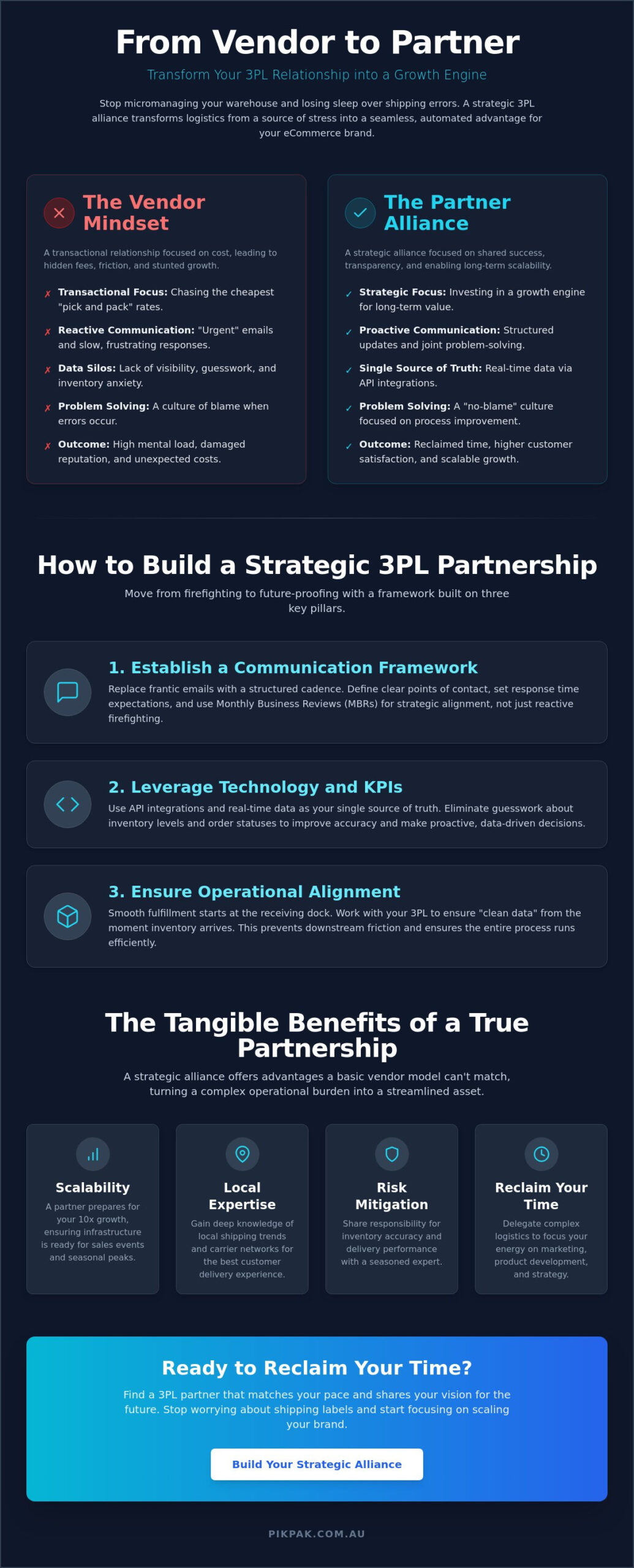
Many eCommerce owners view logistics as a chore to be outsourced to the lowest bidder. This “vendor” mentality treats third-party logistics (3PL) as a simple cost-center. However, viewing your provider as a strategic partner changes the entire trajectory of your business. When you focus on building a strong relationship with your 3pl, you aren’t just buying warehouse space; you’re investing in a growth engine. A partner understands your brand values and treats every package as a promise to your customer. This alignment reduces your mental load, allowing you to stop worrying about shipping labels and start focusing on scaling your brand.
Moving Beyond Transactional Thinking
Chasing the cheapest “pick and pack” rate is a common mistake. Cheap rates often mask hidden costs like high error rates, slow processing times, and poor communication. These issues damage your reputation and cost more in the long run. A strategic partner looks beyond the transaction. They proactively suggest shipping optimizations and help you navigate complex service priorities. By treating your 3PL as an extension of your internal team, you create a culture of shared success. Building a strong relationship with your 3pl means they’re looking for ways to save you money and improve efficiency before you even ask.
The Business Benefits of a Strategic Alliance
A partnership offers tangible advantages that a basic vendor model can’t match. It transforms a complex operational burden into a streamlined, manageable task. This shift allows you to reclaim your time and energy for high-level decision-making.
- Scalability: A true partner prepares for your 10x growth before it happens. They ensure the infrastructure and staffing are ready for your biggest sales events or seasonal peaks.
- Local Expertise: You gain access to deep knowledge of Australian shipping trends and carrier networks. This ensures your customers get the best delivery experience possible, regardless of their location.
- Risk Mitigation: Responsibility for inventory accuracy and delivery performance is shared. You aren’t alone when challenges arise; you have a seasoned expert working to solve problems immediately.
Cultural alignment ensures that your logistics provider is just as invested in your success as you are. When your 3PL understands your brand’s mission, they handle your products with the care they deserve. This leads to higher customer satisfaction and long-term loyalty. It’s about finding a team that matches your pace and shares your vision for the future.
Establishing a Communication Framework That Prevents Friction
Effective logistics communication is the timely exchange of actionable data. Without this foundation, even the most advanced warehouse becomes a black box that creates anxiety for eCommerce founders. Building a strong relationship with your 3pl depends on a structured communication cadence that replaces frantic, “all-caps” emails with predictable, high-value updates. You need a rhythm that balances daily tactical needs with long-term strategic goals. When data flows freely, you reclaim the mental energy previously spent on chasing updates.
Proactive communication is the ultimate antidote to mistrust. If a carrier delay occurs, hearing about it from your partner before a customer complains changes the dynamic entirely. It shifts the conversation from blame to joint problem-solving. Handling exceptions like damages or inventory discrepancies shouldn’t cause panic. With a clear framework in place, these are simply manageable tasks rather than operational crises. This level of transparency ensures you stay in control of your brand’s reputation.
Defining Points of Contact and Escalation Paths
Confusion is the primary source of friction in logistics. You must know exactly who to contact for specific issues to avoid wasting time. Don’t call the warehouse floor for a billing query; use your dedicated account manager or a structured support ticketing system. Setting clear expectations for response times ensures both sides respect the urgency of the business. We advocate for a “no-blame” culture. When a hiccup happens, focus on the process failure rather than the person. This transparency is vital for aligning your service priorities with your actual operational capacity.
Structured Check-ins vs. Reactive Firefighting
Stop treating your logistics provider like a “set and forget” utility. Monthly Business Reviews (MBRs) are essential for long-term health. These meetings should go beyond reviewing invoices to analyze performance scorecards and identify efficiency gaps. Use this time to look at data trends, such as rising return rates or changes in average order weight, which might impact your bottom line.
Quarterly planning sessions are equally critical. If you have a major marketing campaign or a new product launch scheduled, your partner needs to know well in advance. This allows them to scale labor and warehouse space before the surge hits. When providing feedback, keep it constructive and data-driven. Instead of saying “you missed this,” try “how can we adjust the data flow to prevent this in the future?” This collaborative approach is the secret to building a strong relationship with your 3pl that truly scales as your order volume grows.
Leveraging Technology and KPIs as a Single Source of Truth
Trust isn’t just a feeling; it’s a byproduct of transparency. In the past, logistics was often a “black box” where you would send an order and hope for the best. Today, real-time data is the antidote to relationship-damaging assumptions. When you and your provider look at the same dashboard, there is no room for “he said, she said” arguments. Building a strong relationship with your 3pl requires this digital handshake. It empowers your customer service team to answer inquiries with confidence because they have the same end-to-end visibility as the warehouse manager. You can identify potential bottlenecks, like a sudden spike in processing times, before they ever turn into a customer complaint.
Real-Time Visibility Through WMS Integration
The foundation of a modern partnership is the Pik Pak WMS. By using API integrations to link your online store directly to the warehouse, you eliminate manual data entry and the errors that come with it. You gain the ability to see exactly when an order is picked, packed, and despatched in real-time. This automation does more than just move boxes; it syncs your inventory levels instantly across all your sales channels. You’ll never have to deal with the friction of overselling a product that isn’t actually on the shelf. Transparent tracking links are generated and sent to your customers automatically, which drastically reduces the “where is my order” burden on your support inbox.
Mutually Agreed KPIs for Objective Performance
Objective data allows you to measure success without emotion. A healthy relationship relies on developing long-term 3PL partnerships based on clear, measurable targets. These Key Performance Indicators (KPIs) ensure everyone is on the same page regarding what “good” looks like. Instead of guessing how the warehouse is performing, you have a single source of truth to guide your monthly reviews.
- Order Accuracy Rate: Aim for a target of 99.8%. This metric ensures your customers receive exactly what they ordered, reducing the cost of returns and replacements.
- Despatch Timeliness: Define your “Same-Day Despatch” cut-off times clearly. Whether it’s 1:00 PM or 2:00 PM, having a documented deadline prevents confusion and missed expectations.
- Inventory Shrinkage: Set acceptable limits for stock loss and establish strict reporting protocols. This builds accountability and protects your inventory investment.
Building a strong relationship with your 3pl means using technology to simplify complex backend processes. When you delegate the operational burden to a system designed for precision, you reclaim your time to focus on business growth. It’s about moving from reactive firefighting to proactive management, using data as your primary tool for success.
Operational Alignment: The Secret to Smooth Fulfilment
Operational alignment is the bridge between your marketing strategy and your customer’s doorstep. While many founders focus on the final despatch, building a strong relationship with your 3pl actually begins at the receiving dock. If your inventory arrives in a disorganized state, it creates a ripple effect of delays and errors that impact your entire operation. Precision at the start ensures speed at the finish. By aligning your internal processes with warehouse standards, you transform a complex logistical burden into a manageable, automated task.
Dirty data acts like sand in the gears of a warehouse. Wrong SKUs, missing barcodes, or inaccurate weights force staff to stop and manually verify items, which leads to higher costs and slower processing times. You can also drive significant efficiency by involving your logistics partner in your packaging design. A slight adjustment in box size or weight can often move a product into a more cost-effective shipping tier, instantly improving your margins and reducing waste.
Adhering to Warehouse Receiving Guidelines
Your biggest contribution to a smooth operation is strictly following the Warehouse Receiving Guidelines. When you ignore these standards, you risk stock being quarantined or delayed in its availability for sale. Non-compliance often results in additional labor charges as the team works to fix labeling errors or reorganize poorly packed pallets. Implementing Advanced Shipping Notices (ASNs) allows the warehouse to plan their labor around your arrival. This ensures your goods are on the shelf and ready for despatch within hours rather than days.
Forecasting and Data Sharing for Peak Periods
Surprises are the enemy of efficiency in the logistics world. Sharing your marketing calendar is essential for building a strong relationship with your 3pl, especially during high-stakes events like Black Friday or seasonal sales. When you give the warehouse a “heads up” about upcoming promotions, they can adjust staffing levels and optimize floor space in advance to handle the surge. This collaborative approach ensures your delivery performance remains high even when order volume spikes.
Sharing historical data helps the warehouse manage their resources more effectively. This is particularly useful for kitting and assembly projects where labor requirements are higher. By providing projected volumes, you help the team prepare, ensuring that every kit is assembled accurately and shipped on time. If you are ready to align your operations with a seasoned partner that prioritizes your growth, explore our fulfilment services today to see how we can help you scale.
Scaling Your eCommerce Business with Pik Pak
Pik Pak acts as the engine that powers your growth. By leveraging a centralised Australian hub, you gain a national distribution network that works while you sleep. This shift allows you to stop being the person who packs boxes and start being the strategic manager who grows the brand. Building a strong relationship with your 3pl is what makes this transition possible. It’s about moving from a “hands-on” founder role to focusing entirely on marketing and product innovation. You provide the vision, and we provide the infrastructure to make it a reality.
Alignment is the key to this success. We encourage all our partners to review Pik Pak’s service priorities to ensure our operational strengths match your business goals. When your logistics are handled by experts, the complex becomes simple. You no longer have to worry about the logistics of a flash sale or a sudden spike in demand. Our systems are built to absorb that volatility, giving you a stable foundation for long-term planning.
Proactive Problem Solving and Special Projects
Scaling isn’t just about volume; it’s about managing complexity without adding overhead. Pik Pak manages value-added services like kitting and assembly, allowing you to launch limited editions or bundles without logistical headaches. We also handle the heavy lifting of reverse logistics. With the average eCommerce return rate sitting at approximately 19.3%, having a streamlined system to process returns is vital for maintaining your margins. Our team turns these potential friction points into positive brand experiences by processing them quickly and accurately.
Consider the growth trajectory of a typical partner. Many of our clients have scaled from 10 to 1,000 orders a day without hiring a single warehouse staff member or signing a long-term commercial lease. This is the tangible ROI of building a strong relationship with your 3pl. You gain the capabilities of a massive logistics department while maintaining the agility of a lean eCommerce brand.
Reclaiming Your Time for Growth
The ultimate benefit of a strategic partnership is peace of mind. You can refocus on your core objectives knowing that every pick, pack, and ship task is in expert hands. We handle the operational friction so you can prioritize business expansion. Logistics shouldn’t be a hurdle; it should be an enabling force that removes barriers to your success. It’s time to delegate the operational burden and lead your company into its next phase of growth. Partner with Pik Pak Today and see how effortless scaling can be when you have the right team behind you.
Take Control of Your eCommerce Growth Strategy
Success in the competitive landscape of 2026 requires moving beyond transactional logistics. By shifting to a partnership mindset and establishing clear communication cadences, you eliminate the guesswork that often holds growing brands back. Building a strong relationship with your 3pl is the most effective way to turn operational friction into a competitive advantage, ensuring your fulfilment scales as fast as your sales volume. When you align your receiving processes with warehouse standards and leverage real-time data, you reclaim the mental energy needed to focus on your brand’s long-term vision.
Experience the peace of mind that comes with 99.8%+ order accuracy and real-time WMS visibility. Our expert Australian-based support team is ready to help you transition from a hands-on founder into a strategic manager who leads with confidence. You don’t have to navigate the complexities of supply chain management alone when you have a partner dedicated to your operational excellence. Ready to build a better partnership? Contact Pik Pak Logistics today to start streamlining your operations and unlocking your business’s true growth potential. It’s time to let your logistics work for you.
Frequently Asked Questions
How often should I communicate with my 3PL provider?
You should communicate tactical updates daily via a support ticketing system and hold strategic reviews at least once a month. This structure prevents reactive firefighting and ensures both teams stay aligned on long-term growth objectives. Consistent check-ins allow you to address minor issues before they escalate into customer service crises. It’s about maintaining a steady flow of actionable data rather than waiting for a problem to arise.
What are the most important KPIs to track in a 3PL relationship?
Focus on order accuracy, despatch timeliness, and inventory shrinkage as your primary metrics. Aiming for an order accuracy rate of 99.8% ensures your customers receive exactly what they paid for. Despatch timeliness defines how quickly orders leave the warehouse after being placed. Finally, tracking inventory shrinkage protects your capital and ensures your digital store always matches the physical stock on the shelves.
How do I handle mistakes or errors made by my 3PL?
Address errors by focusing on the process failure rather than individual blame. When a mistake occurs, document the incident and work with your account manager to identify where the workflow broke down. This collaborative approach is a cornerstone of building a strong relationship with your 3pl. It turns a negative experience into a roadmap for operational improvement and prevents the same error from happening twice.
Can I integrate my Shopify or WooCommerce store directly with a 3PL?
Yes, modern providers use API integrations to link your Shopify or WooCommerce store directly to their Warehouse Management System (WMS). This connection automates the flow of orders and provides real-time inventory updates across all your sales channels. It eliminates the need for manual data entry, which drastically reduces the risk of human error. Automation is the most efficient way to maintain control over your logistics while scaling.
What information does a 3PL need from me for peak season planning?
Your 3PL needs your marketing calendar, historical sales data, and projected order volumes for the peak period. Providing this heads up at least several weeks in advance allows the warehouse to scale their labor and floor space accordingly. This transparency prevents peak season surprises that could lead to despatch delays. When your provider knows what’s coming, they can ensure your delivery performance remains stable during high-volume events.
Why are warehouse receiving guidelines so important for my relationship?
Following receiving guidelines is the most significant contribution you can make toward building a strong relationship with your 3pl. These standards ensure your inventory arrives in a state that’s easy to scan, count, and store. Ignoring these rules leads to dirty data and stock being quarantined, which delays its availability for sale. Proper labeling and Advanced Shipping Notices (ASNs) keep the warehouse running at peak efficiency.
Is it better to have a local 3PL in Australia or an international one?
How do I know if it is time to switch 3PL providers?
It’s time to consider a switch if your provider consistently misses agreed-upon KPIs or fails to provide real-time visibility into your stock. Communication breakdowns and unexpected hidden costs are also major red flags. If your current setup feels like a weight on your business rather than an engine for growth, you aren’t getting the value you deserve. A reliable partner should simplify your operations and free up your time.