

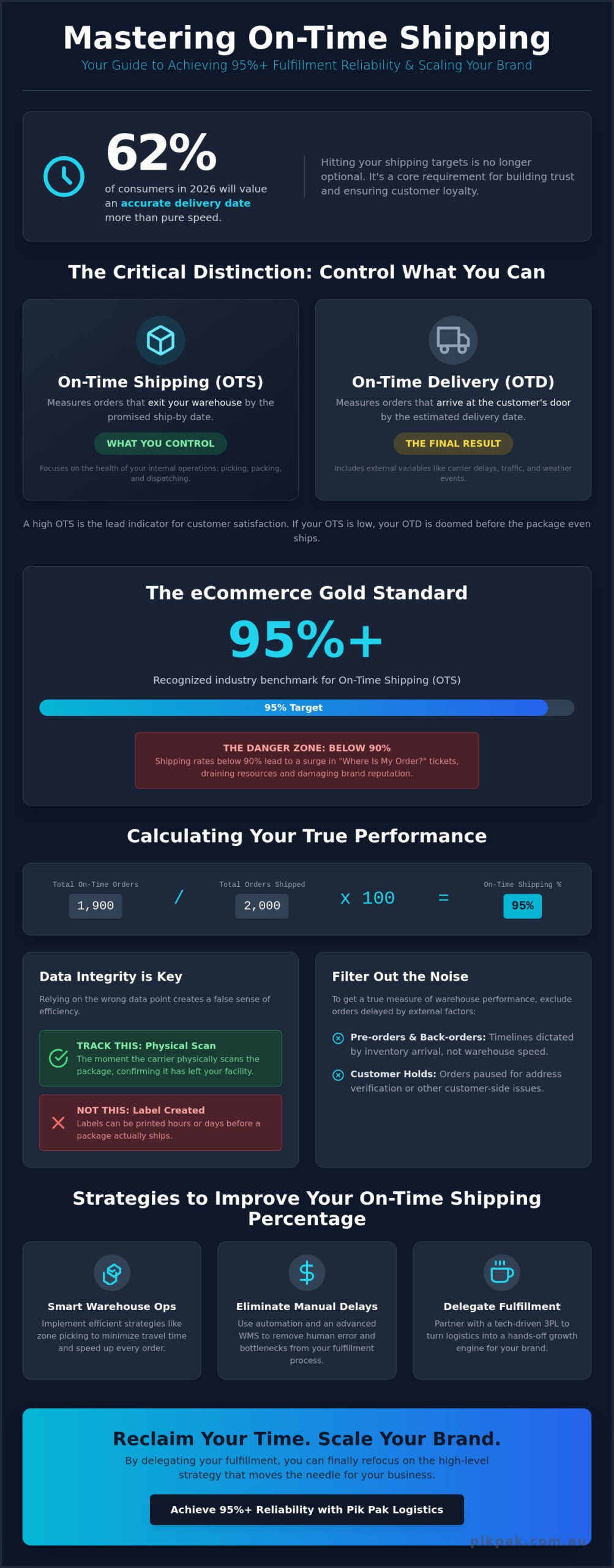
In a 2026 market where 62% of consumers value an accurate delivery date more than lightning speed, hitting your logistics targets is no longer optional. You’ve likely felt the sting of rising carrier rates from UPS and FedEx, combined with the daily stress of manual order tracking and customer complaints about late arrivals. Setting a realistic yet ambitious on-time shipping percentage goal is the first step toward reclaiming your time and scaling your operations. It’s exhausting to manage warehouse inconsistencies while trying to maintain a premium brand image.
We understand that operational friction can keep you from focusing on your core business objectives. You deserve a fulfillment process that runs like clockwork without requiring your constant intervention. This article will show you how to define, calculate, and achieve a world-class shipping target that reduces customer service overhead and builds lasting loyalty. We’ll explore the math behind modern KPIs, the role of AI in hitting 95% plus reliability, and how to turn your fulfillment process into a hands-off growth engine. By delegating these logistical burdens, you can finally refocus on the high-level strategy that moves the needle for your business.
Key Takeaways
- Understand the vital difference between warehouse exit dates and final delivery times to set more accurate expectations for your customers.
- Learn how to establish a realistic on-time shipping percentage goal that balances high performance with the actual capacity of your warehouse team.
- Master the standard calculation for shipping reliability to pinpoint exactly where bottlenecks are stalling your order fulfillment process.
- Identify how to eliminate manual delays by implementing automation and smart warehouse strategies like zone picking to speed up every shipment.
- Discover how delegating your fulfillment to a tech-driven partner allows you to reclaim your time and focus entirely on scaling your brand.
What is an On-Time Shipping Percentage Goal?
Setting an on-time shipping percentage goal is about drawing a clear line between what you can control and what you can’t. In simple terms, On-Time Shipping (OTS) measures the percentage of orders that exit your warehouse by the promised ship date. It doesn’t track when the customer opens the box; it tracks when the box leaves the loading dock. This distinction is vital because while you can’t control a carrier’s traffic delays or weather events, you have 100% authority over your own warehouse efficiency.
Your warehouse or 3PL partner is the engine of your fulfillment process. When you define a clear target for OTS, you’re measuring the health of that engine. It’s a pragmatic way to ensure your internal operations aren’t the bottleneck in your growth. By focusing on the warehouse exit, you eliminate the variables of the “last mile” and concentrate on the precision of your pick and pack teams.
On-Time Shipping vs. On-Time Delivery
Many business owners confuse these two metrics, but they serve very different purposes. On-time delivery (OTD) is the final result, whereas your on-time shipping percentage goal acts as the lead indicator for customer satisfaction. If your OTS is high, your OTD has a fighting chance. If your OTS is low, your delivery metrics are doomed before the package even hits the truck. Measuring your team on OTS creates accountability where it matters most. It’s a key component of Delivery In Full, On Time (DIFOT), a supply chain standard that ensures orders are complete and dispatched as promised.
Psychologically, customers are surprisingly rational. They often forgive a carrier for a late delivery caused by external factors like storms or holiday surges. However, they rarely forgive a brand for a processing delay that keeps their order sitting in a warehouse for days. Aligning your service priorities with a strict ship date expectation builds trust that transcends the shipping label.
The 95% Industry Benchmark
In 2026, 95% is the recognized gold standard for eCommerce leaders. This isn’t just a vanity metric; it’s a survival requirement. When your shipping rate drops below 90%, your customer service team will likely spend more time answering “Where is my order?” emails than actually helping customers. This creates a cycle of operational friction that drains your resources and damages your brand reputation. While some categories like fashion might tolerate a slightly wider window, electronics and high-value goods customers expect near-perfect precision. Aiming for a 95% or higher on-time shipping percentage goal ensures your brand remains competitive and your operations stay scalable.
How to Calculate Your On-Time Shipping Rate
Calculating your on-time shipping percentage goal starts with a simple formula: (Total On-Time Orders / Total Orders Shipped) x 100. While the math is straightforward, the integrity of your data determines its value. You must identify the exact “Promised Date” within your Warehouse Management System (WMS). This is the specific date your system communicated to the customer that their package would leave the loading dock. If an order is promised for Tuesday but leaves on Wednesday, it is late, regardless of how fast the carrier eventually moves.
Data hygiene is where many eCommerce brands stumble. To maintain a truly world-class on-time shipping percentage goal, your audits should compare the promised ship date against the actual carrier “Physical Scan” time rather than just the “Label Created” timestamp. Labels are often printed hours or even days before a package actually moves. Relying on label creation dates creates a false sense of efficiency that will eventually lead to customer complaints. Using advanced WMS platform access can automate this tracking, providing you with real-time accuracy without the need for manual spreadsheets.
What Orders Should You Exclude?
To get a realistic view of warehouse health, you must filter out noise from your data. Pre-orders and back-orders should be tracked separately because their shipping timelines are dictated by inventory arrivals, not warehouse speed. Similarly, “Customer Holds” or orders flagged for address verification delays should be excluded from your primary OTS calculation. These outliers are external friction points. Removing them allows you to see exactly how your pick and pack team performs when all variables are within their control.
The Financial Impact of Low OTS
A low shipping rate carries hidden costs that drain your bottom line. “Where Is My Order” (WISMO) inquiries are the most expensive type of customer service ticket to resolve. According to industry research, 62% of consumers state that an accurate estimated delivery date is more important than raw speed. When you miss that date, you’re not just risking a bad review; you’re paying for the support time to manage the complaint. Furthermore, late shipments often lead to higher refund and return rates as customers lose confidence in the brand. Improving your OTS by even a small margin can significantly boost repeat purchase rates, as reliability is the primary driver of long-term eCommerce loyalty.
Common Obstacles to Meeting Your Shipping Goals
While establishing a clear on-time shipping percentage goal is a vital first step, several internal hurdles can prevent you from hitting your targets. Many businesses mistakenly blame external carriers for delays, but the most significant bottlenecks usually happen within the warehouse walls. If your internal processes aren’t optimized, even the fastest courier can’t save your brand reputation. You need a system that eliminates friction before the package ever reaches the loading dock.
Inventory inaccuracy is the most common silent killer of efficiency. You simply cannot ship what your team cannot find. When warehouse staff spend five or ten minutes searching for a single SKU because it was miscounted or misplaced, your shipping window shrinks. This friction compounds during peak periods, turning minor inaccuracies into major backlogs that frustrate your customers and stress your team.
Staffing fluctuations also play a major role, particularly with the “Monday Rush” problem. Most eCommerce stores see a surge of orders over the weekend. If your warehouse isn’t prepared to scale up labor on Monday morning, you’ll start the week behind schedule. This creates a domino effect where orders placed on Tuesday or Wednesday are pushed out of their promised windows. This makes your on-time shipping percentage goal impossible to reach without expensive overtime or rushed, error-prone packing.
The “Manual Entry” Trap
Re-keying address data or manually transferring order details from your storefront to a shipping platform is a recipe for disaster. Every manual touchpoint introduces the risk of human error and adds unnecessary minutes to the fulfillment cycle. Relying on spreadsheets to manage high-volume shipping is a legacy approach that prevents you from reaching a 95% plus reliability rate. Robust technology support and integration eliminates these hurdles by automating the data flow. When orders move instantly from your checkout to the warehouse floor, you reclaim time and eliminate the errors that lead to “return to sender” shipments.
Inventory Desynchronisation
“Ghost stock” occurs when your website thinks an item is available, but the warehouse shelf is empty. This leads to the dreaded “Out of Stock” email sent to a customer who has already paid. This doesn’t just hurt your current shipping metrics; it destroys trust. Real-time visibility across your entire inventory ensures that your digital storefront always matches your physical reality. Regular cycle counts and a synchronized Warehouse Management System (WMS) are non-negotiable tools for maintaining speed. By ensuring your inventory is always where it should be, you remove the guesswork and allow your pick and pack team to move with precision and confidence.
Strategies to Improve Your On-Time Shipping Percentage
Moving from a theoretical on-time shipping percentage goal to a practical reality requires a shift from reactive fixes to proactive systems. You need to eliminate every unnecessary second from your fulfillment cycle. In Australia, where regional distances often add unavoidable days to the delivery leg, your warehouse speed is your only lever for maintaining a competitive edge. If a package is destined for a remote area in Western Australia or North Queensland, you cannot afford to let it sit on your warehouse floor for 48 hours.
Automation is the foundation of this speed. By connecting your e-storefront directly to your warehouse floor, you ensure that orders are ready for picking the moment the payment is cleared. This eliminates the “data lag” that often eats into your shipping window. Additionally, diversifying your carrier network prevents a single point of failure. If one carrier experiences a local hub delay or a capacity surge, having alternative home delivery shipping options ensures your packages keep moving without interruption.
Warehouse Layout and Pick Path Optimization
Your warehouse floor should be organized by velocity, not just category. Place your “A-class” items; the products that make up the bulk of your daily volume; as close to the packing stations as possible. This reduces the physical distance your team travels, which is often the biggest time-sink in manual operations. Implementing a Zone Picking strategy allows staff to become experts in specific sections, further reducing search time. Professional pick and pack services use these optimized layouts to minimize “touches” per order. Fewer touches mean fewer opportunities for error and a significantly faster path to the loading dock.
Leveraging Cloud-Based WMS
A modern Warehouse Management System (WMS) is no longer a luxury; it’s a requirement for hitting a 95% plus shipping target. Real-time visibility allows you to monitor order aging and identify bottlenecks before they become backlogs. These platforms automate label generation and carrier manifest filing, removing the manual data entry that leads to shipping delays. Perhaps most importantly, you can use this data to hold carriers accountable. If a carrier consistently misses their afternoon pick-up window, your WMS provides the hard evidence needed to address the issue or switch providers.
Effective Communication with Customers
Transparency is a powerful tool for managing brand reputation. Set realistic expectations by displaying “Order by” countdowns for same-day or next-day dispatch on your product pages. If your system detects a delay; perhaps due to a sudden volume spike or a staffing issue; proactive notifications can prevent a customer service crisis. When you are honest about a delay before the customer has to ask, you maintain the trust you’ve worked hard to build. Reliability is about consistency, and clear communication ensures that even when the goal is missed, the relationship remains intact.
Ready to see how professional fulfillment can transform your operations? Explore our comprehensive logistics services and start hitting your performance targets today.
Achieving Your Goal with Pik Pak Logistics
Achieving a world-class on-time shipping percentage goal shouldn’t be a source of daily stress for your team. At Pik Pak Logistics, we’ve built our entire operational model around the service priorities that matter most to growing eCommerce brands: speed, accuracy, and transparency. By delegating your fulfillment to a seasoned partner, you move away from the chaos of manual order management and into a structured environment where efficiency is the default setting. We provide the infrastructure you need to turn your shipping process into a competitive advantage.
Our integrated technology is designed to eliminate the manual delays that traditionally stall the shipping cycle. We provide a robust Australian courier network that ensures your customer delivery options remain reliable, even when shipping to regional or remote locations. This infrastructure allows you to maintain high performance without having to manage multiple carrier relationships yourself. We handle the complexity so you can focus on the results.
Peak periods like Black Friday or seasonal launches often act as a breaking point for manual systems. Pik Pak is engineered to handle 10x growth days without sacrificing precision. We provide the warehouse space and the labor force needed to keep your promises to your customers. This scalability ensures that your brand reputation remains intact during your busiest, most profitable times of the year, making your on-time shipping percentage goal a consistent reality rather than a seasonal struggle.
Effortless Integration and Automation
Connecting your Shopify, WooCommerce, or eBay store takes minutes, not days. Once integrated, our system provides real-time inventory tracking that prevents the “ghost stock” issues discussed earlier. Our WMS platform access provides a calm expert view of your logistics, giving you total visibility into every order’s journey from the shelf to the truck. This automation ensures that your warehouse exit dates are met consistently, regardless of how many orders flood in overnight. You get the control of an in-house team with the efficiency of a global logistics leader.
Focus on Growth, Not Logistics
The true value of a 3PL partner is the ability to reclaim your time and refocus on your core business objectives. Outsourcing your logistics is the fastest way to hit a 99% OTS rate because it removes the operational hurdles that slow down smaller warehouses. We frame complex logistical challenges as simple, manageable tasks, allowing you to delegate the heavy lifting to us. This transition isn’t just about moving boxes; it is about creating the space you need to prioritize business growth and long-term strategy. Let us manage the loading dock while you manage the future of your brand.
Take Control of Your Fulfillment Strategy
Establishing a precise on-time shipping percentage goal is the first step toward building a resilient eCommerce brand. We have covered why distinguishing between warehouse exit and carrier delivery is vital for operational accountability. You now have the tools to calculate your rate accurately and identify the manual bottlenecks that stall your growth. By implementing automation and optimizing your warehouse layout, you can transform your logistics from a source of stress into a streamlined engine of efficiency.
Pik Pak Logistics is here to help you manage these hurdles with ease. Our real-time WMS visibility and seamless eCommerce integrations provide the calm, expert oversight your business deserves. With an expert Australian fulfillment network at your side, you can finally delegate the operational burden and reclaim your time for what matters most. Scaling your brand shouldn’t feel like a constant struggle against your own backend processes.
Ready to hit your shipping goals? Request a quote from Pik Pak Logistics today.
The path to a near-perfect reliability rate is within your reach. Take the next step toward a more efficient and profitable future today.
Frequently Asked Questions
What is a good on-time shipping rate for a small eCommerce business?
A rate of 95% or higher is the current gold standard for eCommerce businesses of all sizes in 2026. While small businesses often face tighter resource constraints, customers still expect the same level of reliability they get from major retailers. Aiming for at least 95% ensures you stay competitive, maintain your brand reputation, and keep customer service inquiries at a manageable level.
How does on-time shipping differ from on-time delivery?
On-time shipping measures when an order leaves your warehouse, while on-time delivery tracks when it reaches the customer. You have complete control over your shipping speed, but delivery is subject to carrier delays and regional logistics. Focusing on your shipping percentage allows you to optimize your internal warehouse health without being penalized for external factors like weather or traffic.
Can a 3PL really improve my shipping percentage better than doing it in-house?
Yes, professional 3PLs typically provide higher reliability through specialized technology and scalable labor. A 3PL uses advanced Warehouse Management Systems to automate workflows that are often manual in small in-house setups. This specialized focus and technical infrastructure make it much easier to hit an ambitious on-time shipping percentage goal consistently, even during unexpected order surges.
What are the main causes of shipping delays in Australia?
Internal warehouse friction is the primary cause of delays, specifically inventory inaccuracies and manual data entry errors. While Australia’s vast geography creates challenges for the final delivery leg, the initial delay often happens on the warehouse floor. “Ghost stock” and inefficient pick paths can add hours or days to the fulfillment cycle before a package even reaches the courier.
How do I track my on-time shipping percentage in Shopify?
You can track this by using Shopify’s native fulfillment reports or through a third-party app integrated with your warehouse system. Compare the “Order Date” with the “Fulfillment Date” for every transaction in your admin panel. For the most accurate data, ensure your system records the actual carrier scan rather than just the moment the shipping label was printed.
What should I do if my shipping rate falls below 90%?
You must immediately audit your pick and pack workflow to identify the specific bottleneck. Check for recurring inventory desynchronization or staffing gaps during peak periods like Monday mornings. If your internal processes are consistently failing to meet the 90% threshold, it is likely time to consider delegating your fulfillment to a partner with more robust automation and labor resources.
Does packaging time count towards my on-time shipping goal?
Yes, every minute from the moment a customer pays until the carrier scans the box counts toward your on-time shipping percentage goal. This includes picking the items, kitting and assembly, and the final packing process. To hit high targets, you must minimize the “touches” required for each order by optimizing your warehouse layout and automating the flow of data.
How often should I audit my logistics provider’s shipping performance?
You should conduct a high-level review of shipping data weekly and a comprehensive audit once a month. Regular monitoring allows you to spot negative trends before they damage your customer loyalty. These audits ensure your fulfillment partner is meeting their Service Level Agreements and providing the transparent, reliable service your business needs to scale effectively.